 MindHub
How to play Tents and Trees
Trees are scattered through a forest. Pitch one tent for each tree. A tent must sit right beside its tree, and no two tents may touch. The numbers along the edges tell you how many tents belong in each line. With only three rules it is learned in moments, yet playing it, the “here or there?” reasoning turns out to be a real pleasure. What follows is the order to reason in.
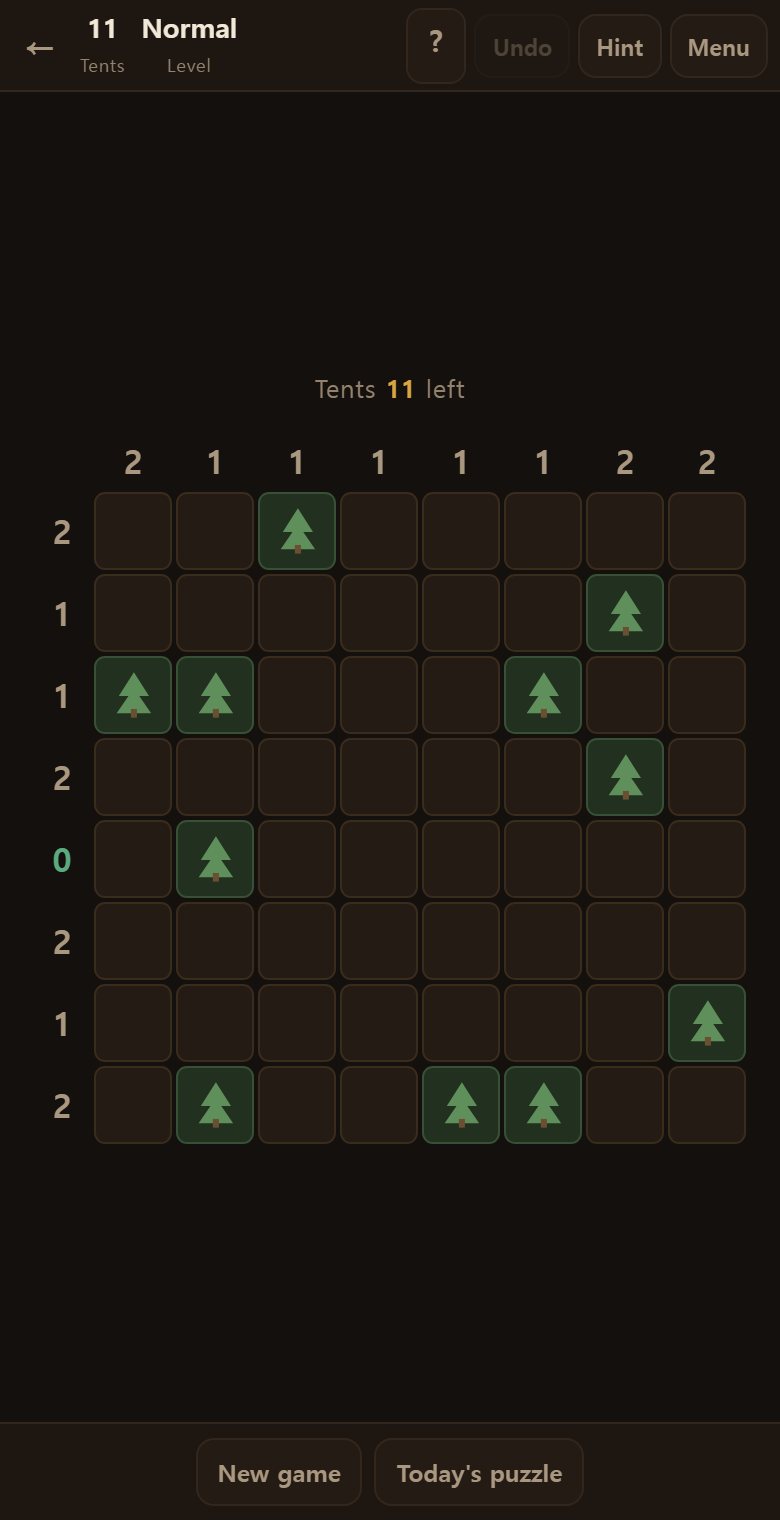
First, look at the screen
The square grid is in the middle, with numbers along the left and the top.
- The grid — green trees scattered about. Everything else is empty.
- Numbers on the left — how many tents belong in that row.
- Numbers on the top — how many tents belong in that column.
- The top bar — tents still to pitch, time, and difficulty.
A number turns green when its line is complete and red when you have overshot it, so you can see at a glance what is finished.
This is what a finished board looks like
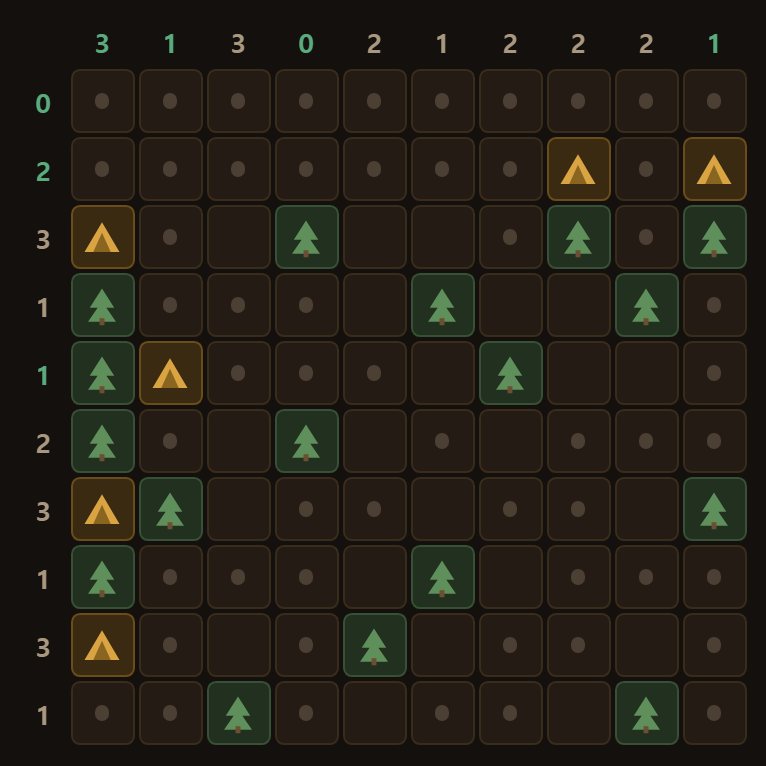
Pair every tree with a tent and it is done.
Tents are drawn as yellow triangles. Trees are the green trees.
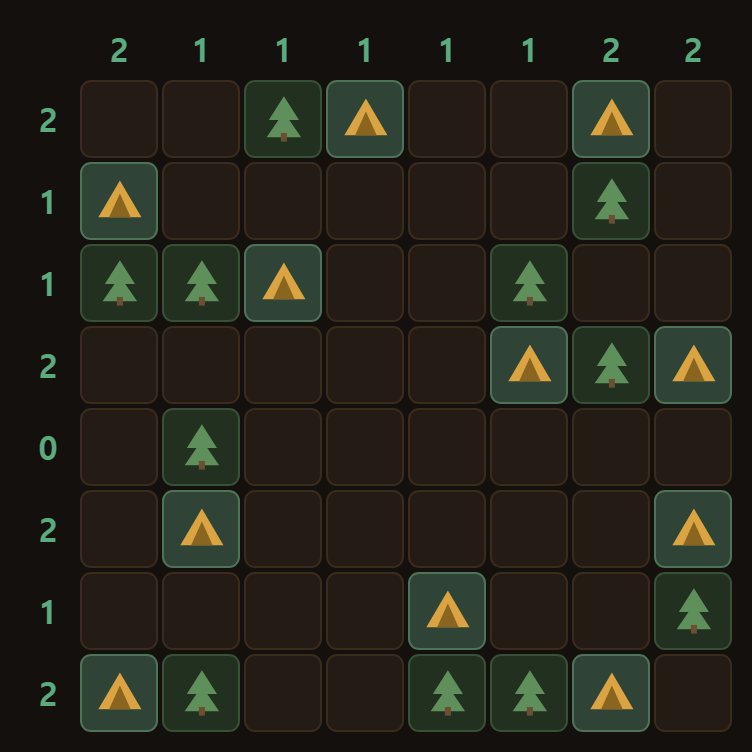
There are always as many tents as trees. The edge numbers, added together, come to the same figure.
A tent goes right beside its tree
A tent must touch its tree along a row or a column — one of the four squares above, below, left or right.
Diagonals do not count. Touching only at a corner is not beside it.
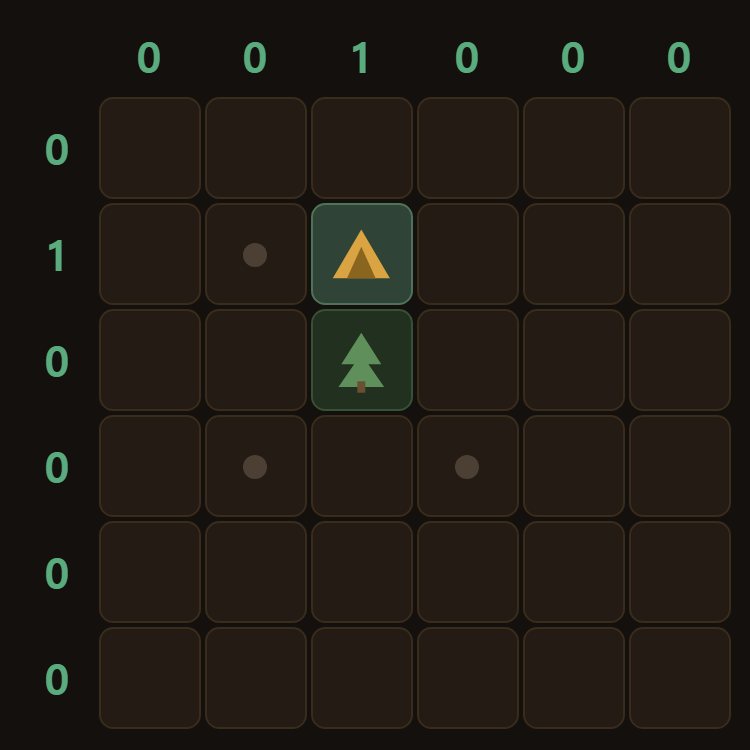
So any square that touches no tree at all can never hold a tent. Cross those off first and the board narrows considerably.
No two tents may touch
Pitch a tent and no other tent may sit in the eight squares around it — not even one touching at a corner.
This is the most powerful rule in the game. Every tent you pitch settles eight squares at a stroke.
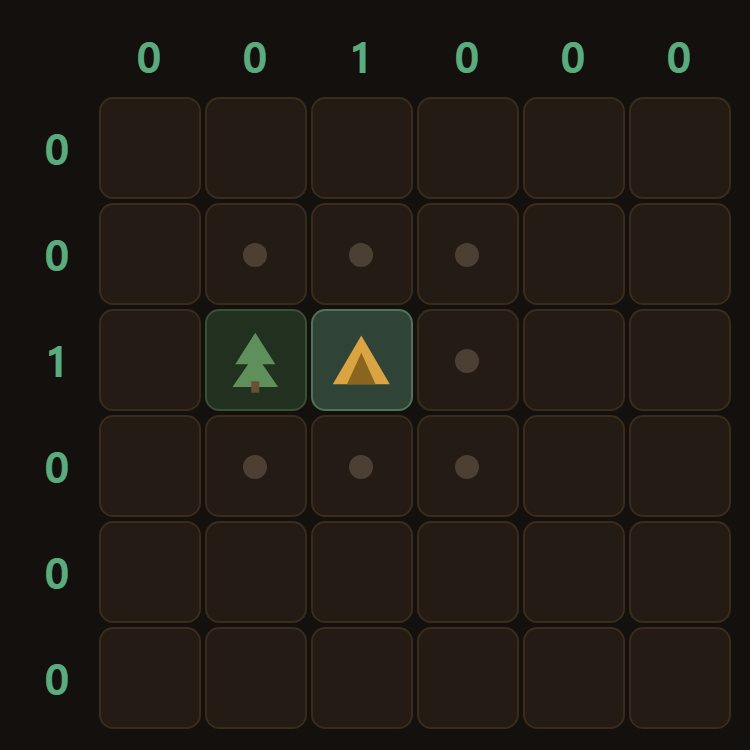
So the moment you pitch a tent, mark the ring around it as grass. Put it off and you will confuse yourself.
Reading the edge numbers
The numbers on the left and top are how many tents belong in that line. They are not the number of trees.
- A line marked 0 holds no tents at all. It is grass from end to end.
- When a line is complete its number turns green, and everything else in it is grass.
- Overshoot the number and it turns red. Something is pitched wrongly.
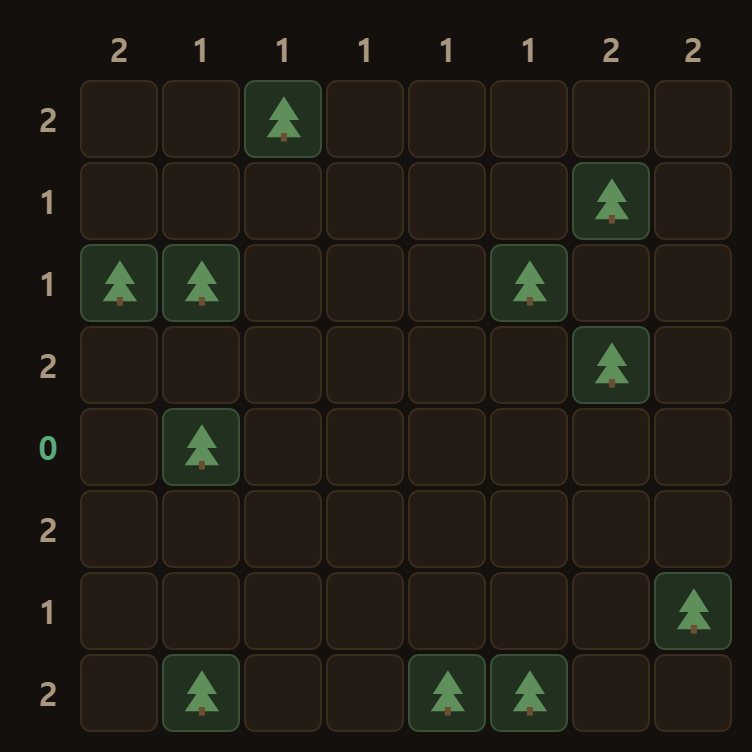
Look for the 0s first. It is the easiest thing you can do the moment the board opens.
One tree, one tent
One tent per tree. A single tent cannot serve two trees, and two tents cannot both belong to one tree.
A tent sitting between two trees is fine — but it counts as the tent of one of them only. The other tree must have a tent of its own.
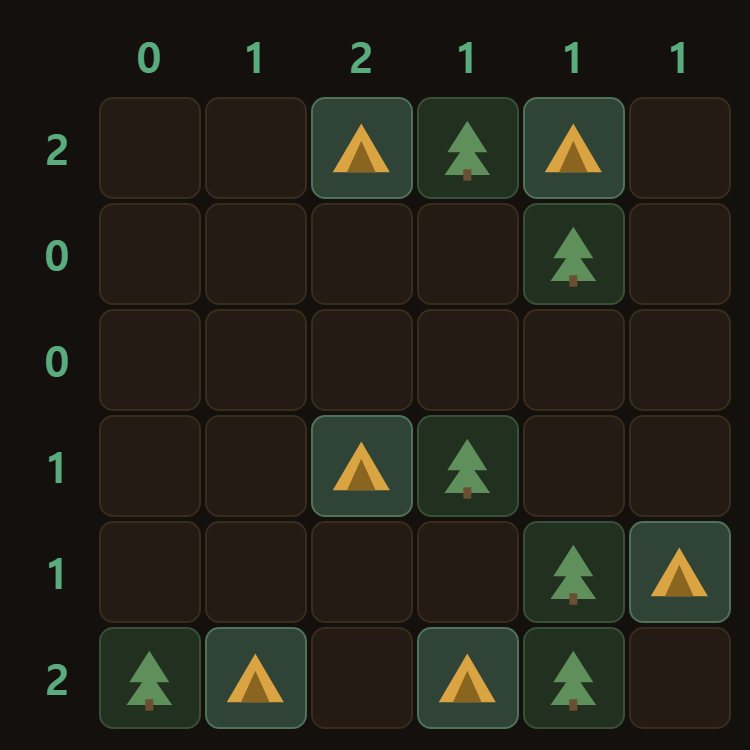
So having the right count is not enough. It is only truly finished when they can be paired off one to one, and the game checks that too.
How to tap
Each tap on an empty square cycles tent → grass → empty.
- Once — pitch a tent.
- Twice — grass, marked with a small dot. Your note that says “not here.”
- Three times — empty again.
- Press and hold to cycle backwards — grass comes first.
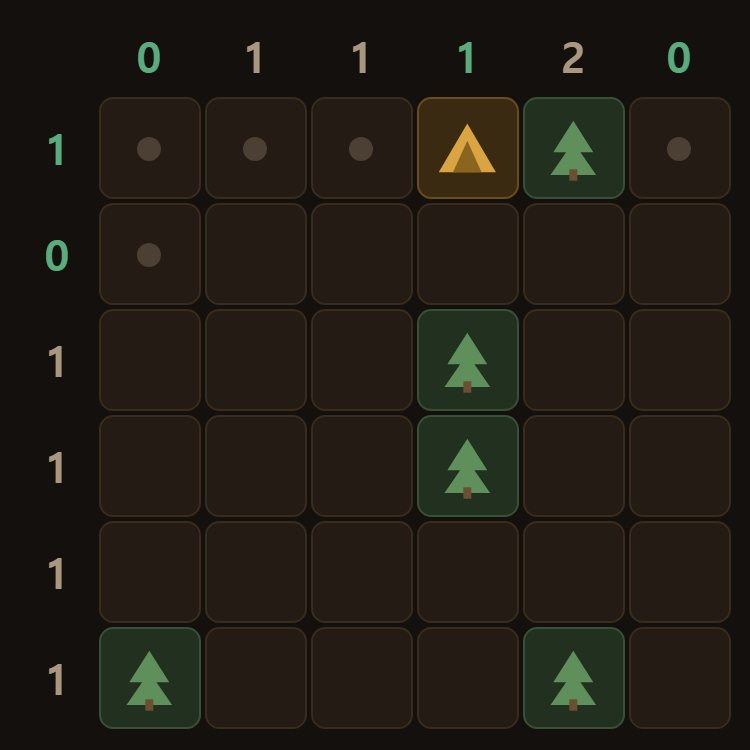
Tree squares do not change when tapped. Do not be sparing with grass marks. Crossing off what is not a tent is half this game.
First job — cross off what touches nothing
There is one thing to do the moment the board opens: mark as grass every square that touches no tree.
No tent can go there. This alone clears about half the board.
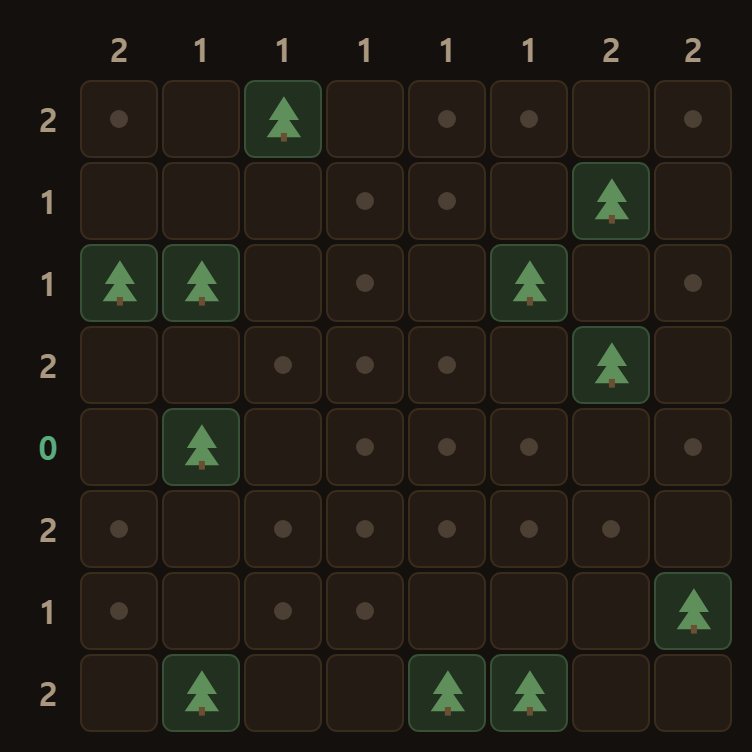
There is nothing to think about, so do it mechanically. The Hint starts here as well.
Next — clear the 0 lines
Find the lines marked 0 along the edges. They hold no tents, so they are grass from end to end.
Nothing to think about here either. And once those two jobs are done, so few empty squares remain that the real reasoning starts to show.
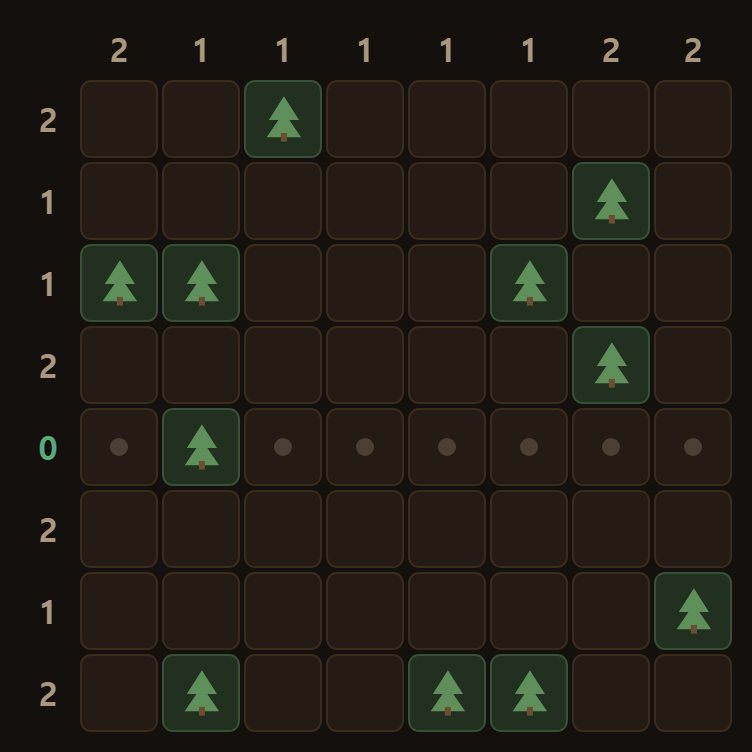
Even where it is not 0, once a line has as many tents as it needs, the rest of it is grass.
When the places equal the number needed
Now the real reasoning. Count the squares in a line where a tent could go.
If that count equals the number of tents the line needs, all of them are tents. There is nothing to choose.
- Needs 3 and has 3 possible squares → all three are tents.
- Needs 2 with 5 possible squares → you cannot tell yet. Look at another line.
- When counting possible squares, leave out squares already grass and squares beside a tent.
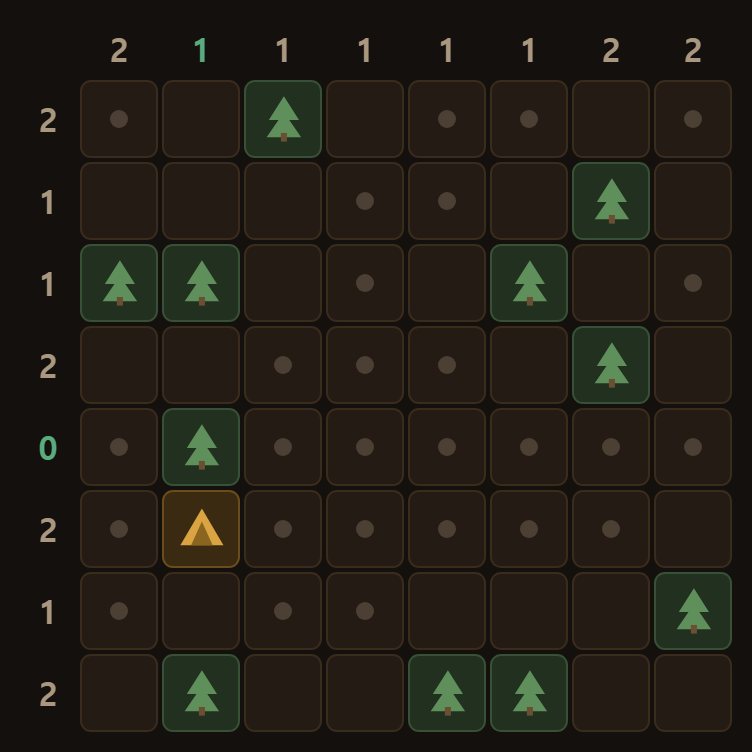
This is the workhorse method. Sweep rows and columns alternately and settled squares come out one after another.
When a tree has only one place to go
You can reason from the trees as well. If a tree has only one square where a tent could go, that is its tent.
With three of its four neighbouring squares already grass, the remaining one is the answer.
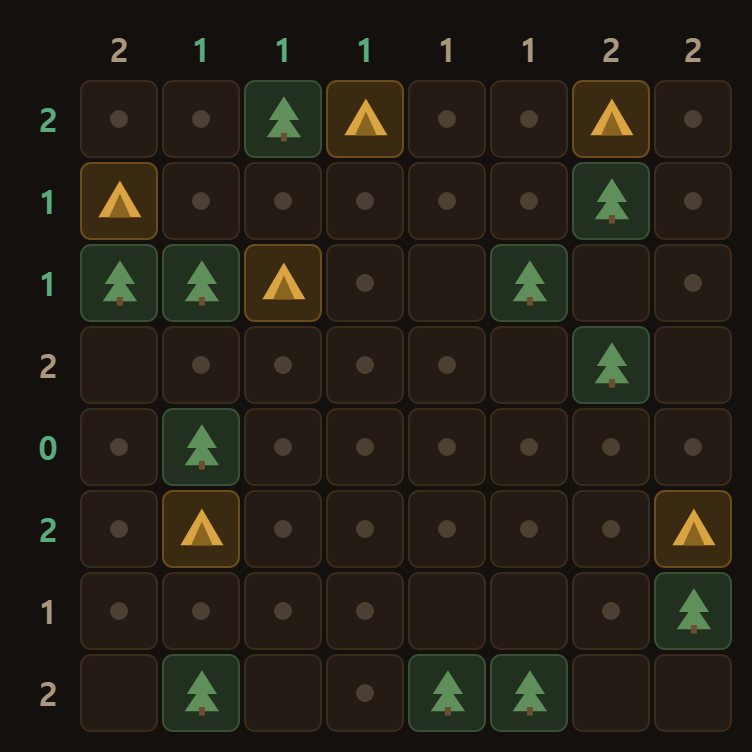
Alternate between reasoning from lines and reasoning from trees. Stick to one and you stall quickly.
Beside a tent is grass, at once
Pitch a tent and the eight squares around it are settled as grass there and then — the four orthogonal and the four diagonal.
The knack is to mark them the instant you pitch. Put it off and you will reason over those squares again later.
- One tent settles eight squares. A very large return.
- Along an edge it is five squares; in a corner, three.
- If a tree stands among those eight, leave it as it is — a tree is not a tent.
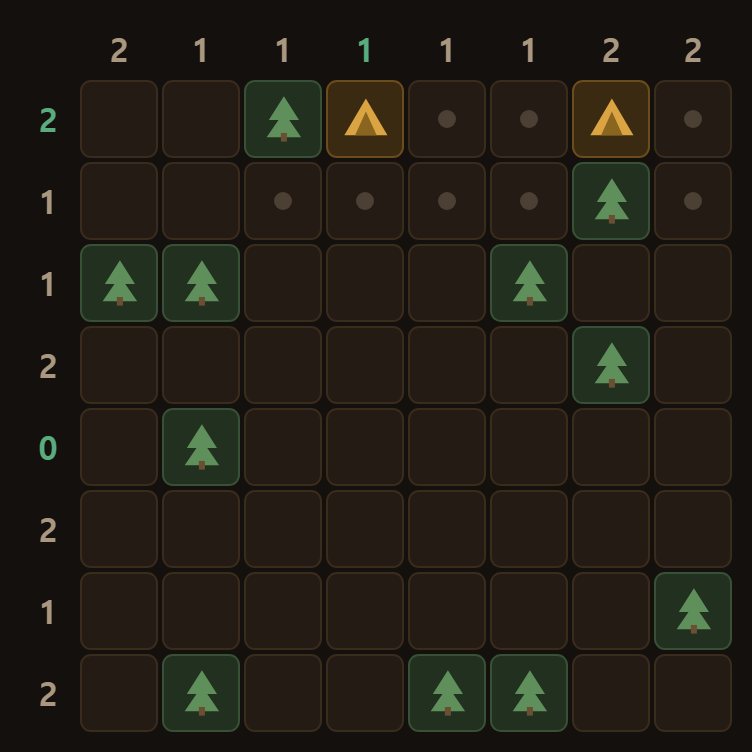
Because of this, the board narrows visibly with every tent. Which is why finding the certain tents first pays.
The hint gives you its reason
Press Hint at the top and it points out one square, says whether it is tent or grass, and tells you why.
- Grass, because it touches no tree
- Grass, because this line already has all its tents
- Grass, because it is beside a tent
- This line has exactly as many possible squares as tents needed
- This tree has nowhere else to go
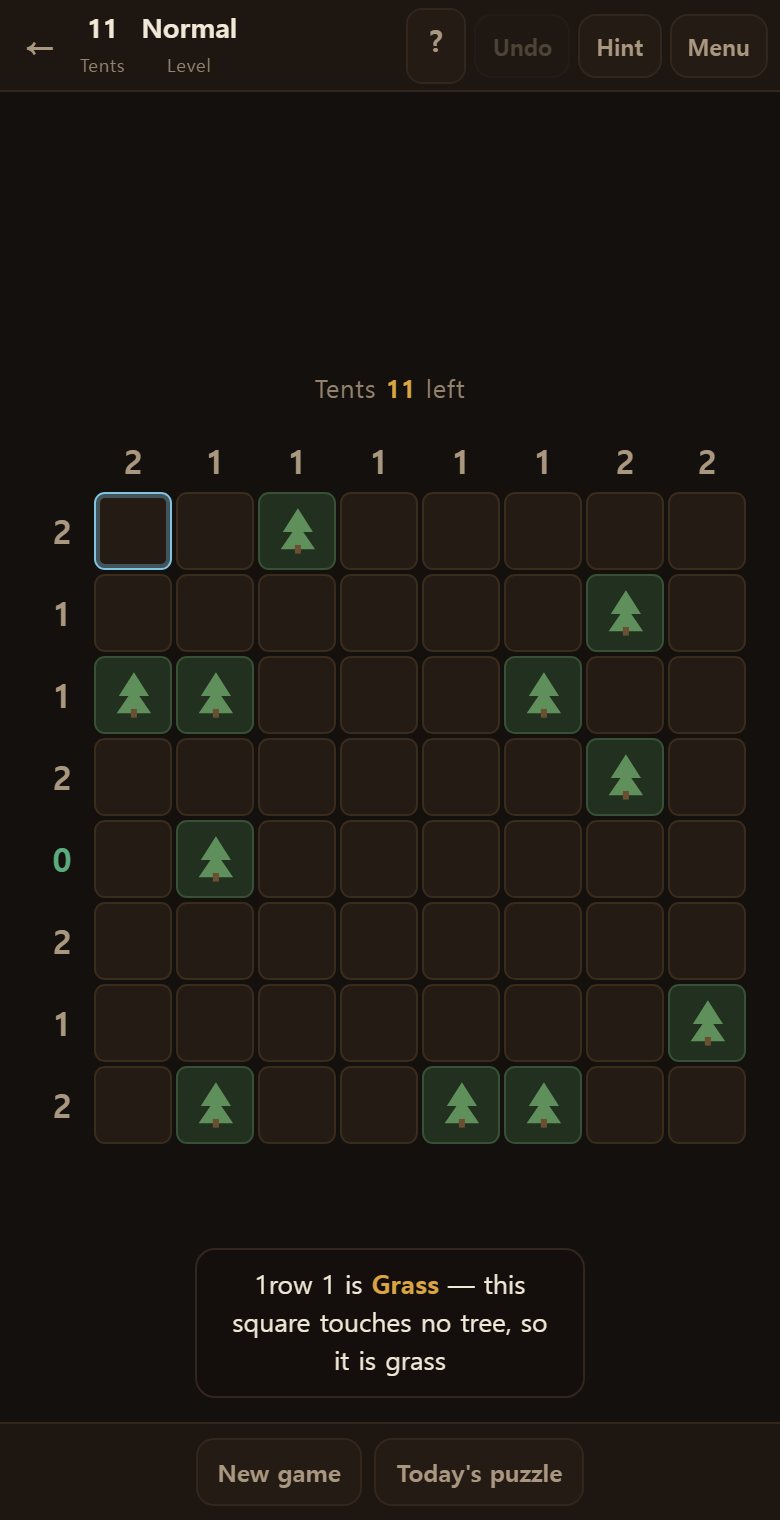
Those five reasons are all there are. Know them and you can solve any board dealt here.
You are told at once if it is wrong
Pitch against a rule and the square turns red.
- When two tents touch — both squares turn red.
- When a tent touches no tree
- When a line overshoots its number — the edge number turns red as well.
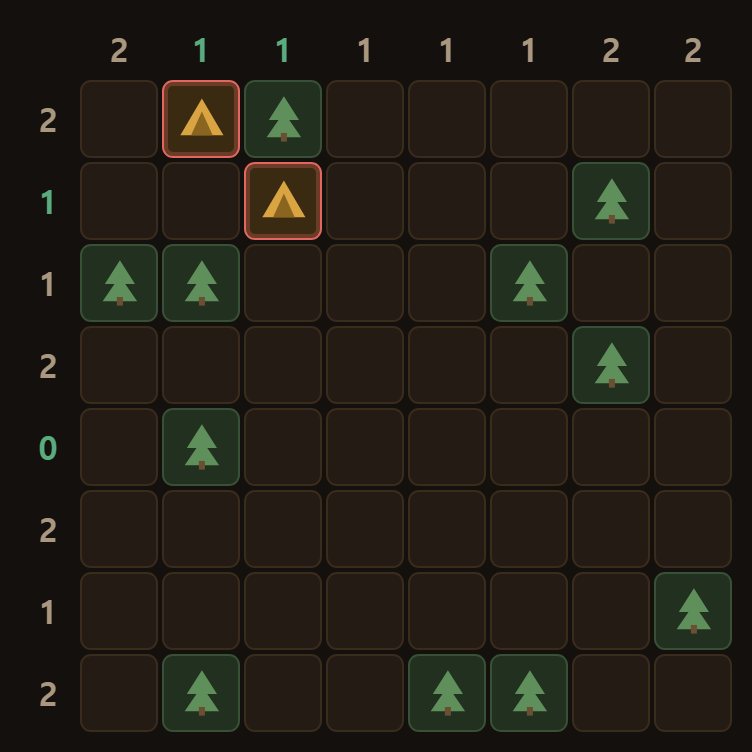
Clear it as soon as it reddens. Reason on from it and everything else goes wrong.
Only boards with a single answer
Scatter trees and numbers carelessly and you get a board with several answers — where pitching correctly still gets you told you are wrong.
Here every board has its answers counted as it is built. If there is more than one, it is thrown away and built again.
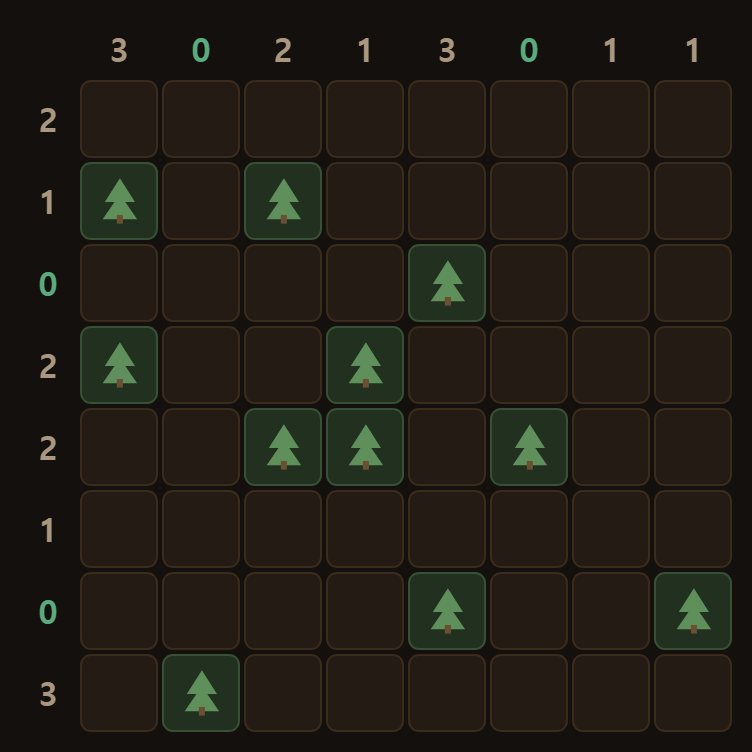
A board someone sends you is counted again at your end.
You never have to guess
There is no need to solve by “let me pitch here and undo if it fails.”
Every board dealt here can be carried to the end with the five kinds of reasoning above and nothing else. That is checked before it is dealt.
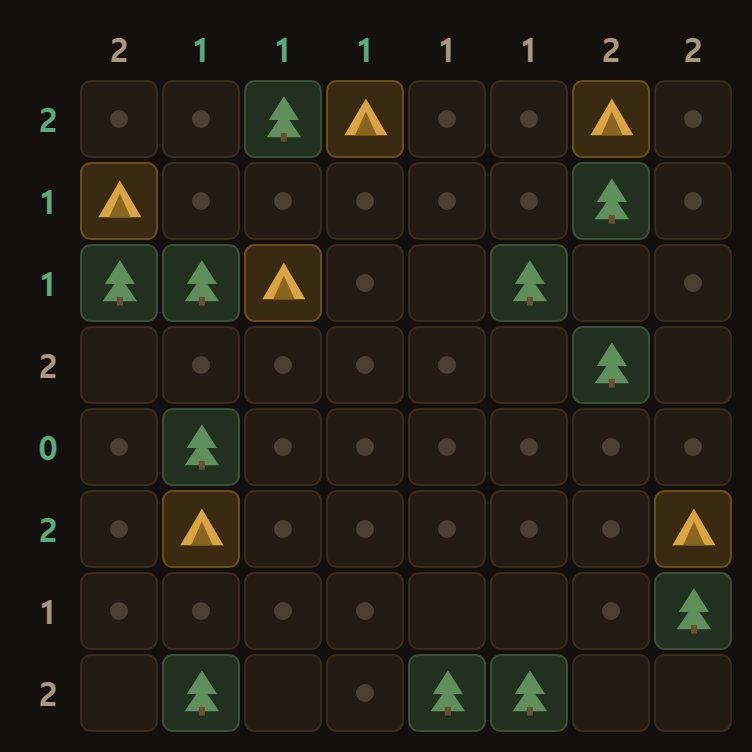
So being stuck means there is a clue you have not seen. Sweep the lines and the trees again, alternately.
Reasoning with a gap between
A slightly more advanced technique. Once you have it, boards fall much faster.
Suppose a line has a run of squares where a tent could go. Since tents cannot touch, you can only place one every other square.
- A run of five squares holds at most three tents.
- A run of four holds at most two.
- When the line needs exactly that maximum, where they go is settled.
- Three tents in a run of five means the first, third and fifth. There is no other way.
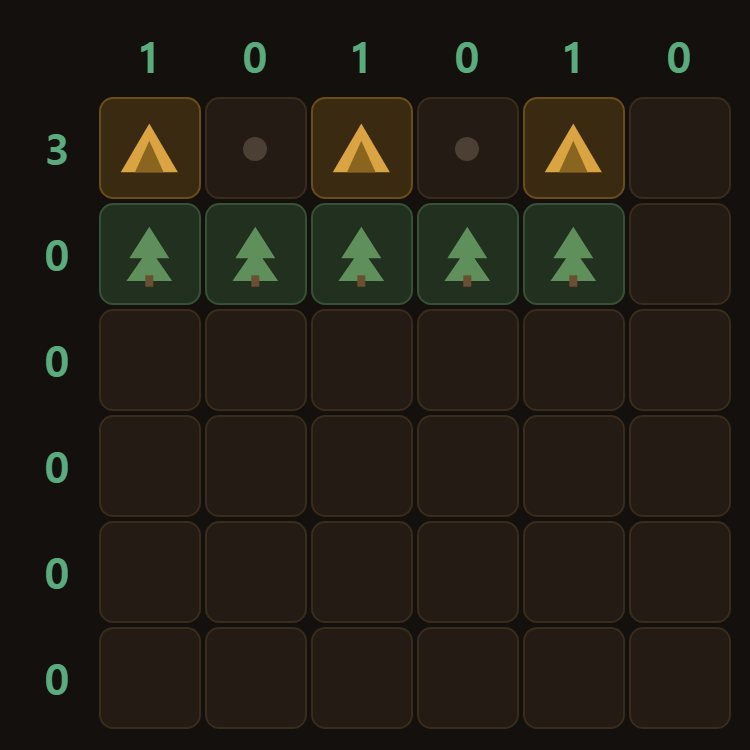
It works the other way too. Two tents in a run of only three means the first and third, with grass in the middle.
Board size and difficulty
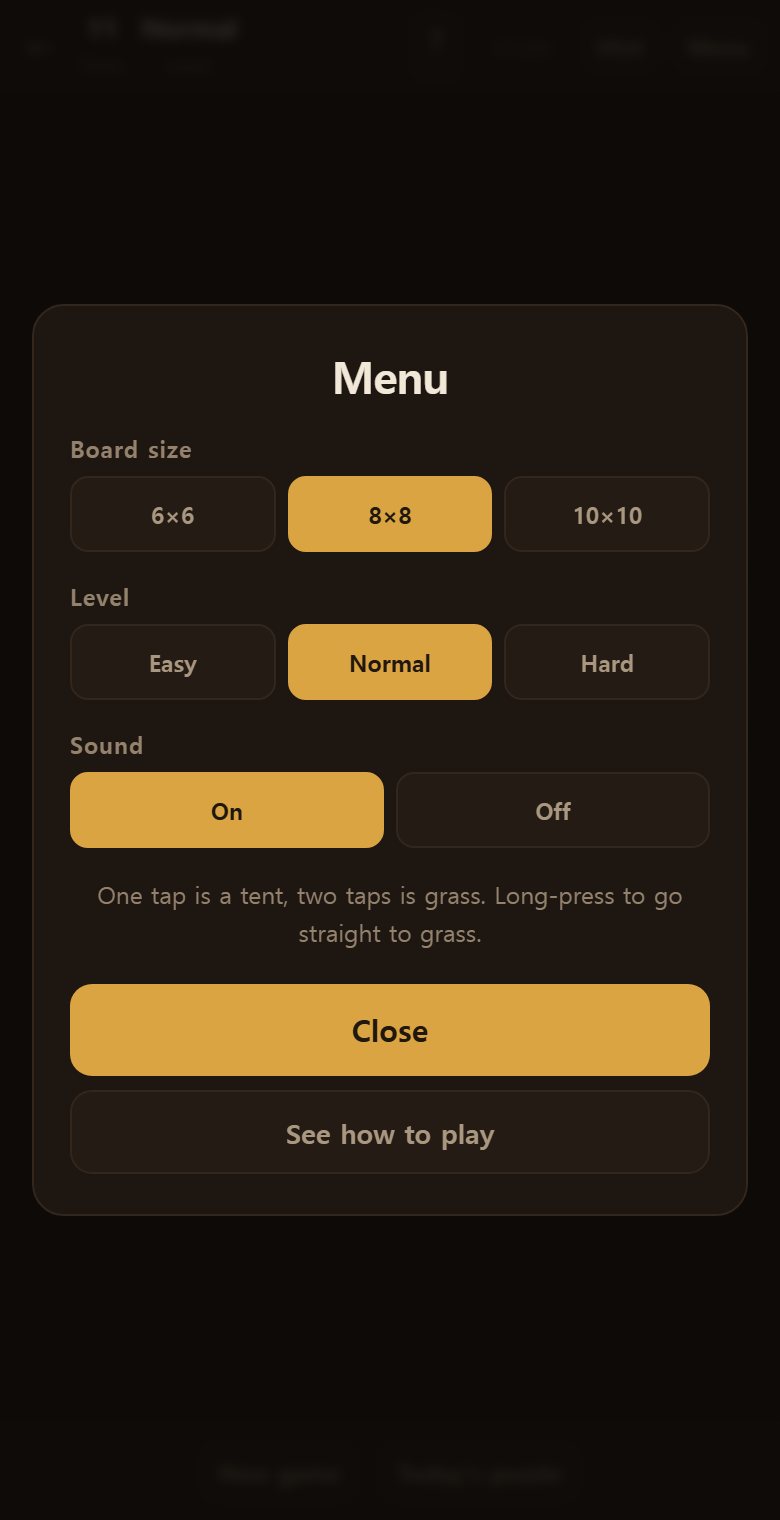
Choose the board size and difficulty from the menu.
- 6 × 6 — five or six trees. Good for learning the rules.
- 8 × 8 — around ten trees. The size that suits it best.
- 10 × 10 — around twenty trees. A board takes a good while.
- Easy, Normal, Hard — the more trees, the harder.
More trees means more tents, and more places where they get in each other’s way — which means more to reason about.
Sharing a board, and today’s puzzle
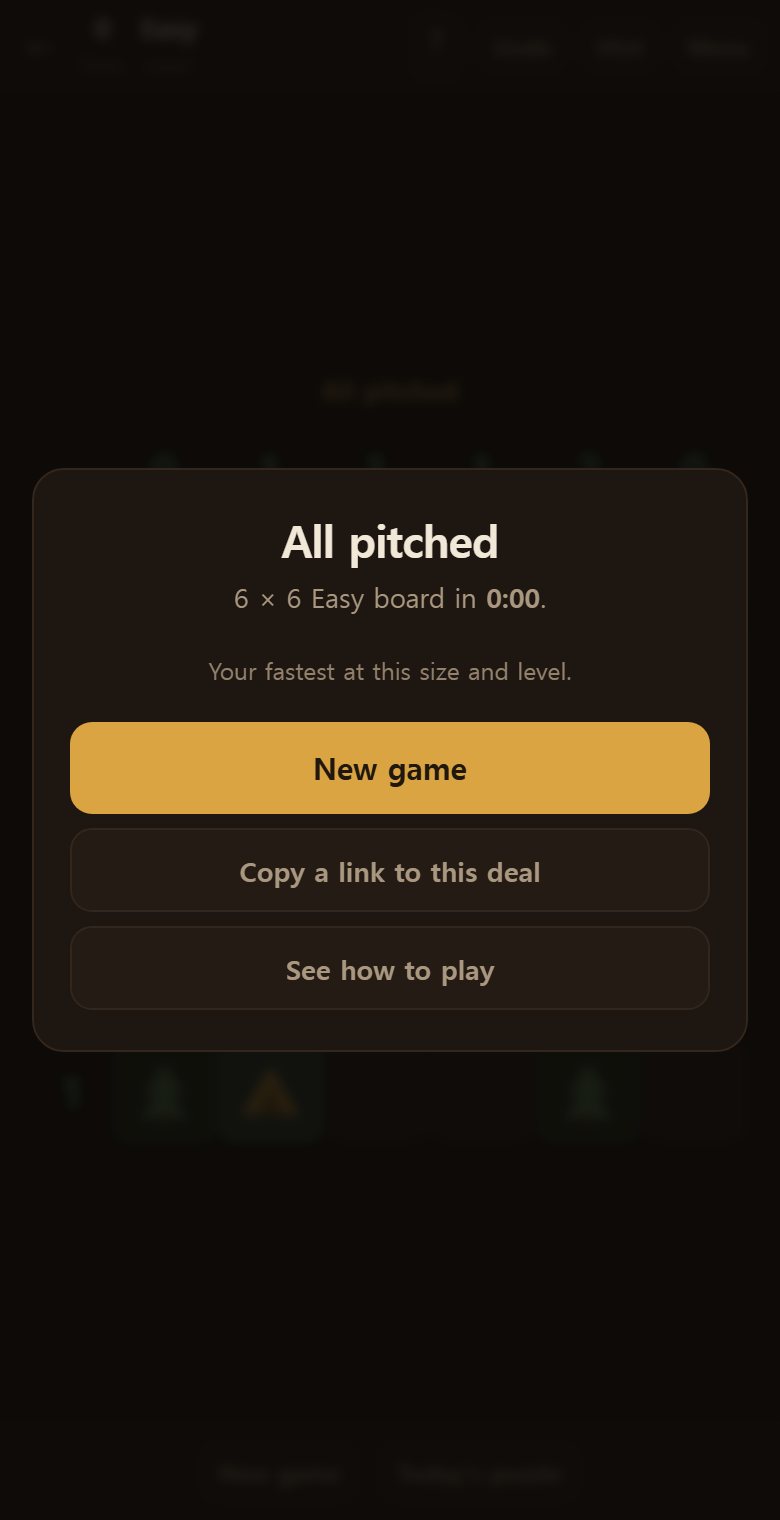
When you finish, press Copy this board’s link to send it to someone. Opening that link gives exactly the same board.
Today’s puzzle, below, is one set board per day. Everyone gets the same one, so you can compare times.
The receiving end counts the answers again too.
How to solve well
Work in this order and it usually falls. Top to bottom.
- Cross off every square that touches no tree. The board halves.
- Clear every 0 line. Up to here there is nothing to think about.
- Count the possible squares in each line. If it equals the number needed, they are all tents.
- Look from the trees as well. Find the tree with only one place to go.
- Pitch a tent, then grass the eight squares around it at once. Put it off and you get muddled.
- Sweep rows and columns alternately. Stick to one and you stall quickly.
- Stuck? Hint. It gives the reason too, so next time you see it yourself.
Common mistakes
Boards that stall here nearly always come down to one of these four.
- Treating a diagonal as beside — the most common. A tent must touch its tree along a row or column.
- Not marking grass — leave the ruled-out squares unmarked and you re-examine the same place over and over.
- Reading the edge numbers as tree counts — they are tent counts.
- Pitching a tent and not clearing its ring — those eight squares are grass immediately. Mark them at once.
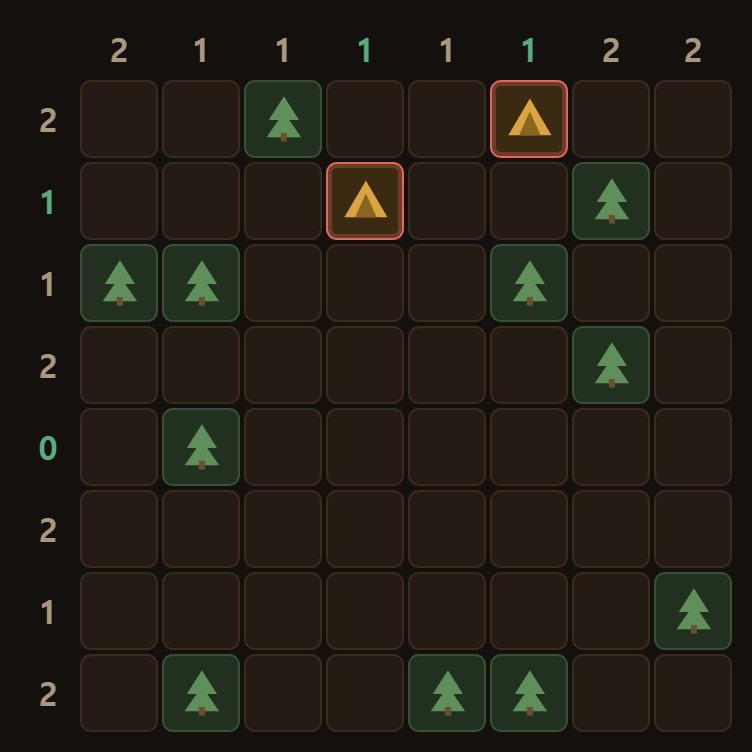
Clear a red square the moment you see one. Carry on with a conflict in place and finding where it began becomes very hard.
When you finish
Every tree paired with a tent, every line matching its number, no two tents touching — and it ends there.
The tents turn green and your time appears.
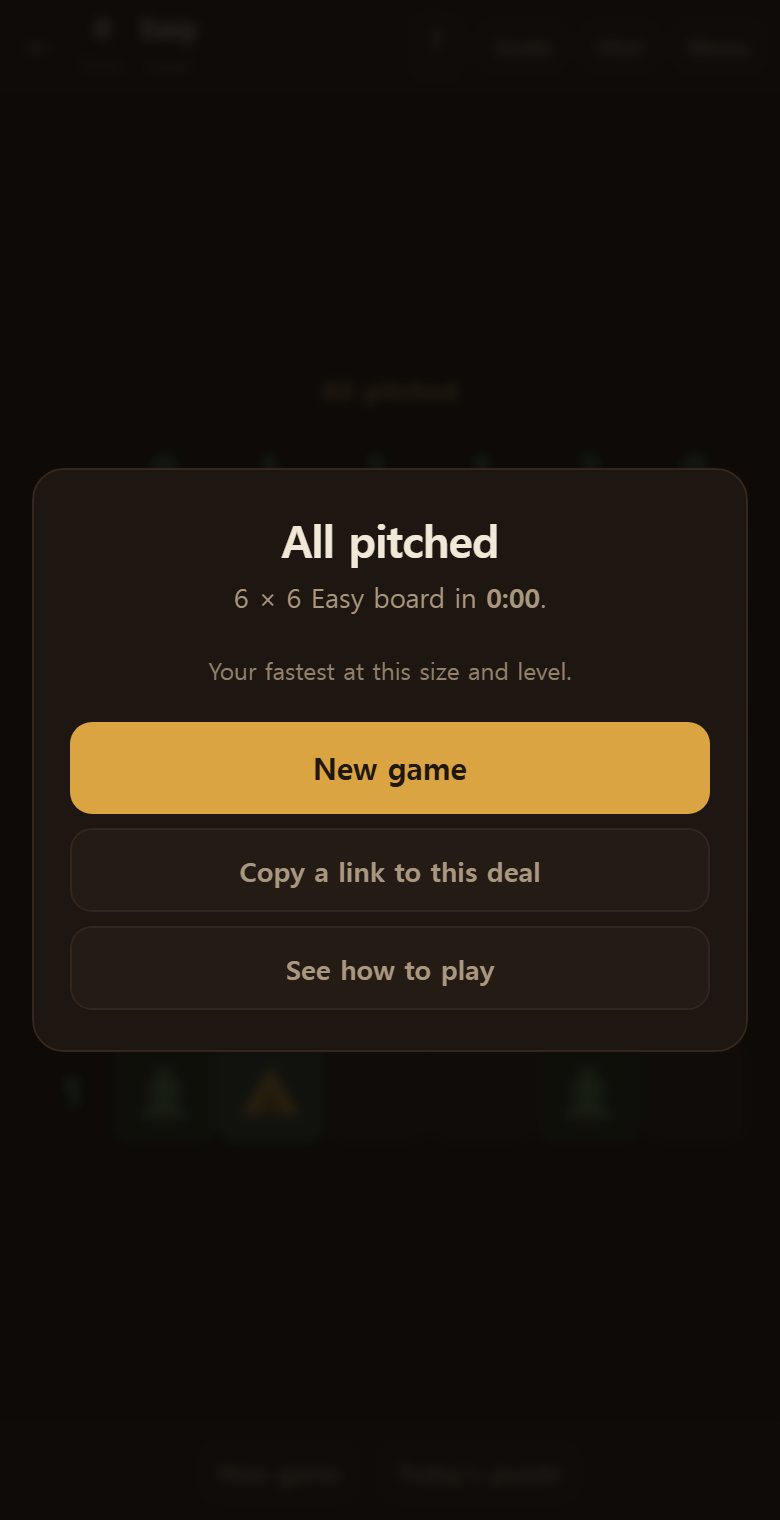
A best time is kept separately for each board size and difficulty.
Common questions
No. It must touch along a row or column — one of the four squares above, below, left or right.
That is not allowed either. No other tent may sit in the eight squares around a tent.
No, they are tent counts. The totals match, which makes it easy to confuse, but a line with three trees may hold only one tent.
Mark as grass every square that touches no tree. Then the 0 lines. Those two alone halve the board.
Crossing off what is not a tent is half this game. Unmarked, you reason over the same square again and again.
No. It is one to one. A single tent between two trees is fine, though — it counts as the tent of one of them only.
The counts may be right while the pairing fails — one tree with two tents and another with none. Start from the red squares.
No. Every board has its answers counted before it is dealt, and any with more than one is discarded.
Never. Every board is built so that the five kinds of reasoning the hint uses carry you to the end.
- Start with the lines marked 0. That whole line is grass.
- Any square that touches no tree is grass. Mark them all first and the board shrinks a lot.
- If a line has exactly as many possible spots as tents needed, every one of them is a tent.
- The moment you pitch a tent, the eight squares around it become grass. Mark them straight away.
- Press Hint when you are stuck. It gives you the next square and the reason for it.