 MindHub
How to play Speed
There are no turns in this game. Both sides play at the same time. Onto either of the two middle piles, any card one rank from the top one can go. Whoever empties hand and pile first wins.
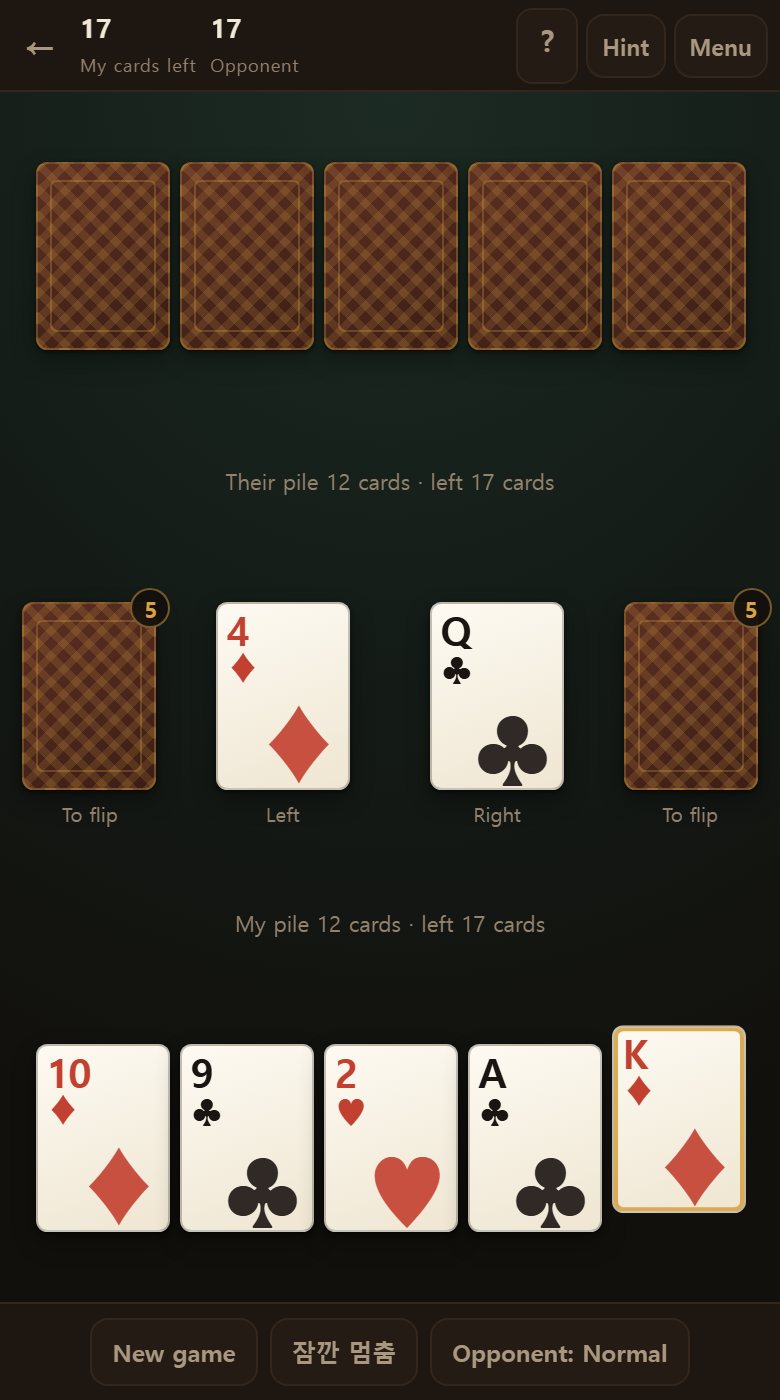
First, a look at the screen
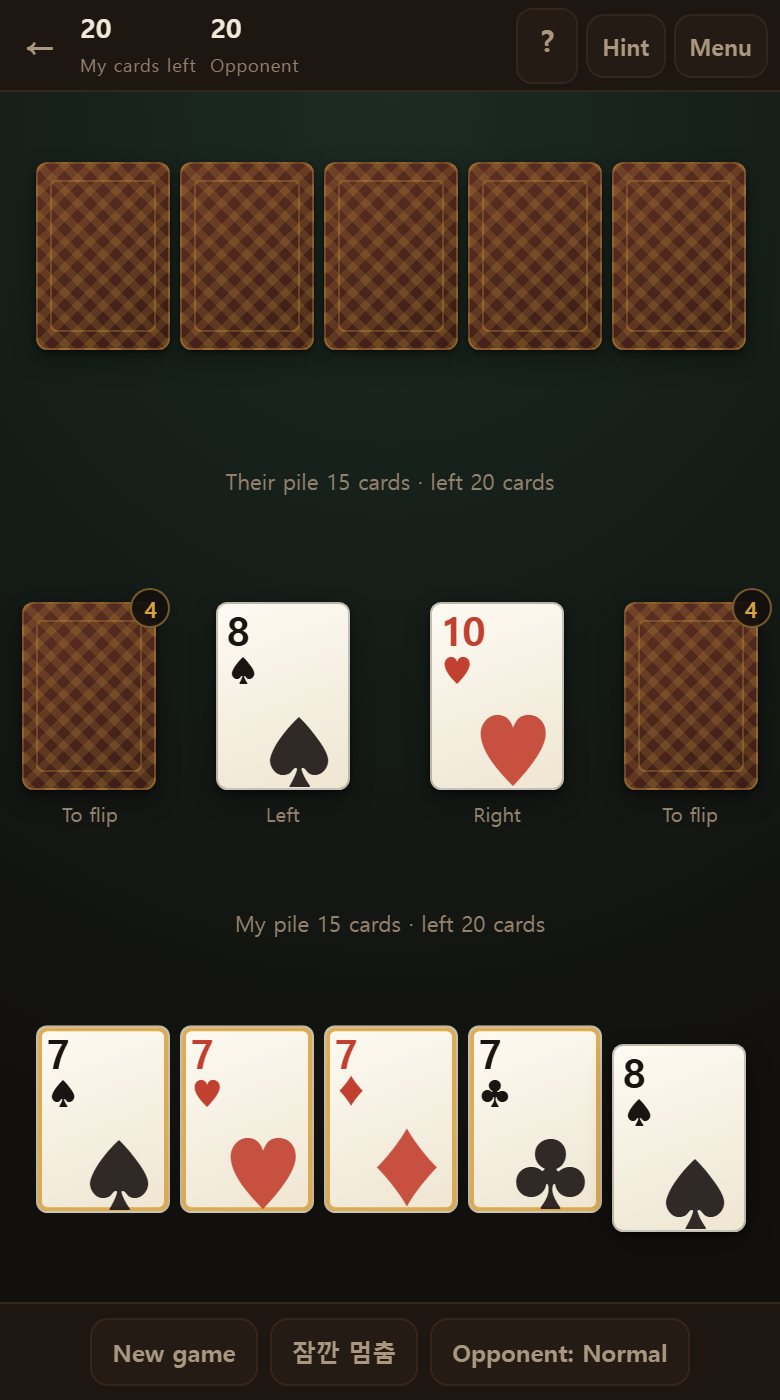
Their hand above, four places in the middle, your hand below.
- The five face-down cards at the top — their hand. You cannot see what they are.
- The two inner cards in the middle — where you play. Left or right, either will do.
- The two outer piles — the cards turned when both sides are stuck.
- The five cards below — your hand. Any that lift with a gold ring can be played.
- The figures at the top — how many cards each side has left, and the time so far.
The gold rings keep changing, recalculated every time a middle card changes. You can play by the rings alone without knowing the rule.
How the cards are dealt
The fifty-two divide exactly.
- Each side gets five in hand plus fifteen in their pile — twenty apiece
- Two outer flip piles of five each
- Two inner piles of one card each
- 5 + 15 + 5 + 1, doubled, is 52 — nothing left over and nothing short.
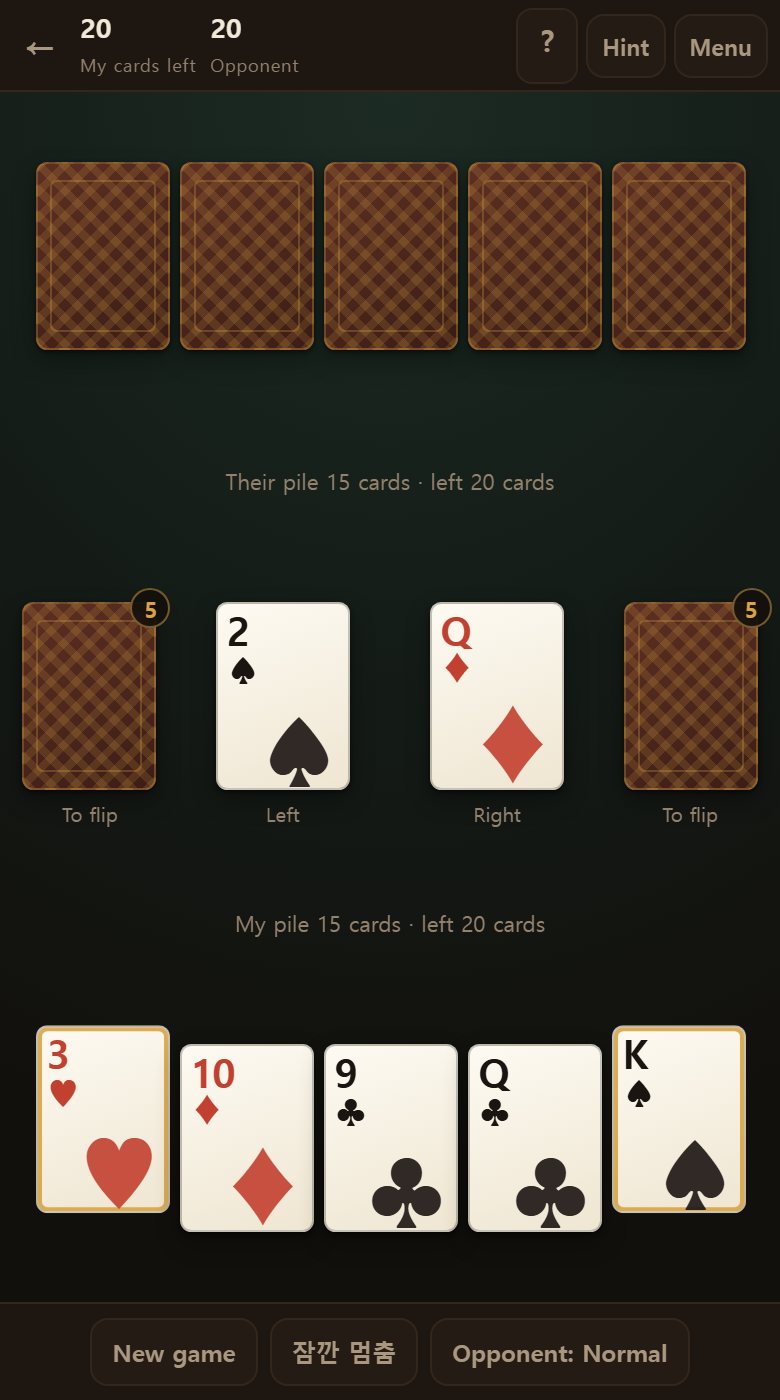
So twenty cards stand between you and the win. Emptying your hand is not enough — it refills from the pile, and the pile has to go too.
One tap plays it
Tap a card once and it goes. There is no separate step for choosing which pile.
If both would take it, it goes to whichever leaves you the better follow-up.
- Tapping an unplayable card does nothing at all. A wrong tap costs you nothing.
- One tap with a finger, one click with a mouse.
- The keys 1 to 5 map to the five cards in hand, in order.
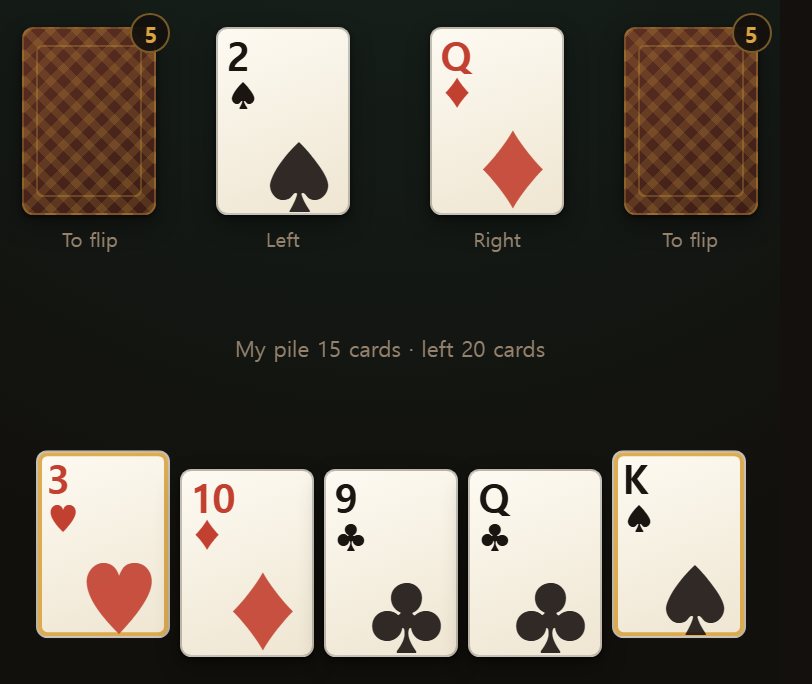
Requiring two taps would not be Speed. So the game chooses the pile for you. Once you are used to it, the keyboard is far faster — no moving your hand, just 1 through 5.
One rank up or down
With a 7 on top, the only playable cards are a 6 and an 8. Suit and colour do not come into it.
But there are two piles. With a 7 on the left and a J on the right, you can play a 6, an 8, a 10 or a Q.
- J counts 11, Q 12 and K 13.
- The card you play becomes the new top of that pile.
- Every card played is refilled at once from your pile. Your hand always holds five.
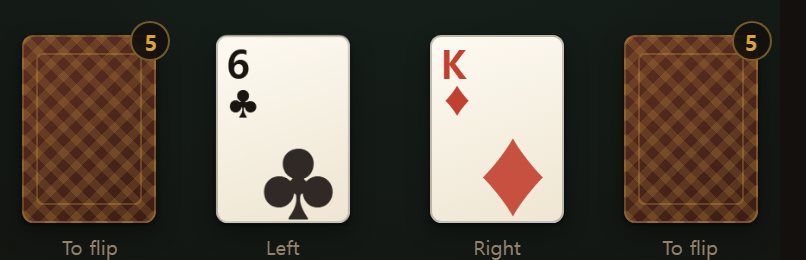
The commonest mistake is watching one pile. Watch both and the cards you can play double.
A follows K
The ranks wrap round like a clock. An A goes on a K, and a K goes on an A.
So the game rarely jams. It does not stop dead at a king the way Golf does.
- On a K you can play a Q or an A.
- On an A you can play a 2 or a K.
- So every card has two ranks it will go on.
- This is where most plays are missed — the habit of seeing a K and not looking for an A.
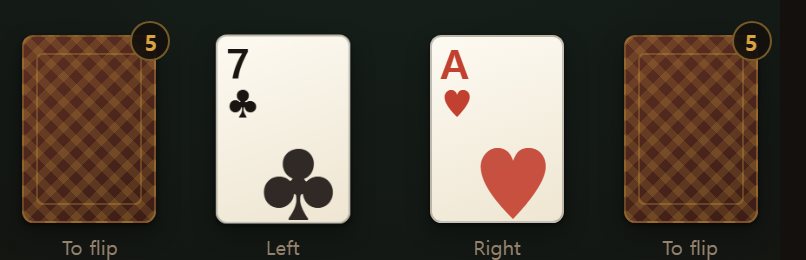
Without wrapping, the game jams far too often and keeps stopping. Speed is no fun stopped, so wrapping it was.
Both stuck means a flip
Sometimes neither side can play. After a moment, one card from each outer pile is turned onto the middle.
The tops change and the game opens up again.
- The flip is automatic. There is nothing to press.
- The flip piles hold five each. When they run out, the middle piles are split again to refill them.
- If even that fails, the game is drawn — which happens very rarely.
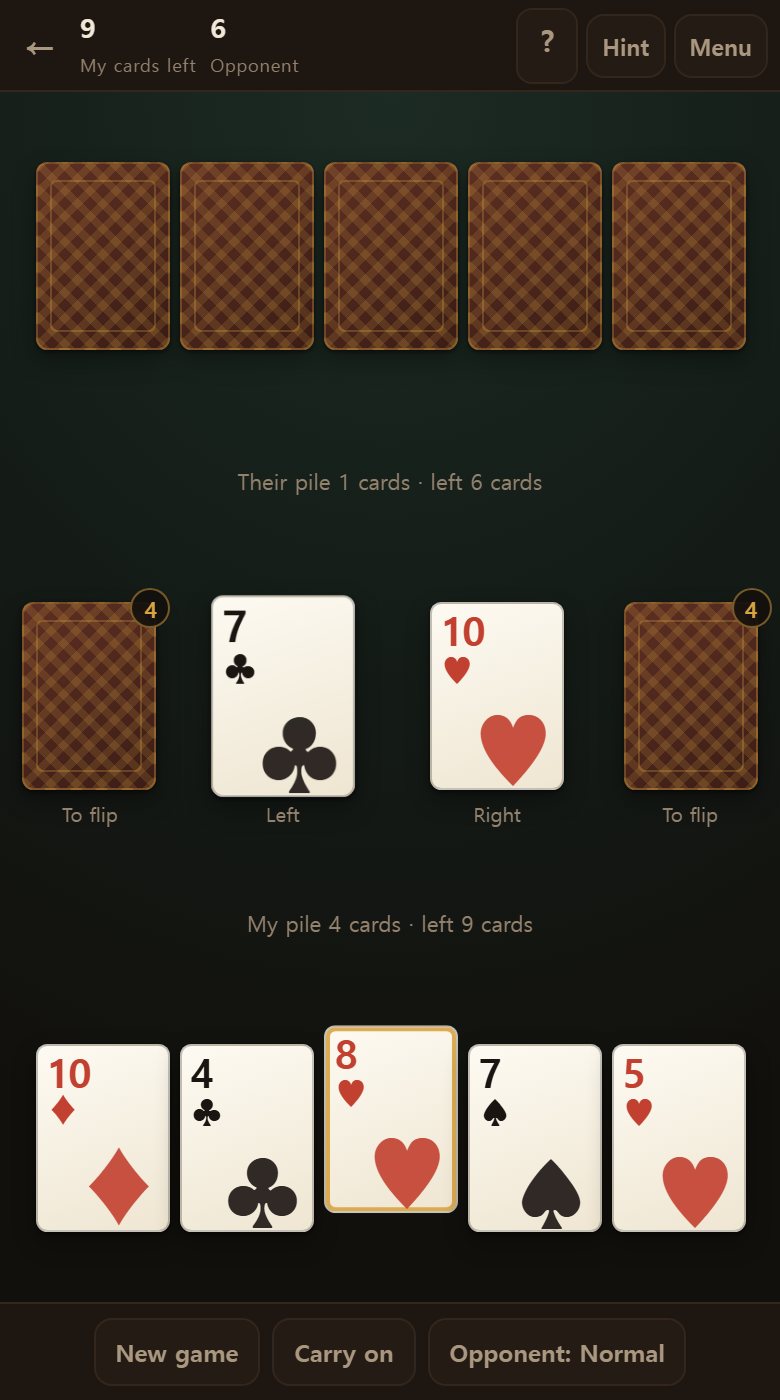
Do not rest your eyes while stuck. The moment it flips, whoever moves first takes it. Before the flip, learn your five cards. Then when the new cards appear, your eyes only have to read the middle.
How to get faster
The eyes come before the fingers. A few habits make a large difference.
- Watch both piles. Fixing on the left and missing the right is the commonest loss.
- Decide your next card in advance. Spot it before you tap the current one and they go out back to back.
- Cards that chain are the ones to want. Play an 8, then a 9, then a 10 and three go at once.
- With two cards of the same rank, you can play one to each pile.
- If you think you are stuck, do not stop — sweep all five cards once more.
- Do not forget that K and A join up. That is where most plays go missing.
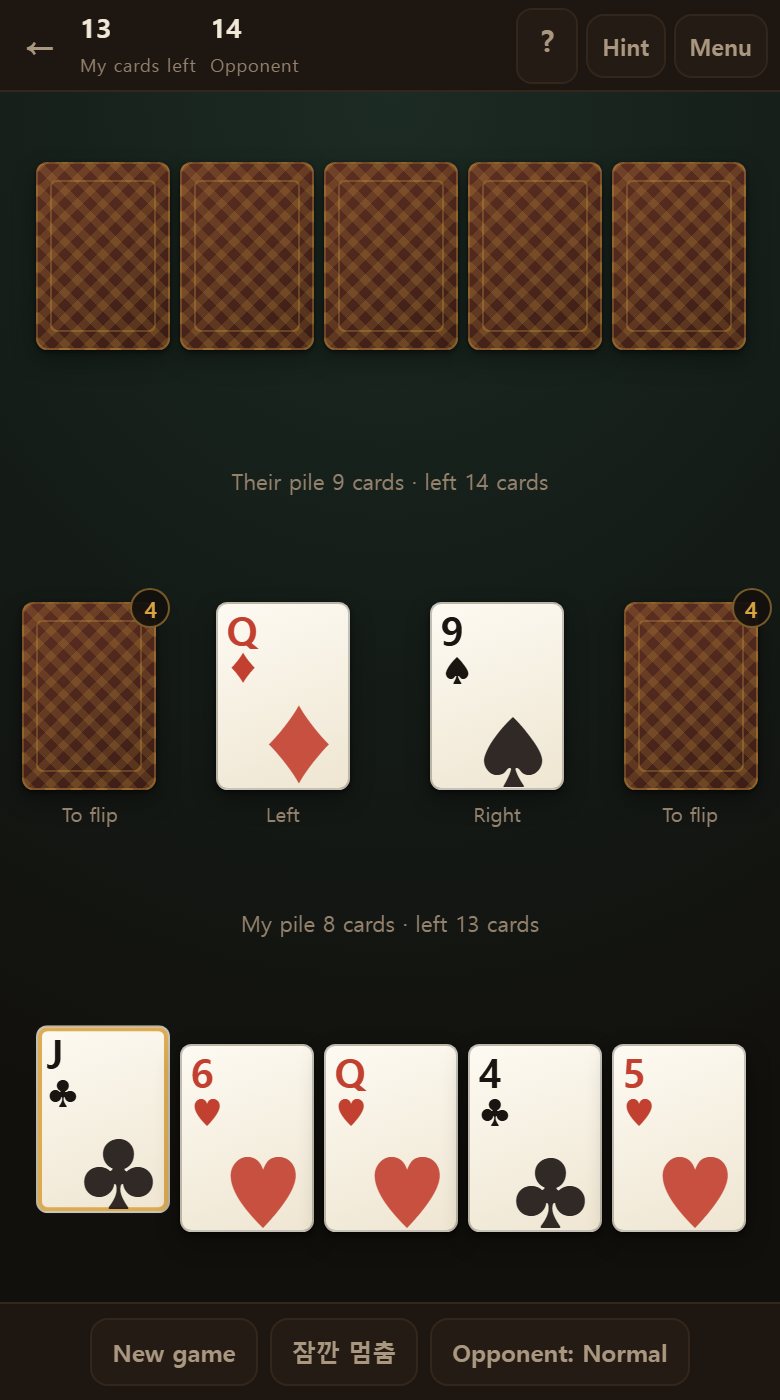
What separates fast players from slow ones is not the fingers but the eyes. Slow players read the cards one by one. Fast players take in five cards and two piles as one picture. A few games is enough to start.
Difficulty is how fast their hand is
The computer does not get cleverer, only quicker. The Opponent: Normal button below changes it.
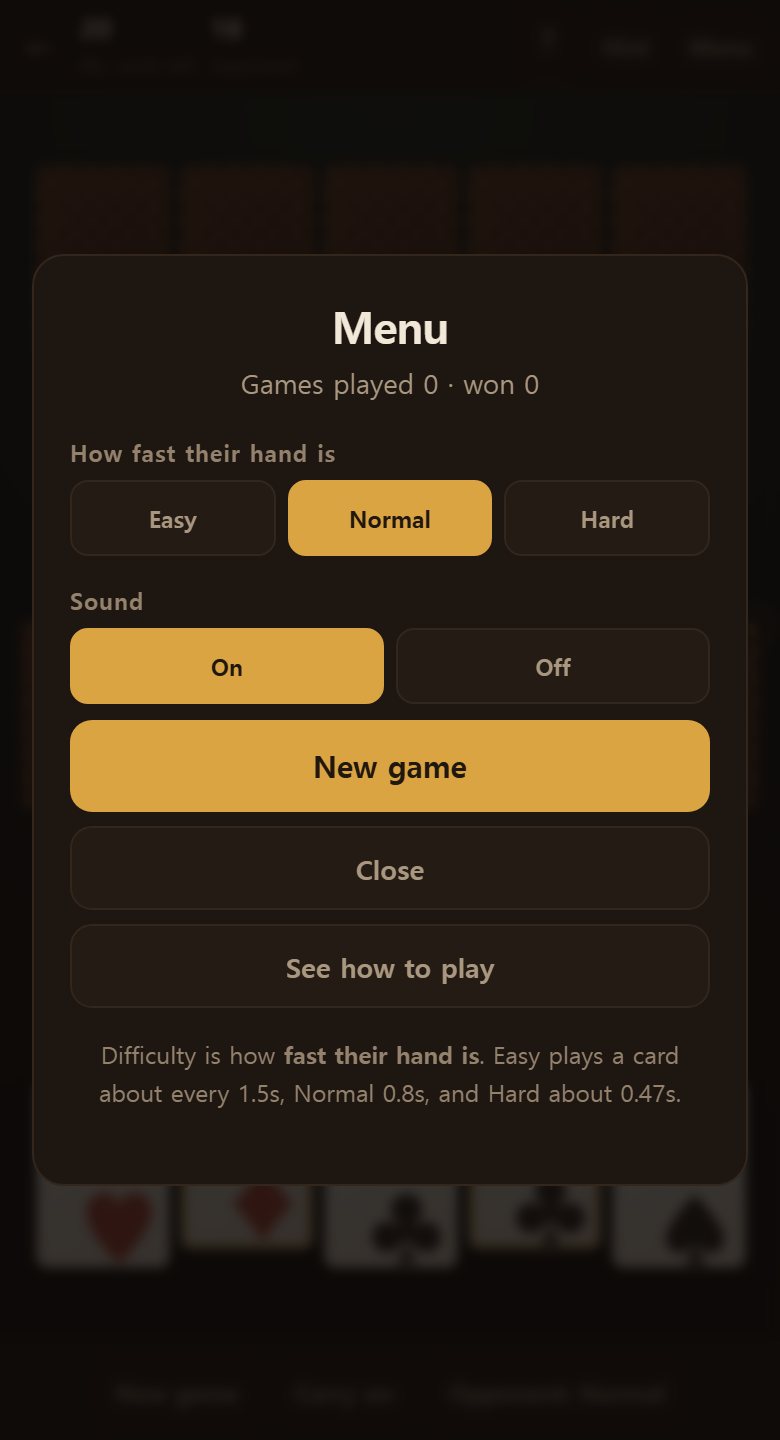
- Easy — a card about every 1.5 seconds. Start here if it is your first game.
- Normal — about every 0.8 seconds. Beatable once your hand is in.
- Hard — about every 0.47 seconds. Your eyes have to be very quick.
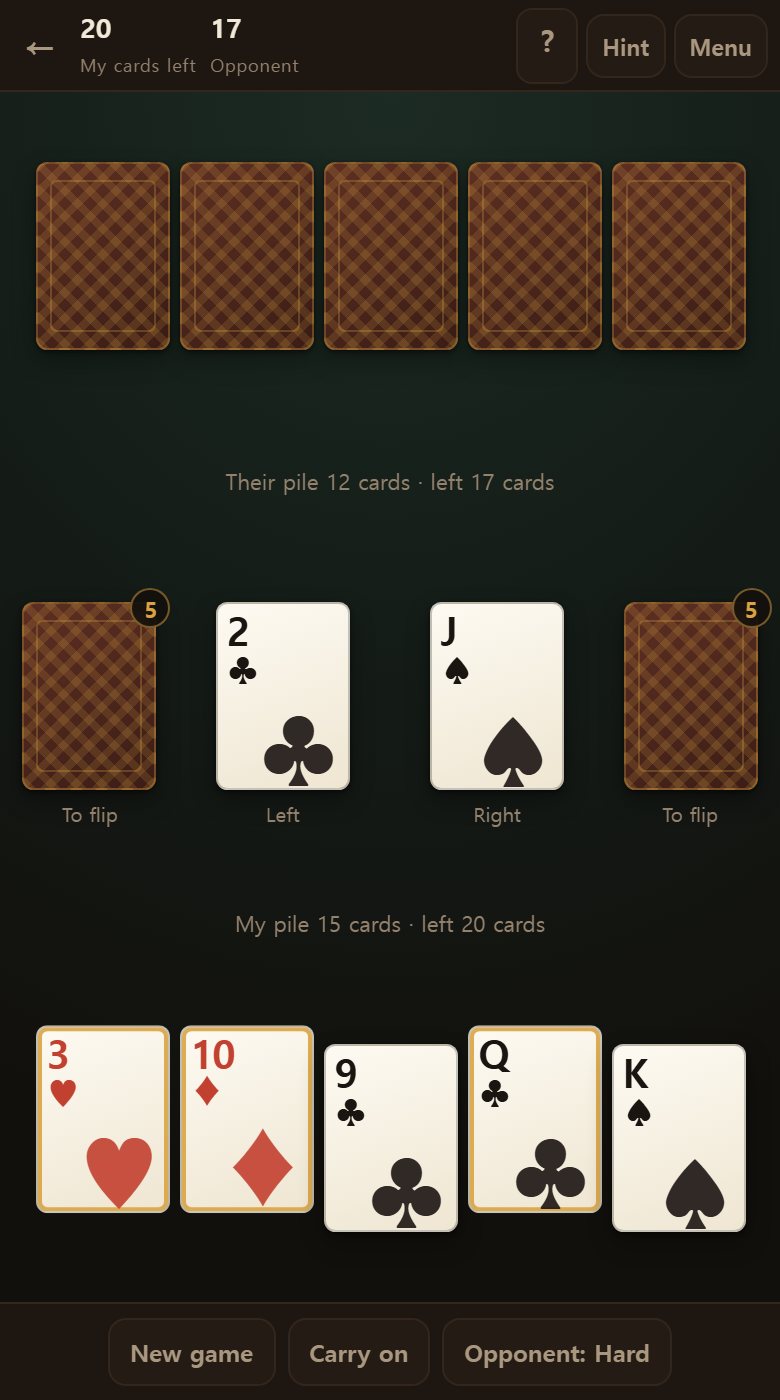
At every setting the computer cannot see your hand. It sees only its own cards and the two middle piles.
You can pause
A real-time game you cannot step away from would be a nuisance. Press Pause below and the clock and the opponent both stop.
Press again to carry on. P does it too.
- While paused, tapping plays nothing — and the computer plays nothing either.
- Pausing is good for practising finding every card you could play.
- Opening how to play or the menu pauses it too. Closing them starts it again.

Without a pause, a real-time game is ruined by stepping away for a moment. So you can stop it whenever you like. Pause is also for practice. A card you could not see in the rush is plainly there once you stop — you were not seeing it, not lacking it.
Your time is kept
Win and your time is recorded. Try to beat it at the same difficulty.
Games of Speed do not vary much in length. It is a question of how smoothly you can move twenty cards.
- The menu keeps games played and games won.
- The opponent's hand speed is set in the same place.
- Your record stays on this device. Nothing is sent anywhere.
There is a hint too
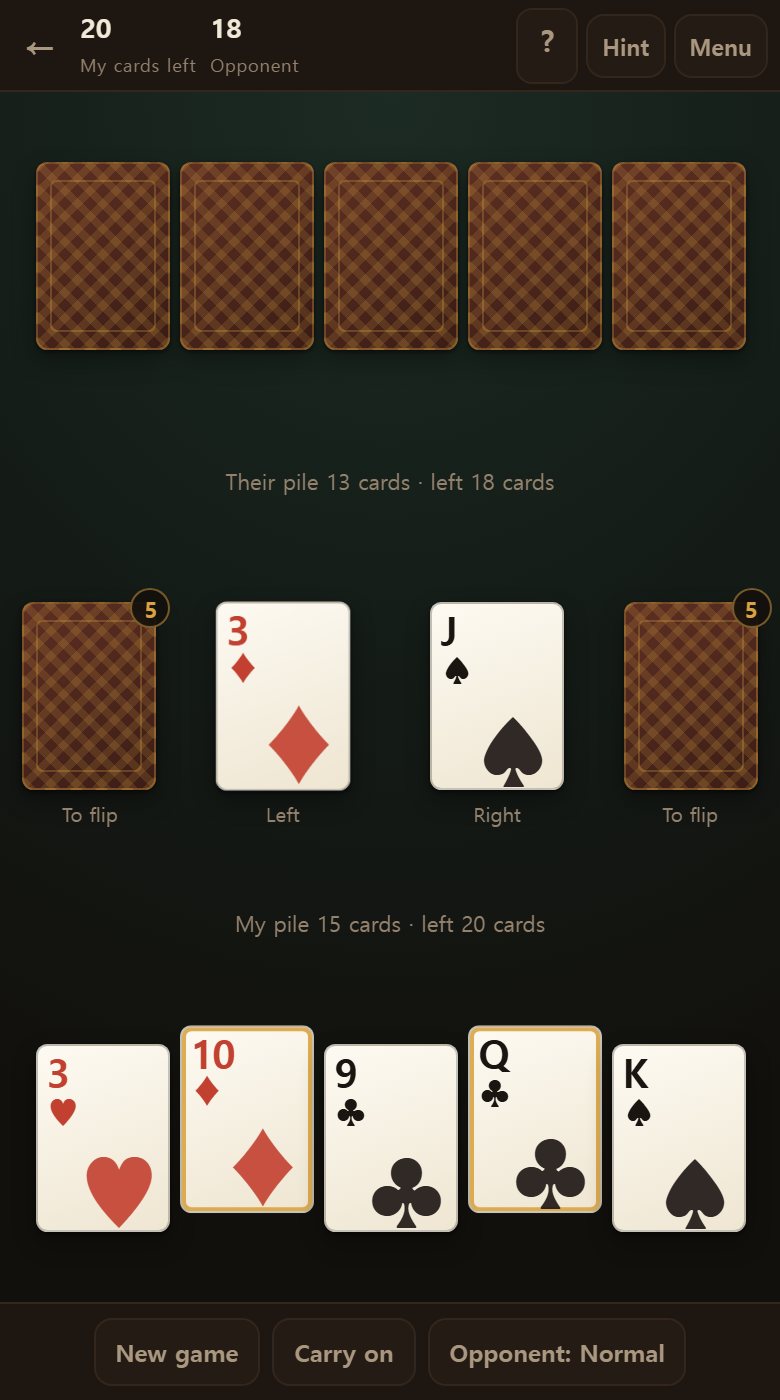
If you are lost, press Hint at the top. It marks one playable card in blue and names the pile.
But the clock runs while you press it. In the heat of a game your eyes beat the hint.
- With nothing playable it tells you to wait — meaning a flip is coming.
- Use the hint while practising. In a real game it stops your hand, which costs you.
- You can pause and then look at the hint. No time passes that way.
How a game unfolds
Speed has no turns. Either side plays the moment they can, so hands collide over the same pile.
- Whoever taps first plays. A tenth of a second settles it.
- If they play first, the middle card changes and your card is suddenly unplayable.
- So when you see a play, do not hesitate.
- When your hand drops below five, the pile refills it by itself.
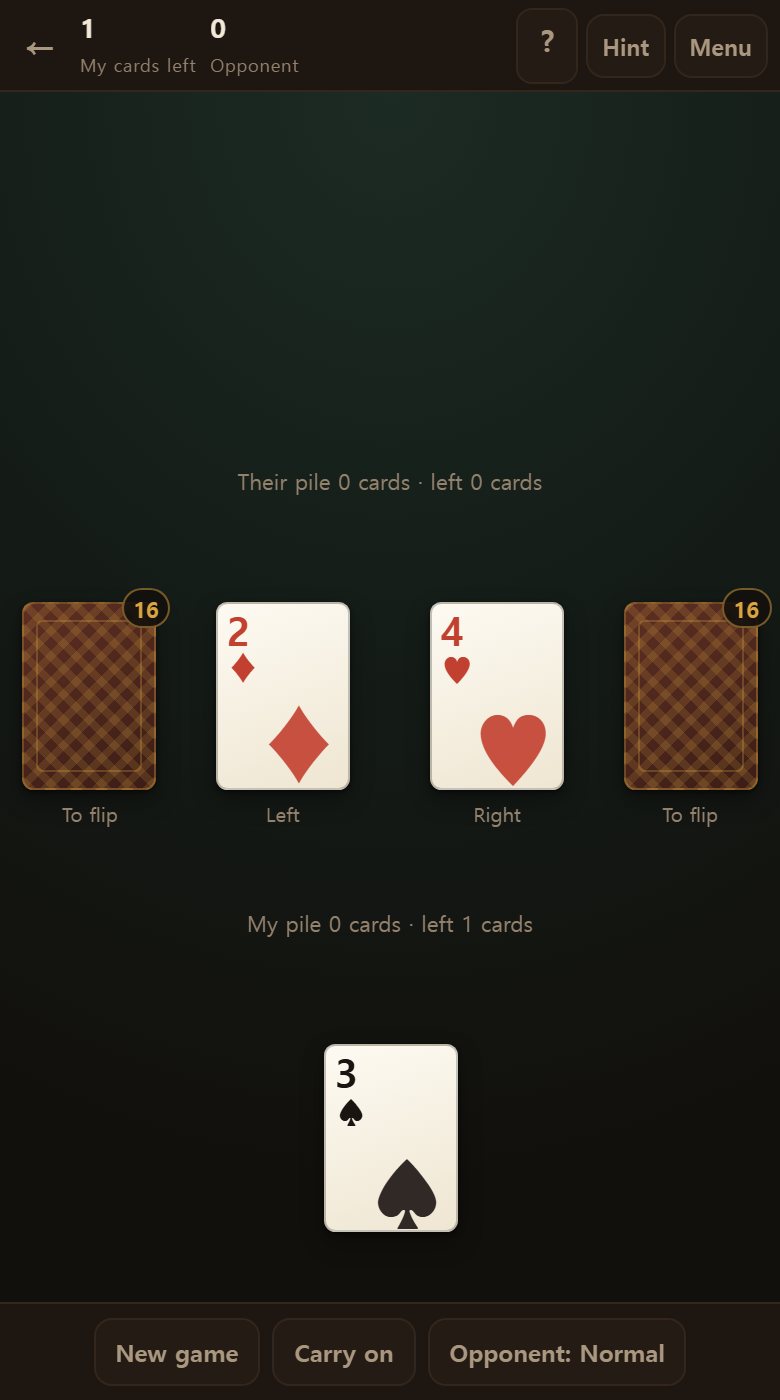
Games here are lost not for not knowing but for being late. The hand has to move the instant you see it.
Reading the figures at the top
The top of the screen shows how many cards each side has left, and the time so far.
- My cards left is your hand plus your pile together.
- When that reaches 0, you win.
- The middle also shows each side's pile and cards left separately.
- The clock runs from the moment the game starts, and stops with the pause.

If their number is falling much faster than yours, you are being outpaced. Concentrate on getting even one card down first.
How to lose quickly
Things people do before their hand is in. Simply avoiding them helps a great deal.
- Watching one pile — there are two. Watch both and your plays double.
- Trying to choose the pile — there is no need. One tap sends it to the right one.
- Looking for the perfect play — Speed has almost no good or bad moves. The fast move is the good move.
- Pressing hint — while you do, they keep playing.
- Freezing — even when nothing looks playable, sweep your five once more. While you sit still, they keep shedding cards.
The whole of it in one line: read both piles in turn, and tap the moment you see it.
The order to learn in
Nobody starts fast. Building up in this order is the comfortable way.
- Learn the rules on Easy. At 1.5 seconds you can look at your leisure.
- Next, train the eye to read both piles in turn. This gains you the most.
- Then make K to A wrapping second nature. Early on this is where plays keep escaping you.
- Once settled, move up to Normal. At 0.8 seconds a person can win.
- Hard is 0.47 seconds — the hand has to move ahead of the eye.
Pausing and finding every card you could play helps more than you would expect. It teaches the eye to hold both piles at once.
When a game ends
Whoever empties hand and pile first wins. Twenty cards out and it is over.
The game stops there and your time appears. Games played and won are kept in the menu.
- If neither side can play and even the flip piles are gone, it is a draw — very rare.
- New game reshuffles all fifty-two and deals again.
- A loss just means another game, so there is no need to fret over the record.
- Your record stays on this device. Nothing is sent anywhere.
A game of Speed takes a minute or two. Not brooding over a loss but playing again straight away is what this game is for.
Common questions
It is not one rank from either middle pile. Only cards with a gold ring will play.
When both would take it, it goes wherever leaves the better follow-up. One tap is what keeps this fast.
Use the Opponent: Normal button below to set Easy. Only its hand speed changes.
After a moment it flips by itself. There is nothing to press.
Your pile has run out. Play what is in your hand and you win.
Yes — press Pause below, or the P key.
The flip piles ran out and neither side can play. It happens very rarely.
- Watch both middle piles. Watching one costs you half your plays.
- Pick a card that opens the next one and two or three go out in a row.