 MindHub
How to play One Stroke
A figure is made of dots and lines. Trace every line exactly once without lifting the pen and you win. No line twice, and none left untraced. But a dot may be passed through as often as you like. This game holds a very old secret: a way to tell whether a figure can be drawn at all simply by looking at it. That is explained here too.

First, a look at the screen
The figure of dots and lines sits in the middle.
- The dots — where lines meet. You tap these to trace on.
- Grey lines — not yet traced.
- Gold lines — already traced.
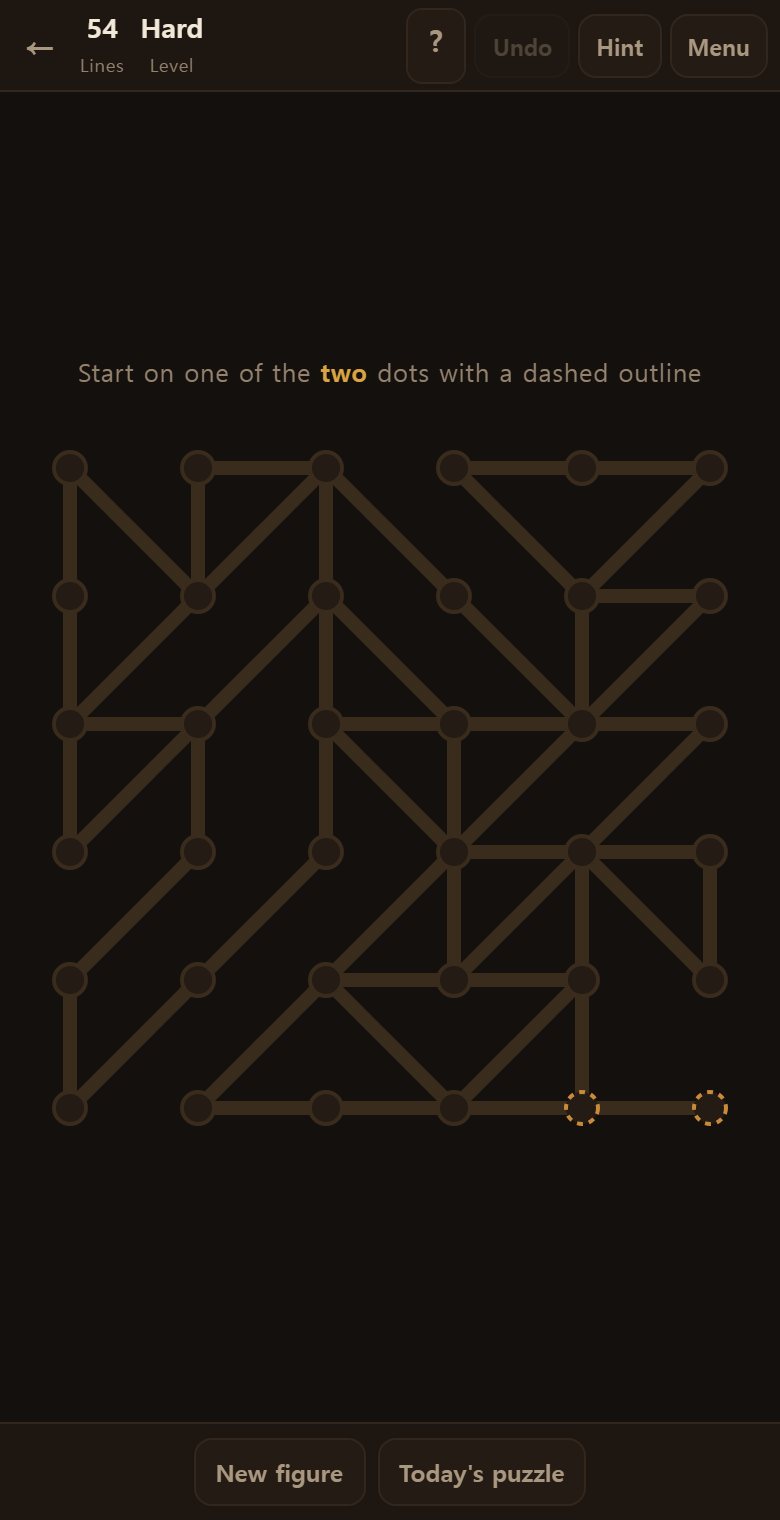
- Dots with a dashed outline — dots where an odd number of lines meet. These matter a great deal.
- The top — lines left, time and difficulty.
When lines left reaches 0, it ends there.
Tapping dots to trace
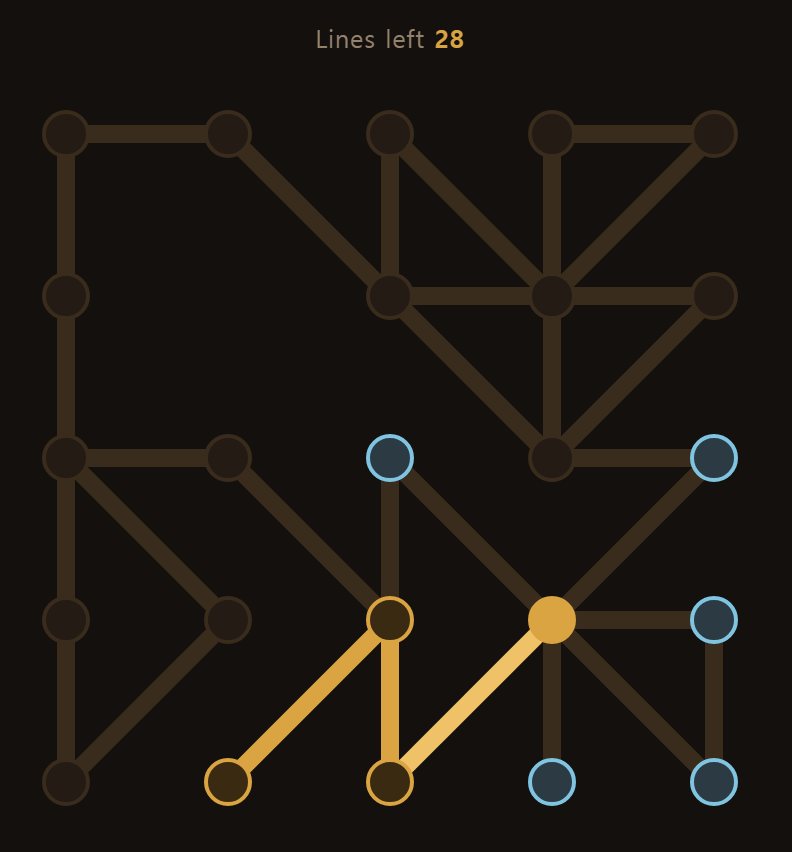
First tap a dot to start from. After that you tap connected dots to move on.
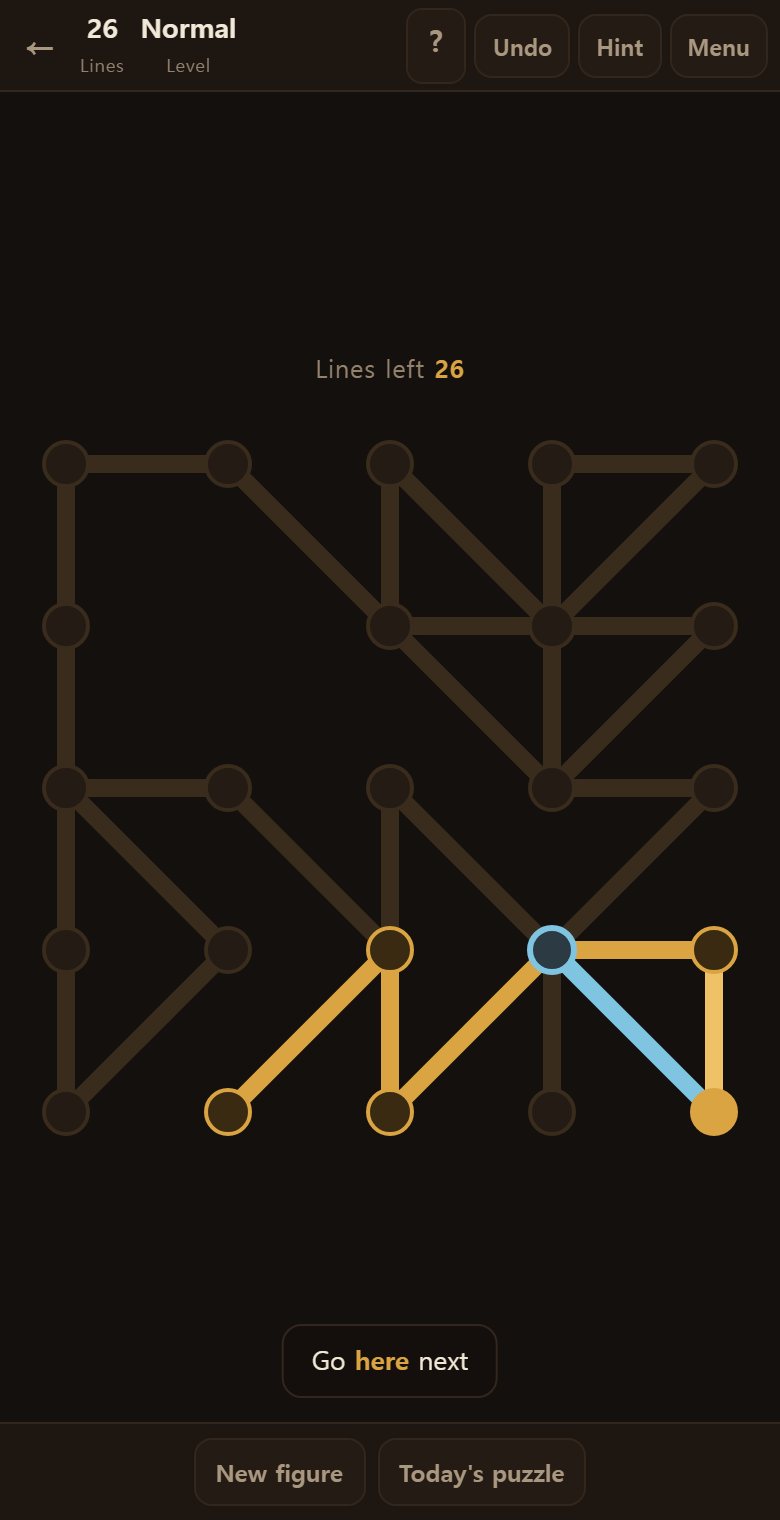
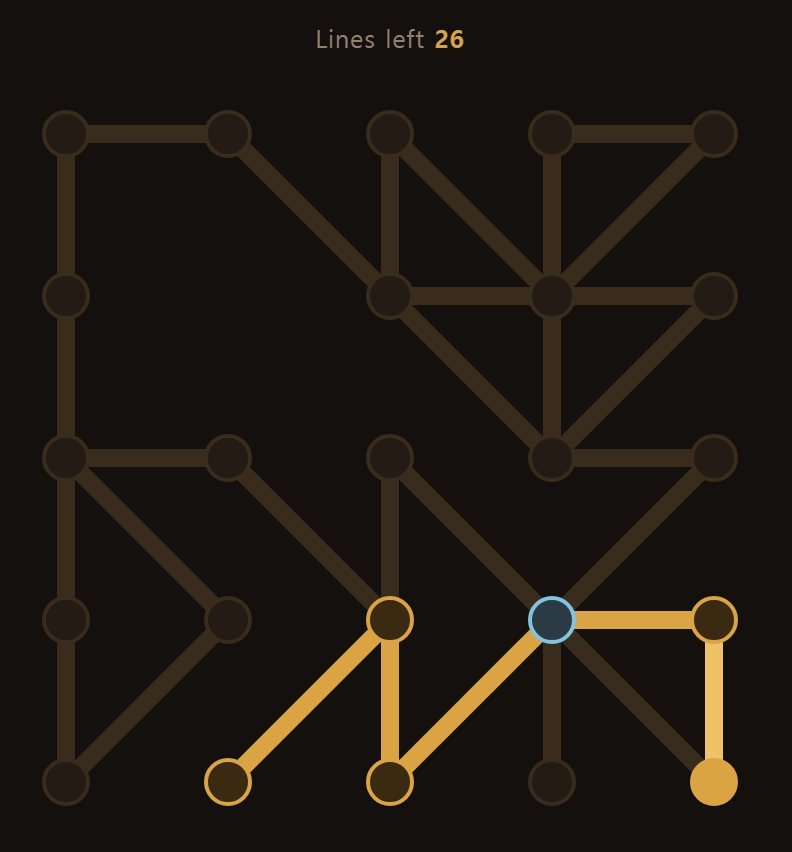
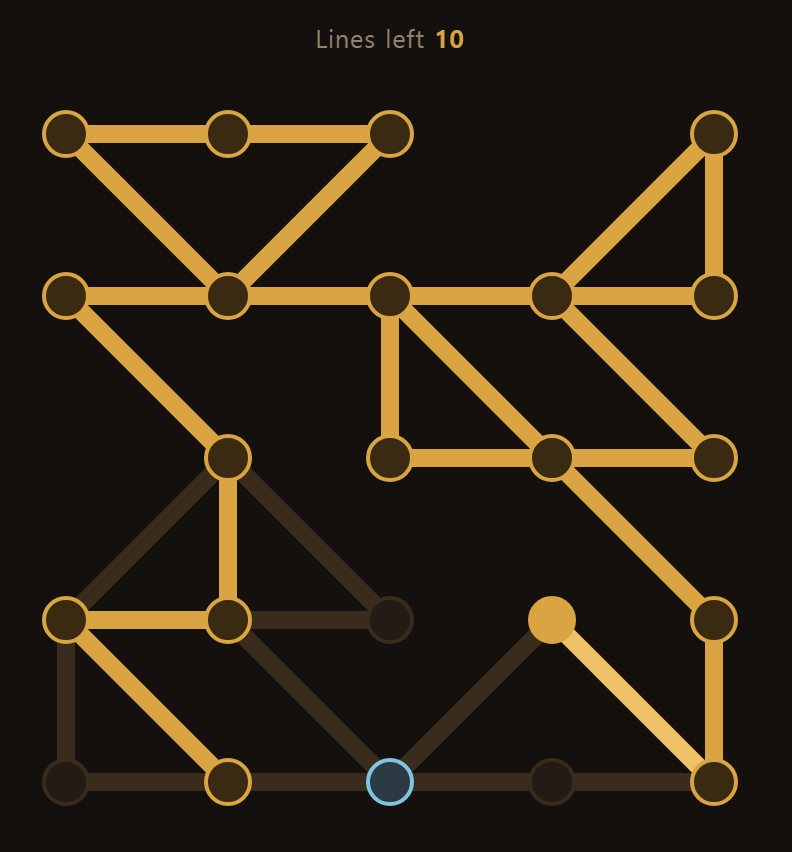
The dots you can reach from where you stand light up blue. Choose among those.
- The dot you stand on fills solid gold.
- The line you just traced is a slightly brighter gold, showing where you came from.
- Lines traced earlier stay in deeper gold.
Tap a dot with no line to it and it says there is no connection.
Lines once, dots as often as you like
This is where people get most muddled.
A line is traced once only. You cannot come back along one you have used.
But a dot may be passed through any number of times. Coming back through the same dot and leaving by a different line is quite normal.
- A traced line changes colour and stands out. Treat it as no longer there.
- A visited dot is unchanged. You can tap it and pass through again.
- A dot with four lines is passed through twice — in and out, twice over.
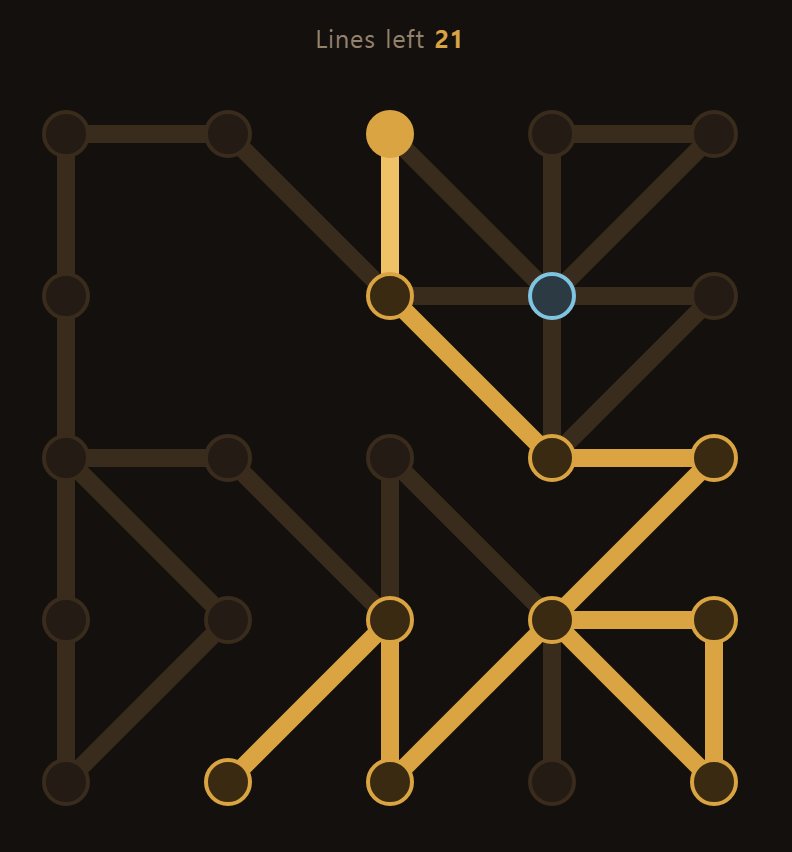
So a dot with many lines will be visited several times. Do not avoid one because you have been there. The counting is simple: six lines means three visits, eight means four — half the number of lines meeting there.
Passing through a dot again
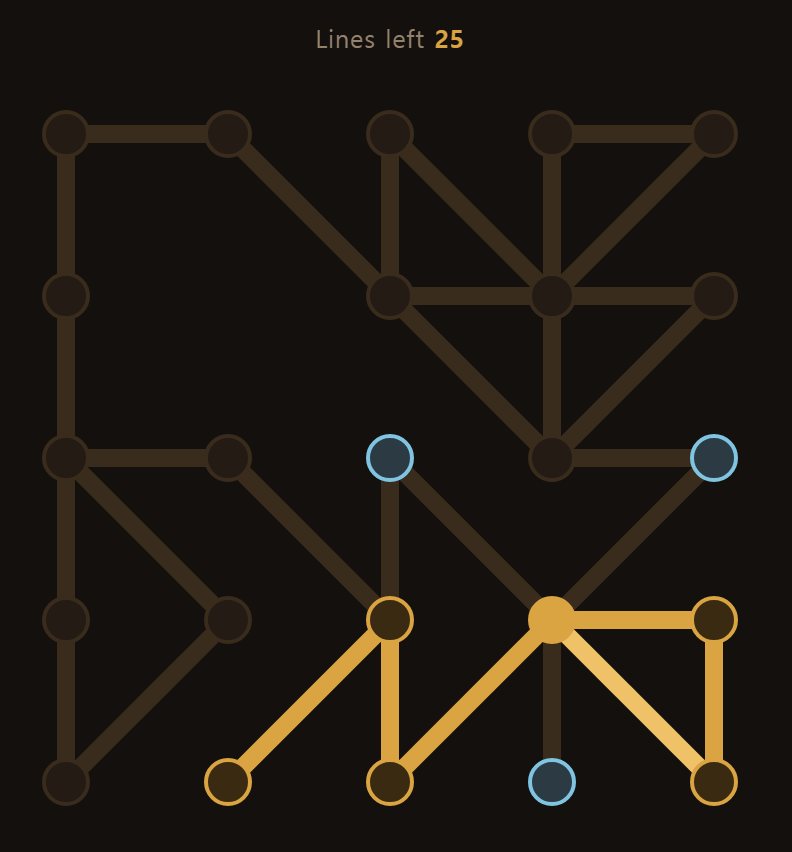
Take a dot with four lines. Going in and out again uses two of them. To use the other two you have to come back to that dot.
So a dot with four lines is passed twice, one with six three times.
That is the thread leading into the odd dots that follow.
Odd dots — the secret of this game
Count the lines meeting at a dot. Where that count is odd, we shall call it an odd dot. On screen it has a dashed outline.
Why does it matter? Because passing through a dot uses lines in pairs — one in, one out. So a dot you only pass through must have an even number of lines.
- A dot with an even count — in and out, repeated, and it works out.
- A dot with an odd count — one line is left without a partner. You must start or finish there.
- There is only one start and one finish, so there can be at most two odd dots.
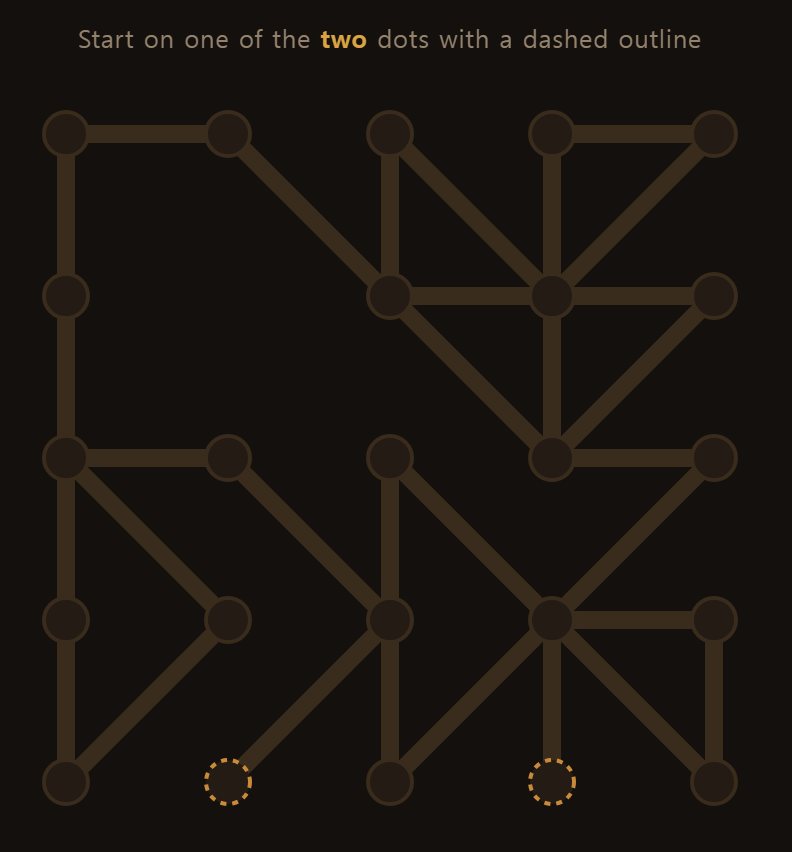
This was worked out three hundred years ago, from the question of whether seven bridges could each be crossed once.
There must be either 0 or 2 odd dots
Putting the above together:
- No odd dots — start anywhere and you return to where you began.
- Two odd dots — you must start at one of them and finish at the other.
- Four or more odd dots — it cannot be done at all. There are not enough starts and finishes.
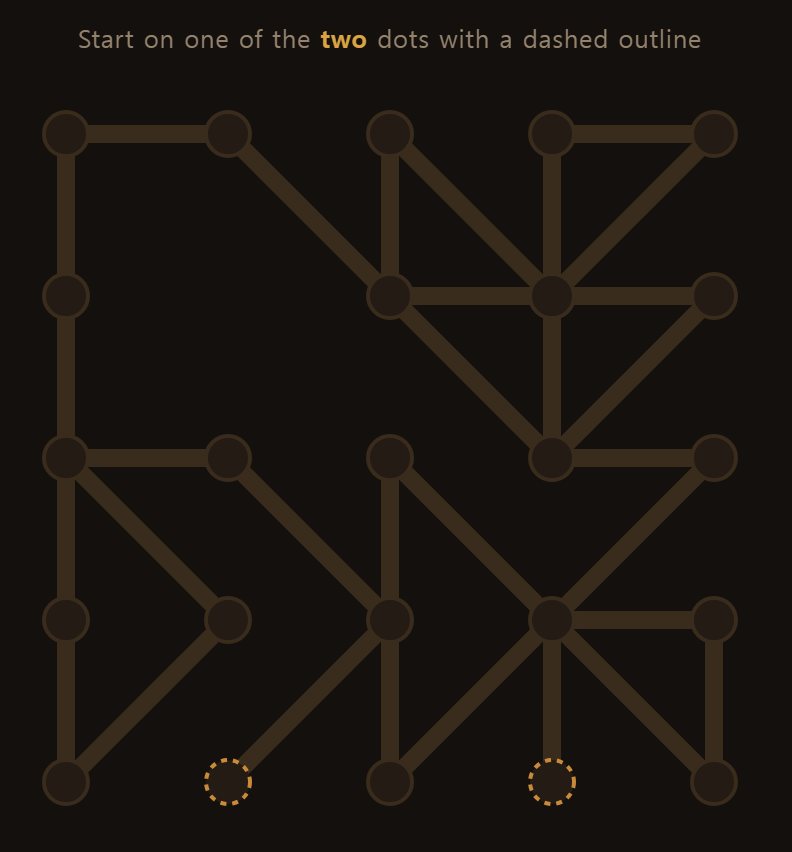
And one more: every dot with a line has to hang together as one figure. A separated cluster cannot be reached without lifting the pen.
Why four odd dots cannot work
Think of a cross: one line running from the centre dot up, down, left and right.
Each of the four tips has exactly one line, so all four are odd dots. All four would have to be a start or a finish, and there is only one of each. So it can never be done.
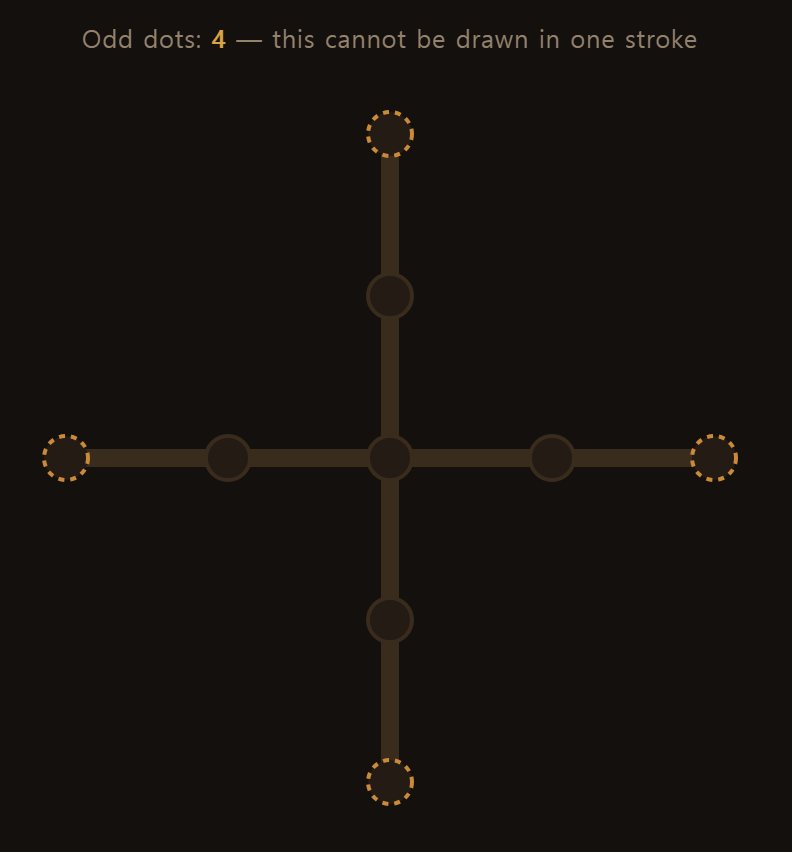
Try it. Wherever you start, one line is always left over.
Where to start
This is where people go wrong most often.
With two odd dots, you must start at one of them. Start anywhere else and the figure can never be completed, however easy it looks.
- Look for the dots with a dashed outline. Those are the odd dots.
- Tap one of them to begin.
- Tap anywhere else and it refuses, saying you cannot start there.
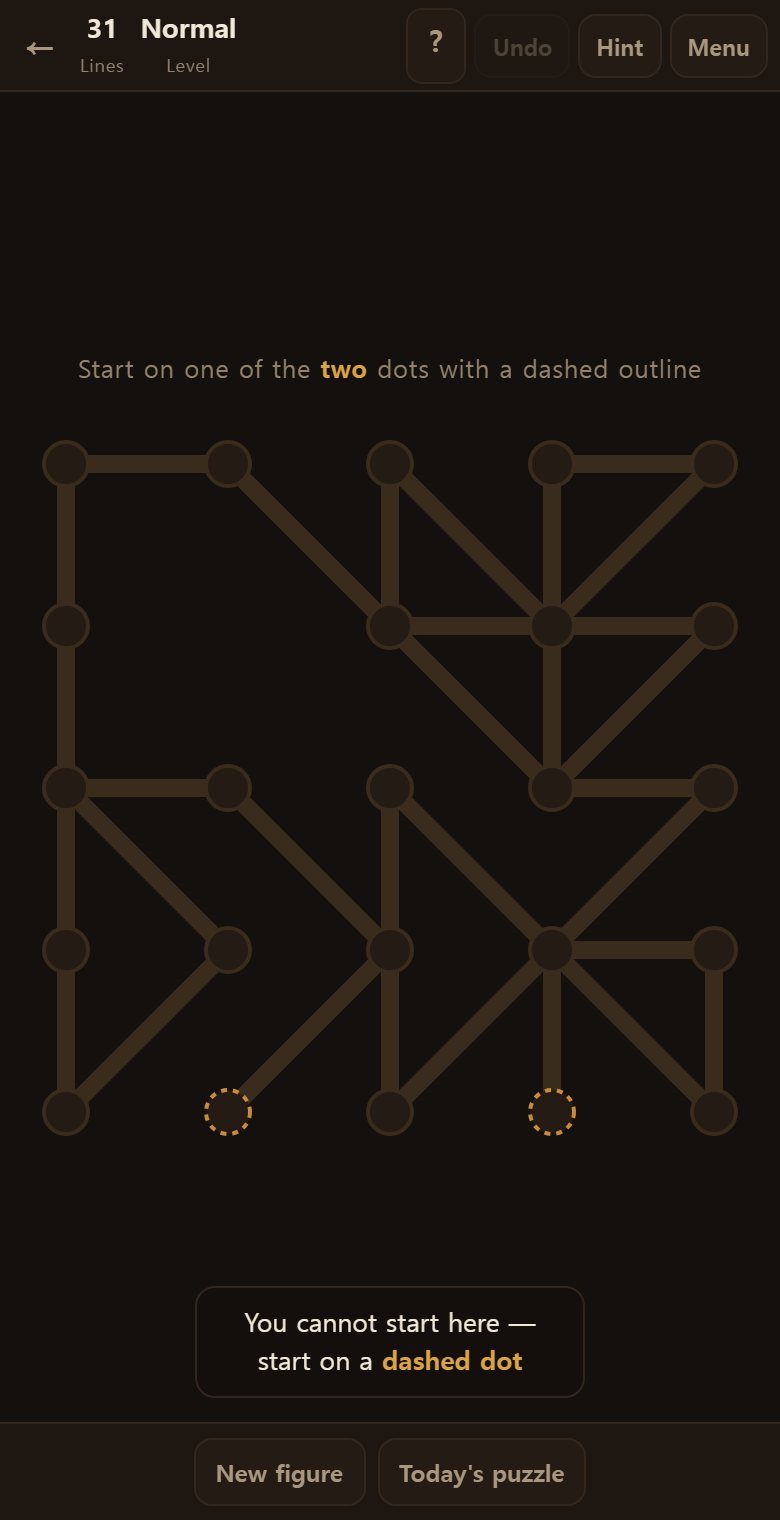
With no odd dots there are no dashed outlines either. Then you may start anywhere, and you come back to where you began. It is worth thinking through why. A dot you merely pass through needs one line in for every line out, so its count must be even. A dot whose count does not pair off can only be a start or a finish.
Only drawable figures are handed out
Every figure has its odd dots counted as it is built. If the count is not 0 or 2, lines are added or removed until it is.
Then it is actually drawn through once. If the arithmetic says yes but the drawing fails, the figure is thrown away and rebuilt.
A figure someone sends you is drawn through again at your end. Hand-editing the link to send an impossible one will not open.
Watch out for dead ends
Even a drawable figure will jam if you take the lines in the wrong order.
When there is nowhere to go, the screen says so. Undo a few steps and take another route.

A jam is the order's fault, not the figure's. Every figure here can be drawn. When you jam, look at where the untraced lines are. Usually they sit off in a corner. You spent the line that crossed to them some steps ago — next time, save it.
Leave the bridges for later
There is one very old trick for not jamming.
Some lines, if removed, would split the figure in two. Call such a line a bridge.
At a fork, take a line that is not a bridge first. Cross a bridge too early and you are on the far side, unable to return to the lines left behind.
- With several lines available, take the one that is not a bridge first.
- When only a bridge remains, cross it then.
- Dealing with corners and dead ends first tends to leave the bridges until late.
- You judge a bridge by eye — cover the line with a finger, and if the figure falls into two pieces, it is one.

The hint on screen uses this trick. Watch it a few times and your eye picks it up.
Hint
Press Hint at the top and it answers to the position you are in.
- Before you start — it tells you to begin at an odd dot, and marks one.
- Part way — it marks the next dot in blue.
- Already lost — it tells you this route cannot complete the figure.
The third is particularly useful, warning you before you jam that this route will end in one.
Undo
Press Undo at the top and the line you just traced never happened. Any number of steps.
Undo earns its keep here. The moment you suspect a jam, go back a few steps and take another route.
Start over in the menu returns the same figure to its untouched state. On a keyboard, undo is Ctrl+Z.
Grid size and difficulty
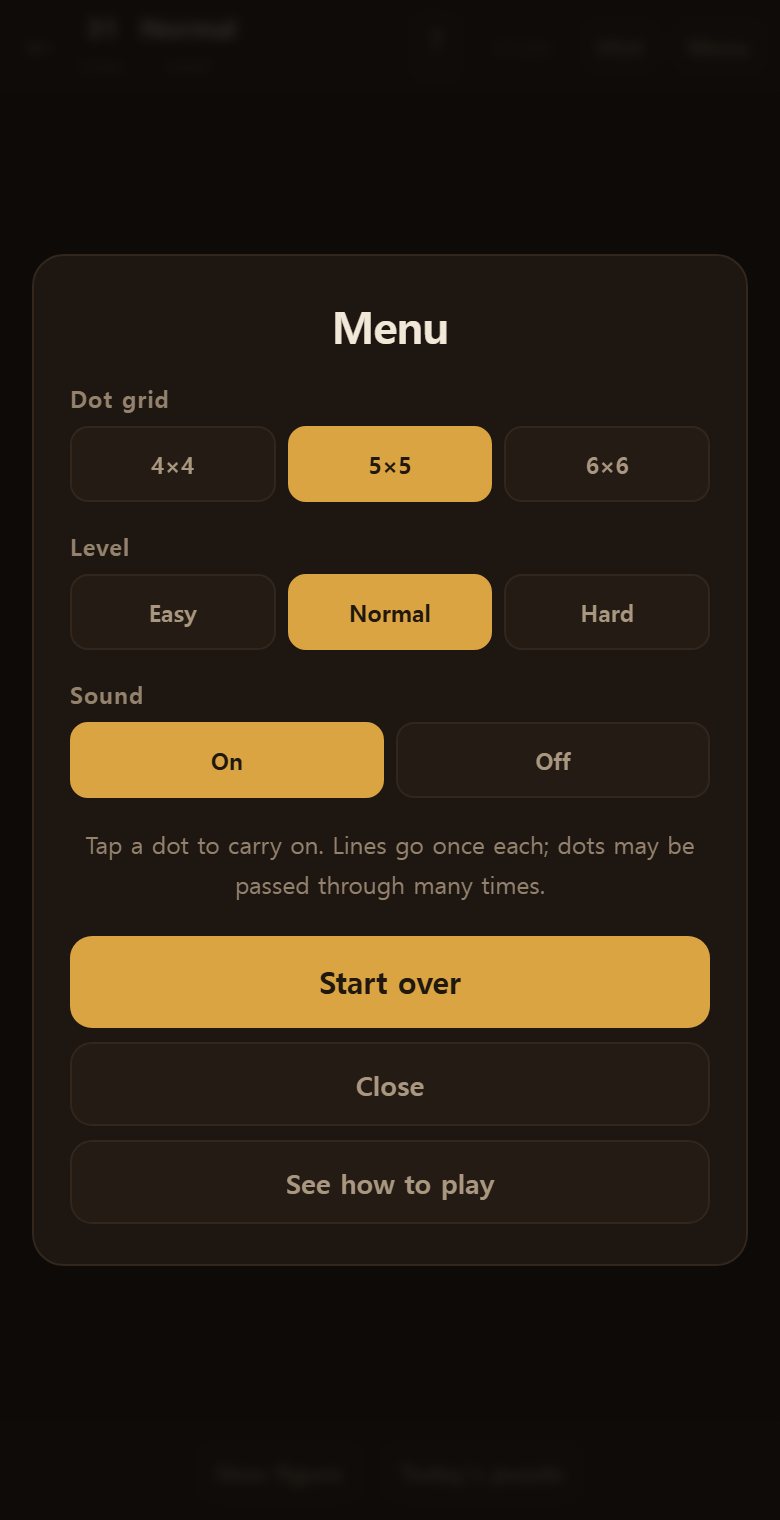
The menu sets grid size and difficulty.
- 4x4 — sixteen dots, about twenty lines. Good for learning the rules.
- 5x5 — twenty-five dots, about thirty lines. The best size for most purposes.
- 6x6 — thirty-six dots, about fifty lines. A figure takes a while.
- Easy, Normal, Hard — the more lines, the harder.
There are diagonals too, which makes the figures far more interesting. But two diagonals never cross as an X within one cell — there would be no telling which line you tapped.
Sharing, and today's puzzle
Once drawn, Copy link sends this figure to someone else. Opening it gives them exactly the same figure.
Today's puzzle below is set for the day. Everyone gets the same figure, so times can be compared.
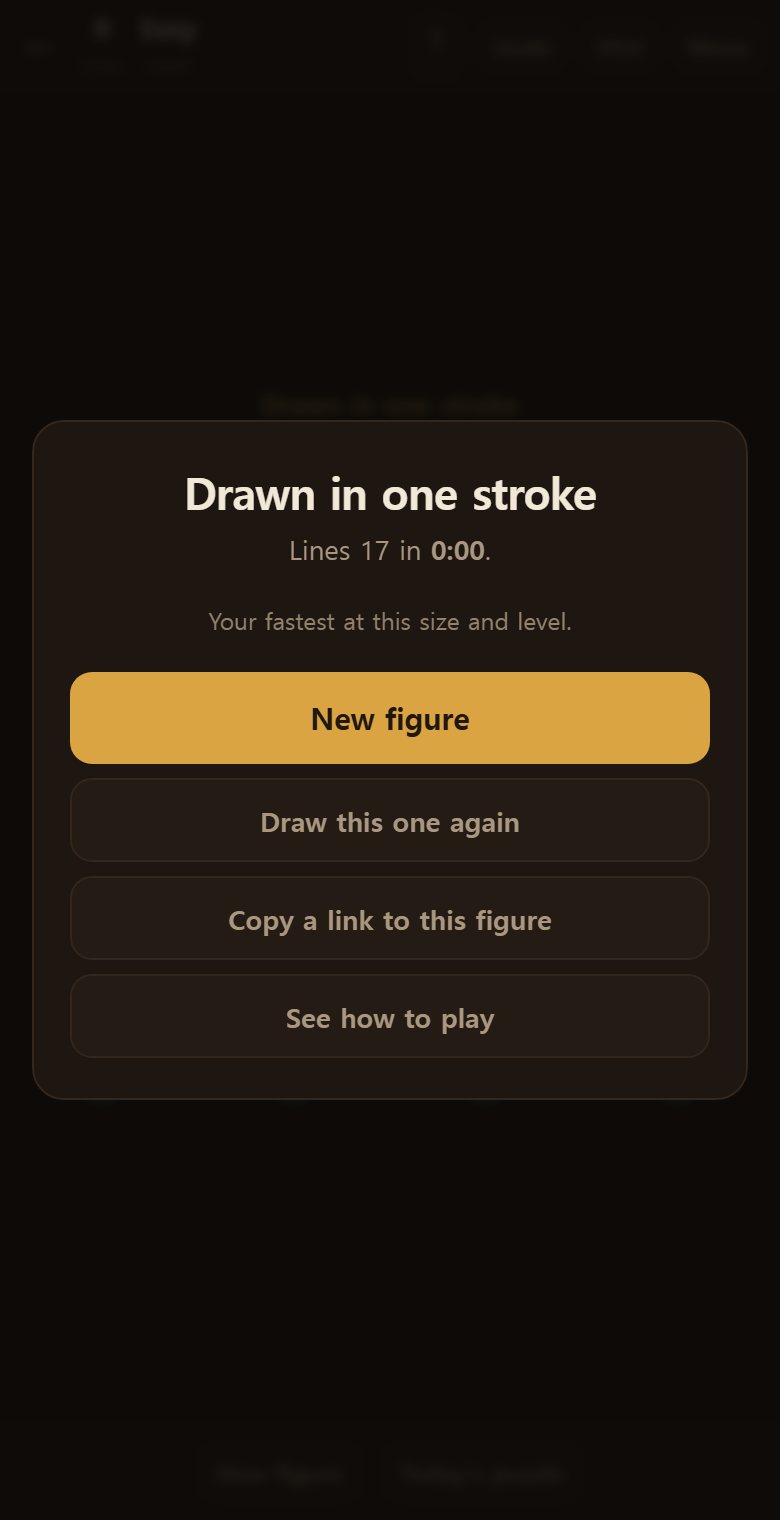
Their end draws it through again to confirm it can be done.
How to solve it
In this order, it usually comes out.
- Find the dashed dots first. If there are two, you must start at one of them.
- With no dashed dots, start anywhere and you return to where you began.
- Deal with corners and dead-end lines first. Left late, they trap you.
- Leave the bridges until later. Cross one early and you cannot come back.
- Reachable dots light up blue. Choose among those.
- Suspect a jam? Undo at once — any number of steps.
- The hint will even tell you this route will end in a jam.
Common mistakes
Figures jam here in one of four ways, nearly always.
- Starting anywhere — the commonest of all. With two odd dots, you must begin at one of them.
- Trying to visit each dot once — dots may be visited freely. It is the lines that go once each.
- Crossing a bridge early — once on the far side, the lines left behind are out of reach.
- Leaving the corners for last — a dead-end line has no way back, and traps you at the finish.
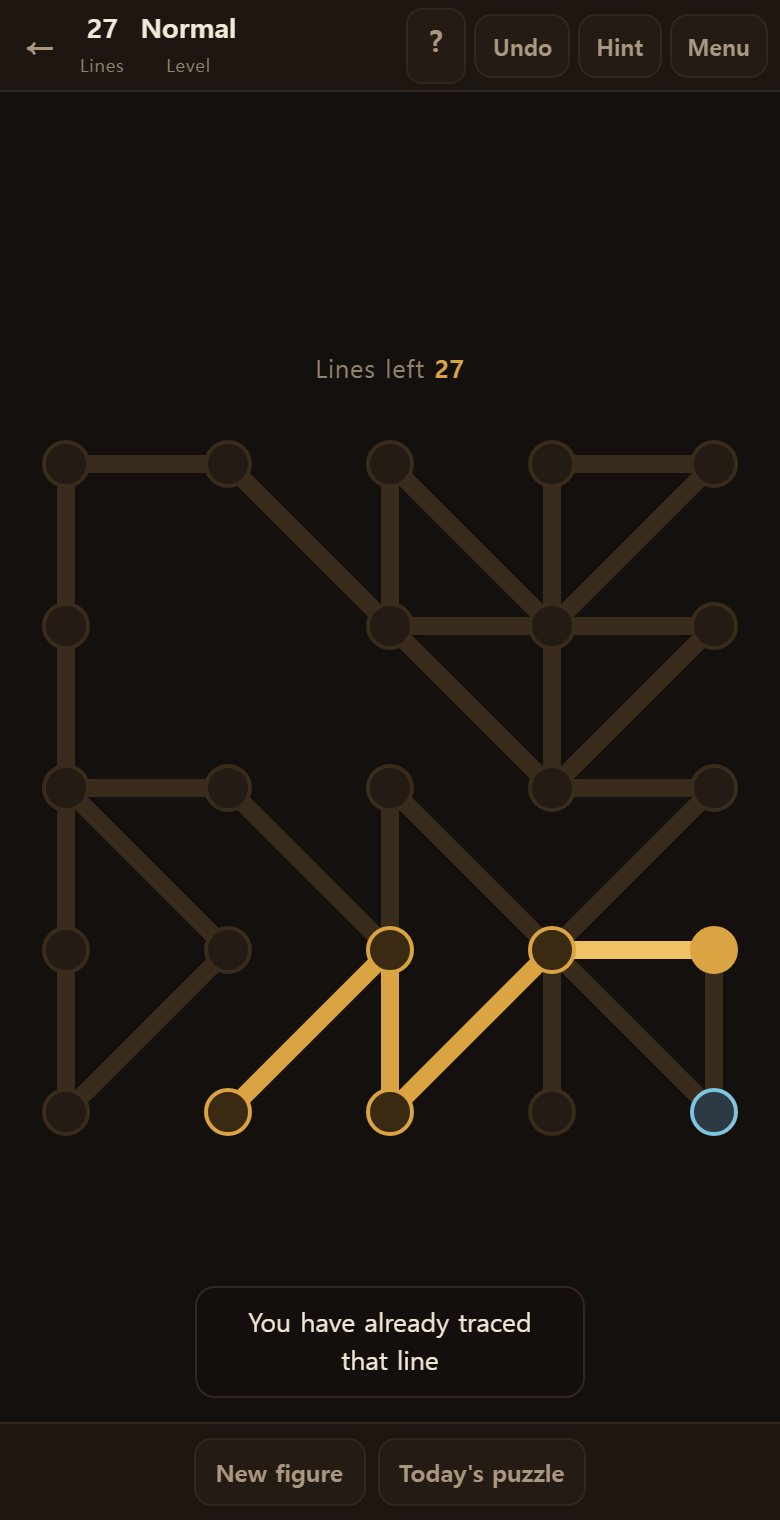
A jam is the order's fault, not the figure's. Undo back to the fork and take the other way.
When it is fully traced
Trace every line once and it ends there. The lines turn green and your time is shown.
Replay starts the same figure again from the beginning.
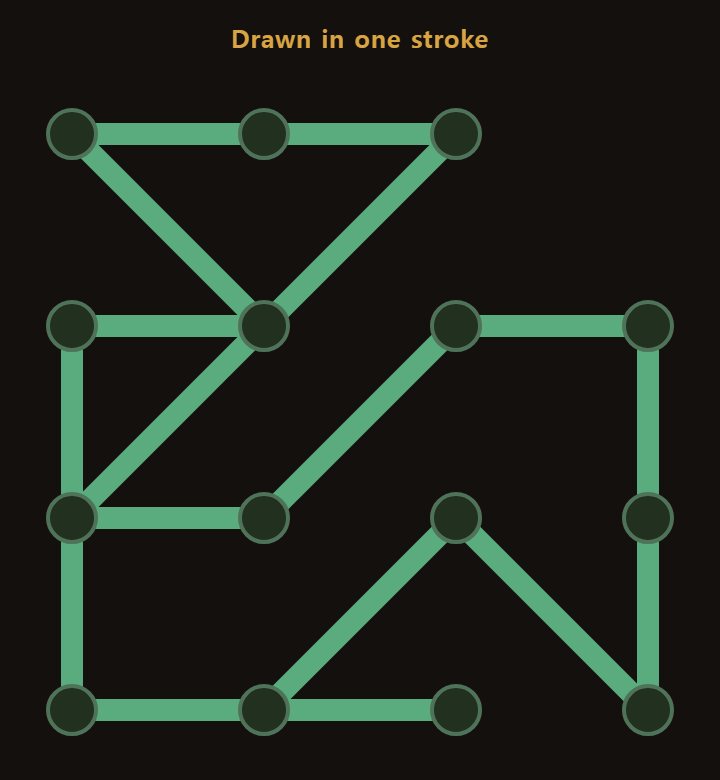
A best time is kept separately for each size and difficulty.
Common questions
With two odd dots you must start at one of them — the dots with a dashed outline. With no odd dots at all, anywhere will do.
A dot where an odd number of lines meet. Passing through pairs a line in with a line out, and an odd count leaves one unpaired — so you have to start or finish there.
You may. It is the lines that go once each. Dots may be passed through freely, and usually are.
The order went wrong, not the figure. Undo back to the fork and take the other way.
Leave the lines that would split the figure until later. Cross one early and the lines behind you are unreachable. Dealing with corners and dead ends first is the same idea.
No. Every figure has its odd dots counted and is actually drawn through once before it is handed out.
An odd dot must be a start or a finish, and there is one of each. With four, two are left over and it can never be drawn.
Yes, and they make the figures far more interesting. But two diagonals never cross as an X within one cell — there would be no telling which line you tapped.
Yes — press Replay once it is drawn, or Start over in the menu.
- Find the odd dots first. If there are two, you have to start on one of them.
- With no odd dots at all you may start anywhere and you come back to where you began.
- At a fork, leave the line that would split the figure until later. Cross it early and you cannot get back to what is left.
- Deal with corners and dead ends early and you will not get trapped later.
- Press Undo when you are stuck. You can take back as many steps as you like.