 MindHub
How to play Gomoku
Take turns placing stones; whoever lines up five in a row first wins. Across, down or diagonally — any of them counts.
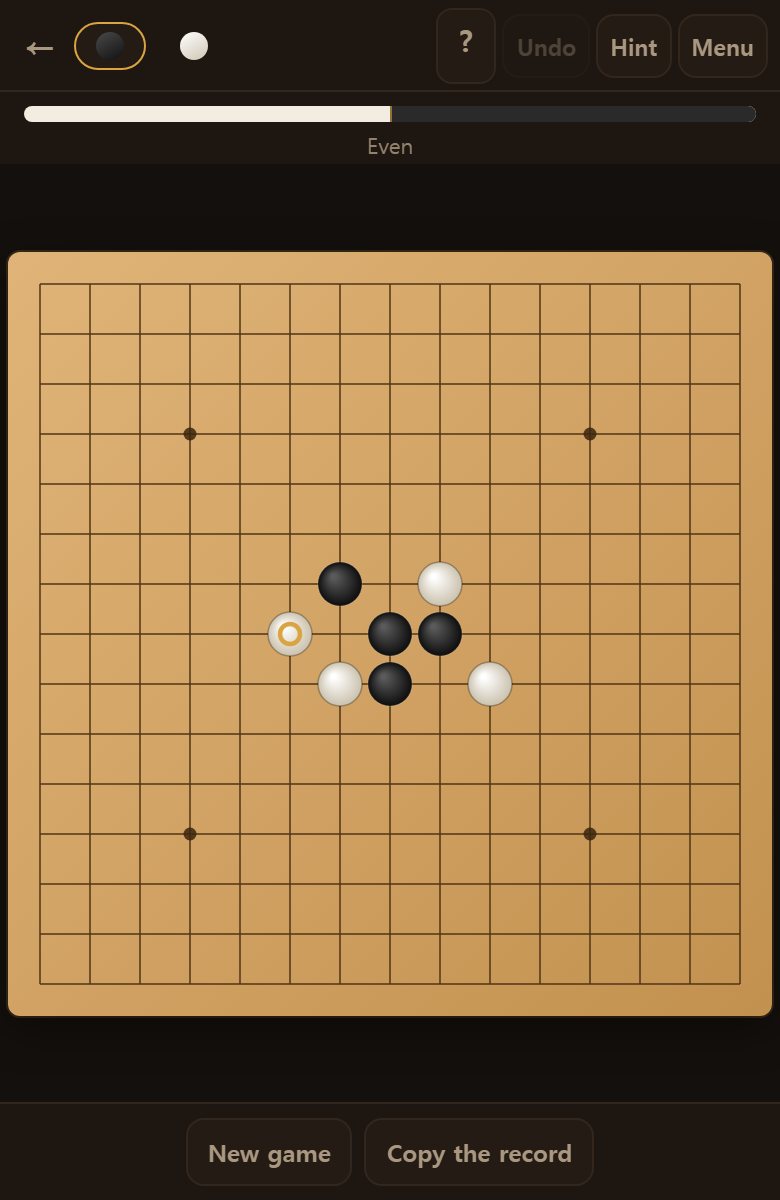
First, look at the screen
Fifteen lines across and fifteen down. Stones go not inside the squares but on the points where lines cross.
- Black plays first, then white, then black again.
- The gold circle — the stone just played, marked so you do not lose track of where it went.
- The bar at the top — who stands better right now. Filling to the left means black is doing well.
- An ✕ mark — a point where black may not play. Explained in full below.
Forbidden points are marked with a ✕ before you play. So there is no need to learn the forbidden-move rules first — anywhere without a ✕ is fair game. If you want to know why a point is forbidden, tap it. It tells you whether it is a double-three or an overline.
You start with an empty board
Open a new board and there are no stones at all. Black simply plays anywhere.
Most people start at the centre, because the centre has the most directions to grow in. Play at the edge and one side is walled off, which costs you.
- The board is fifteen by fifteen — 225 points to play on.
- The five small dots on the board are there to help you count positions. They have nothing to do with the rules.
- From the centre point you can grow in eight directions. From a corner, only three.
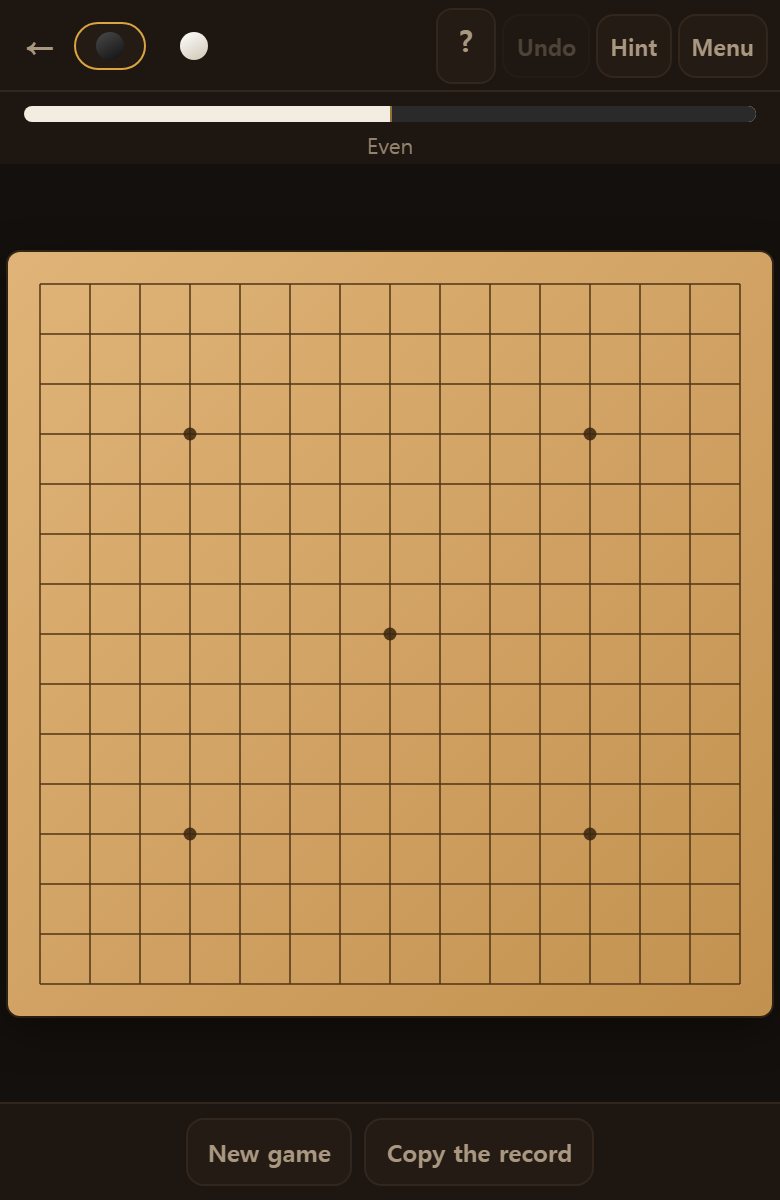
The first move does not decide much. This game starts to turn after three or four moves have piled up.
How to place a stone
With a finger it takes two taps. Tap once to pick the point, tap again to commit.
The points are small and easy to miss. Picked the wrong one? Just tap somewhere else.
- A faint stone previews on the point you picked. If it looks right, tap again.
- You cannot play on a point that already holds a stone.
- You can take it back with Undo at the top.
- With a mouse a single click plays it. Two taps is only for fingers.

It is because a fingertip is far wider than a point. Play on one tap and you keep landing on the neighbouring point and having to undo. Splitting it into pick, then confirm puts an end to that.
Line up five and you win
Get five of your stones side by side with no gaps and it ends there.
Across, down or diagonally, all count. A line is drawn through the winning five.
- An enemy stone in the middle does not count.
- Nor does a gap in the middle. They must be touching.
- Both diagonals count — ↘ as well as ↗.
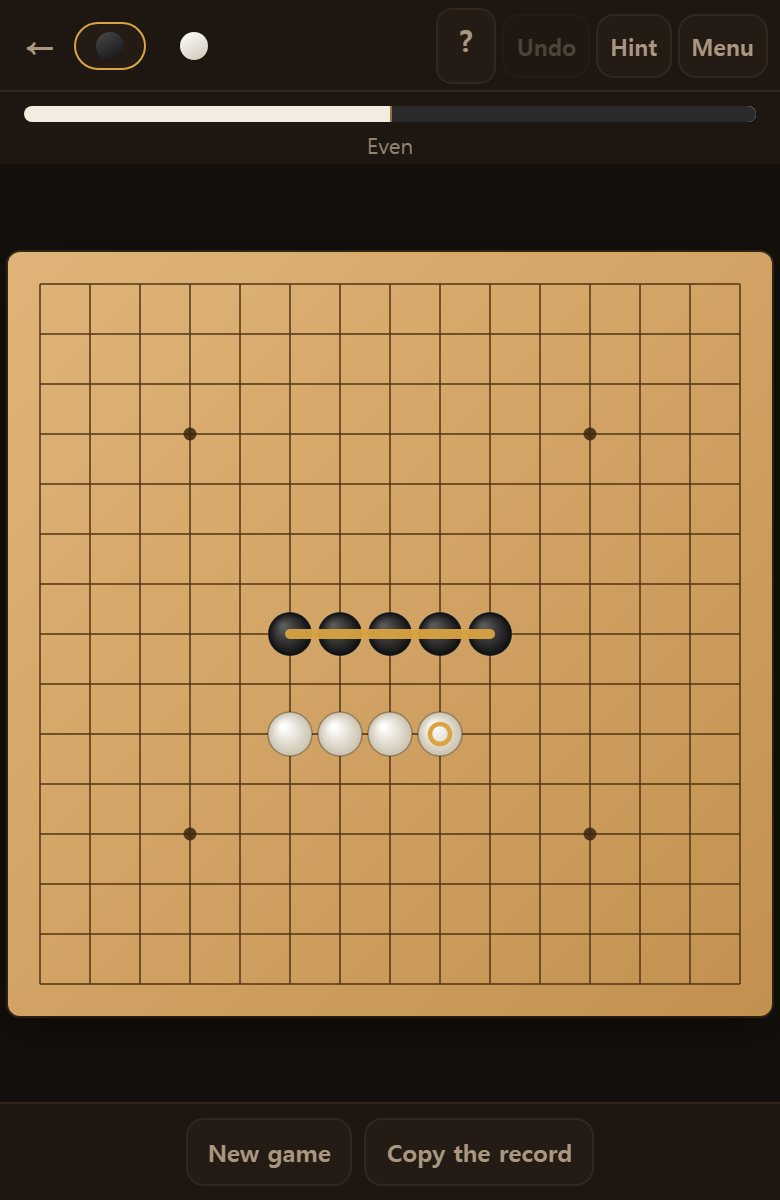
There are four lines to build along — one across, one down, and two diagonals. It looks like eight directions, but opposite pairs are the same line, so we count four. So every time you place a stone, read all four lines. Watching one line and being caught on another is the most common way to lose.
What is an open three?
Three of your stones in a row with both ends empty is an open three.
Why does it matter? Leave an open three alone and next move it becomes an open four. An open four makes five at either end, so it cannot be blocked — block one end and the other end wins.
So when an open three appears, your opponent has to block it.
- A three blocked at one end is far weaker. Even at four it only grows one way.
- So when you build a three, always check both ends are empty.
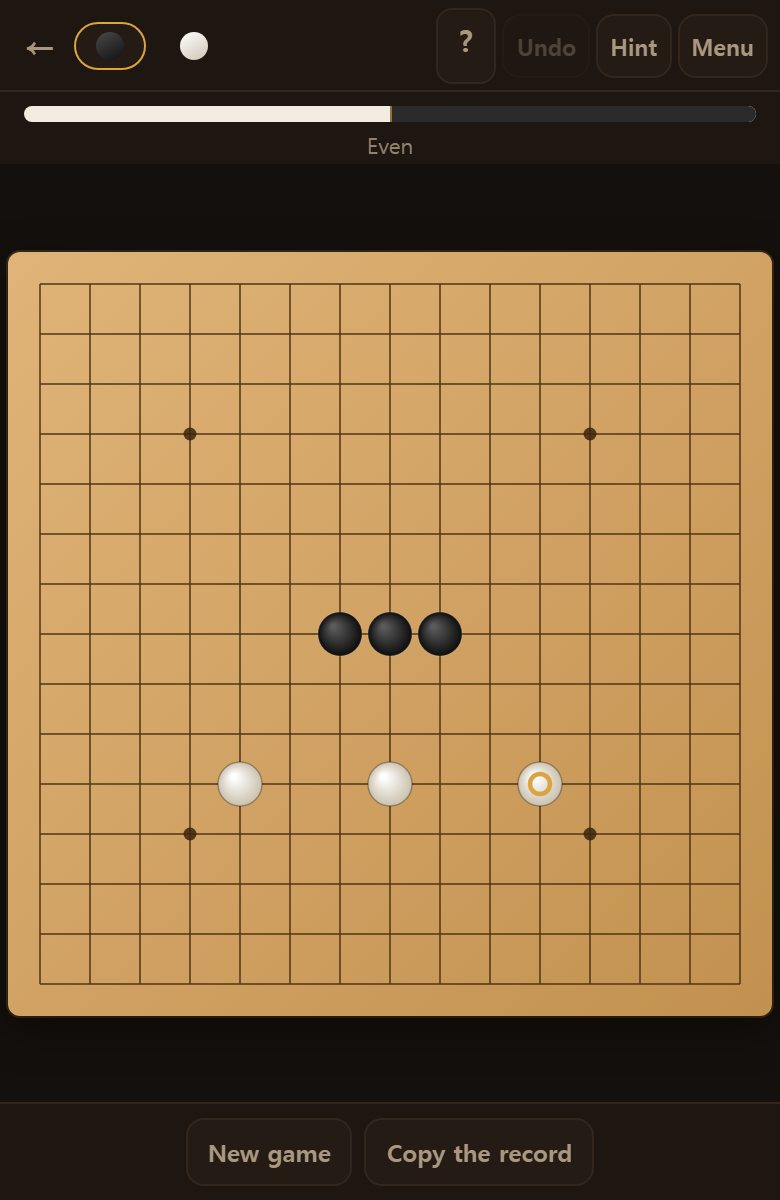
Playing moves your opponent must answer, one after another, is the basis of this game. While they block, you grow the other side. That one line is very nearly the whole game. Keep making open threes and your opponent never gets a turn to build anything of their own.
How to open
In gomoku the centre is everything. Play in a corner and there are barely any directions left to build five in. Play in the centre and all eight directions are open.
- Play your first stone dead centre. Black moves first, so this is the best point on the board.
- Keep your stones together. Scattered stones never connect into anything.
- Do not dig in only one direction. One block and it is over. Look for points where two directions cross.
- If your opponent has three in a row it is already late — watch them when they have two. Once it is an open three you have lost the chance.
- When the point you want to attack on and the point you need to block are the same square, that is the best move on the board.
Between beginners, the game is usually won by whoever makes an open three first. So once you know the rules, watch only this — can I make an open three, and is my opponent about to? Playing Black adds one more thing. Making two open threes at once is a forbidden double-three, so you cannot play it at all. Black therefore aims to overlap one open three with a four instead.
Why only black has forbidden moves
Moving first is far too big an advantage here. With no rules at all, black played well wins nearly every time, and that is no fun.
So two things are forbidden to black only. White has no restrictions at all.
- Double three — you may not play a point that creates two open threes at once. Your opponent can only block one, which is too strong.
- Overline — six or more in a row does not win. Black must have exactly five.
- Because the player who moves first simply wins. With no restrictions at all, Black wins — that has been proved.
- So Black alone is barred from double-threes and overlines, to even things up.
- White has no restrictions whatsoever. White may play double-threes, double-fours, and wins with six in a row too.
- Black needs exactly five. Six in a row is not a win for Black — it is a forbidden move.

Forbidden points show an ✕. The ✕ in the middle of the picture is one — four black stones sit in a cross, so playing the centre would make two open threes. You can see it rather than memorise it.
How to win
The heart of it is to keep playing moves your opponent must answer, while your own shape grows.
- Make an open three first. While they block it, grow the other side.
- Finding a point that blocks and builds in a single move is excellent.
- When three enemy stones line up, block at once. Put it off and you are too late.
- When blocking, think about which end to block. The end that also grows your own shape is better.
- The centre beats the edge. More directions to grow in.
- Learn the shape where stones are placed with a gap between them. It is harder to block than a solid row.
- The point that joins two stones you already have is usually the best point.

In one line: give your opponent no choices. Keep playing moves with only one place to block and they spend the whole game blocking. Meanwhile you quietly grow a second line.
Stuck? Take a hint
Press Hint at the top and it points out a point worth playing.
If there is a winning point it shows that; if not, it shows where you must block. It does not hand you the game — only what the rules already give you.

Watch the bar too. It shows not the stone count but whose shape is better. With fewer stones but an open three, the bar still leans your way.
The open four — already unstoppable
Four of your stones in a row with both ends empty is an open four.
Get this far and you have already won. Block the left and five comes on the right; block the right and five comes on the left. One move cannot block two places.
- That is why your opponent must block while it is an open three. Once it is an open four it is too late.
- And the other way round: if you can make an open four, that game is over.
- When three enemy stones line up, block right then and there.
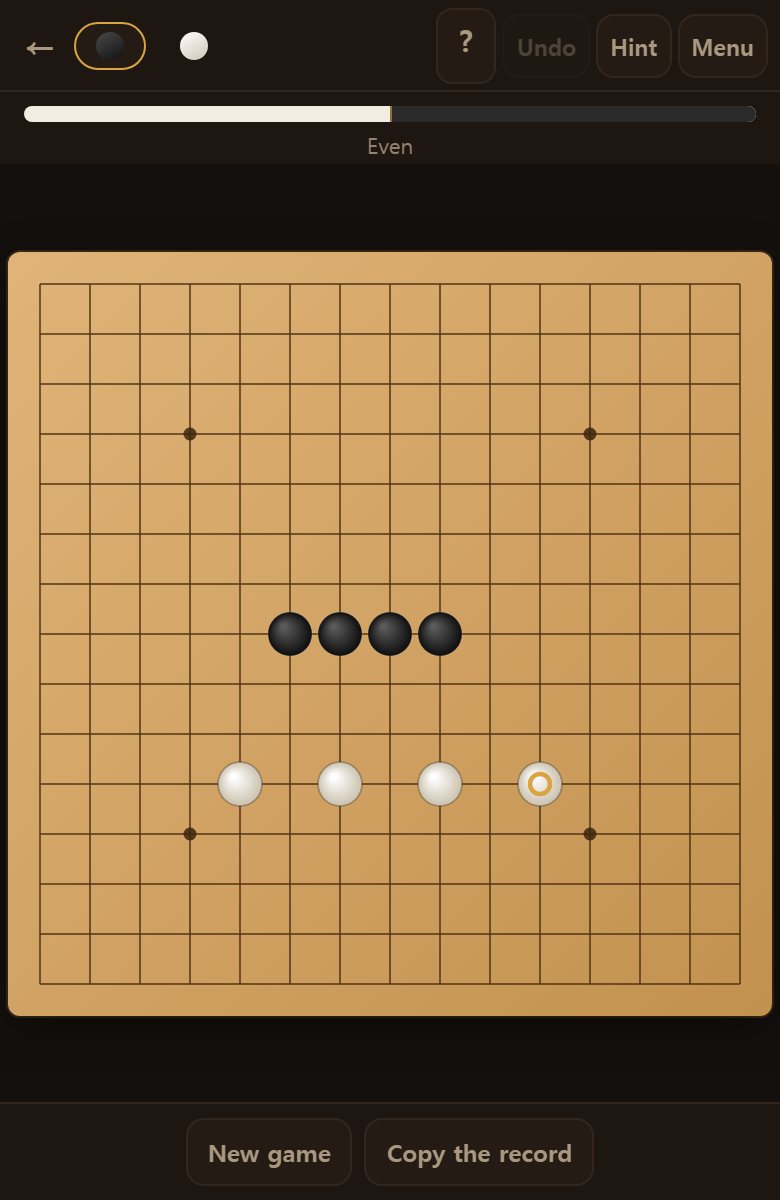
Learning this game is really about growing the eye that spots it before it becomes an open four.
A blocked four is far weaker
The same four is a different matter with one end blocked. There is only one point where five can form, so blocking it settles the matter.
- Open four — two points make five. Unstoppable.
- Blocked four — one point makes five. Block it and that is that.
- So whenever you build a shape, check that both ends are empty.
- Build against the edge and one side is off the board, so it is blocked from the start.
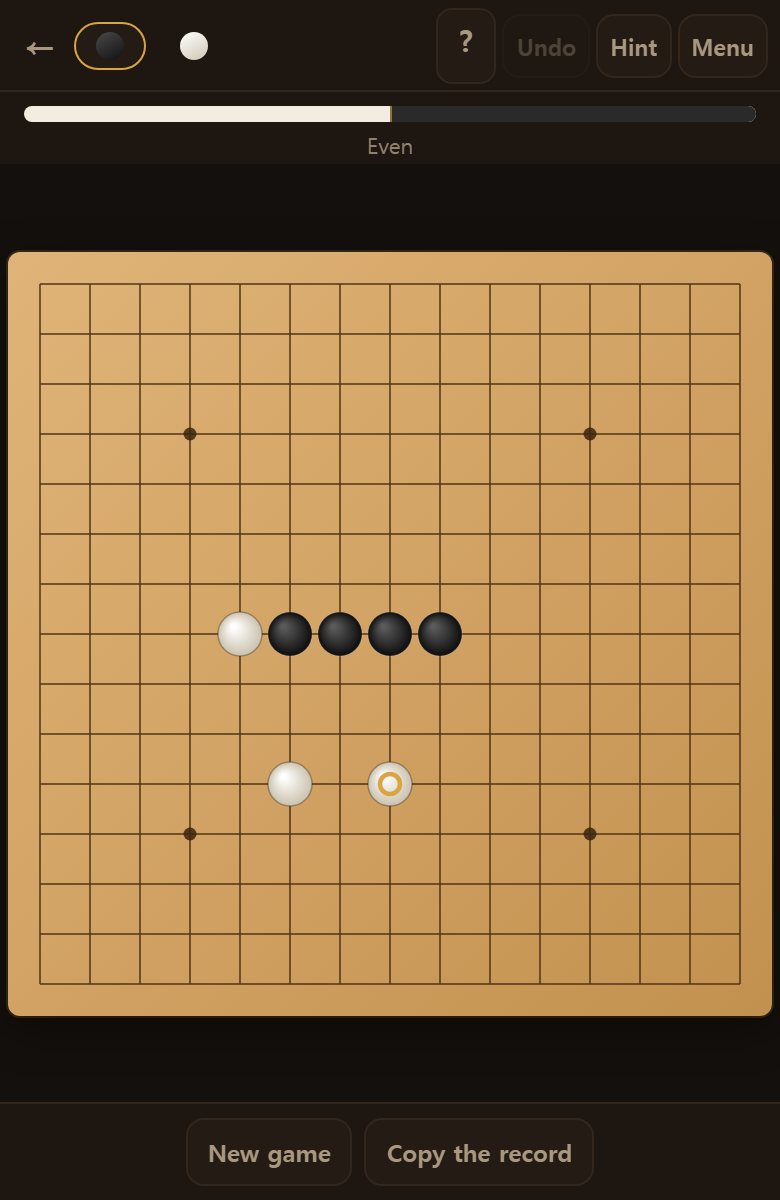
A blocked four is not useless. It costs your opponent a move to block, and you can spend that time growing elsewhere.
Double four — two places in one move
When a single move creates fours in two places, blocking one still leaves five at the other. Like the open four, it cannot be stopped.
- The empty point in the middle of the picture is that spot — four across and four down at once.
- Unlike the double three, the double four is forbidden to neither colour — here only the double three is barred, and only for black.
- Setting such a point up in advance is the pleasure of this game.
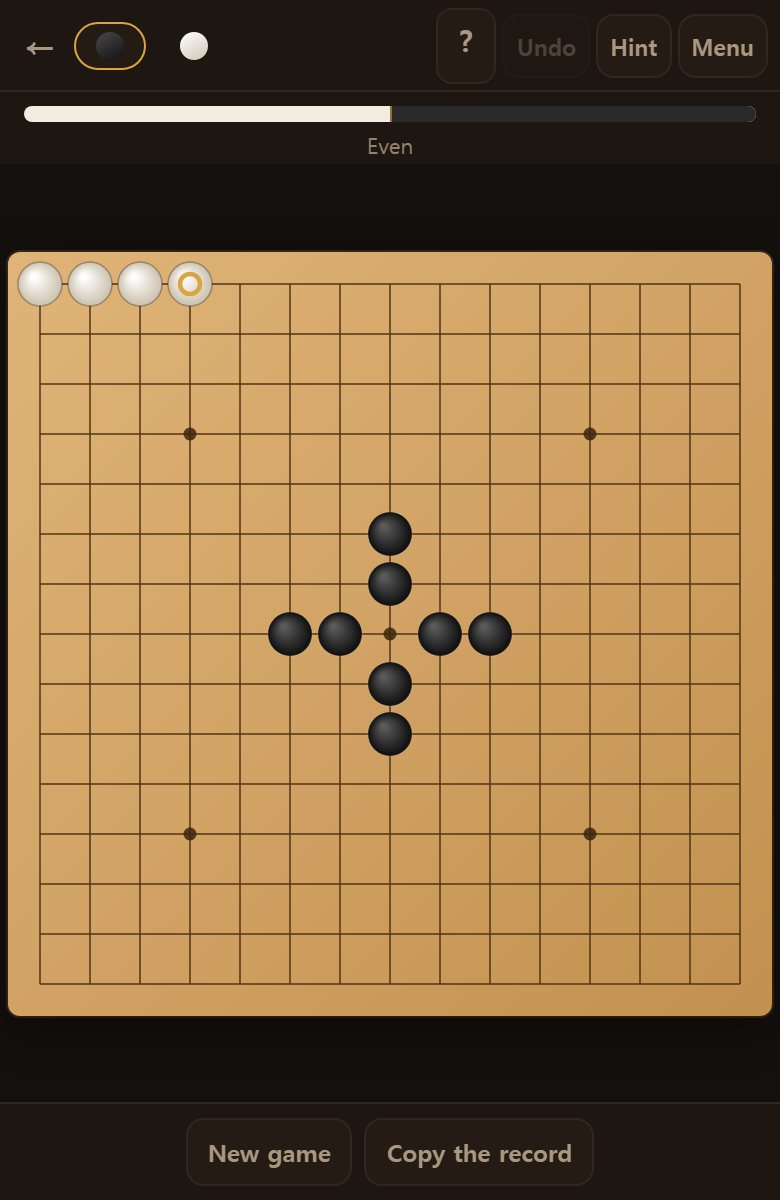
The road to winning nearly always runs through threatening two places at once. Threaten one and your opponent just keeps blocking.
Overline — black must have exactly five
If black lines up six or more, it is not a win. This is called an overline, and it is forbidden to black.
- Black wins only with exactly five.
- White wins with six or seven just the same. No restriction.
- Points that would make an overline also show an ✕, so nothing to memorise.
- Switch to the Free rules in settings and an overline counts as a win.
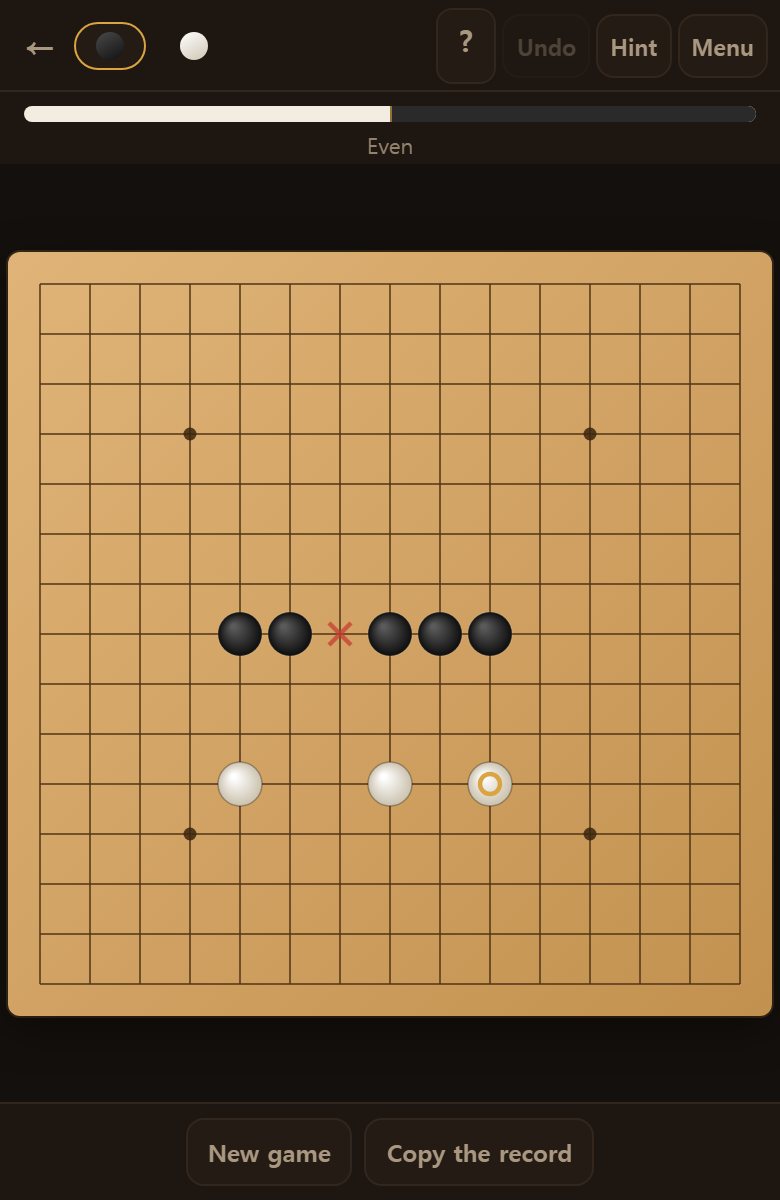
The reason for this rule: allowing overlines gives black a way around the double-three ban. The two rules come as a pair.
Undo
Press Undo at the top and your move and the computer’s step back together. On a keyboard it is Ctrl+Z.
You can go all the way back to the start, as often as you like. If you feel stuck, do not save it up — use it.
- Use it to take back a misplaced stone, and to try out a different line.
- Playing several branches from the same position teaches you why a move is bad.
- New board clears everything. That is not the same as Undo.
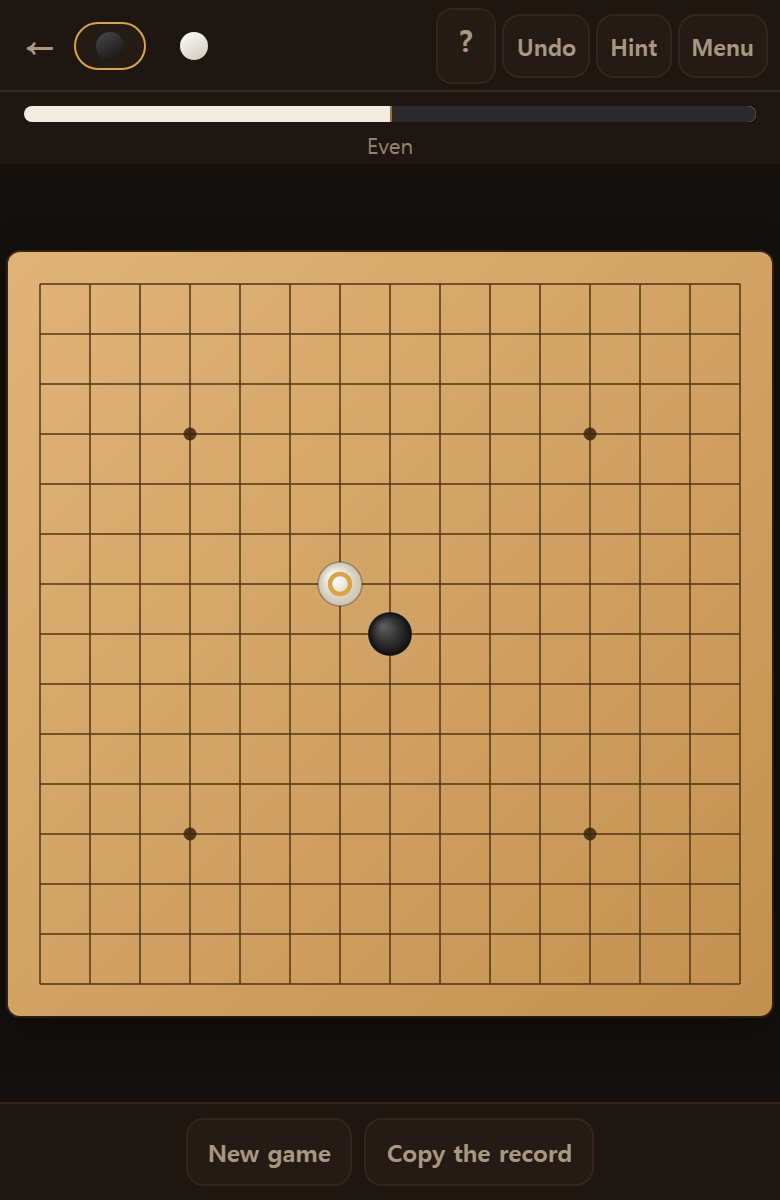
In gomoku a single move ends the game. Allow one open four and it is already over, so pressing undo is usually too late. Undo is better used to work out why you lost. Step a losing game back two or three moves and you will see the move where your opponent built the open three.
Sharing the record
Press Copy record below and you get a link holding the whole sequence of moves. Open that link and the same game unfolds again.
- Keep a game you played well and open it again later.
- Send it to someone and they see the same game.
- The worse the loss, the more a replay is worth — you can see where it turned.
Open a lost game and find when you missed the open three. That single move is usually where it turned.
Common mistakes
Lost games nearly always come down to one of these four.
- Building only your own shape — the most common. Make your three instead of blocking theirs and they are one move ahead, so you lose.
- Blocking an open three too late — once it is an open four you cannot. Block it while it is three.
- Blocking whichever end — the same block is worth double if the end you pick also grows your own shape.
- Starting at the edge — one side is off the board, so you have fewer directions. The centre is better.
All four come from not looking at your opponent. Before you play, get into the habit of counting how many of their stones are joined up.
When the game ends
When five join up, a gold line is drawn through them and the game ends. How many moves it took and which rules you played by are kept with it.
- If the board fills with neither side connecting, it is a draw. Very rare.
- If black is made to play a forbidden point, black loses there and then.
- Your record so far — wins and losses — is kept on this device too.
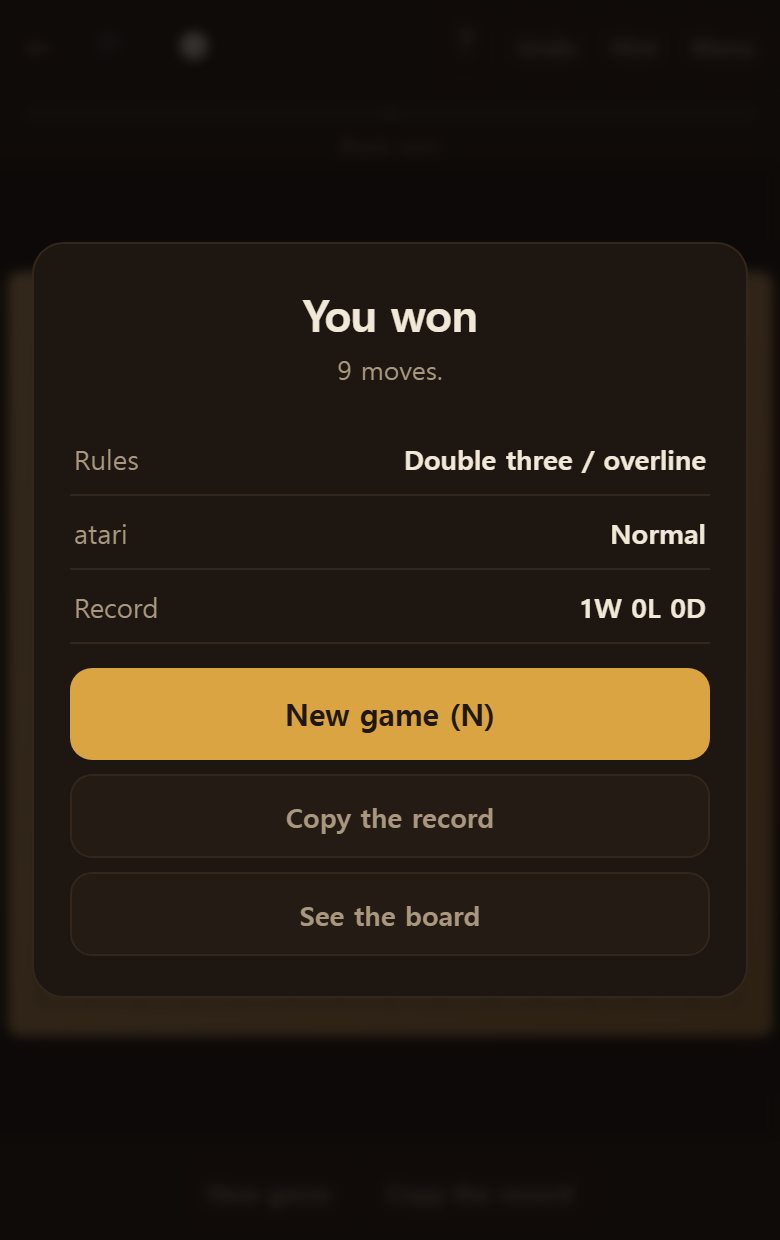
On a finished game, press View board to lift the overlay and look at the connected five as it stands.
Common questions
With a finger it takes two taps. Also, black cannot play on a point marked ✕.
It marks a point black may not play — one that would make two open threes, or six in a row.
Black wins with exactly five. Six or more does not count. White wins with six.
Switch to the Free rules in settings and they disappear. Bear in mind that moving first is then a big advantage.
Lower the difficulty in settings. On Easy it drops good moves on purpose — though never a winning move or a necessary block.
Press Copy record and the moves so far are copied as text. Paste it back to see that game again.
Both ends empty makes an open three; one end blocked makes a blocked three. Left alone, an open three becomes an unstoppable open four, while a blocked three at four is settled by blocking one point. So when you build a three, whether both ends are empty is everything.
Block without exception when your opponent makes an open three. Otherwise you are better off growing your own shape. Best of all is a point where blocking and building are the same move.
Only two things are barred to black here: the double three and the overline. Black may play a double four.
A move that creates two or more open threes at once. Two open threes mean two separate ways to make an open four next move, so there is no single point that stops both. Black alone is barred from it.
Because White moves second. With no restrictions the first player simply wins, so only Black is tied down to keep the game balanced. White may play double-threes, double-fours, and wins with six in a row.
Black needs exactly five. Six or more is an overline and is forbidden. Such points carry a ✕ beforehand, so you cannot actually play there. White does win with six.
No. Points you cannot play carry a ✕ before you play them. Anywhere without one is fine. Tap a marked point and it explains why it is blocked.
- An open three — three in a row with both ends free — forces a block. String those together.
- Find the point that blocks and builds in one move and you win.