 MindHub
How to play Golf Solitaire
You clear the board a card at a time, joining one to the next. There is exactly one rule: a card can go up if it is one rank above or one below the top of the pile. Clear all thirty-five cards in the seven columns and you win.
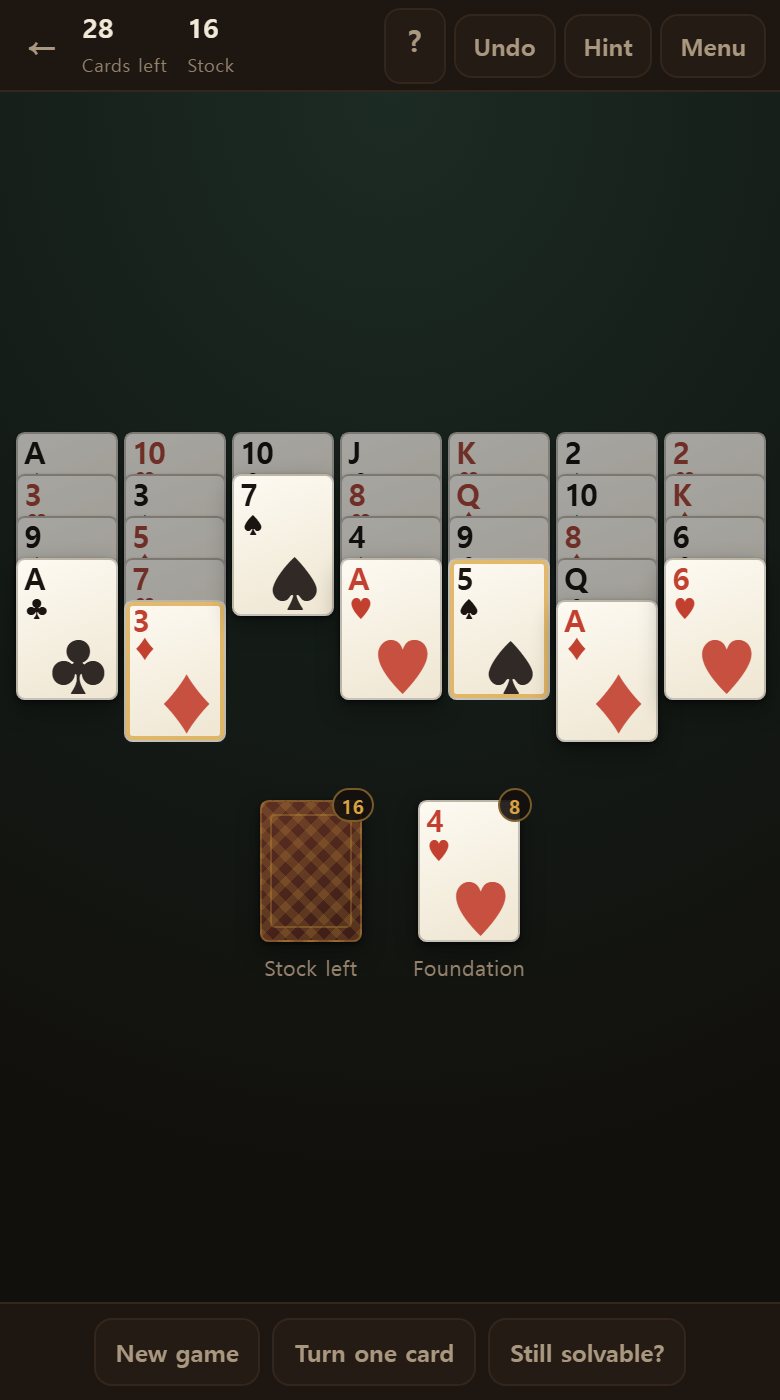
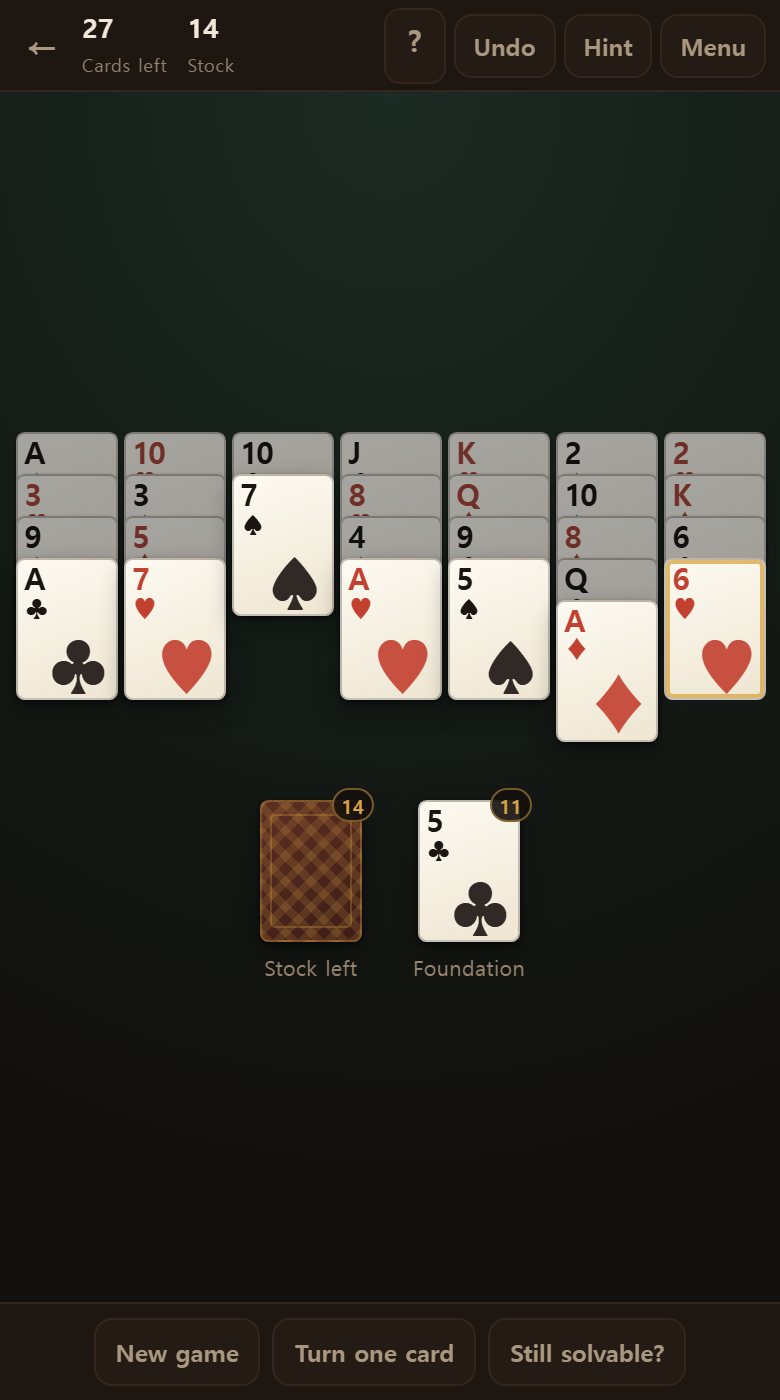
First, a look at the screen
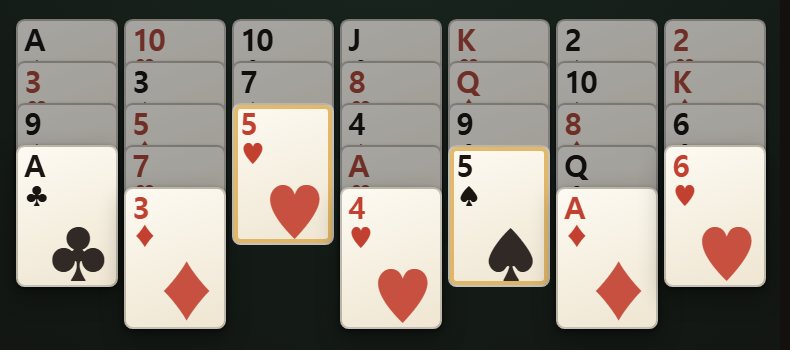
Seven columns of cards stand above, with two cards below them.
- The seven columns — five cards each, thirty-five in all. These are what you have to clear.
- The face-down card at the bottom left — the stock, still unused. Sixteen cards in it.
- The face-up card at the bottom right — the pile. Its top card is what you play against.
- The figures at the top — cards left in the columns, and cards left in the stock.
Only the bottom card of each column is bright; the ones above it are dimmed. What is available and what is not separates at a glance.
This is how a board is dealt
Five overlapping cards in each of seven columns. Nothing is face down — everything is face up, so you can see where each card is from the start.
One card is already on the pile. That is where you begin.
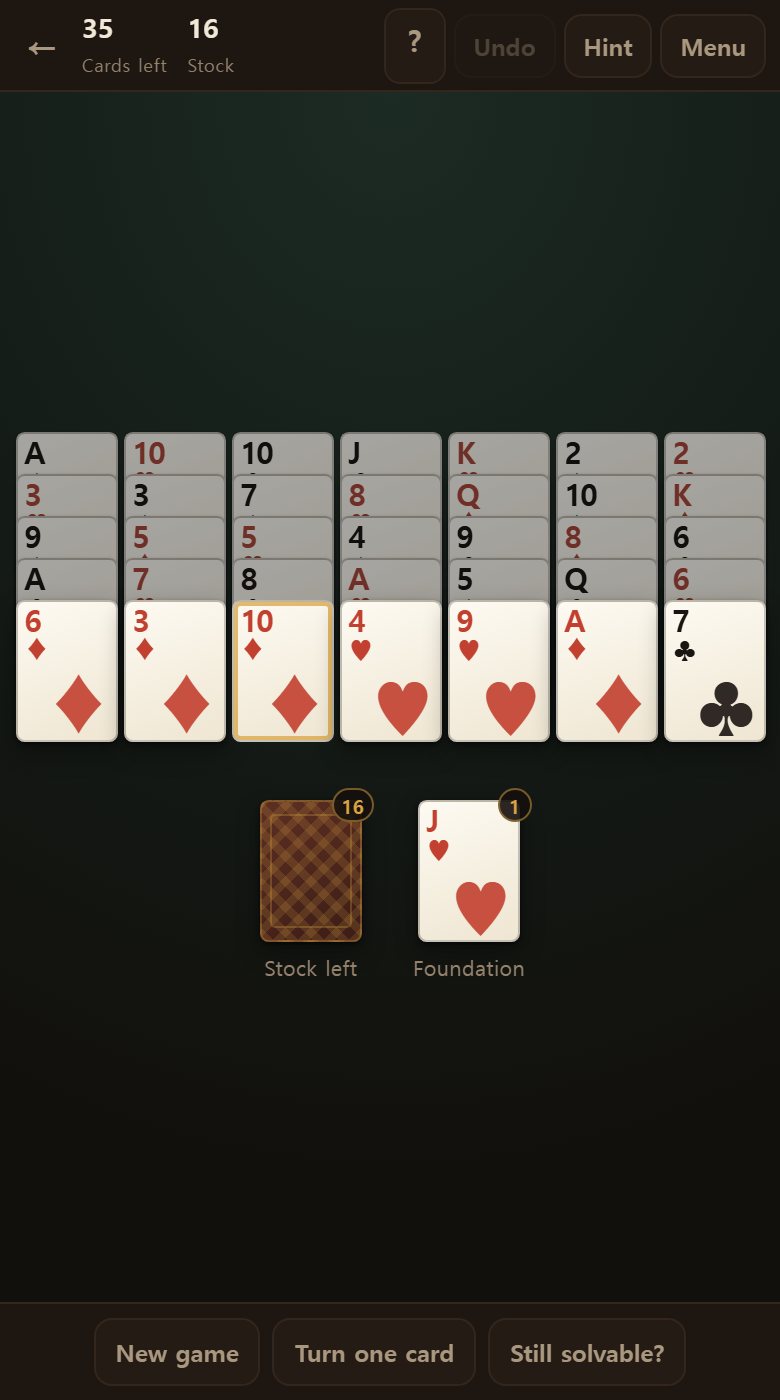
Seeing everything matters. Golf is not a game of luck but a game of choosing the order.
One rank up, one rank down
With a 7 on the pile, the only cards you can play are a 6 and an 8.
Suit does not come into it at all — 6♠ or 6♥, it makes no difference. Nor does colour. The only question is whether the rank is one away.
- On a 5, play a 4 or a 6.
- On a 10, play a 9 or a J.
- J counts 11, Q 12 and K 13.
- The card you play becomes the new top, and the next move is measured against that.
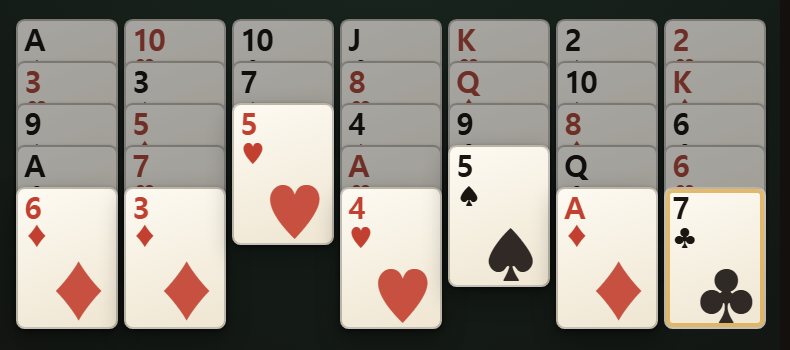
So you can run long chains up and down — 6 7 8 7 6 5 4 — and there is nothing more satisfying than several cards going out in a row.
The run stops at a K
K is the highest card, and nothing is one rank above it. So only a Q can go on a K.
A is the lowest, and only a 2 can go on an A.
K does not carry round to A. The ranks do not wrap like a clock.
- On a K — only a Q. The way up is closed.
- On an A — only a 2. The way down is closed.
- Every rank in between has both ways open.
- Which makes K and A the cards that break a run.
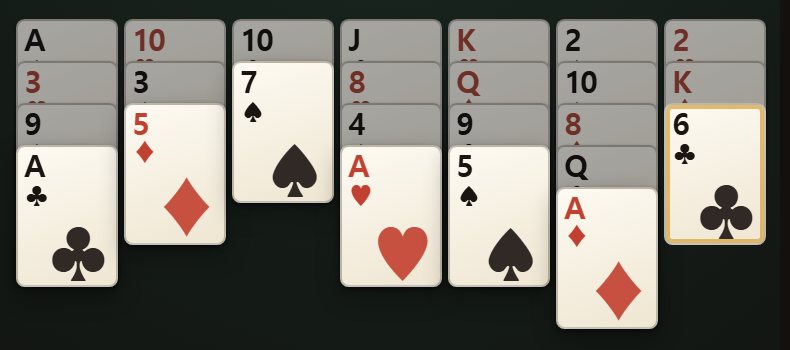
So a K or an A on the pile halves your options. Before playing a K, check that a Q is available. A K buried in a column is worse still. Clear everything above it and the column stops dead at the K. Get it out early.
Only the bottom card is available
Five cards may overlap in a column, but only the bottom one can be played.
Clear it and the card above becomes the new bottom. So to reach any card, you first have to clear everything below it.
- Tapping a covered card does nothing, and the line below tells you why.
- Five cards to a column, seven columns, thirty-five cards.
- An emptied column simply stays empty. Nothing can be placed there.
- Every column you empty leaves less to watch, and the board gets easier.
- Which makes cards buried in deep columns the real problem of this game.
- A shallow column can be cleared whenever, so there is no hurry there.
Stuck? Turn a card
With nothing playable anywhere in the seven columns, tap the stock at the bottom left. One card turns over and becomes the new top of the pile.
The target changes, and plays open up again.
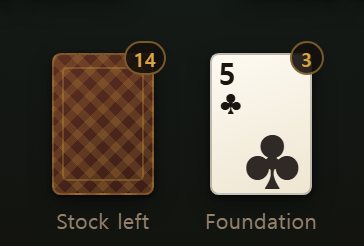
The stock holds only sixteen cards, and it never comes back. Turn one and it is gone. So before you turn, make quite sure there really is nothing playable in the columns.
When to turn and when to hold
This is where games of Golf are decided. Sometimes it is better to deliberately not play a card you could play, and turn instead.
Say you can play a 6, but afterwards there is no 5 and no 7 and you jam immediately. Better to turn and build a longer run.
- Before playing, look at what follows on from it.
- One card then a jam is worse than four or five going out in a row.
- When the stock is nearly gone, be sparing — play while you can.
- Given two options, take the one that digs into a deep column.

At first, just play what you see. After a few games, “that will jam me” starts to jump out at you. Keep cards left and stock in view together at the top. Twenty cards left and three in the stock is not a moment for thrift — it is a moment to force a path now.
Which column should I dig?
Sometimes the same rank is playable from several columns. Choose like this.
- Dig the deepest column first. A five-card column is the most urgent.
- A shallow one will keep. One or two cards can go at any time.
- Emptying a column outright leaves less to watch and makes the ending far easier.
- A column with consecutive ranks stacked together is a gift — the whole lot goes out at once.
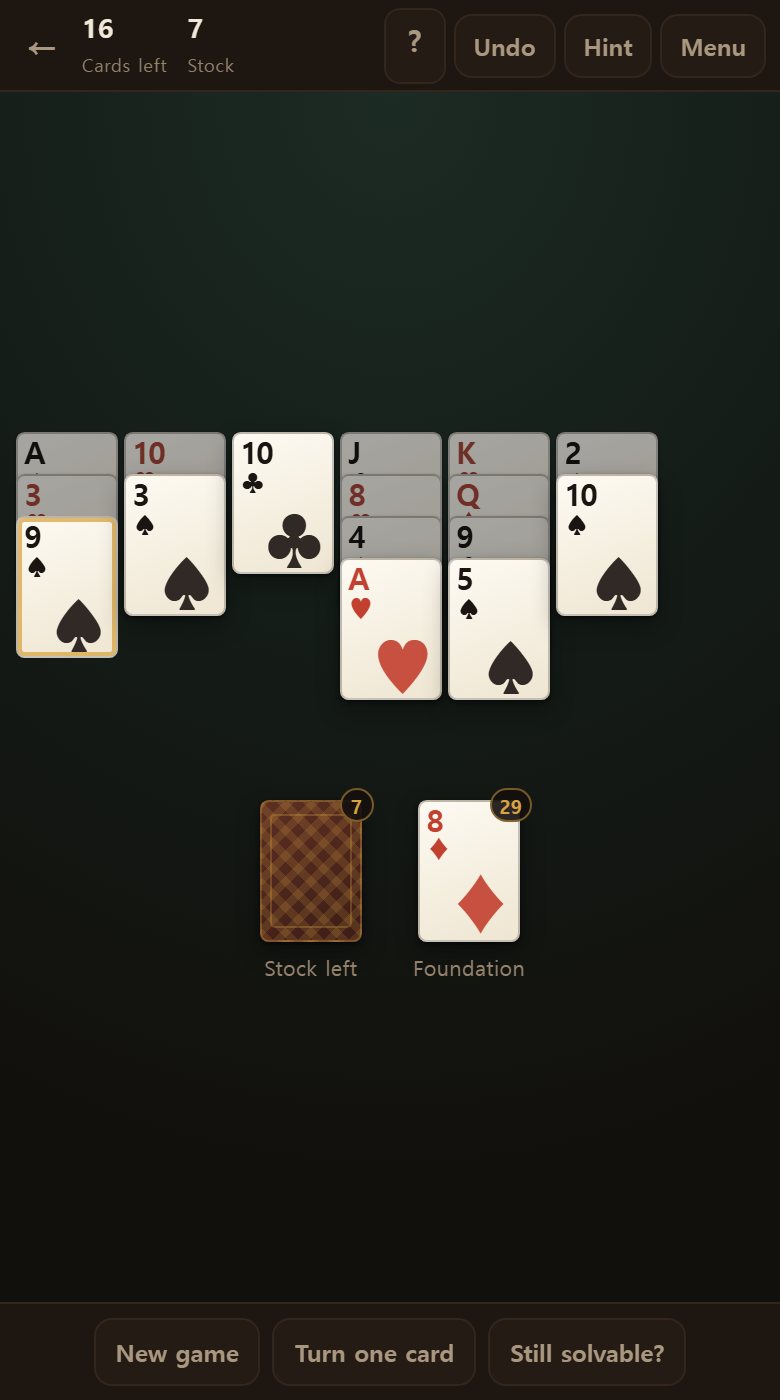
Clear only the shallow columns and you end up with five deep ones left — by which point the stock is gone and there is nothing you can do.
Only solvable boards are handed out
The short rules of Golf bring one great advantage: whether a board can be solved can be worked out completely.
Since only the bottom card of each column is available, the whole state of the board is described by how many cards remain in each column and what is on top of the pile. There are not many possibilities.
So boards here are not estimated — only verified ones are handed out.
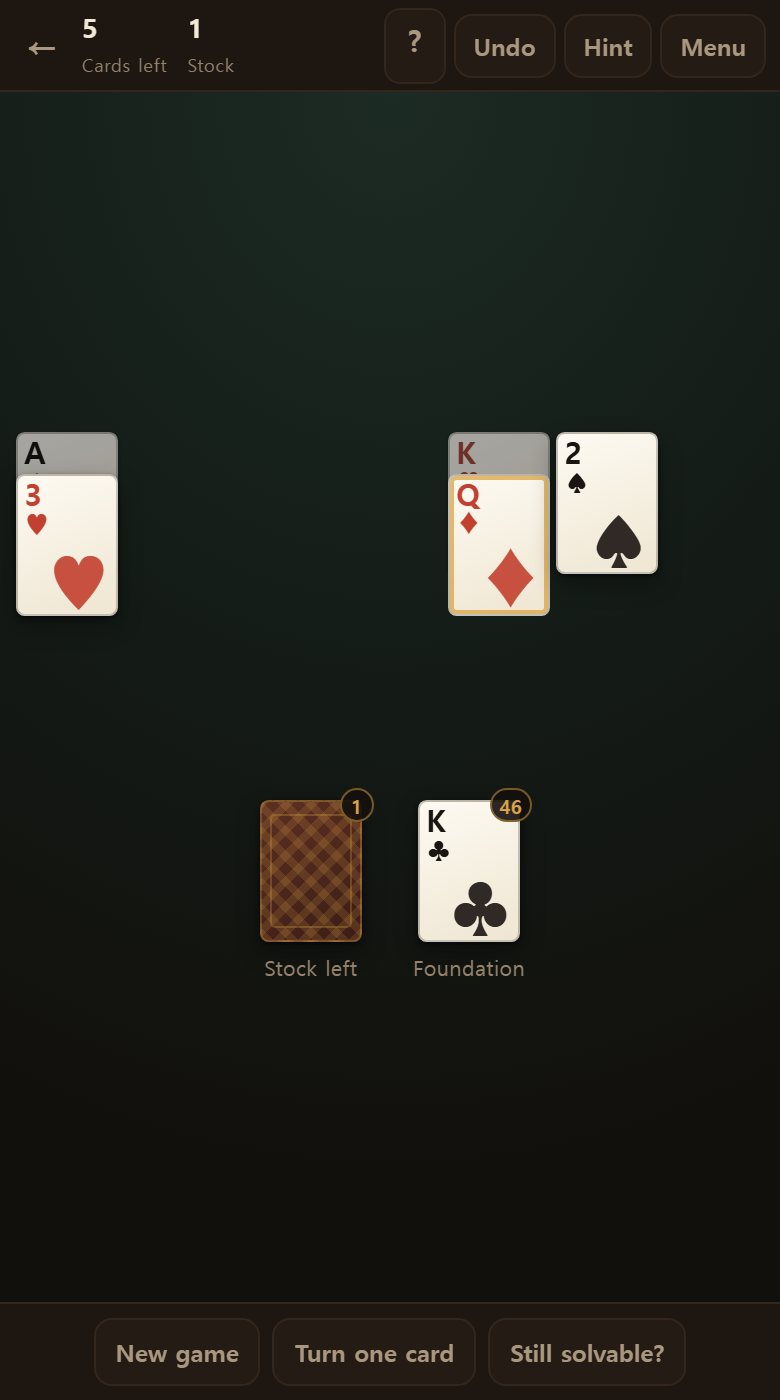
If you are stuck, there is an order you have not seen. Press Can I still win? below and it tells you whether the position can still be won.
Undo and hint
Played the wrong card? Press Undo at the top. There is no limit, and a card turned from the stock comes back too.
If you cannot see it, press Hint. It marks the first move of a winning path in blue, and no more than that.
- Tap the bottom card of the column it marks and it goes up.
- Sometimes it says to turn a card — meaning holding back is the right move.
- Columns can also be chosen with the 1 to 7 keys.
- On a keyboard, undo is Ctrl+Z and hint is H.
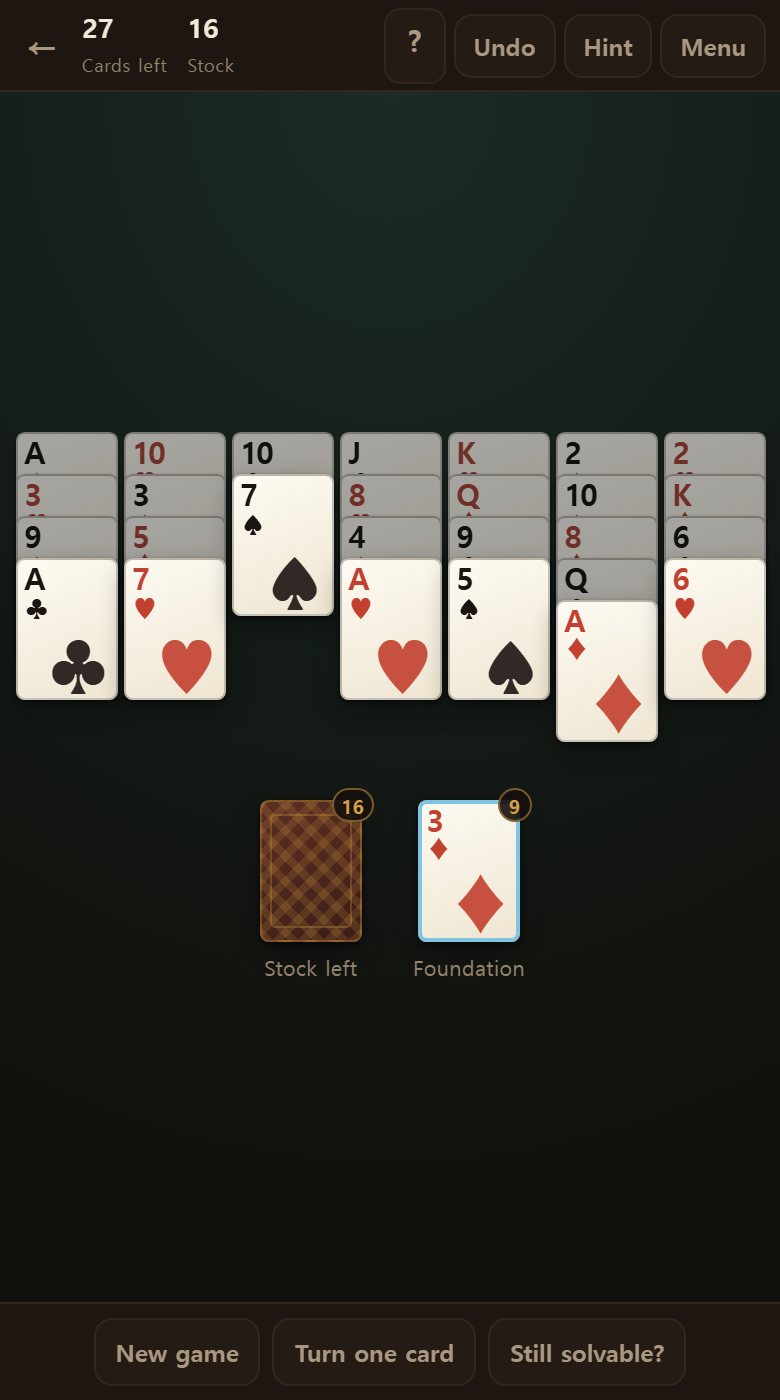
Nothing is face down in Golf, so undoing is not cheating. Everything was visible from the start; taking a move back and counting again is how the puzzle is meant to be solved. When the hint gives you a move, count the run that follows and see why. That one effort is what makes you see it yourself next time.
You can let K carry round to A
Turn on wrapping in the menu and an A may go on a K, and a K on an A. The ranks then run round like a clock.
Runs join up far more readily and the game gets easier. Worth leaving on while learning, or when playing with a child.
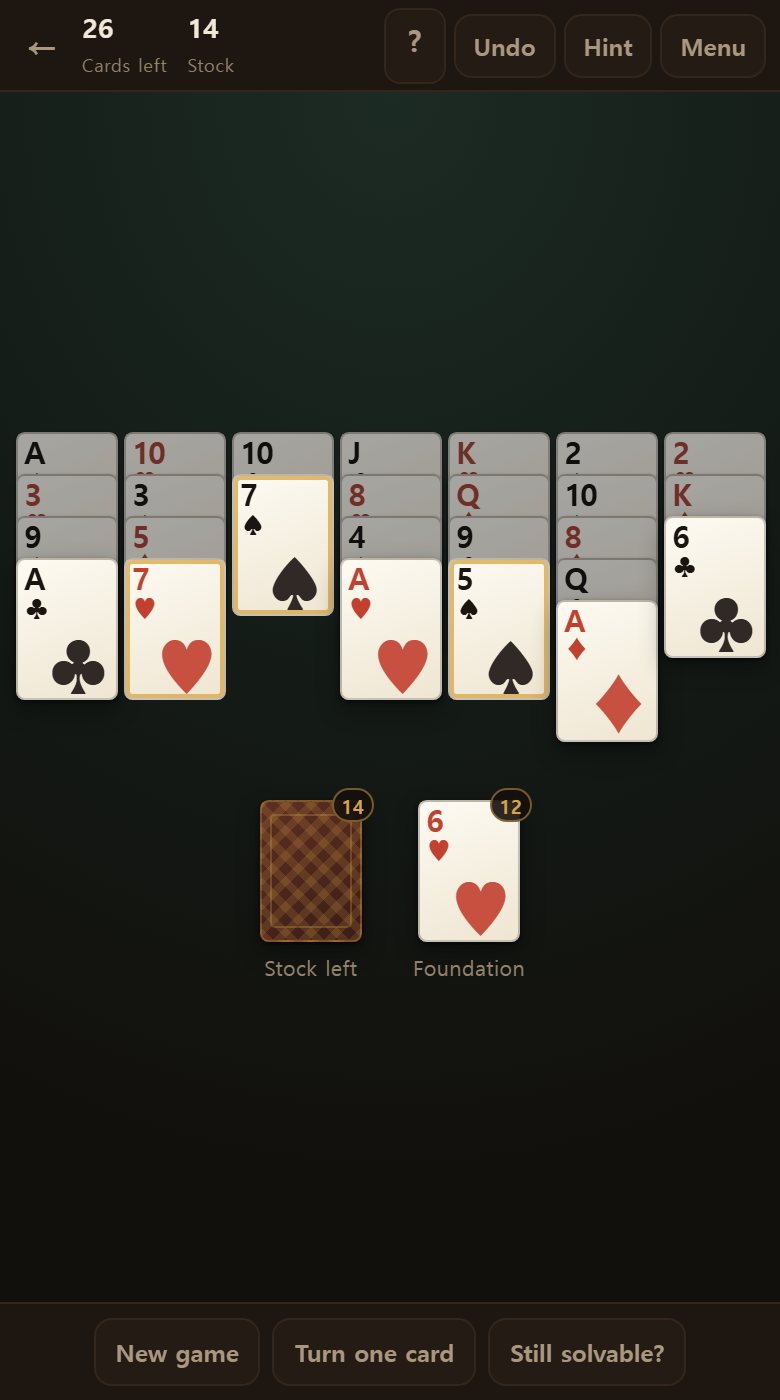
It is off by default — that is the real Golf rule, and the harder one.
When it is cleared
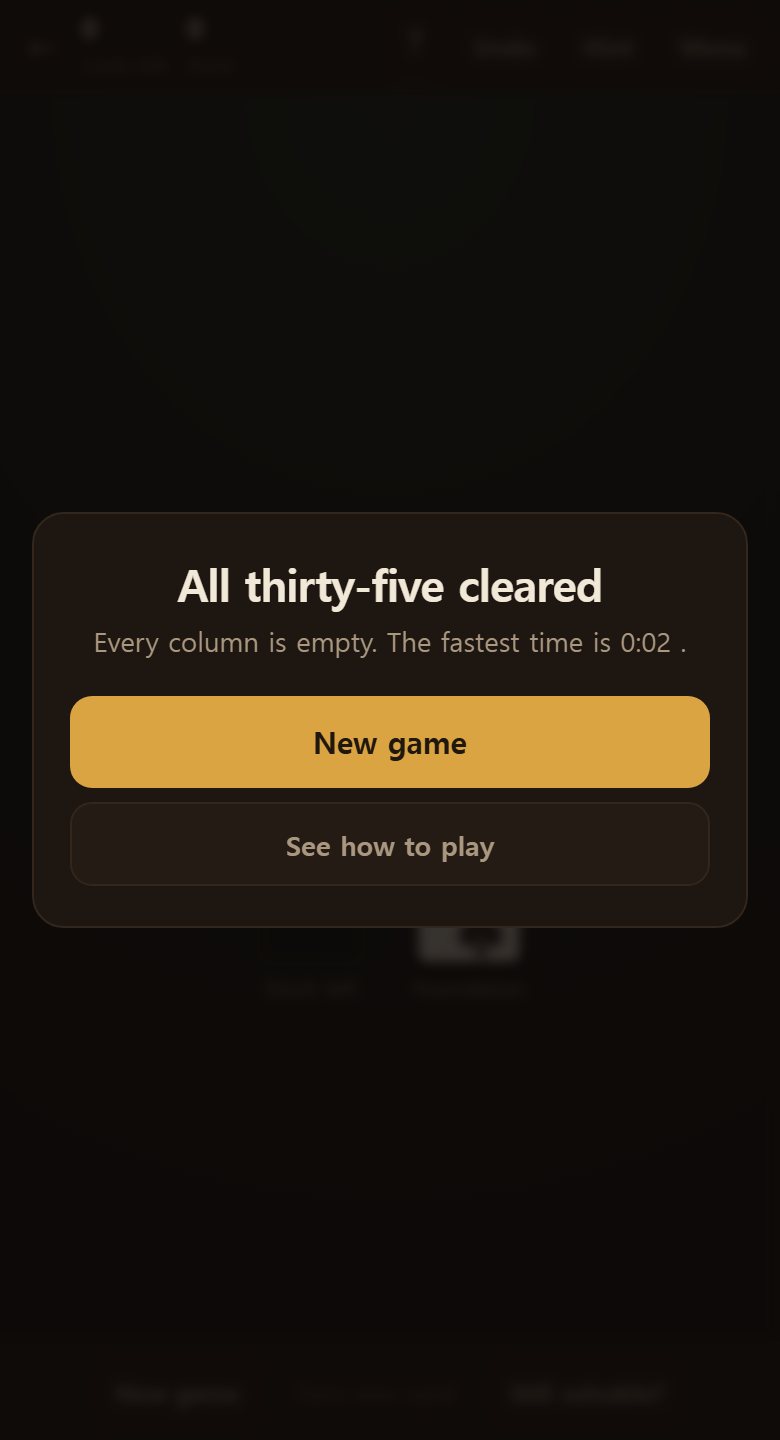
Empty all seven columns and you win. Cards left in the stock do not matter.
Your time is kept as a record. Try the same board again, faster.
- The deal number is kept with it. Note it down and you can open the same board again.
- The fewer cards from the stock you used, the better you played it.
- Press New game to play again.
- Your best times stay on this device. Nothing is sent anywhere.
Emptying a column outright
Clear a column to the end and it disappears altogether — one less place to watch.
- The fewer columns remain, the more plainly the next play presents itself.
- Reading seven columns and reading three are entirely different labours.
- So pushing one column all the way beats half-digging several.
- But do not dig one column into a jam — keep checking what the others still offer.
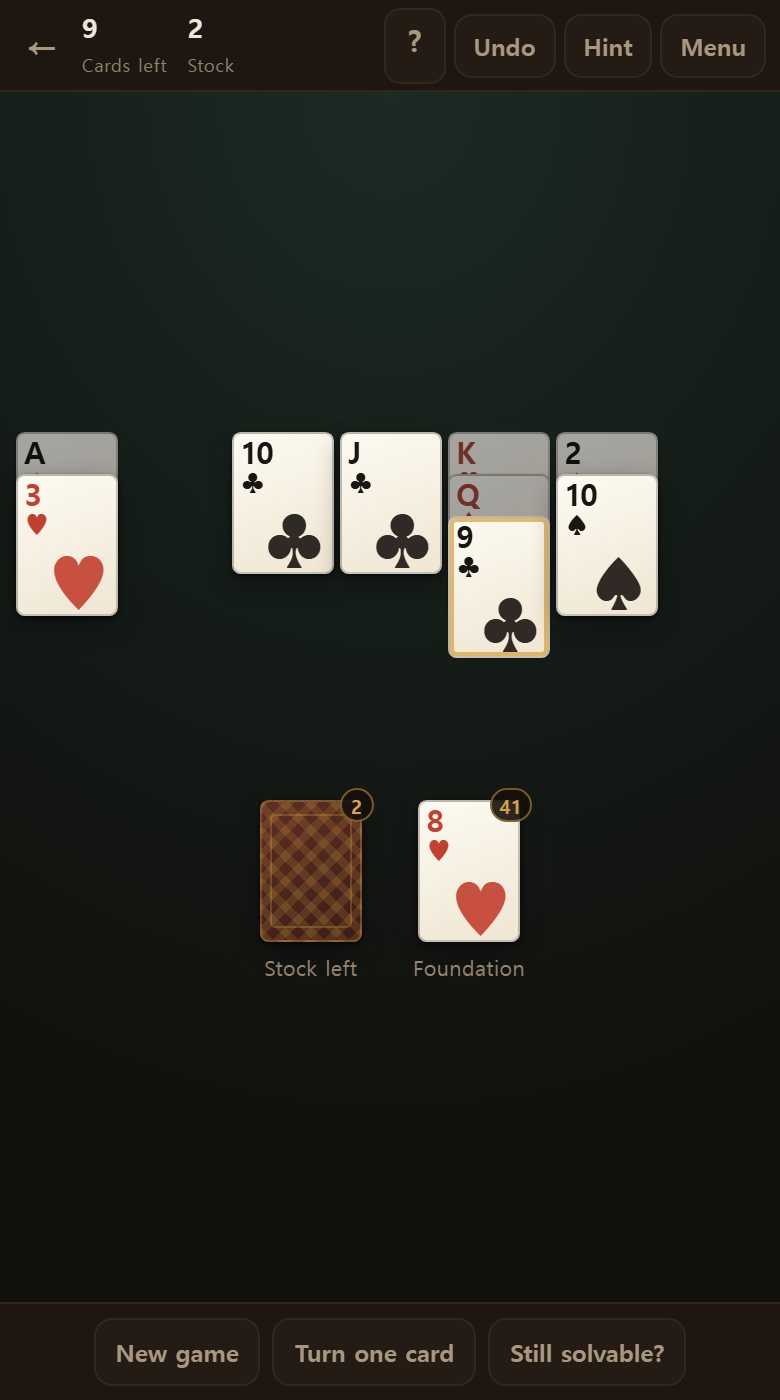
Endings are hard not because of the number of cards but because of the number of places to read. Emptying columns is what reduces that.
Can I still win — it actually solves it
Press Can I still win? below and it genuinely plays the position out to the end before answering. Nothing is estimated.
- Still winnable means a path remains. Keep looking.
- Too late means you cut the path somewhere. Undo back.
- Golf's short rules mean the whole thing can be worked out completely, so the answer is exact rather than approximate.
Press it after each undo and you can find which move lost it. The point where it turns back to still winnable is the fork.
How to win
Five habits and far more boards come out.
- Dig the deepest column first. Shallow ones will keep.
- Clear the kings early. Nothing goes on a K, so a column stops dead there.
- Push one column all the way and empty it. Fewer places to read makes the ending far easier.
- Look once more before turning. Sweep all seven columns to be sure nothing is playable.
- Given two runs, take the longer. The short one will still be there later.
All five are really one: be sparing with the stock. Sixteen cards, no second pass. Almost every lost game is one where the stock went first.
Common mistakes
Boards that jam are nearly always one of these four.
- Playing whatever is playable — the commonest of all. Take every card you can and the run breaks. Look first at what follows on.
- Turning too readily — there are only sixteen cards. Every one you save is a path kept open.
- Putting off the kings — nothing goes on a K. Leave one buried and that column never opens.
- Working only the shallow columns — they clear quickly and it feels productive, but the deep ones sit there untouched.
All four come from playing only the move in front of you. Golf is not about the next card but about the whole run that follows.
Common questions
It has to be one rank from the top of the pile. The line below tells you why it was refused.
Only the bottom card of a column is available. Clear what is below it first.
Not under the standard rule. Turn on wrapping in the menu and you can.
No. Once the sixteen are turned, that is that — which is why you must be sparing.
Try undoing. This site only hands out boards that can be cleared.
Quite right. Emptying the seven columns wins it; the stock is not counted.
No. Golf ignores suit and colour entirely. Only the rank matters.
- Dig into the deepest column first. The shallow ones can wait.
- Emptying a column outright cuts down what you have to look at. The endgame gets much easier.