 MindHub
How to play Yut Nori
Throw four yut sticks and move your pieces by what comes up. Get all four of your pieces around and out before your opponent and you win. This is the game Koreans play at Lunar New Year.
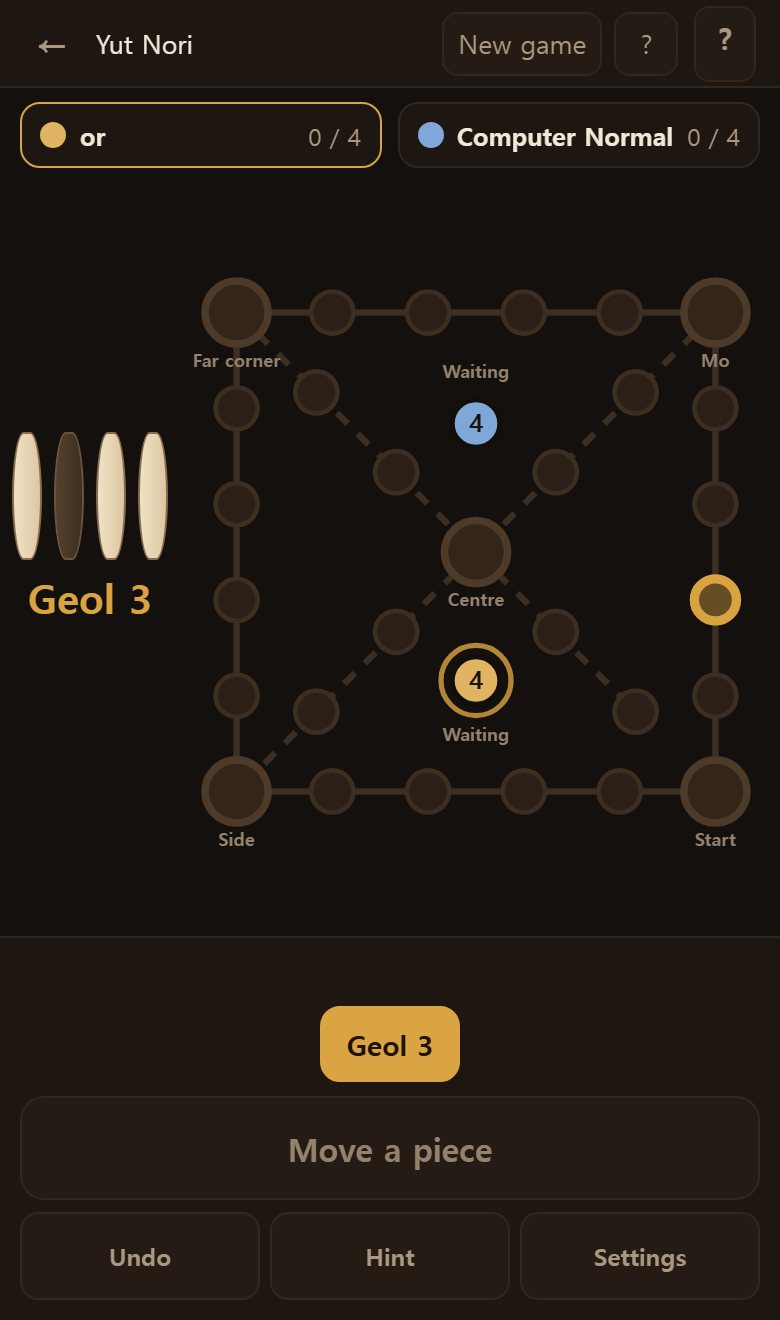
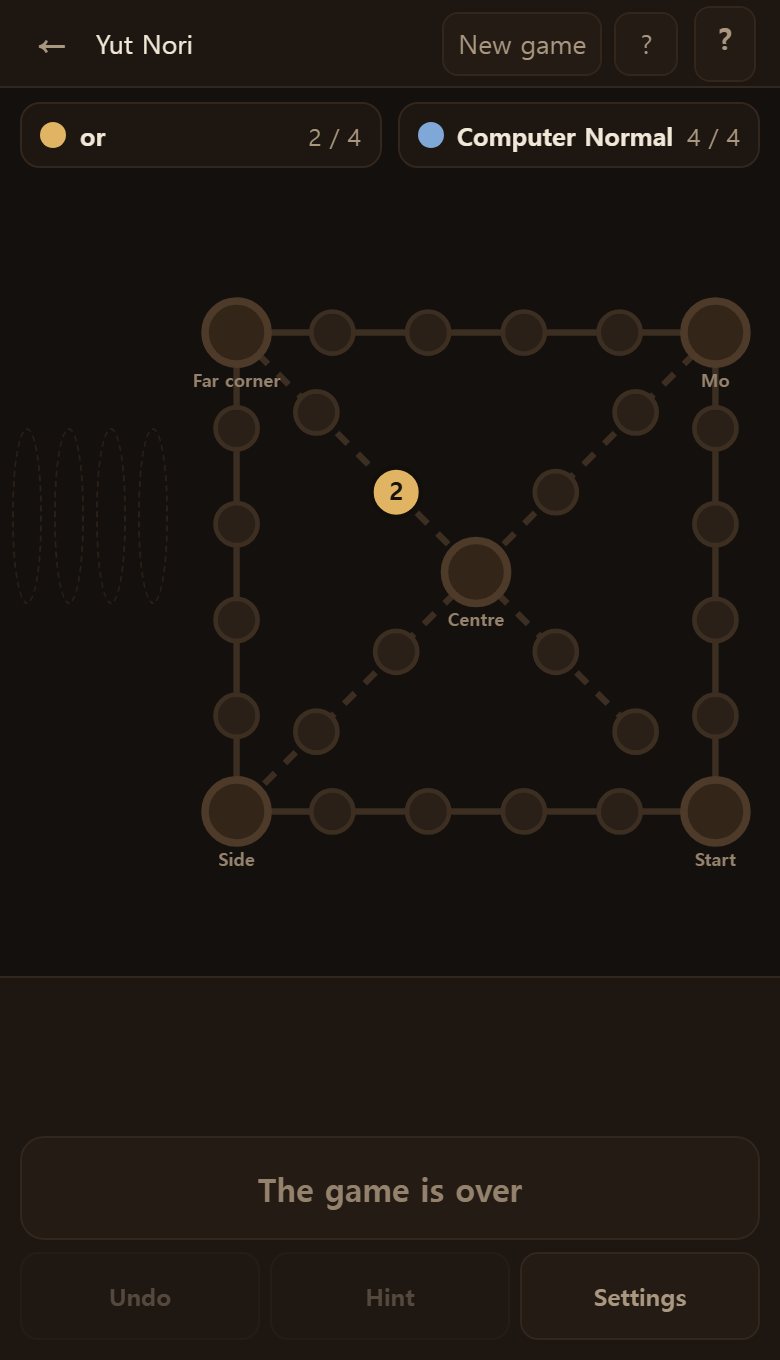
First, look at the screen
The square yut board is above; below is where you throw the sticks.
- The circles around the square — the path your pieces travel. It begins at Start, bottom right.
- The dotted lines across the middle — the short cuts. Taking them gets you round far quicker.
- Yellow pieces are yours, blue pieces your opponent’s.
- The waiting area in the middle — how many pieces have yet to enter.
- The four sticks below — throw them and the result shows as a picture.
- The figures at the very top — how many pieces each side has brought home (2 / 4, for instance).
You start with an empty board
Open a new game and no piece is on the board. They all sit in the waiting area in the middle.
You begin by throwing and entering one piece by the value that comes up. Counting starts from Start, bottom right.
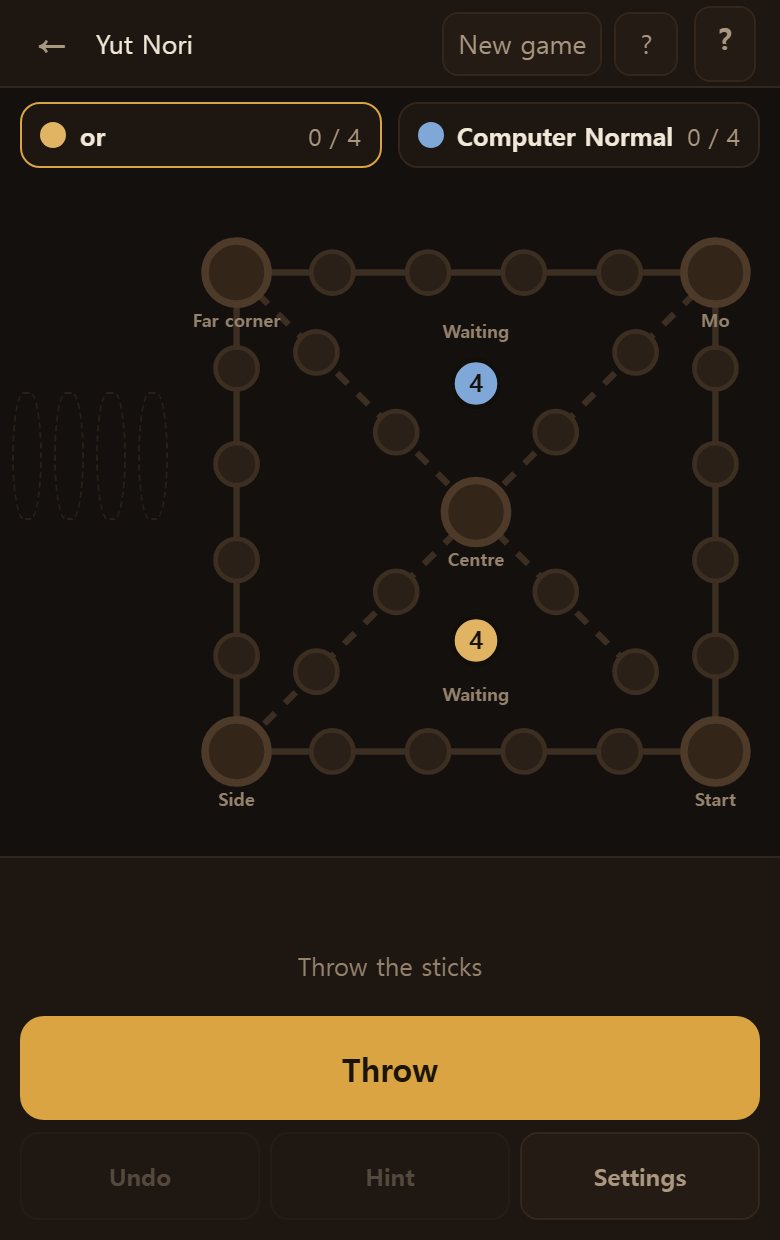
Five circles are drawn larger — Start, Mo, Back-mo, Wing and Bang. They are drawn large because they matter.
What are do, gae, geol, yut and mo?
Each stick has a flat side (the belly) and a rounded side (the back). Throw all four and count how many land flat side up.
- One flat side up → do, move one space
- Two flat sides up → gae, move two spaces
- Three flat sides up → geol, move three spaces
- Four flat sides up → yut, move four spaces
- None flat side up → mo, move five spaces
- The five results are not equally likely. A yut stick is a half-round, so the flat side lands up a little more often — roughly six times in ten.
- That makes Gae and Geol the common ones, each turning up about one throw in three (34.6%).
- Do is 15.4%, Yut is 13.0%, and Mo comes up once in forty throws (2.6%).
- Yut and Mo together — the throws that earn you another go — come to about one in six (15.5%).
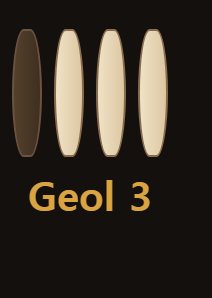
On screen the pale sticks are showing the flat side; the dark ones the rounded side. Real yut sticks are half-moons, so the belly comes up slightly more often, and that is reproduced here.
Yut or mo means another throw
Throw yut (4) or mo (5) and you throw again. That is very good news.
The value you rolled does not vanish — it stacks up below. Throw mo and then geol, and mo 5 and geol 3 sit side by side at the bottom of the screen. You get to use both.
- You choose which of the stacked values to use first.
- Press a value and the spaces it can reach show faintly.
- Using a value that captures first is usually the better bargain.
- Roll yut repeatedly and you keep throwing. With luck you throw three or four times in one turn.
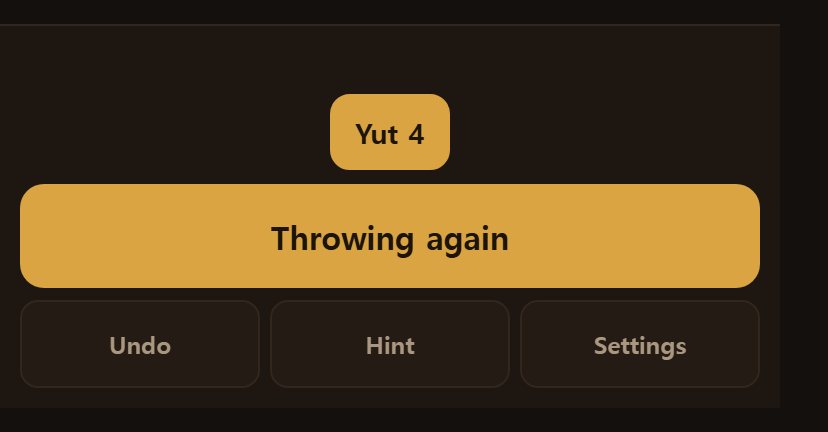
The order you spend stacked values in matters. If a do would capture and you spend the geol first, the chance is gone.
How far is one lap?
The board has twenty spaces around the outside and two short cuts through the inside. So the distance you travel depends greatly on which way you go.
- Go all the way round the outside and you must walk all twenty spaces to get out.
- Turn at Mo onto the short cut and it is far shorter.
- Turn again at Back-mo and it is shorter still.
- The quickest route cuts across Mo → Bang → the Wing side.
So in yut a big number is not always good. A mo (5) that carries you past a short-cut space can cost you, while a do (1) that lands you exactly on Mo can be worth a great deal. Do not be disheartened by a small throw. Where you stop matters more.
How to move a piece
First press Throw. Then press one of the values that appear below, and press the piece you want to move, or one of the faintly lit spaces.
- Pieces not yet entered sit in the waiting area in the middle. Press it and one comes out.
- Pieces enter one at a time. All four never come out at once.
- With nowhere at all to go, the turn passes to your opponent by itself. The screen tells you so.
- Moved the wrong piece? Press Take back.
- Pressing a piece already on the board moves that piece. Pressing the waiting area brings out a new one.
Once you have picked a value, if only one space is reachable you can simply press it. When several are, which piece you move is where the skill lies.
The short cuts are quick
Two dotted paths cut across the inside of the board. These are the short cuts.
When a piece stops exactly on Mo, Back-mo or Bang (the centre), it turns onto the short cut on its next move. That is far shorter than going all the way round.
- Mo is the large space at the top right. Turn here and you pass through the centre to the bottom left.
- Back-mo is the large space at the top left. Turn here and you head for the centre.
- Bang is the very centre. Turn again here and you get out fastest of all.
- How much faster — the shortest route from the start to home is eleven steps.
- From Mo, going the long way round leaves fifteen steps to home; cutting across leaves six. That one turn saves nine steps.
- Once you reach Bang (the centre) you are only three steps from home. Cutting again at Bang is the shortest road there is.
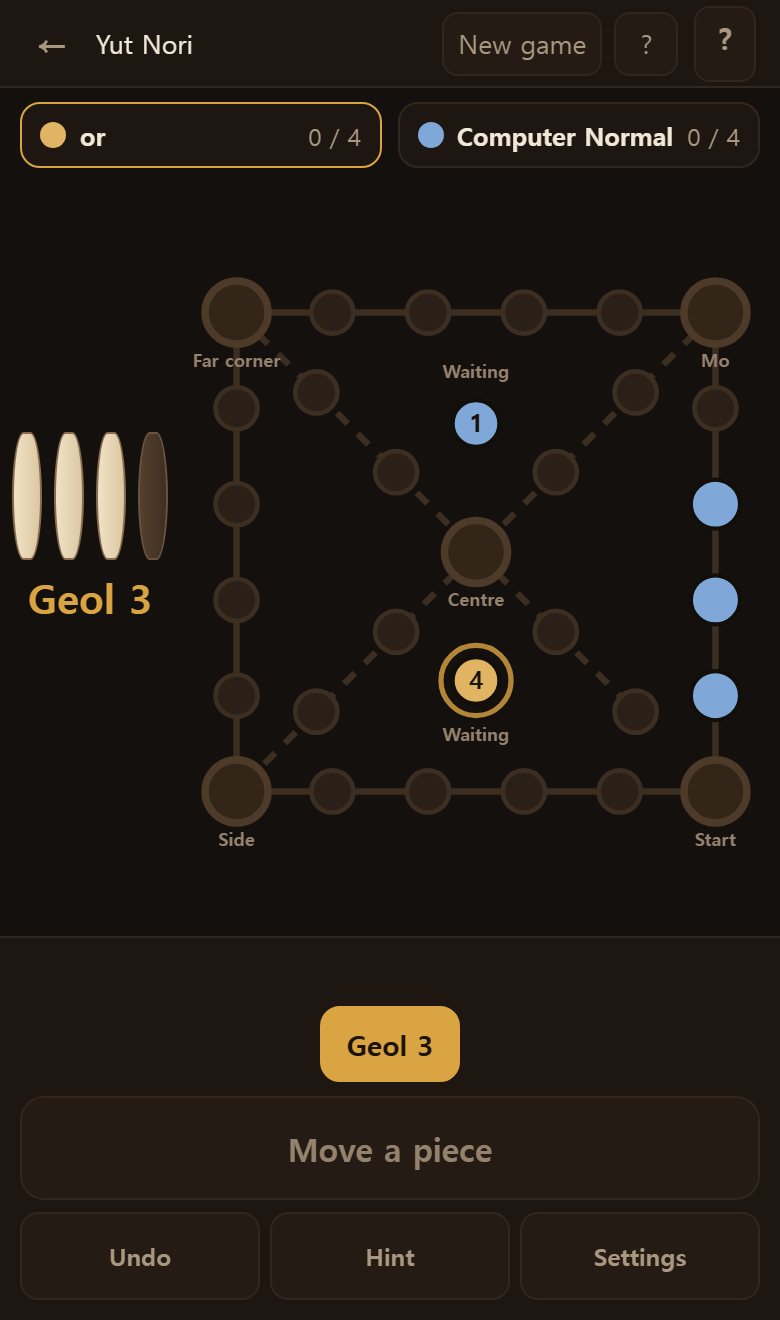
Passing over is not enough — you must stop exactly on the space to turn. This is the single most important thing in yut. One space decides the game.
Capturing — sending a piece back to the start
If an opponent’s piece stands where yours lands, it is sent right back to the start. Everything it had travelled is lost.
And you throw again. Twice the gain.
- Capture a stacked piece and both go back at once.
- A piece already home cannot be captured.
- The further along the piece you capture, the greater the gain.
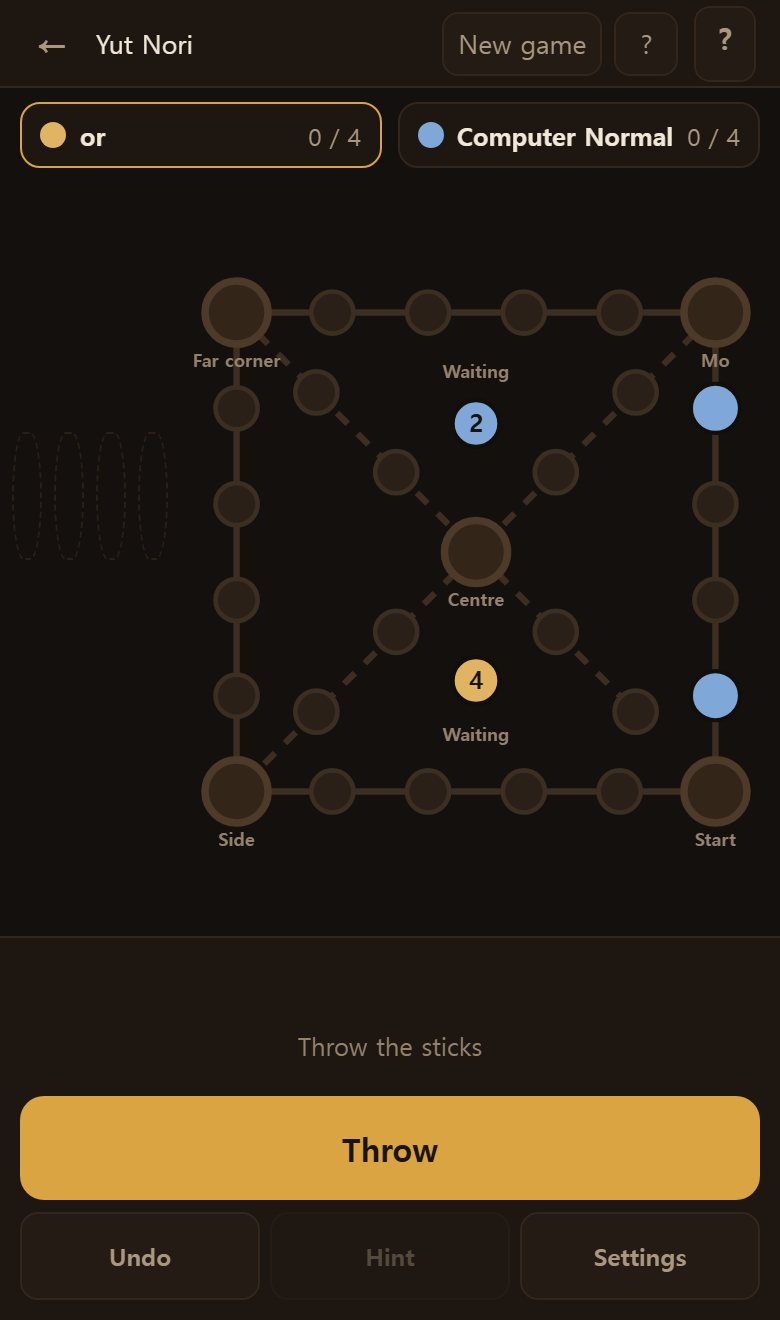
Capturing a piece that was nearly home turns the whole game over. That is why yut stays interesting to the last. So never relax because you are nearly there. The further ahead you are, the more carefully you must pick spaces where you cannot be caught.
Stacking — your own pieces travel together
If one of your own pieces is already there when another lands, the two stack and travel together. This is called carrying. A number appears inside the circle on screen.
Stacked, two pieces move on one turn, which is quick. Three or four can stack as well.
- Stacked pieces are one body. They cannot be separated again.
- One move carries as many pieces as are stacked, all together.
- They come home together too, which can win you a great deal at the finish.
- But if captured, the whole stack goes back to the start.
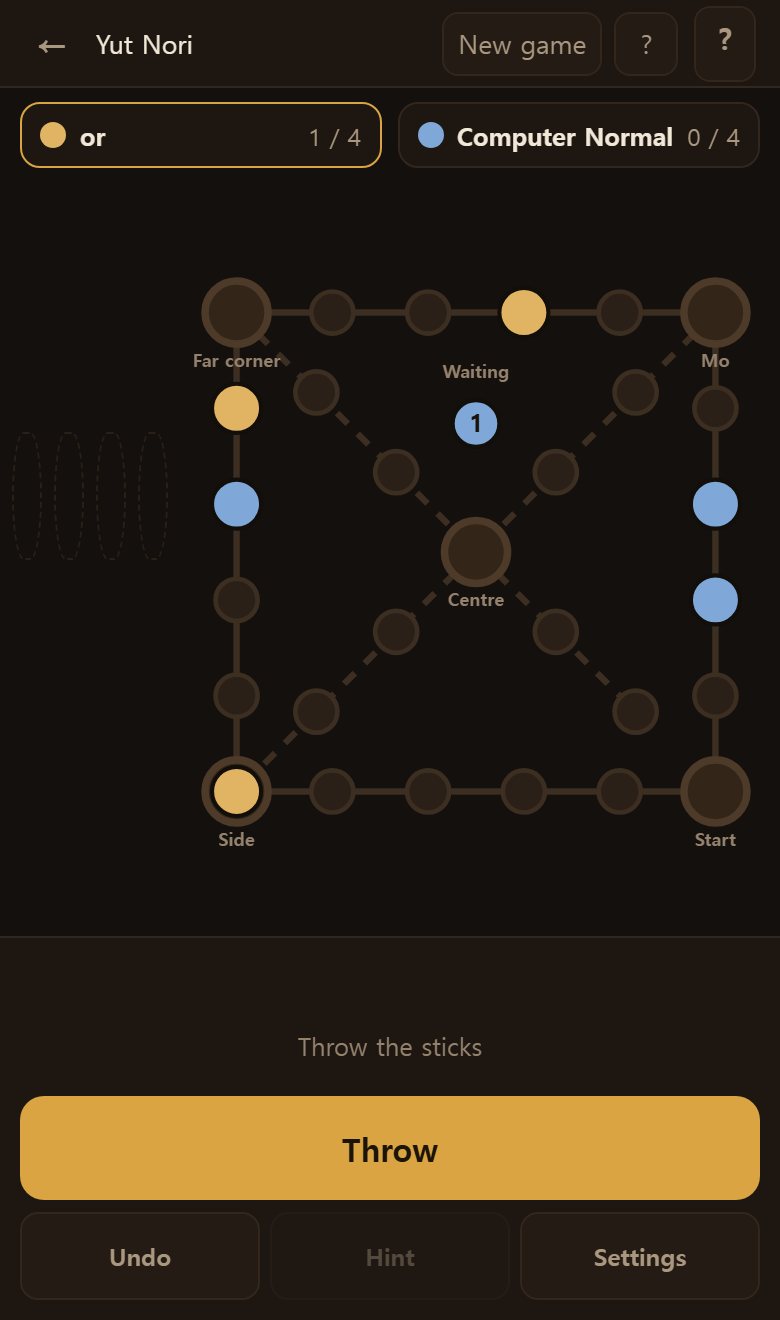
Still, captured means both go back. With an enemy piece chasing from behind, it is safer not to stack. When you are ahead, keep them apart and stack only when you must. Stacking is putting everything on one square. It wins big and loses big. Think of it as a move for when you are behind, and you will usually be right.
Stacking or catching — which is worth more?
There are only two moves that turn a game of yut around — stacking and catching. Both are big, but they work in completely different ways.
Stacking saves your own steps. Two horses advance on one throw, which roughly halves the number of throws you need.
Catching destroys your opponent's steps — and it earns you another throw on top. The further their horse had travelled, the more it is worth.
- Catching a horse near the start is not worth much. It only sends them back a few steps.
- Catching one that has taken a shortcut and is close to home sends it back more than ten steps. That is the big one.
- Catching a stack sends both horses at once back to the start. Games are decided right there.
- So when you are ahead it is safer not to stack — do not give yourself a way to lose everything at once.
- When you are behind you have to stack. Playing it safe will not close a gap.
In short — ahead, split up and play safe; behind, stack and play big. And when a catch is available, taking it is usually right. Because the extra throw comes with it, catching is the only move that gains you steps and a throw at the same time.
To win
Bring all four pieces out of the board and you win. A piece leaves once it has been all the way round.
- A piece that is out cannot be captured again. It is safe.
- The top of the screen shows how many you have brought home.
- Unsure which piece to move? Press Hint below.
- The number of pieces can be set to 2, 3 or 4 in settings. Fewer means a shorter game.

All four horses have to get home, so you are always choosing between driving one horse all the way and moving all four evenly. Stacking and travelling together is usually faster — two horses advance on one throw. But if a stack gets caught, both horses go back to the start. It wins big and loses big. Stacking is dangerous when an opponent sits ahead of you. If you have to pass a square where you can be caught, send them separately instead.
How to play well
The throwing is luck, but which piece you move is skill.
- When a value stops exactly on a short-cut space (Mo, Back-mo, Bang), use it nearly every time.
- Do not stand one to five spaces ahead of an enemy piece. You will be captured next turn.
- The reverse holds: stand behind an enemy piece and you can capture it.
- Among stacked values, spend the capturing one first. It earns you another throw.
- When ahead, keep your pieces apart rather than stacked. Then you cannot lose everything at once.
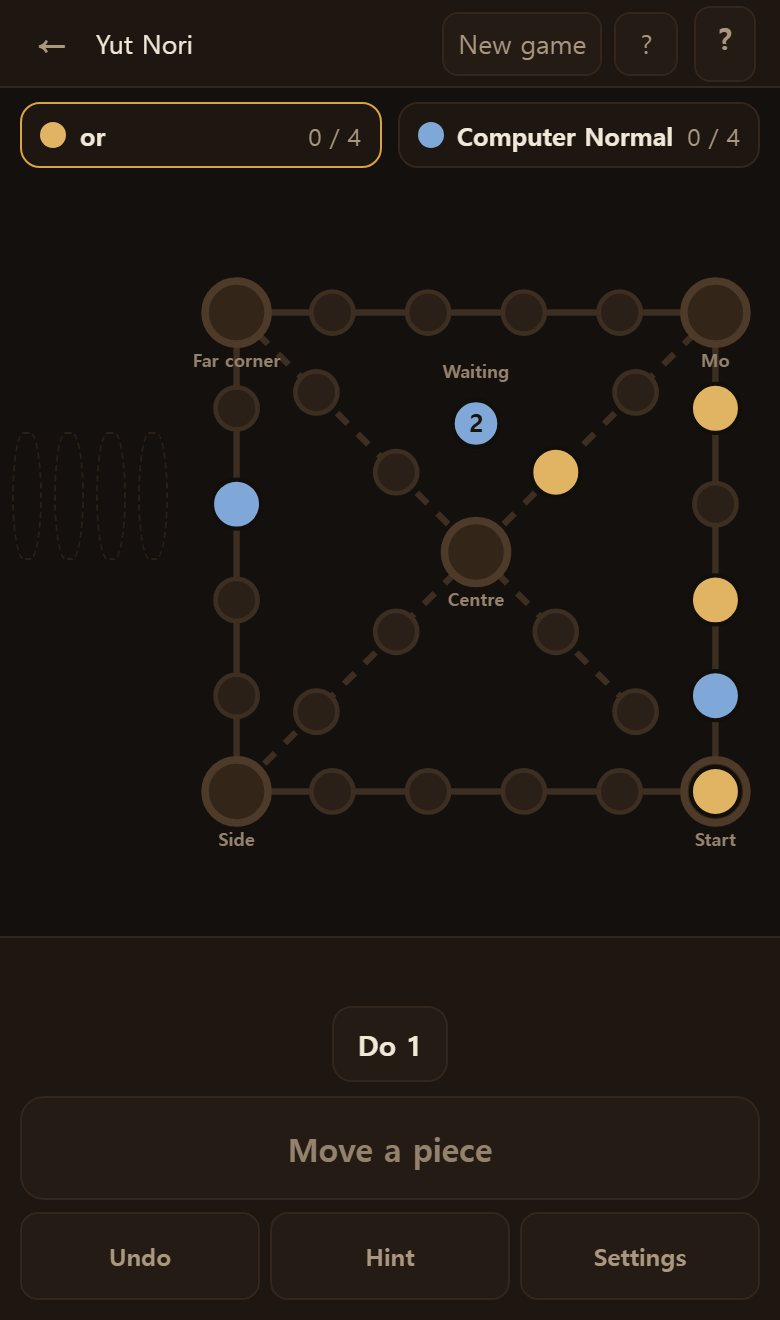
In one line: stop exactly on the short cuts, and never stand where you can be captured. Those two alone will noticeably increase how often you win. The rest is the throw.
What you can set
Open Settings below and there are three things to choose.
- Opponent strength — Easy, Normal, Hard.
- Two players on one device — pass the device back and forth and play person against person.
- Number of pieces — 2, 3 or 4. Fewer means a shorter game.
- Sound is switched off here too.
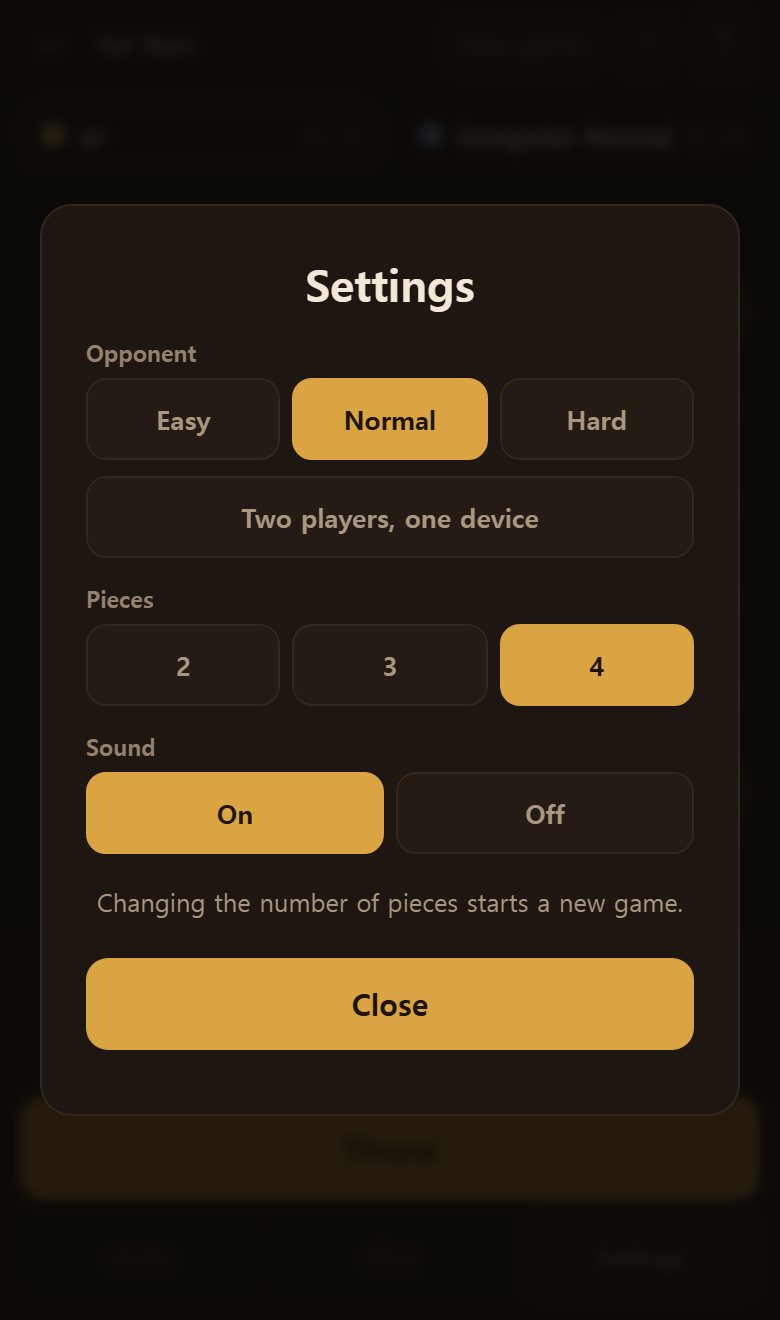
Changing the number of pieces starts a new game. Finish the one you are on before changing. With a small child, two pieces is about right. A game is short enough to end before they lose interest.
Take back
Press Take back below and your last action never happened. The value spent and the piece moved come back together.
- Use it when you picked the wrong piece.
- You can also take back a stacked value you spent by mistake.
- After your opponent has moved, it steps back past that as well.
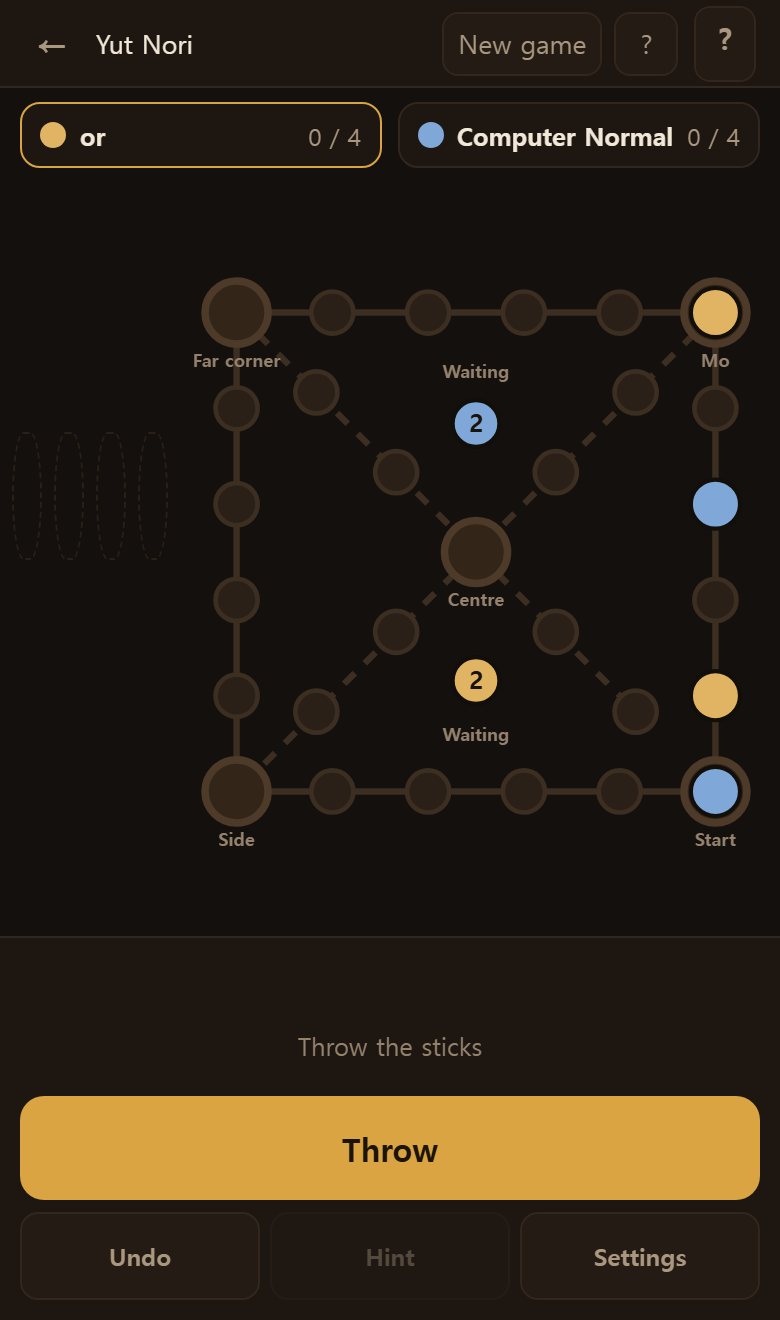
But the throw is not re-rolled. Take it back and the same value comes up again. There is no point undoing a throw you dislike. Taking back is for when you picked the wrong piece to move.
Hint
Press Hint below and it points out which piece to move and where.
- With several values stacked, it tells you which to spend first as well.
- When a capture is available it usually points there.
- It is also good at spotting a move that stops exactly on a short cut.
- Taking a hint leaves no mark on your record.
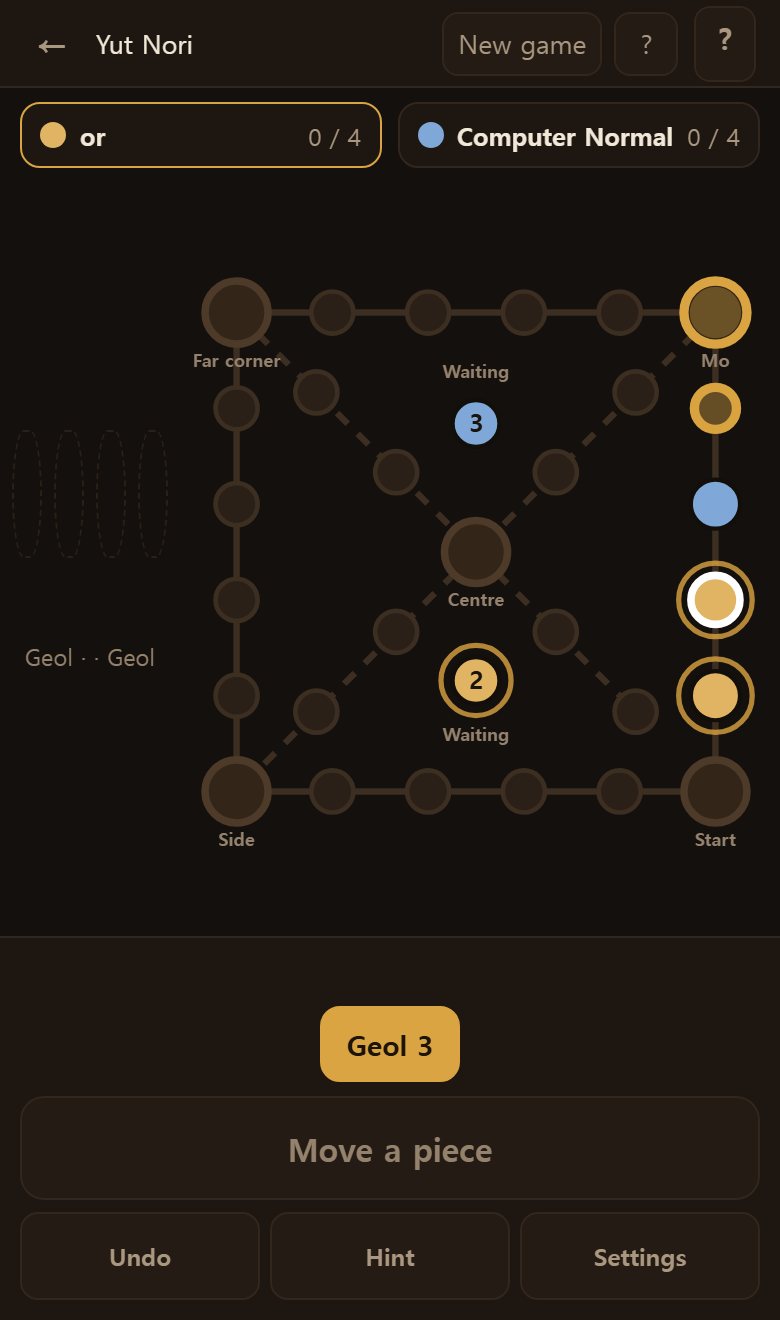
When the hint points at a move, count the board and work out why that one. It is usually a short cut or a capture. After a few you see it yourself.
Common mistakes
Lost games nearly always come down to one of these four.
- Overshooting a short cut — the most common. A value would have stopped exactly on Mo, Back-mo or Bang, and you spent another one first.
- Standing where you can be captured — one to five spaces ahead of an enemy piece and the odds of being taken next turn are very high.
- Stacking while ahead — one capture sends both back to the start. When winning, keeping them apart is safer.
- Spending stacked values in any order — save the capturing one for later and your opponent slips away in the meantime.
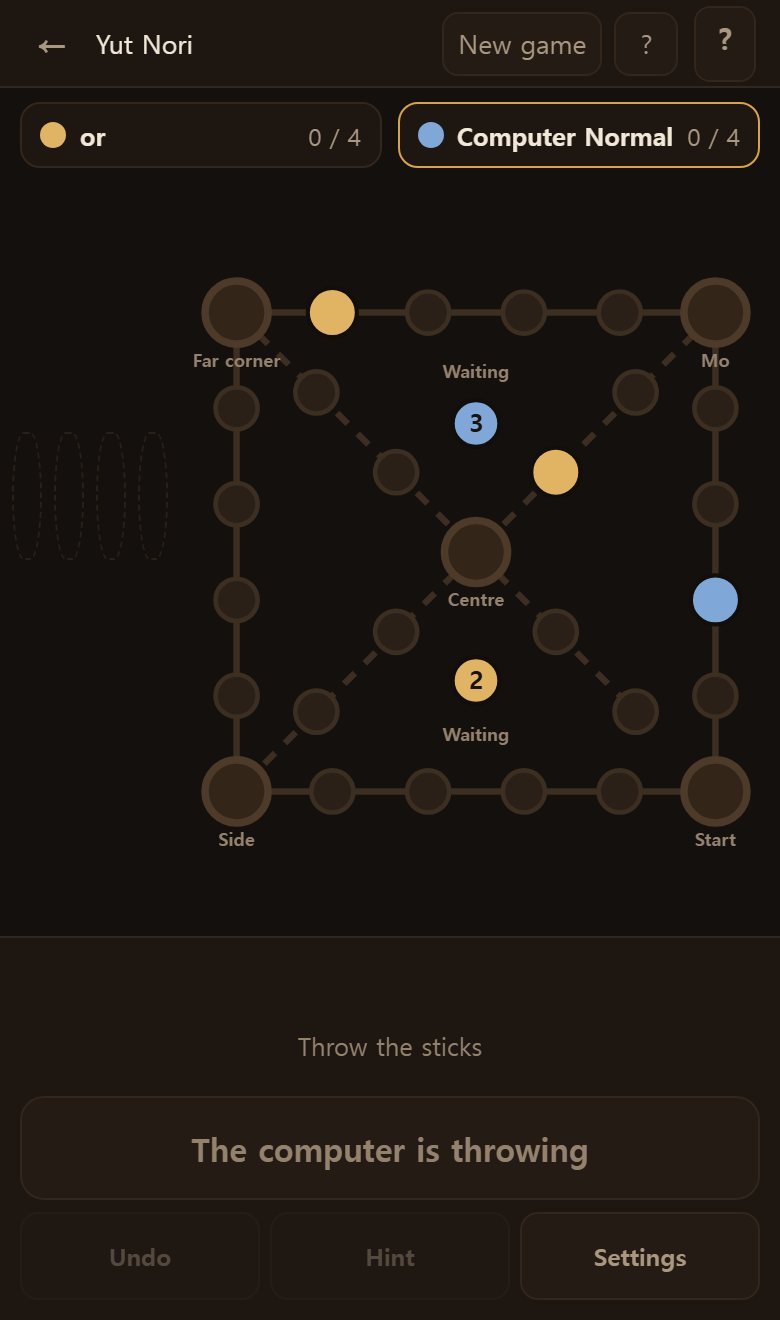
All four come from looking only at the move in front of you. The throw is luck, but the order you spend it in is entirely yours.
When the game ends
Whoever brings all their pieces home wins, and the game ends there.
- Press New game to start again from an empty board.
- Your settings (opponent strength, number of pieces) carry over.
- Because throws are involved, no two games are ever the same.
Do not brood over a loss. In yut you can play well and still lose to the sticks. Count instead how many times you stopped exactly on a short cut. If that number is rising, so is your skill.
Common questions
With nowhere to go, the value goes unused and the turn passes to your opponent. The screen says so.
That is right. Waiting pieces enter one at a time. They are not stacked, merely waiting.
You must stop exactly on Mo, Back-mo or Bang to turn. Merely passing over carries you on round the outside.
In Settings below, choose Two players on one device and you can take turns on the same device.
Yes. In Settings you can choose 2, 3 or 4. Fewer pieces means a shorter game.
Switch to Easy in Settings. Bear in mind that the throw is luck, so even good play loses sometimes — which is part of the fun.
No. The value stands. Taking back is for when you picked the wrong piece, not for re-rolling a bad throw.
If one of them captures, spend that first — a capture earns another throw. Next comes any value that stops exactly on a short cut. With neither available, the order makes little difference.
It depends. Behind, stacking helps you catch up quickly; ahead, keeping them apart is safer. A captured stack sends both pieces back to the start.
It is the rule families disagree about most, so it was deliberately left out. In some houses it moves you one square back, in some it does not count before you have started, in some it does not exist at all. Picking one would make the rules wrong for everybody else.
You are not meant to. It comes up about once in forty throws (2.6%), because the sticks are half-round and land flat side up more often. The common results are Gae and Geol.
Cutting at Mo leaves six steps to home; going the long way round leaves fifteen. One turn saves nine steps. That is why landing a horse on Mo matters so much.
Every horse in the stack goes back to the start together. That is why stacking wins big and loses big. If an opponent is sitting ahead of you, sending them separately is safer.
- You choose the order you spend piled-up throws in. Spend a capturing throw first.
- Stacking is faster but loses everything at once. When you are ahead, keep them apart.