 MindHub
How to play TriPeaks Solitaire
The cards are stacked into three peaks. You bring them down by taking any card one rank from the top of the pile. The longer the run, the more each card scores — and playing for long runs is where the pleasure lies.
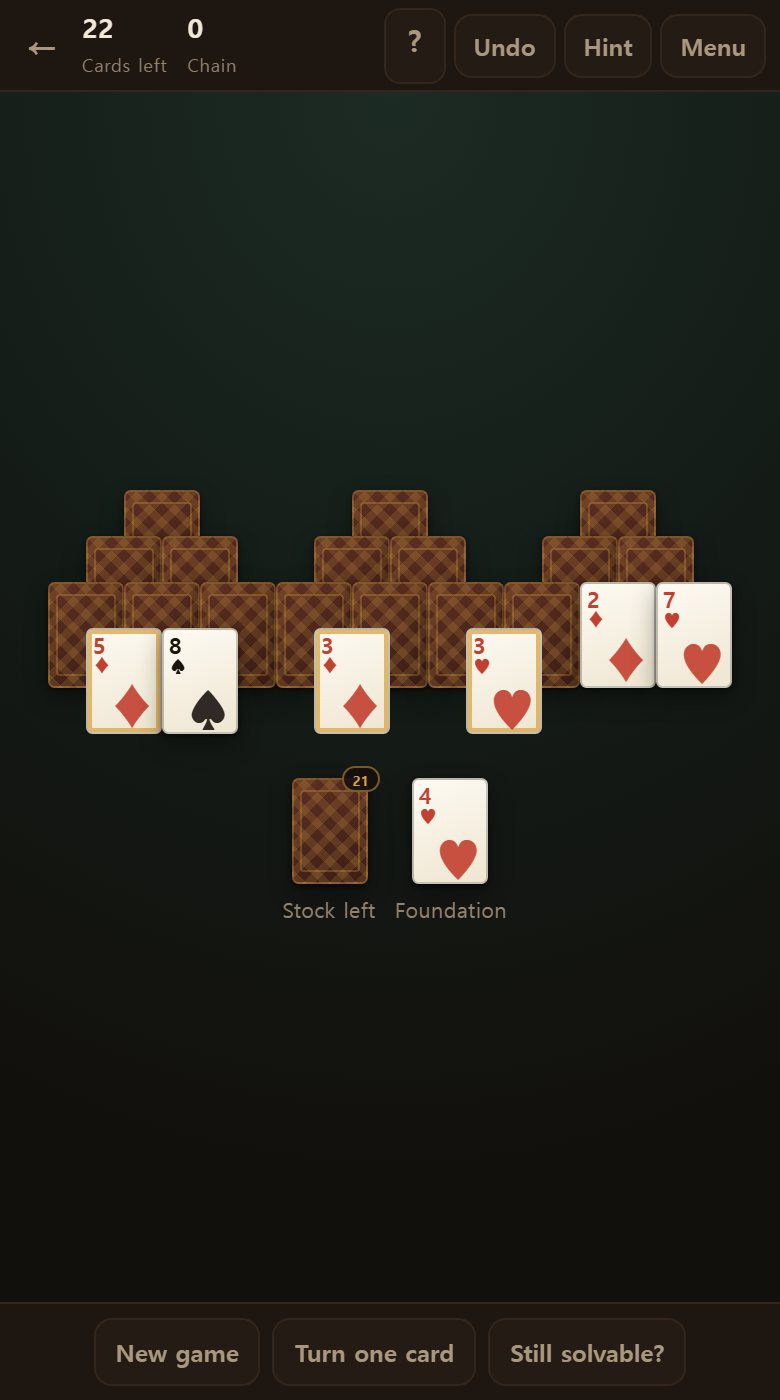
First, a look at the screen
The cards form peaks above, with two cards below them.
- The three peaks — twenty-eight cards in all. These are what you must clear.
- The ten along the bottom — face up from the start. This is where you begin.
- The face-down card at the bottom left — the stock, holding twenty-three cards.
- The face-up card at the bottom right — the pile. Its top card is what you play against.
- The figures at the top — cards left, your current run, and your score.
Cards ringed in gold are the ones you can take. Nothing to memorise — it is there to see.
This is how a board is dealt
Each peak is four rows deep: one card at the summit, two beneath, four beneath those, and a bottom row of ten running across all three peaks.
Only that bottom row is face up; everything above is face down.
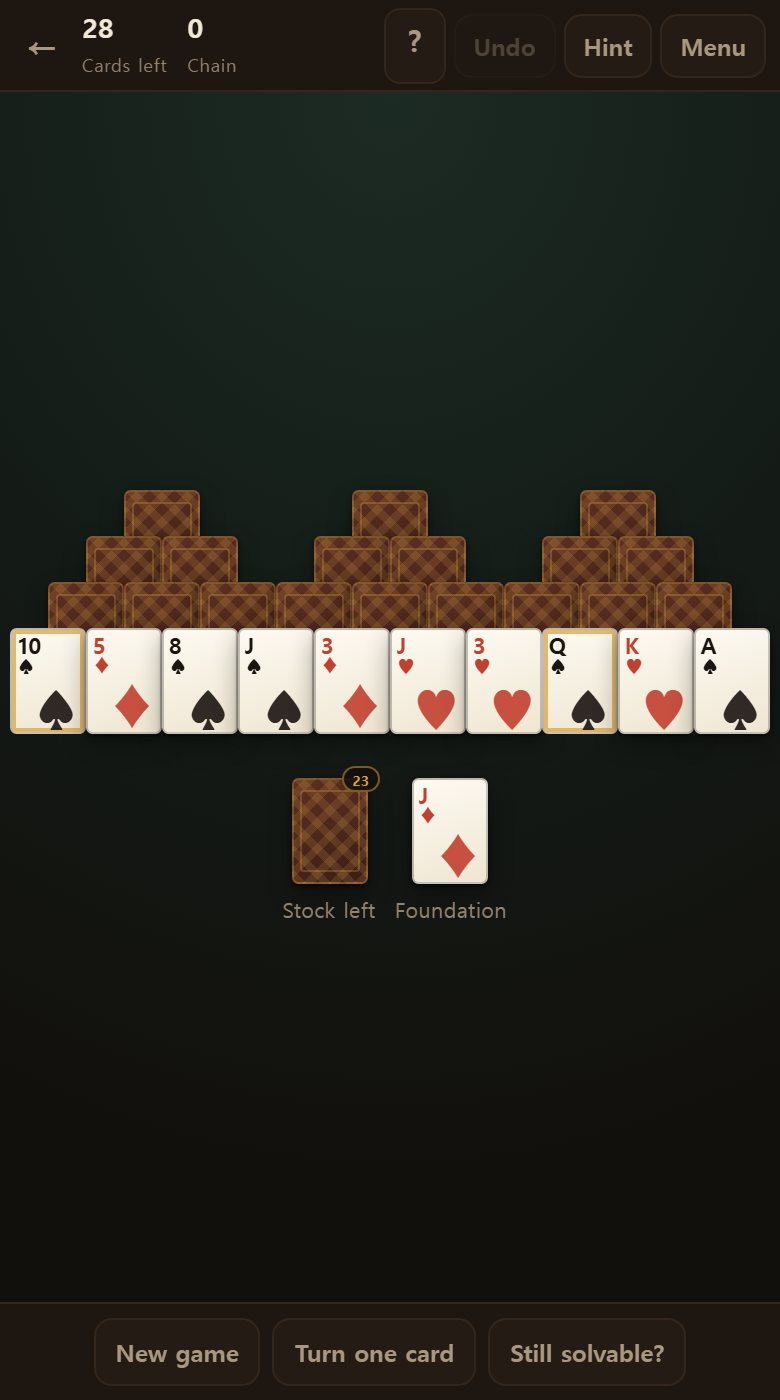
So unlike Golf, TriPeaks has cards you cannot see. Not knowing what will come up is half the game.
One rank up, one rank down
With a 7 on the pile, the only cards you can take are a 6 and an 8.
Suit and colour do not come into it. Only whether the rank is one away.
- J counts 11, Q 12 and K 13.
- The card you take becomes the new top, and the next move is measured against that.
- So you can run long chains up and down — 5 6 7 6 5 4 3.
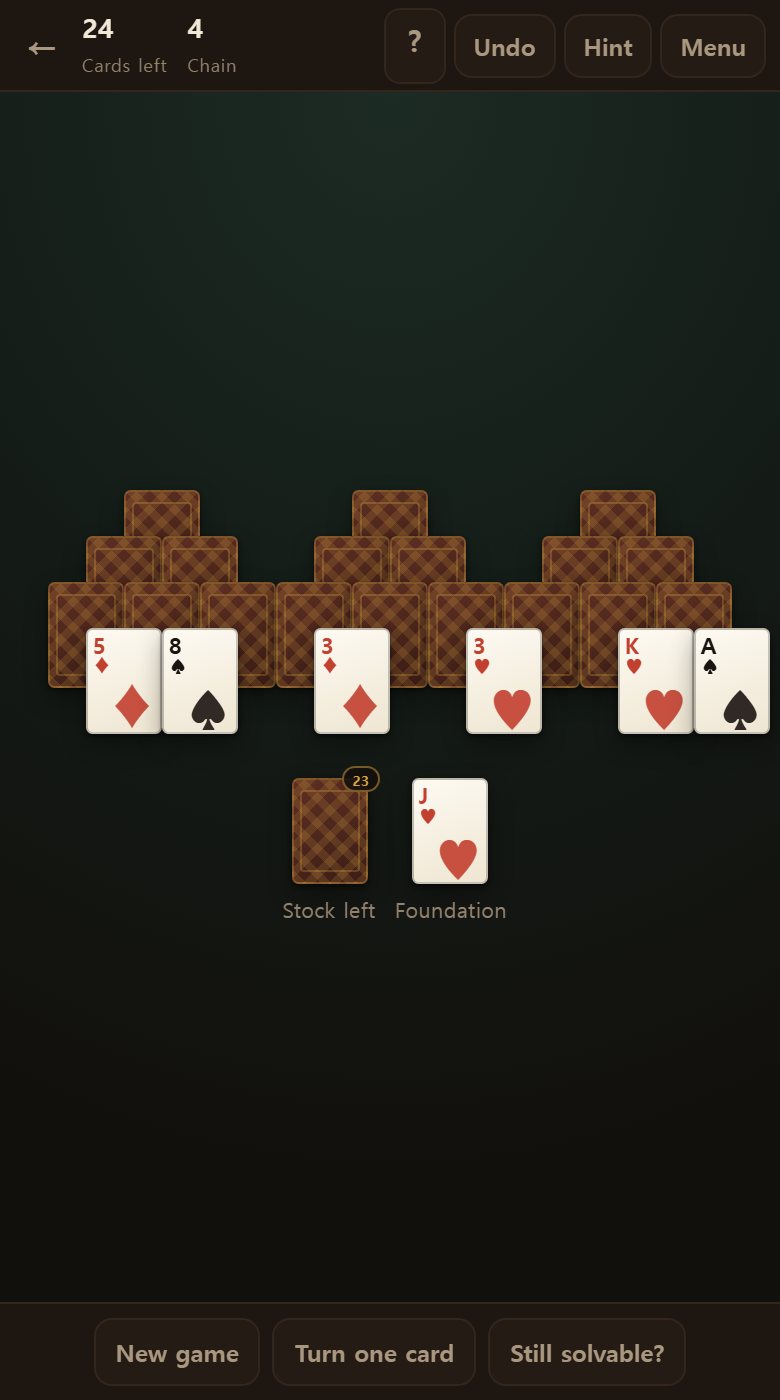
Here, A follows K
Unlike Golf, TriPeaks lets the ranks wrap round like a clock.
An A goes on a K, and a K goes on an A, so runs rarely break.
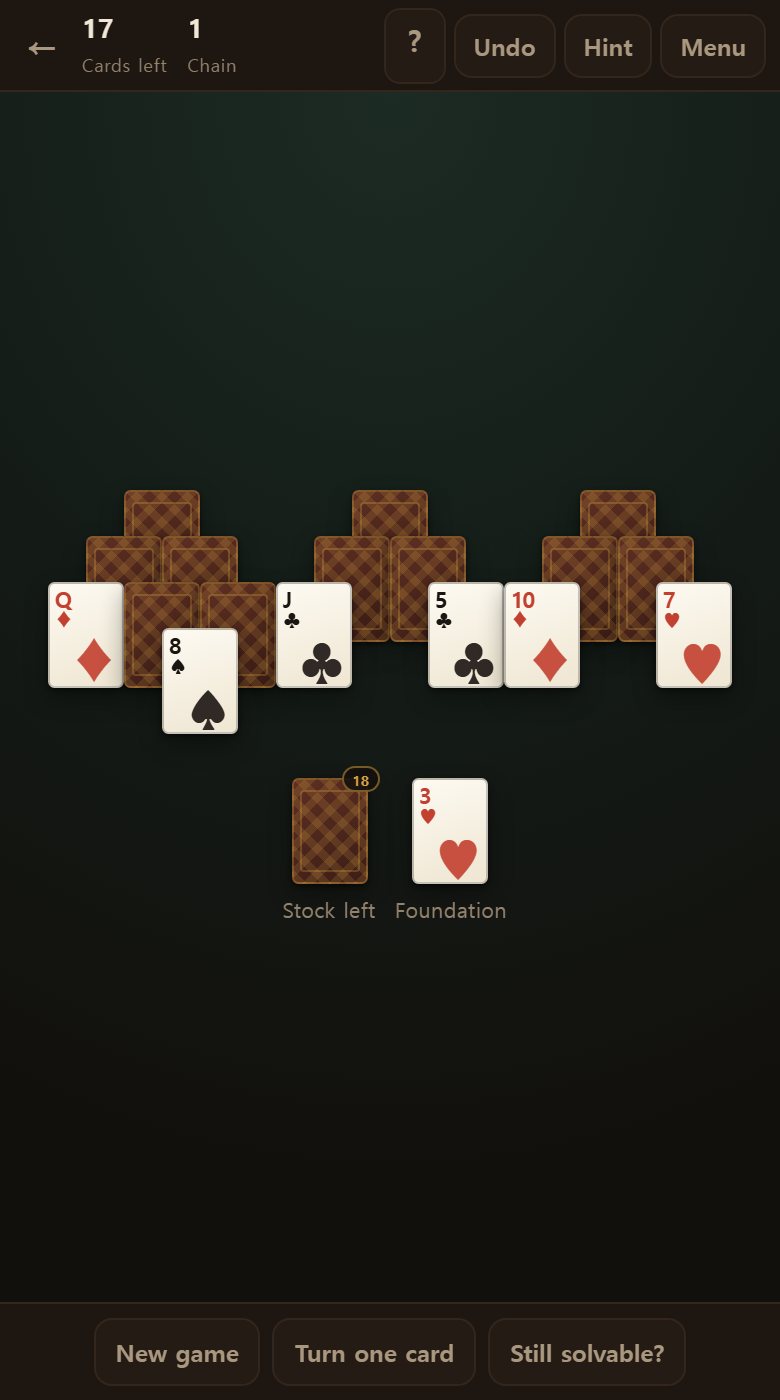
The menu can turn wrapping off, which makes it much harder. It is on by default, that being the common rule.
Covered cards lie face down
The peaks overlap by half, so any card rests on two beneath it.
Both have to go before the card above turns face up. One is not enough.
- Tapping a face-down card does nothing.
- Until it turns, there is no telling what it is — which is why the game cannot be calculated all the way through.
- The ten along the bottom are all available from the start.
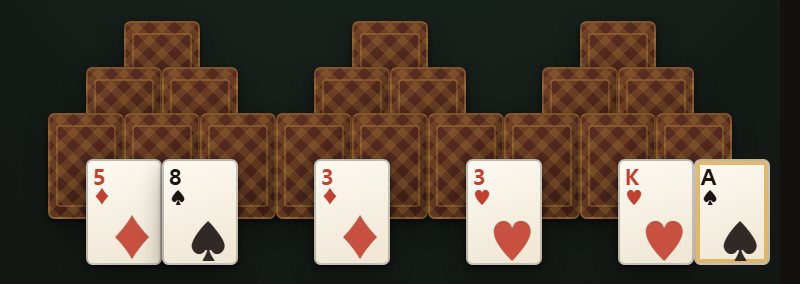
Dig one peak and it opens quickly while the other two stand untouched. Better to bring all three down evenly.
A long run scores heavily
Your score comes from how many cards you take in a row without turning — and it does not add up evenly. It grows as it goes.
Ten cards taken one at a time is 10 points. Ten taken in a row is 55 — more than five times as much.
- The chain figure at the top shows how many you are into a run.
- Past three cards, it says so in large type.
- Turning a single card from the stock breaks it back to 0.
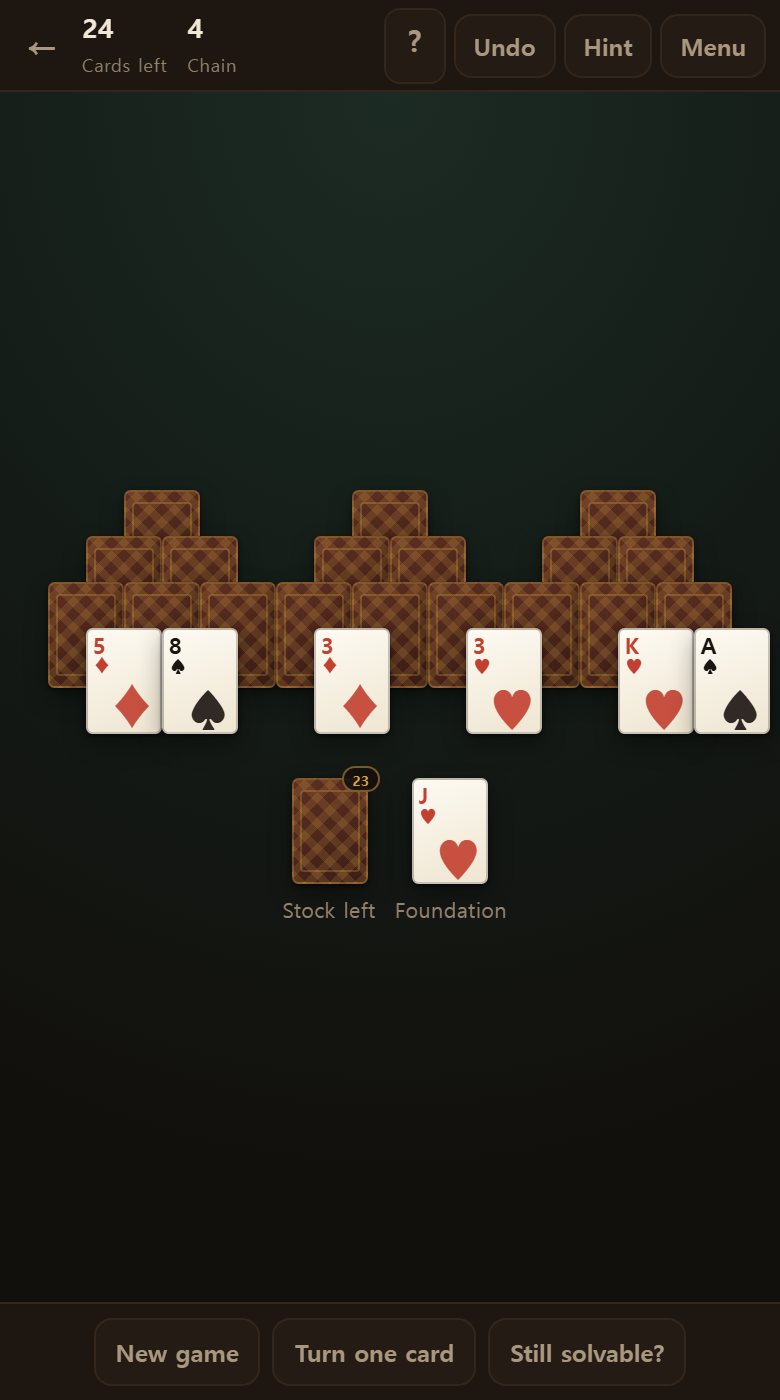
So the real pleasure here is “how far can I run it?”. Even without clearing the peaks, a long chain is a good game.
Stuck? Turn a card
With nothing to take from the peaks, tap the stock at the bottom left. One card turns onto the pile as the new top.
The target changes and plays open up again.
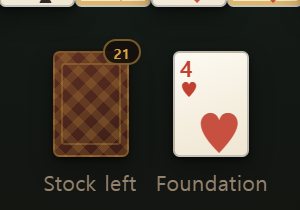
The stock holds only twenty-three cards and never comes back — and turning also breaks your chain. You lose both at once.
When to hold and when to turn
This is where skill shows in TriPeaks. When two cards are available, which you take decides how long your chain runs.
Say both a 6 and an 8 are available. Take the 6 and there is no 5 or 7 to follow, and it breaks. Take the 8 and a 9, a 10 and a J run on after it. The 8 is the answer.
- Before taking, look once more at what follows on.
- Turning a face-down card creates new possibilities. Choosing the move that opens one is a strategy in itself.
- One long run is worth far more than several short ones.
- When the stock is nearly gone, spend it. Cards left over score nothing.
- Play with the chain figure in view. Turning sends it straight back to 0.
Scoring rises with the length of the chain. Ten cards one at a time and ten in a row differ several times over. So holding one card back to build a longer run is nearly always worth it.
Which peak to bring down
Bringing all three down evenly is the basic principle. Dig one and the others jam completely.
- Taking from towards the middle of the bottom row opens what is above sooner.
- The cards at either end support only one card above. There is no hurry there.
- Open the side with the most cards still face down. That is where the paths come from.
- The three summit cards open last. Take care not to jam just before them.
- When torn between two, take the one with more cards resting on it.
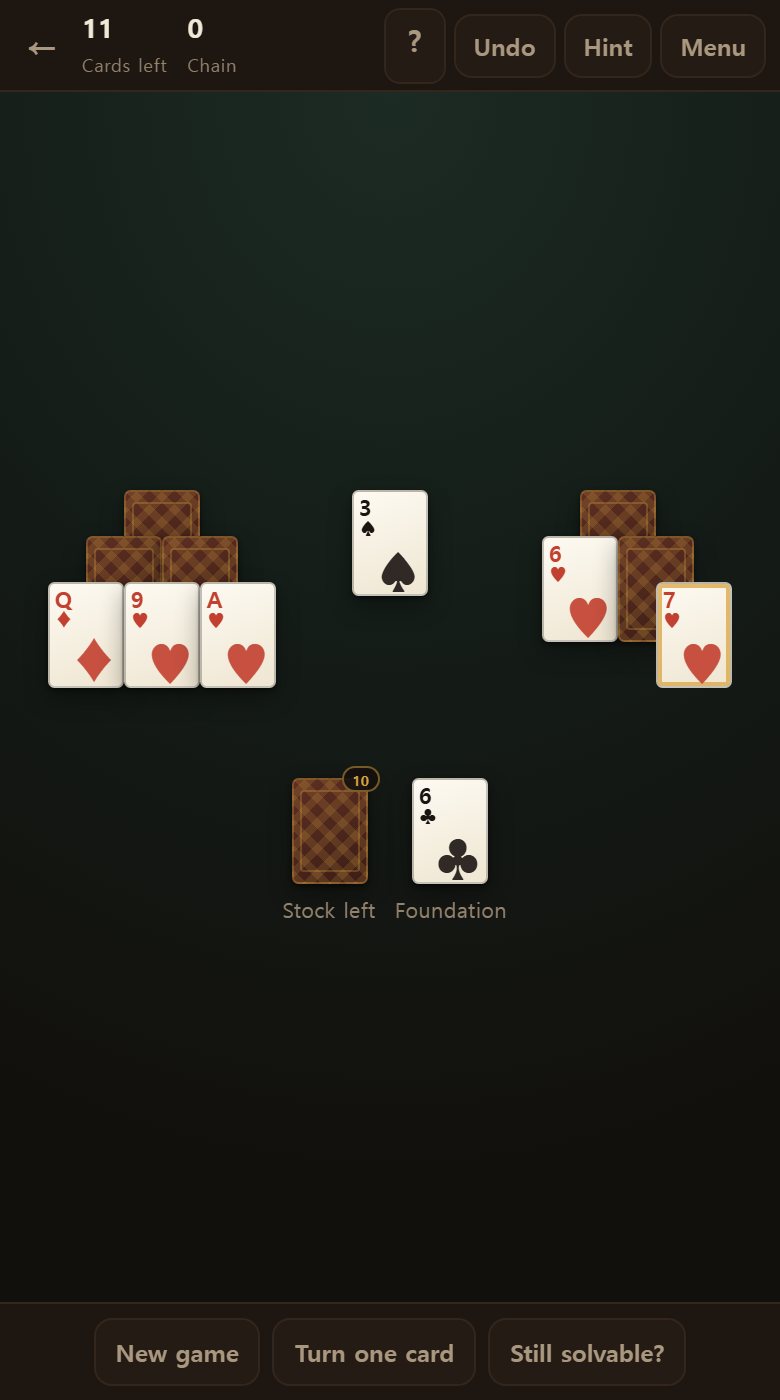
Even a peak brought fully down leaves you short of moves while the other two stand. Lower all three together and there is always a card to continue with.
Only solvable boards are handed out
Deal TriPeaks at random and some boards cannot be cleared at all.
Here, every board is checked as clearable to the end, with the face-down cards known. Any that cannot be is thrown away and rebuilt.
But you do not know the face-down cards, so a verified board is not necessarily an easy one. It means a path exists.
- Every board is brought fully down in check before it is handed out. Any that cannot be is discarded.
- So a jam is never the board's fault — it is the order you took them in.
- Undo and take them in a different order, and the path is there.
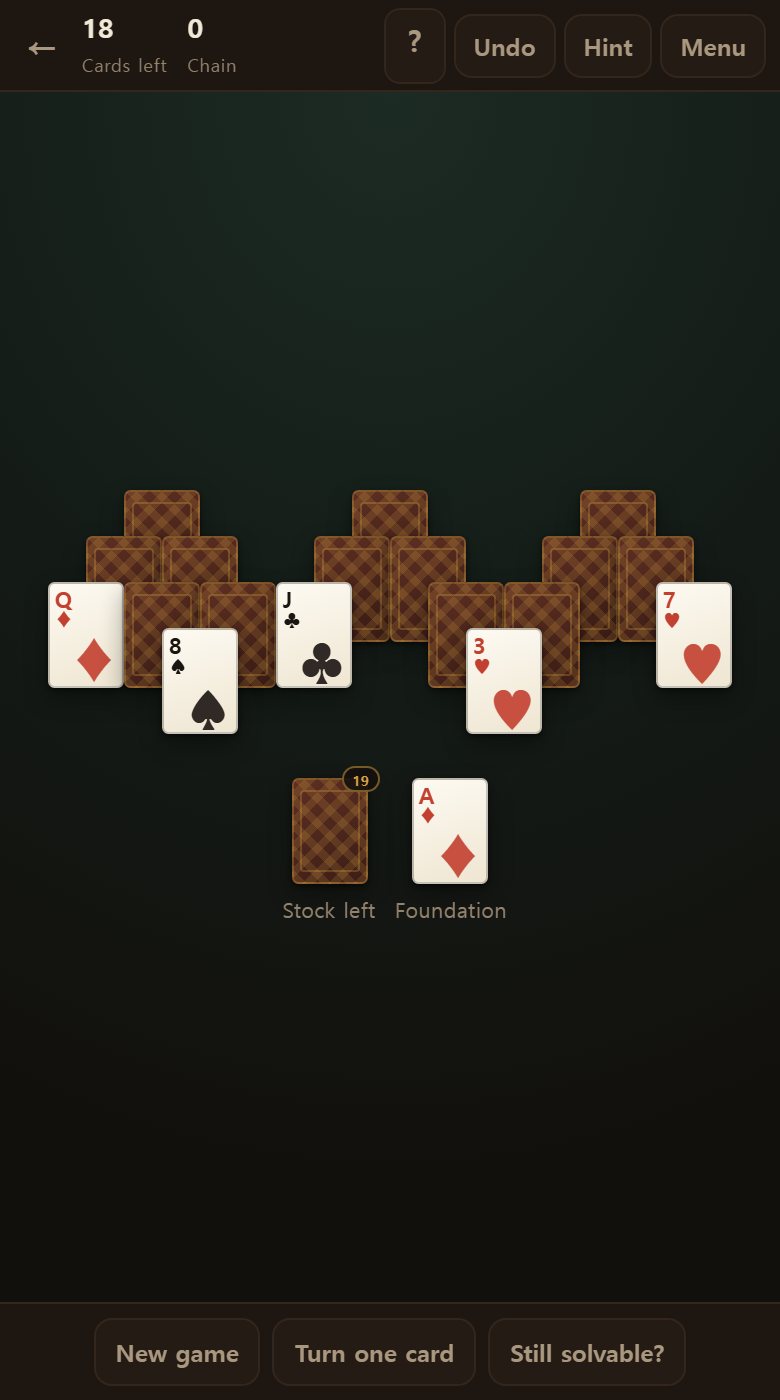
To ask whether a path still exists from here, press Does it still solve? below. It does not estimate — it plays the position out to the end before answering.
Undo and hint
Took the wrong card? Press Undo at the top, as often as you like. A turned card goes back to the stock, and your chain comes back with it.
If you cannot see it, press Hint. It marks the first move of a winning line in blue, and no more.
- The hint searches knowing the face-down cards, so it sees further than you can.
- Sometimes it says to turn a card — meaning holding back is the right move.
- Using the hint leaves your score untouched. Nothing is deducted.
- On a keyboard, undo is Ctrl+Z and hint is H.
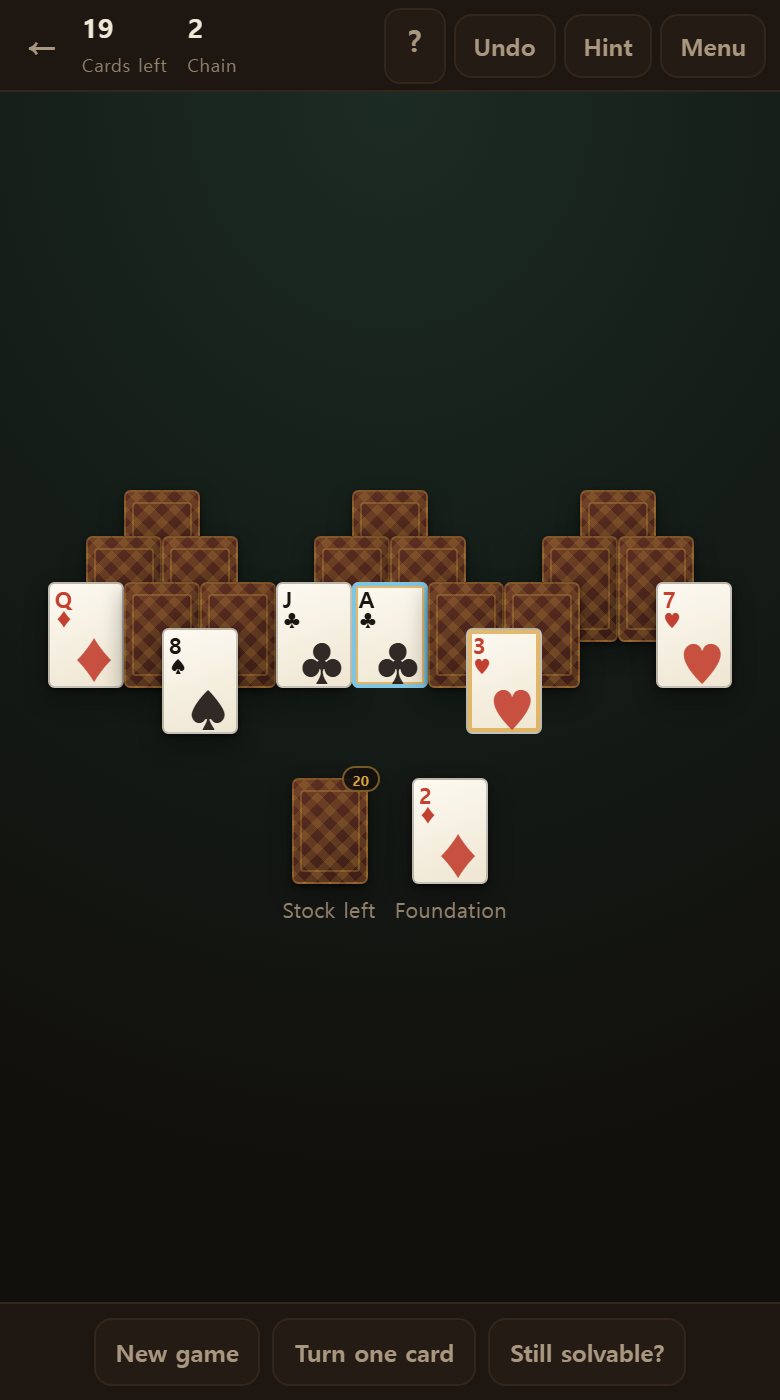
When the hint marks a card, count what follows on from it yourself. That is when you see why it chose that one.
When the peaks are down
Bring all three peaks down and you win. Cards left in the stock do not matter.
Clearing the peaks adds a bonus to your score. Your best score and your longest chain are both kept.
- The board number is kept too. Note it and you can open the same board again.
- Even short of clearing them, what you took still scores.
- Your record stays on this device. Nothing is sent anywhere.
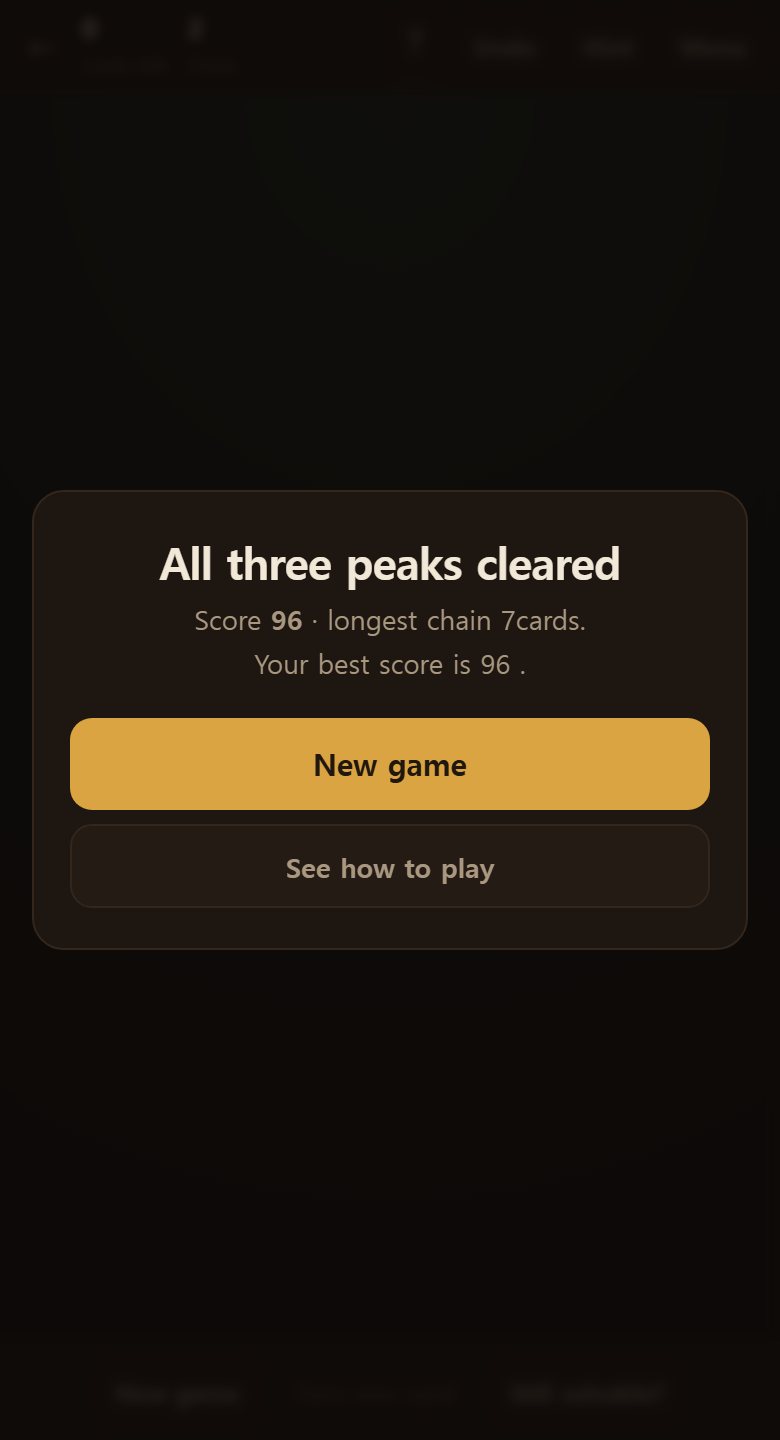
How the scoring works
Within a chain, each card scores according to its position: the first 1 point, the second 2, the third 3, and so on.
- So three in a row is 1 + 2 + 3 = 6 points.
- Five is 15, and ten is 55.
- Ten cards taken one at a time is 1 point each — only 10.
- Clearing the peaks adds a separate bonus.
- After a turn, the next card counts from 1 again. Turning costs more than it appears to.

So TriPeaks is a game of clearing the board and a game of building runs at once. A long chain can outscore a full clear.
Undo
Press Undo at the top and your last action never happened. On a keyboard it is Ctrl+Z.
- A turned card goes back to the stock.
- A broken chain comes back too, and your score with it.
- You can undo as far back as the start.
- Undoing does not un-see a card — what has once been turned stays known to you.
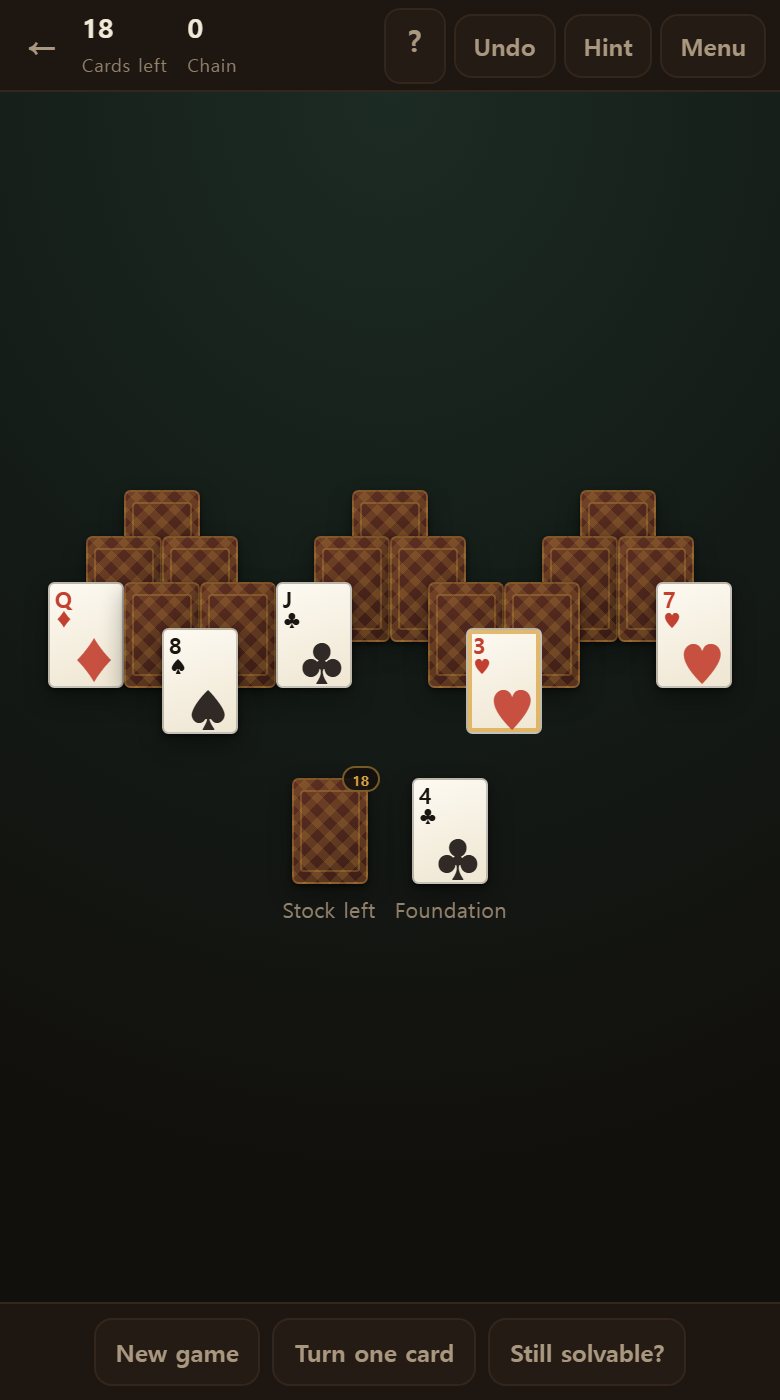
If you feel a long run slipped away, undo without hesitation. A broken chain costs a great deal of score, so rebuilding it is nearly always worth it. With cards face down, you cannot see ahead at first. So undoing and taking them again is how you see ahead — once a card has been turned, the fork before it looks quite different.
How to score well
Five habits will change your score markedly.
- Look ahead before taking. Five cards running is worth far more than one card and a break.
- Bring all three peaks down evenly. Dig one and the others jam completely.
- Take the card with more resting on it. One card is not the same as another in what it opens.
- Sweep the peaks once more before turning. Be sure nothing there continues the run.
- Given two ways to continue, take the longer. The short one is usually still there later.
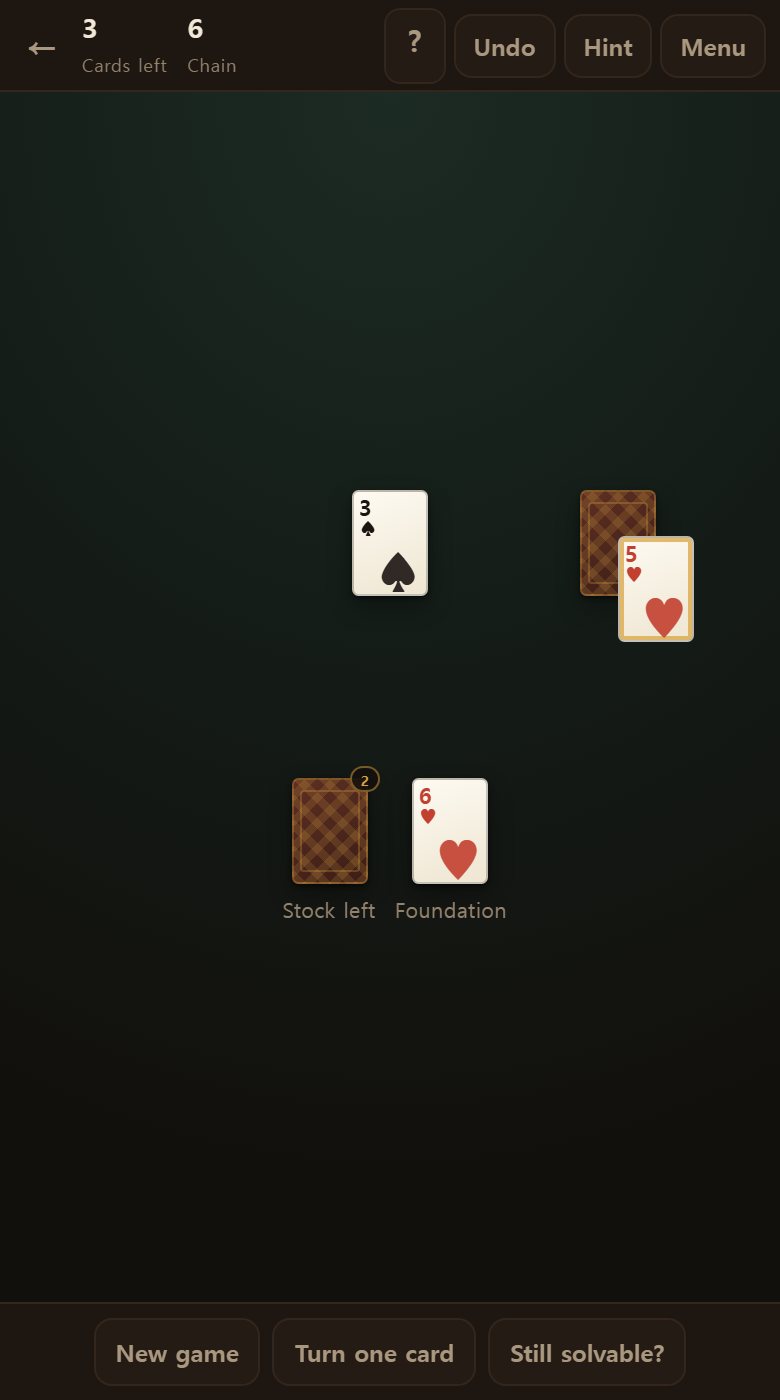
All five are really one: build long runs. Ten cards in a row scores several times what ten taken singly does.
Common mistakes
Low-scoring games are nearly always one of these four.
- Taking whatever is available — the commonest of all. Take everything you can and the run breaks, forcing a turn — and a turn sends the chain to 0.
- Digging one peak — one side drops away while the other two stand. The summits never open and you jam there.
- Turning too readily — the stock is only twenty-three cards, and every turn sends chain and scoring back to the start.
- Not counting the covered cards — a dim card opens as soon as the two beneath it go. Treating it as absent hides the paths from you.
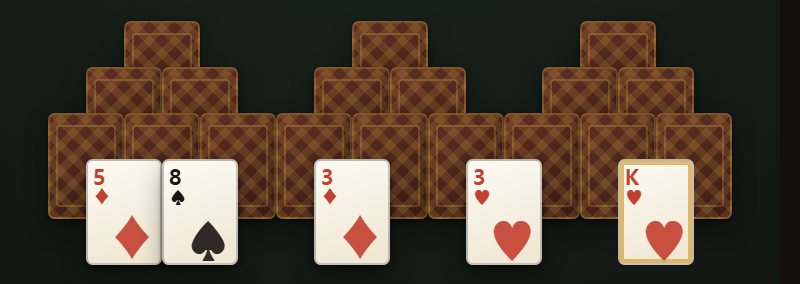
All four come from taking only the card in front of you. TriPeaks is not about one card but about the whole run that follows.
Common questions
It has to be one rank from the top of the pile. Only cards with a gold ring will lift.
Take both of the two cards supporting it and it turns by itself.
Yes — the ranks wrap round in TriPeaks. You can turn that off in the menu.
How many cards you have taken in a row without turning from the stock. The longer it runs, the more each card scores.
No. Once the twenty-three are turned, that is that.
Try undoing. This site only hands out boards that can be cleared.
That is a good game. Building long runs is a goal of TriPeaks in its own right.
- Before you take a card, look at what chains after it. A long run pays much better.
- Do not dig into one peak alone. Bring all three down evenly and the tops open up.