 MindHub
How to play Spot the Pair
Every card is laid out face up and you find the matching pair by eye. There is nothing to remember. Each board holds exactly one pair; every other card is a loner. What is measured is how fast you clear a set number of boards.
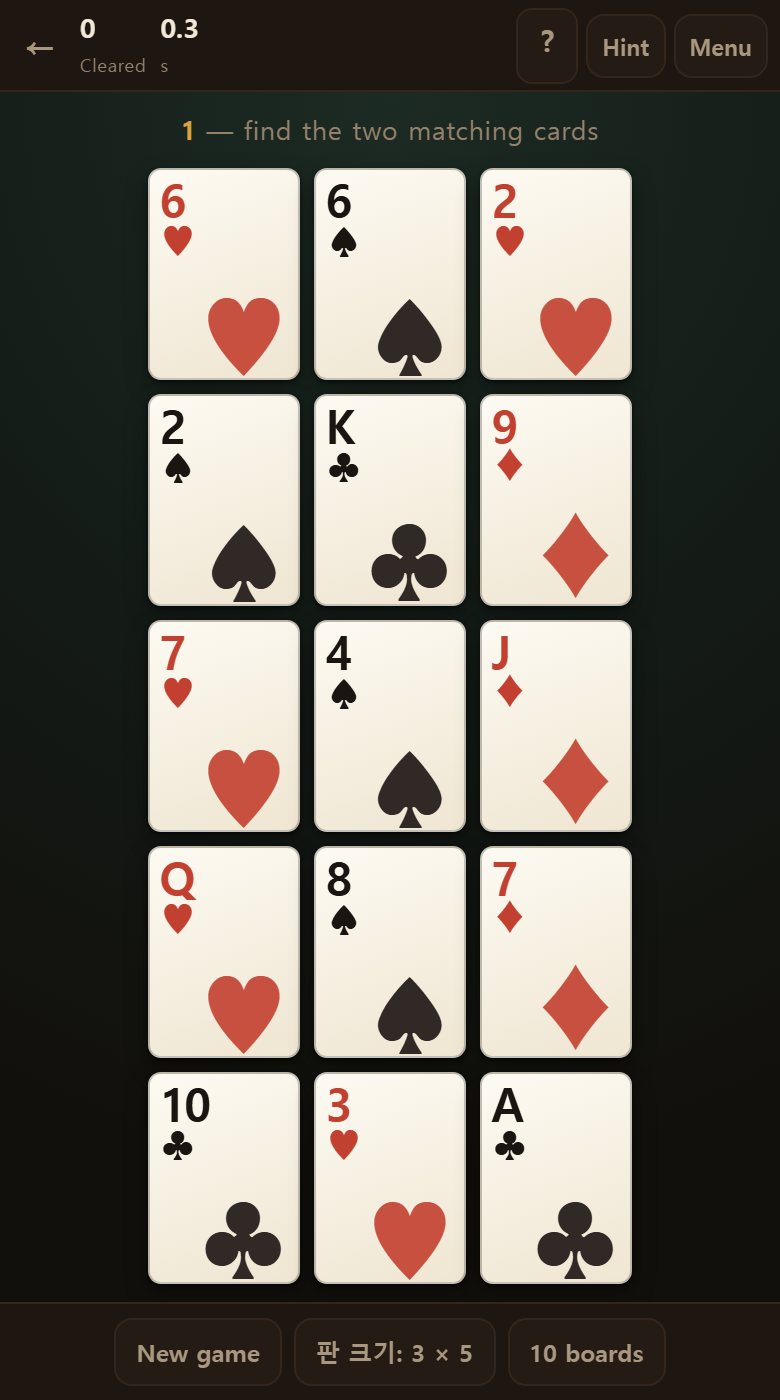
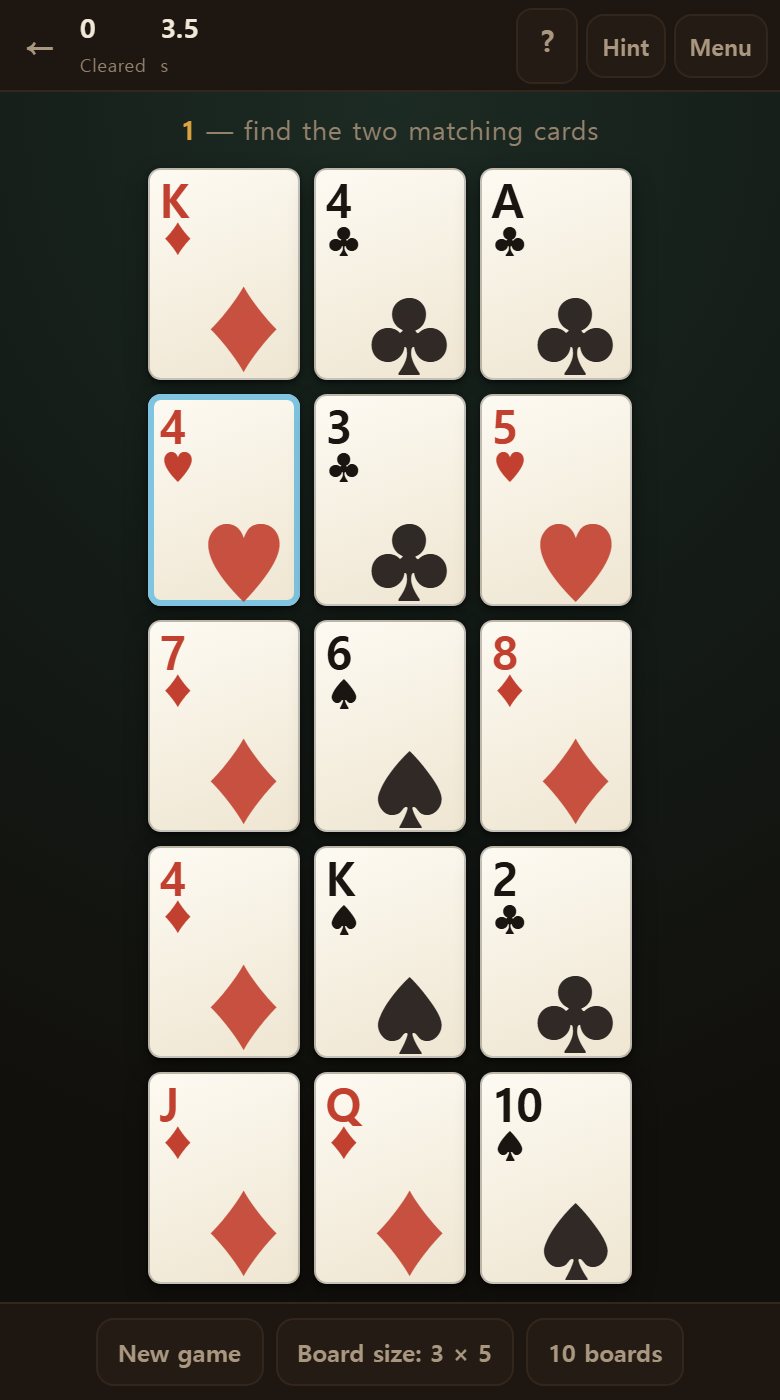
First, a look at the screen
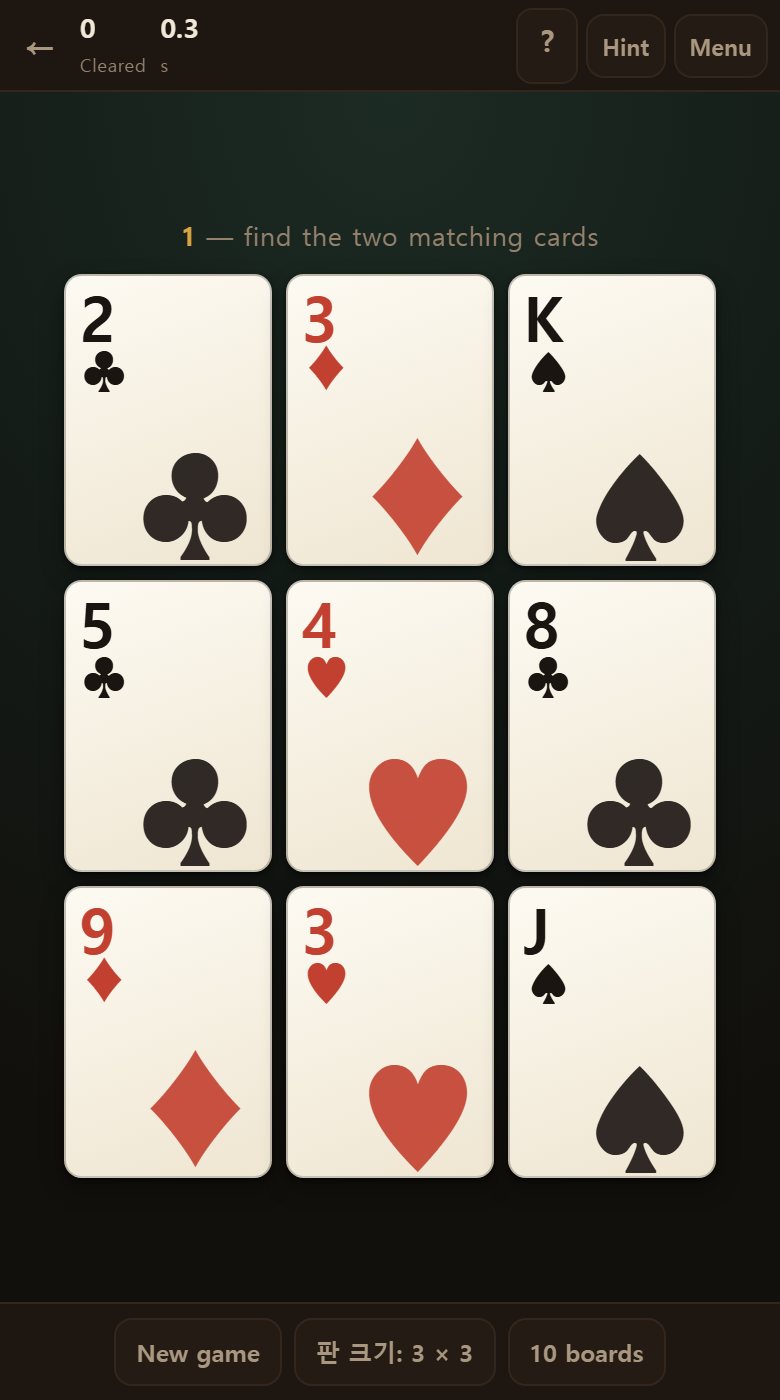
The cards lie in a grid, all in plain sight. Nothing is face down.
- The grid — exactly one pair is hidden in here.
- Top left — boards cleared, time elapsed, and misses.
- The line above the grid — which board you are on.
- The buttons below — new board, board size, and how many boards to time.
Unlike Concentration, there is nothing to remember — it is all visible. The only work here is scanning.
There is exactly one pair
That is the promise this game makes. Boards are built so that a match occurs once and once only.
So if you have found two cards that look like a pair, that is the answer. There is no need to wonder whether another lurks elsewhere.
- Find the pair and that is the answer. There is nothing further to check.
- So do not spend time hunting for a better pair.
- Every other card is a loner, so no other two of them match.
Two pairs would make it trivial; none would make it impossible. So it is held to exactly one, and a check confirms it for every board.
A pair is the same rank and the same colour
This is where people trip up. Matching ranks alone is not a pair. The colour has to match too.
- 7♠ and 7♣ — both black, so they pair.
- 7♥ and 7♦ — both red, so they pair.
- 7♠ and 7♥ — different colours, so not a pair.
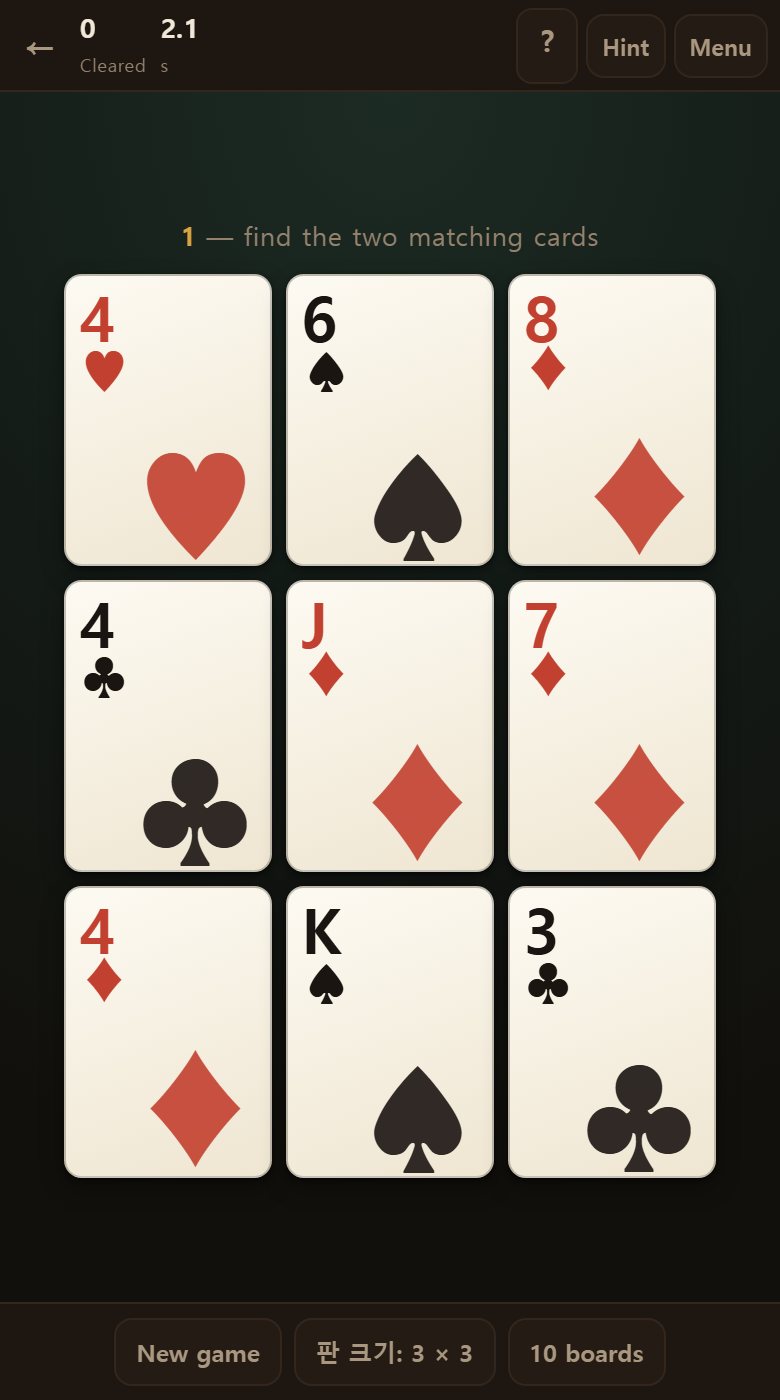
So when the same number appears twice, check the colour first. Boards deliberately mix in same-rank, wrong-colour cards. That is the trap.
Tap two cards to match
Tap one and it lifts with a gold ring. Tap the other and you are told at once whether it matches.
- A match makes both flash gold, and a new board is dealt straight after.
- A miss turns them red and leaves the board alone. Just look again.
- Picked the wrong card? Tap it again to drop it. Esc clears it too.
- You can leave one card picked for as long as you like — it will not let go by itself.
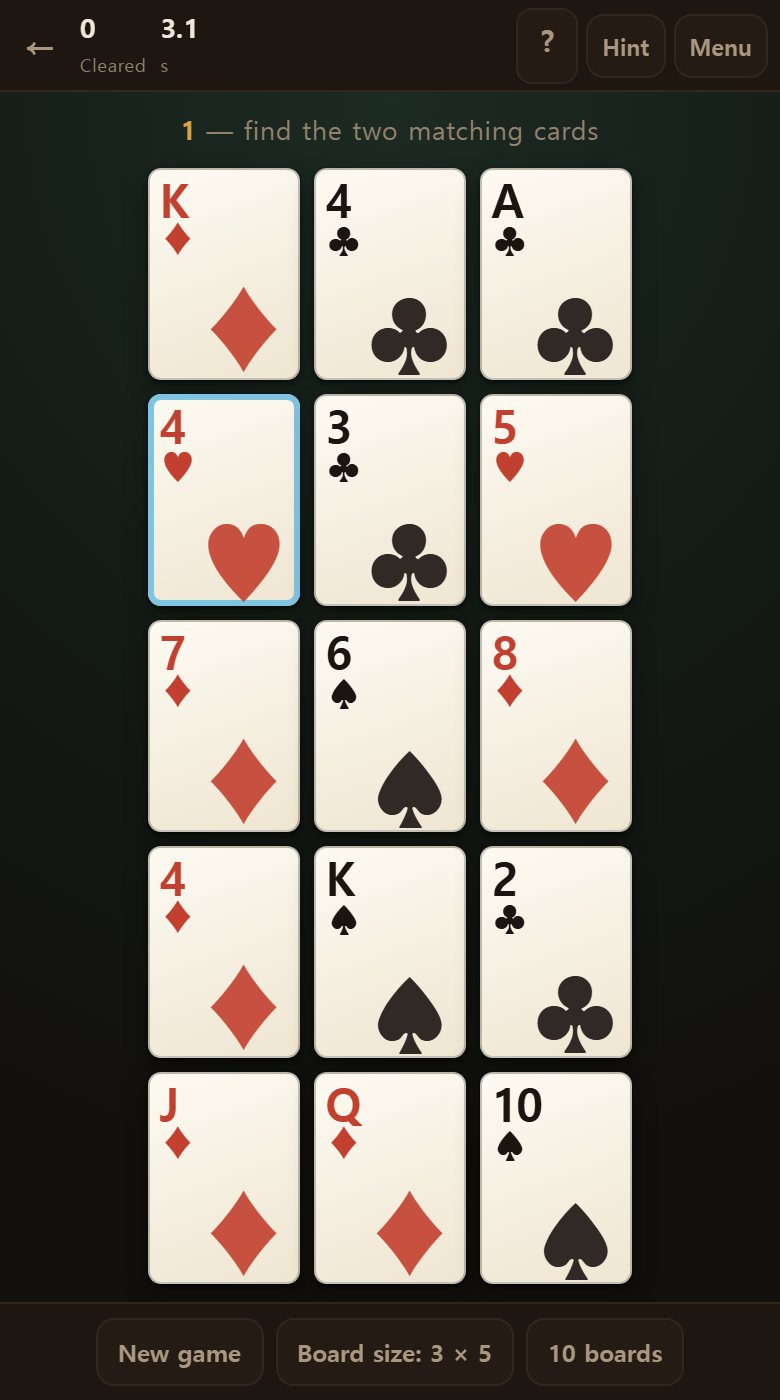
You tap the two in turn; there is no dragging a selection round them. So a finger and a mouse work exactly alike.
A miss costs little
A miss only adds one to your miss count. The board does not change, and no time penalty is added.
But the clock keeps running while you miss. So looking once more before you tap is quicker than tapping at random.
- A miss leaves the board as it was. Look again on the same one.
- No time is added as a penalty, either.
- But the miss count accumulates to the end. It is never cleared.
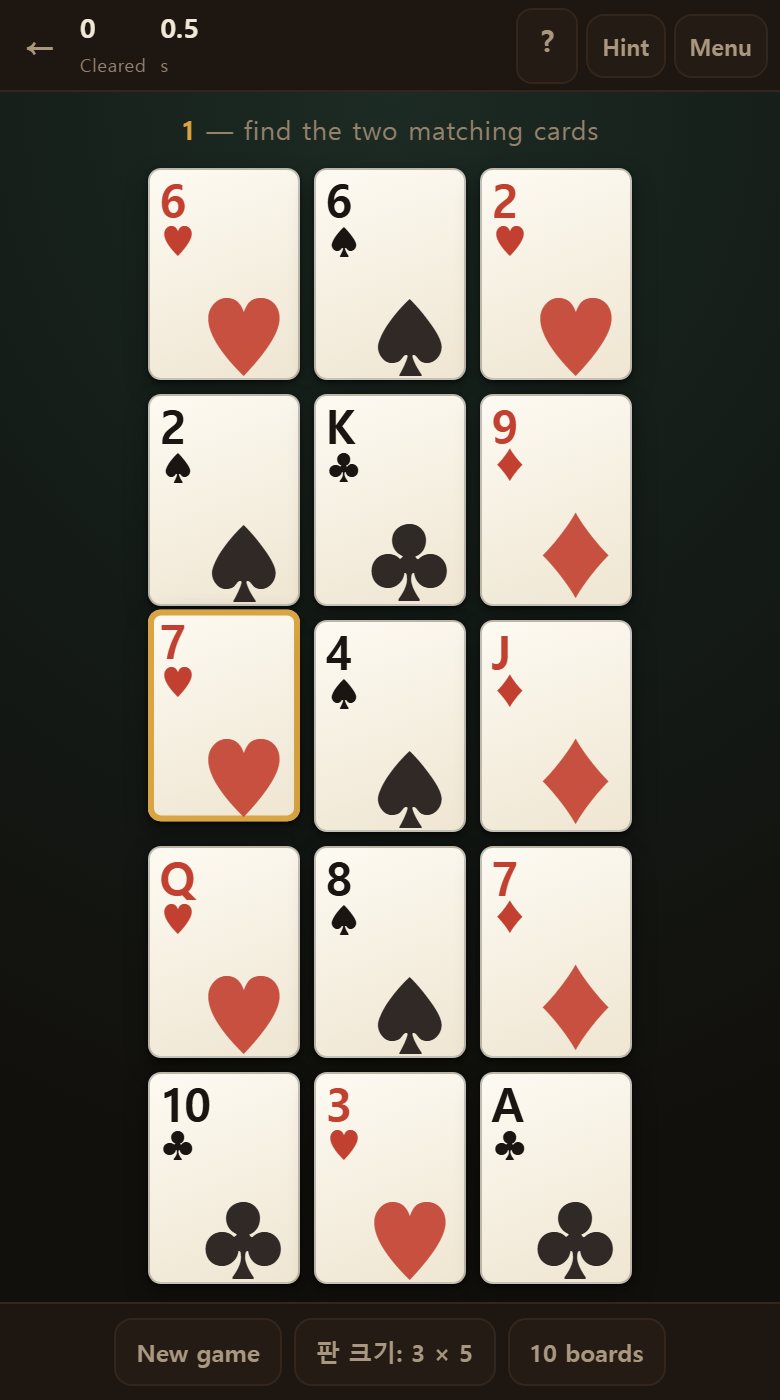
Your misses are shown at the end alongside your time. Read together, they show plainly whether you were rushing. With only one pair on the board, a guess almost never lands. On a 3x7 there are over two hundred ways to choose two cards. Do not guess.
How to find it faster
Scanning at random is slow. Fix an order and you speed up considerably.
- Scan the ranks first. Only when the same number shows twice do you check the colour.
- Look at reds and blacks separately. You only cover half at a time, which halves the work.
- Work row by row. Let your eye wander and you read the same card twice.
- Court cards — J, Q, K — stand out. Try pairing those first.
- A 10 is two characters wide and visible from further off. A useful clue.
- If nothing comes, change the direction you scan in. Reading down after reading across shows you a different board.
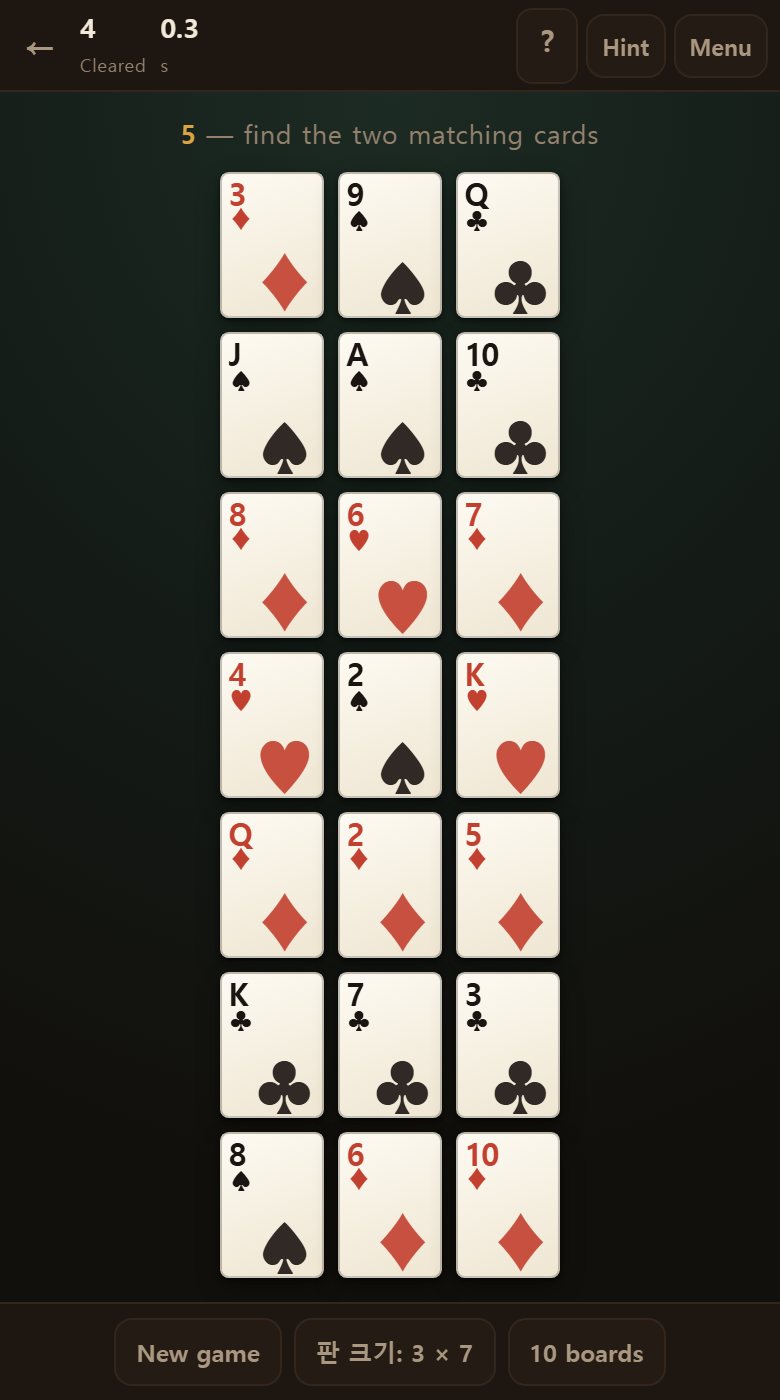
The commonest mistake is skipping the colour. Tap as soon as the numbers match and you are wrong half the time.
Board size and boards timed
The two buttons below change these.
- 3x3 — nine cards. Good for a first game, or for playing with a child.
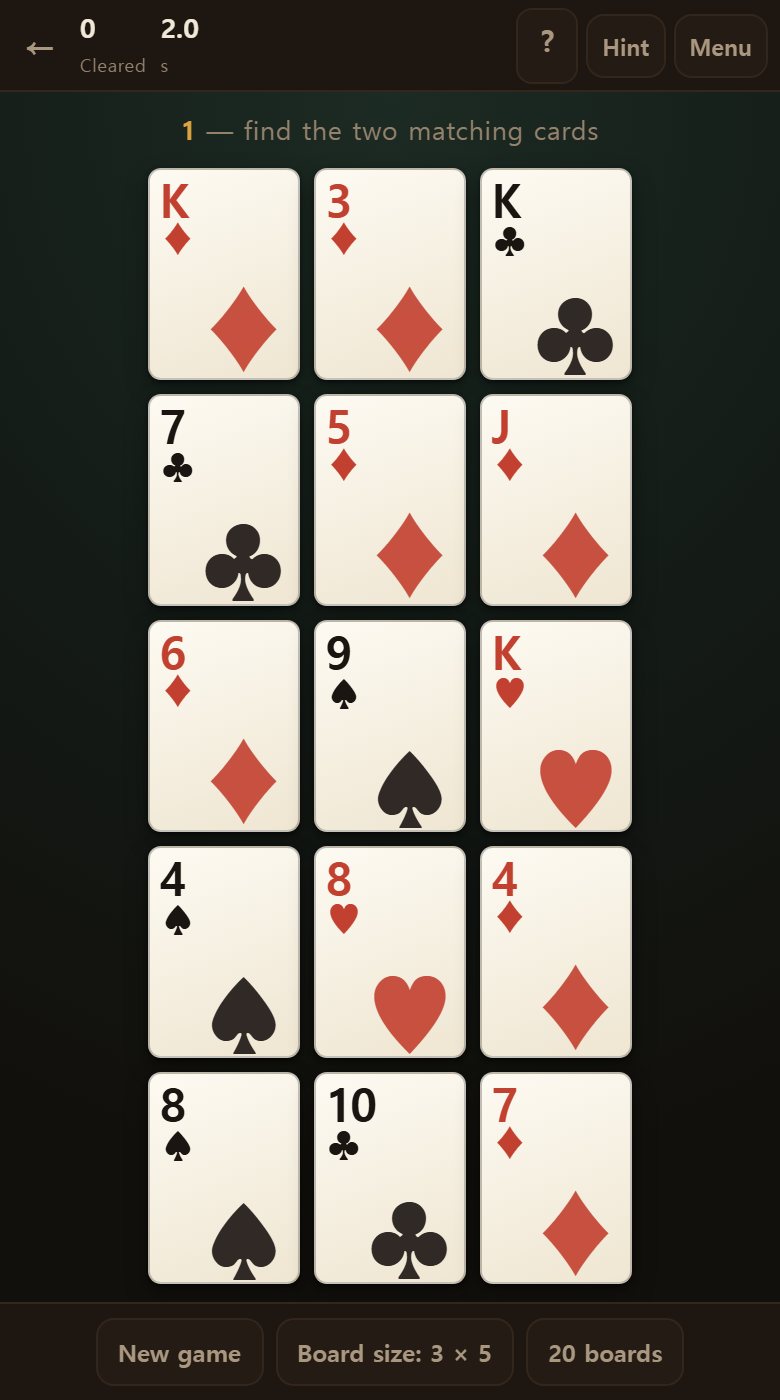
- 3x5 — fifteen cards. The standard.
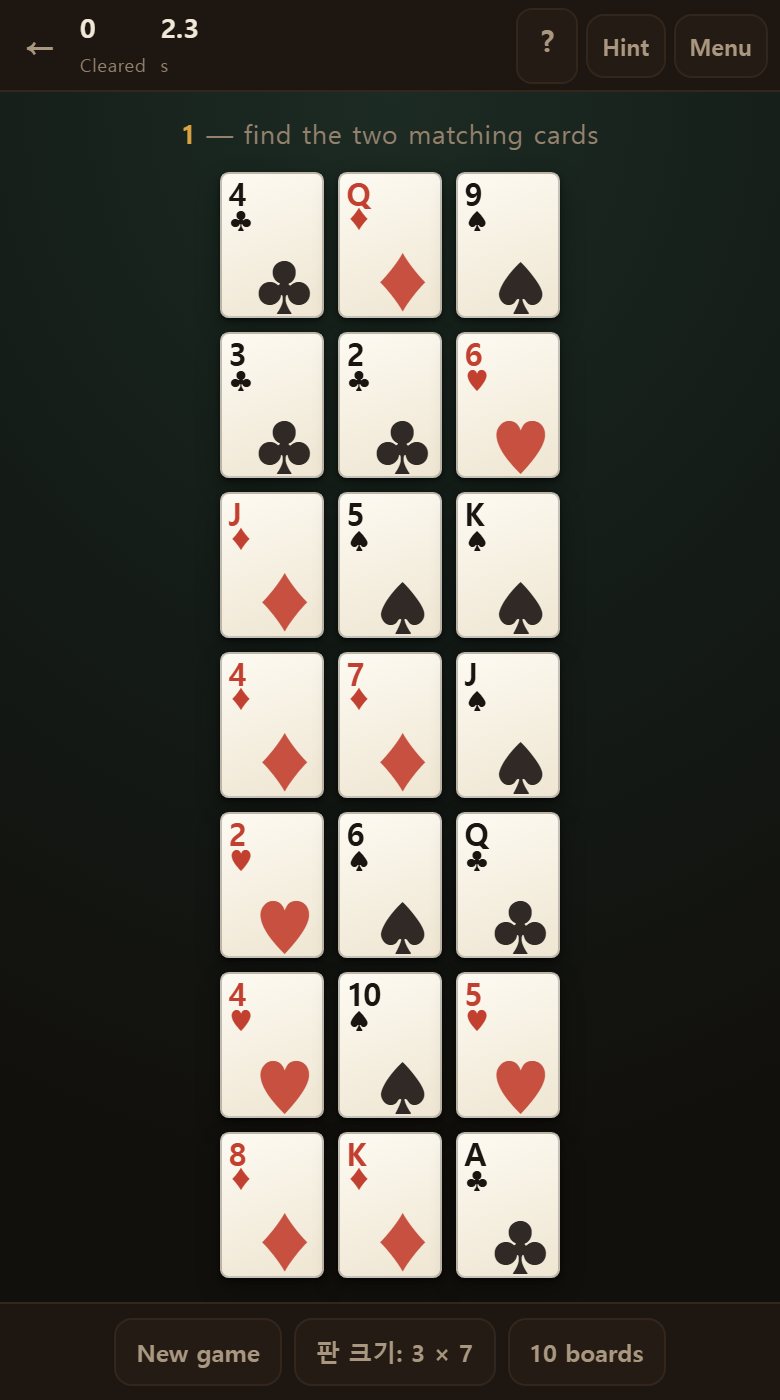
- 3x7 — twenty-one cards, and a great deal more ground to cover.
- 5, 10 or 20 boards — how many you clear before the clock stops.
- The two are set separately, so twenty small boards and five large ones are both possible.
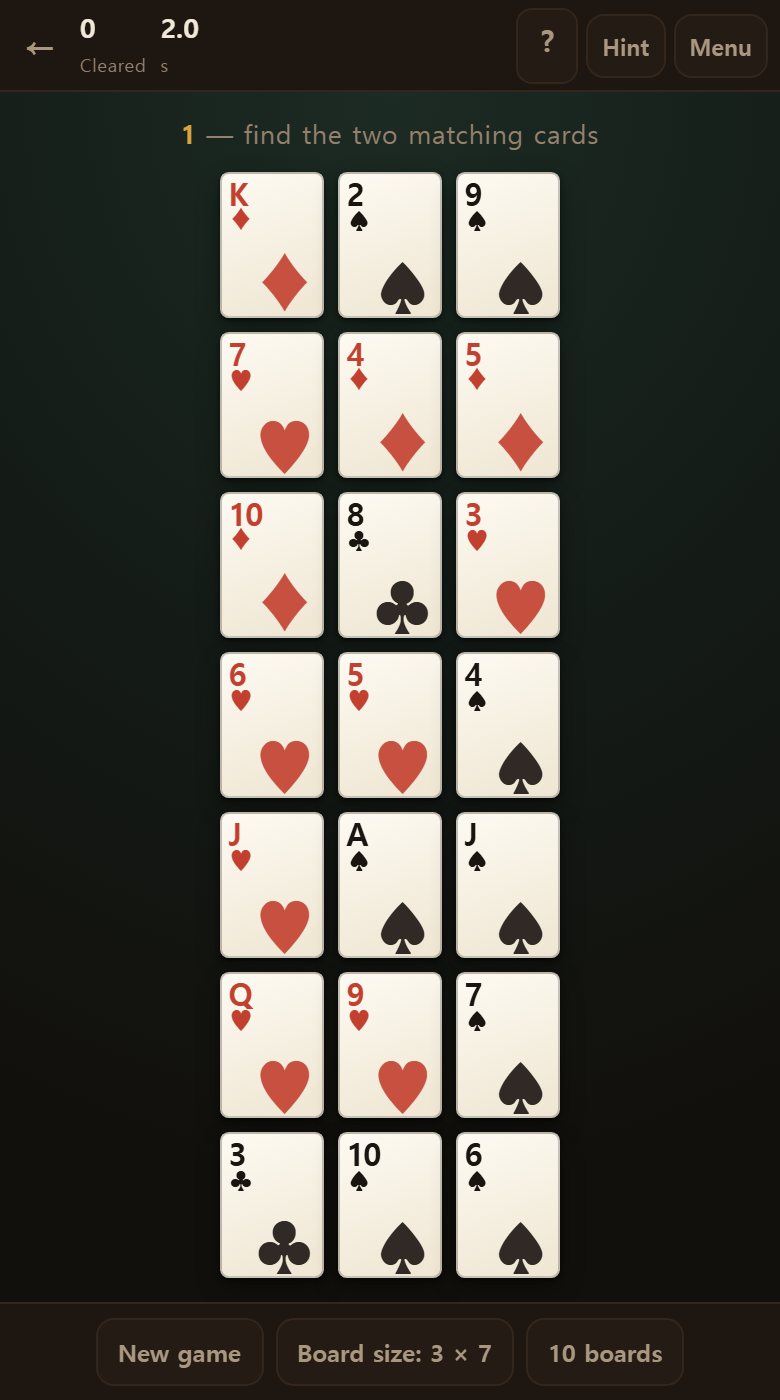
Records are kept per size and per number of boards. Ten boards at 3x5 and ten at 3x7 are separate records.
The clock runs from the start
Press new board and the clock starts immediately. There is no separate start button.
It stops once you have cleared the number of boards you set, and shows your time and your misses.
- The clock reads to a tenth of a second, so you can see what each board cost you.
- The clock does not stop between boards. It measures the whole run.
- It stops the instant you clear the last board.

Opening the menu stops the clock; closing it starts again. No time passes while you look at the settings. So if you need a moment, leave the menu open. Your record stays intact.
Hint gives you half
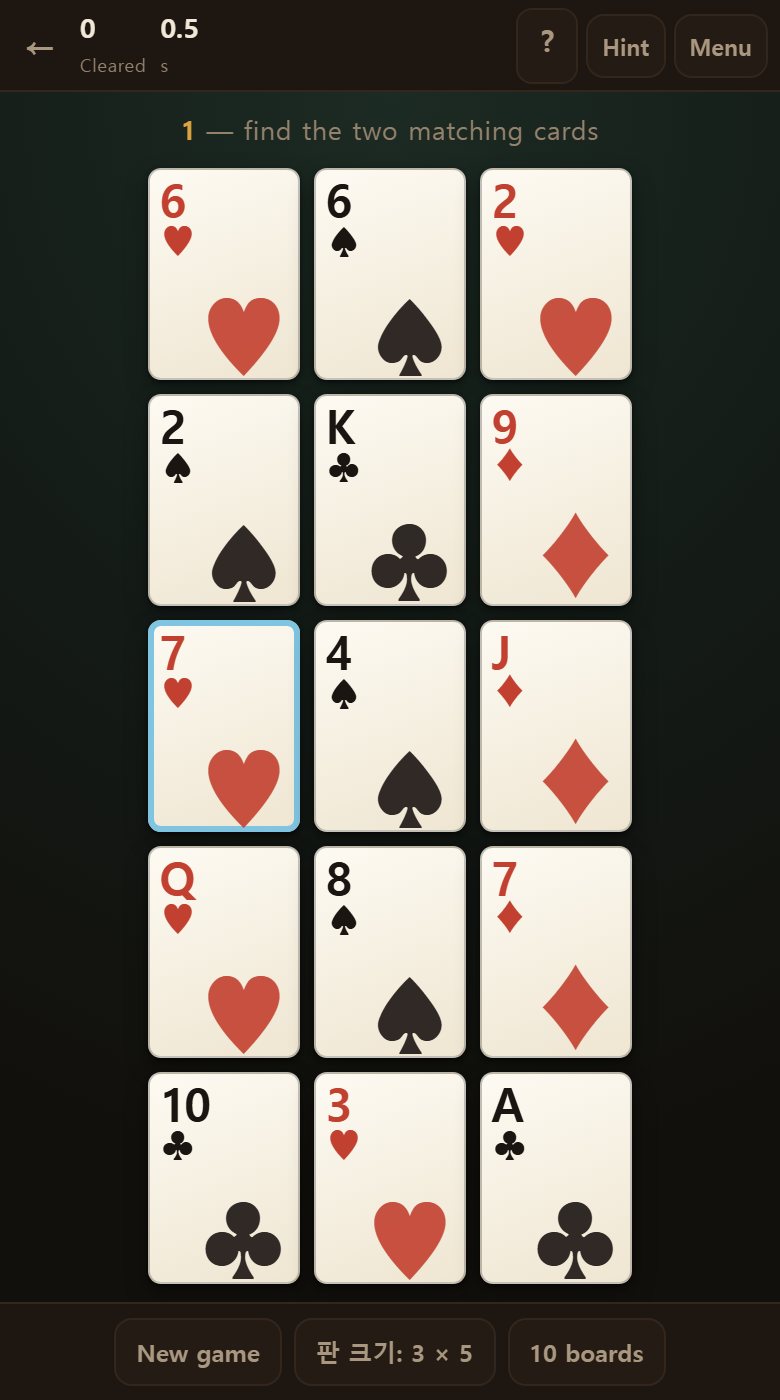
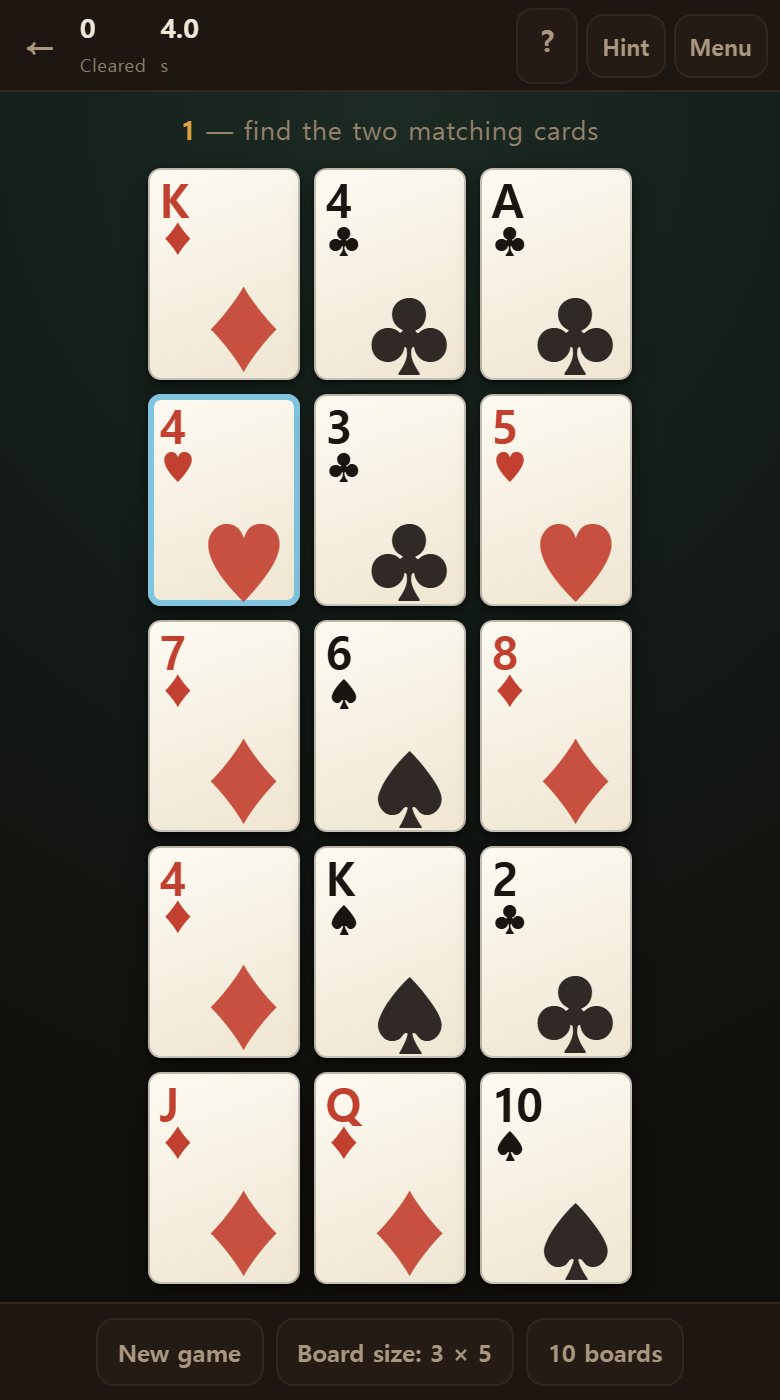
Stuck? Press Hint at the top. It marks one card of the pair in blue.
The other you find yourself. Marking both would be an answer sheet.
- From the card it marks, look for the same rank in the same colour.
- Knowing even one card cuts the ground to cover sharply.
- Using the hint leaves no mark on your record.
If you have already picked the card it marks, it gives you the other one instead. So in real desperation, press it twice. But leaning on it stops your eye improving. Use it only when a board has held you up for a long while.
How is this different from Concentration?
Both are about finding pairs, but the work is different.
- Concentration — face down, and you remember. Memory does the work.
- Spot the Pair — all face up, and you scan. The eye does the work.
- Concentration is a contest against an opponent; this one is against the clock.
What counts as a pair — same rank, same colour — is identical in both, because a word should mean the same thing throughout the site.
How a run unfolds
Here the boards never pause. Clear one and the next is dealt on the spot, with the clock still running.
- It ends when you reach the number you set — ten boards by default.
- Your record is the total time for the run, not a per-board figure.
- So a long struggle on one board costs the whole run.
- When stuck, pressing Hint and moving on is sometimes the better play.
Ten boards inside a minute is good going — about six seconds a board, which is within reach at 3x5.
How to get faster
Five habits will make a visible difference.
- Scan the ranks first. Taking in the colour at the same time halves your speed.
- Only when the same number shows twice do you check the colour. That is usually where the answer is.
- Scan by row. Let your eye jump about and you read the same place twice.
- Never re-read a row. With only one pair on the board, once through is enough.
- If nothing comes, change direction. Switching from across to down shows you a different board.
All five are really one: fix the path your eye takes. The difference between fast and slow is not sharper eyes but never reading the same place twice.
Common mistakes
Slow boards are nearly always one of these four.
- Starting with the colour — the commonest of all. Checking twenty-one colours one by one takes an age. Read the ranks first and check the colour only where they repeat.
- Letting the eye jump about — you end up reading the same place three or four times.
- Guessing — misses go up and the clock keeps running. Pure loss.
- Clinging to one board — this game times the whole run. If you cannot see it, use the hint.
All four come from hurrying — and hurrying makes this game slower, not faster. One calm pass is the quickest route.
Settings are in the menu
Open the menu below and board size and boards-to-time are set in one place. The clock stops while you are in there.
- Board size — 3x3, 3x5, 3x7.
- Boards timed — 5, 10 or 20.
- Sound is turned off here too.
- How many runs you have played is shown above as well.
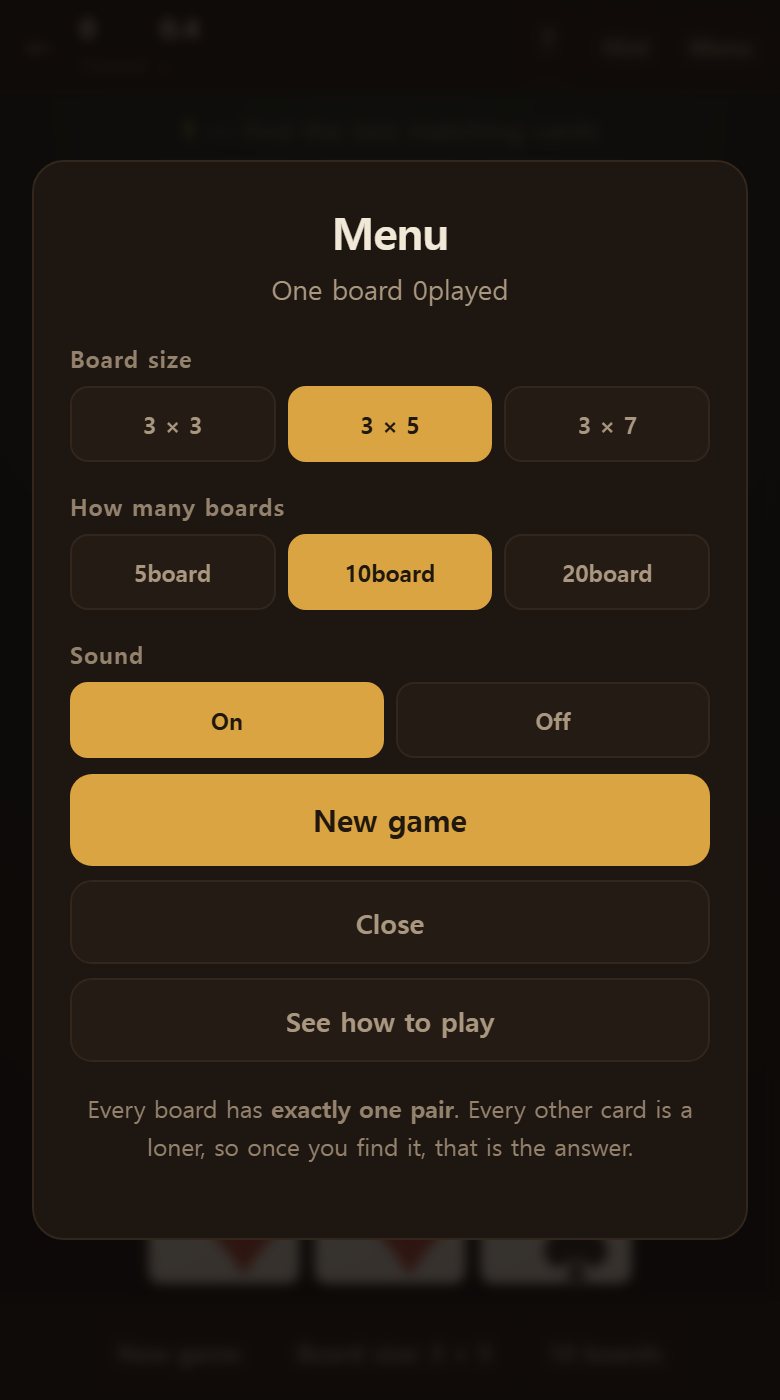
Changes take effect from the next board. The one you are on will not change under you, so open it freely.
How the boards are built
A board with exactly one pair does not come out of a shuffle. It has to be built on purpose.
- First the pair that will be the answer is chosen — two cards of the same rank and colour.
- The remaining places are filled with cards chosen never to pair with each other.
- Once full, the pairs are counted again to confirm there is only one.
- If not, the board is thrown away and rebuilt.
So “there is no pair here” never happens. There is one, and only one. Check the colours again. A 3x7 board needs twenty-one cards from a deck of fifty-two, which makes filling it with loners tighter than you might think. The bigger the board, the more same-rank, wrong-colour cards get mixed in — and those are the trap.
Reading your record
Finish the run and you get your time and your misses together. Read side by side, they show how you played.
- Short time, few misses — you scanned well.
- Short time, many misses — you were guessing. Look once more next time.
- Long time, no misses — careful but slow. Fix the path your eye takes.
- Records are kept per size and per number of boards. Ten at 3x5 and ten at 3x7 are separate records.
Your record stays on this device. Nothing is sent anywhere. To watch yourself improve, leave the settings alone and run the same size and count repeatedly. A few days is enough to see the time come down noticeably.
Common questions
The colour has to match too. The 7♠ pairs with the 7♣, and the 7♥ with the 7♦.
There is one. A pair is placed when the board is built, and confirmed afterwards. Check the colours again.
No. Exactly one to a board. Find it and that is the answer.
Tap it again to drop it, or clear everything with Esc.
Only the miss count goes up — though the clock keeps running meanwhile.
Opening the menu stops it; closing it starts it again.
Records are kept per size and per number of boards. Finish one run at those settings and it appears.
- Scan the ranks first. When you see the same number twice, then check the colour.
- Looking at reds and blacks separately is much faster — you only scan half.