 MindHub
How to play Spider Solitaire
You put cards in order from high to low. Line up K down to A and those cards come off the board. Do it eight times and you win.
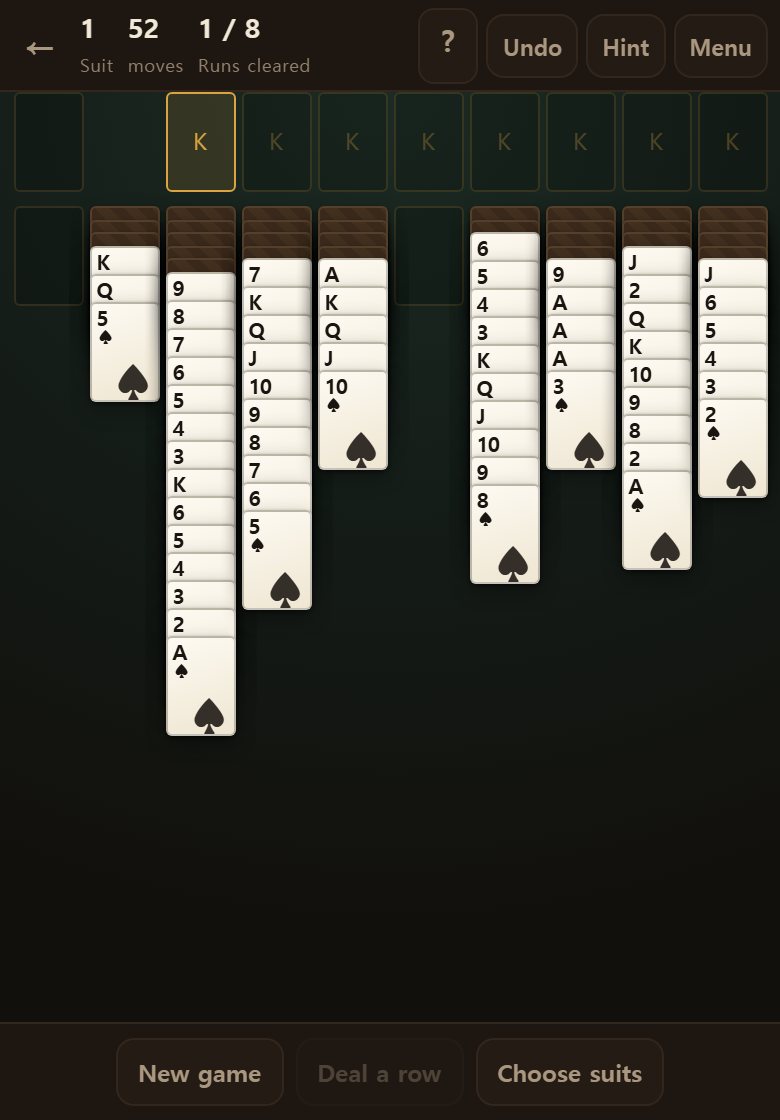
First, a look at the screen
The screen has two parts: what sits along the top, and the ten columns of cards below.
- The stock at the top left — cards not yet in play. Tap it for more.
- The eight spaces beside it — where completed runs go. Fill all eight and you win.
- The ten columns below — where you move cards. This is the whole game.
- The figures at the top — how many suits are in play, how many moves you have made, and how many runs you have taken.
A card showing its back is one you cannot see yet. Clear what sits on it and it turns face up.
This is how a deal looks
A new game deals fifty-four cards into ten columns — six each in the first four, five each in the other six.
In every column only the bottom card is face up; the rest lie face down. The remaining fifty wait in the stock at the top left.
- Two decks are used — 104 cards in all.
- At one suit, all eight runs are ♠, so the same card appears many times. That is normal.
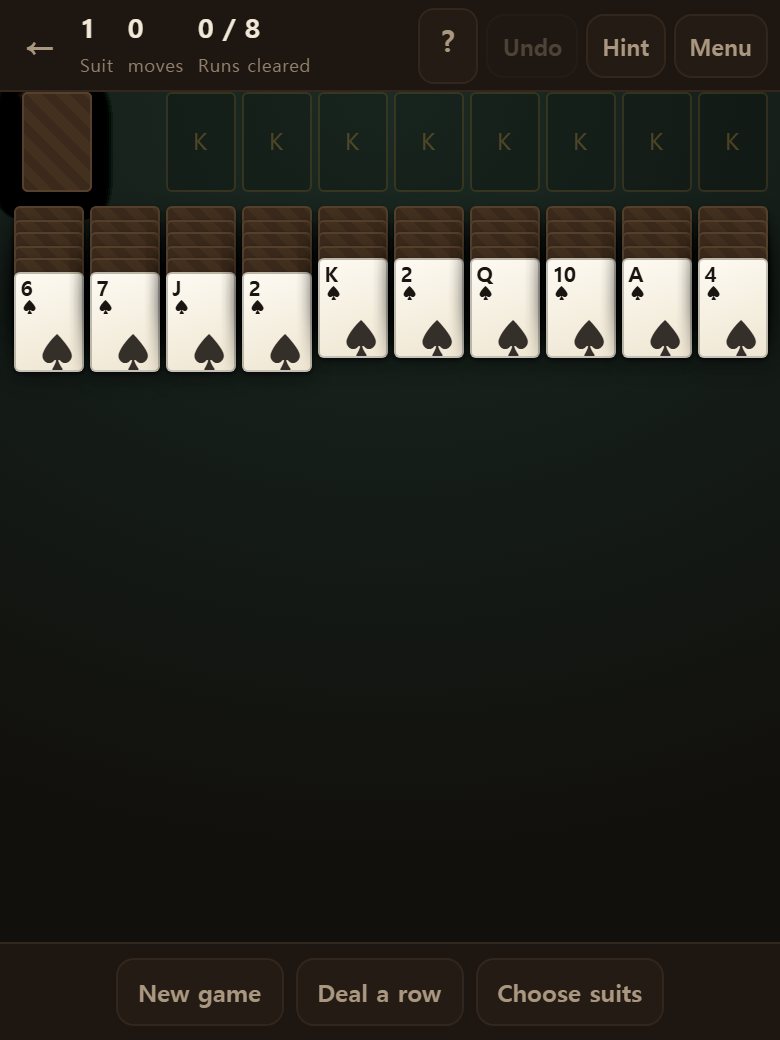
At the start there is little to move. That is to be expected — a card or two, a new one turns, and things open up.
Reading the top bar
Four small figures across the top tell you at a glance how the deal stands.
- Suits — how many are in play. At 1 it is all ♠, which is easy.
- Time — how long since the deal began.
- Moves — how many cards you have moved.
- Runs taken — how many of the eight you have completed.

The eight spaces below light gold one by one. All eight lit means you have won.
Moving cards
Press and drag a card with your finger to the column you want. With a mouse, press and drag the same way.
- Touch a card and it comes away together with everything below it.
- A single tap, without dragging, moves it for you when there is only one sensible destination.
- When several destinations would do, the card keeps a gold ring. Then tap the column you want.
- Pick up a card that cannot move and it flashes red, with the reason written below.
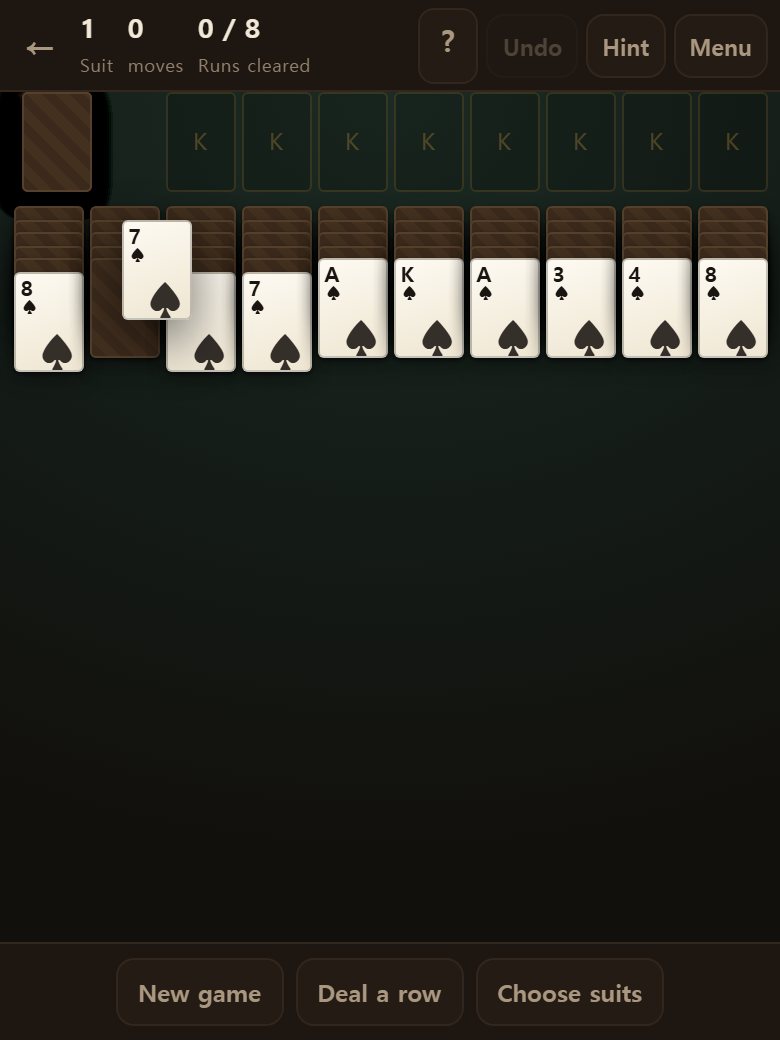
A bad move is nothing to worry about. Undo at the top steps back one move at a time, as often as you like.
Where can a card go?
There is exactly one rule: a card goes on a card one rank higher.
So a 7 goes on an 8. Not on a 6, not on a 9 — exactly one higher.
- The suit does not matter. A 7♠ may go on an 8♥.
- Any card may go into an empty column.
- The order runs A (1), 2, 3 … 10, J (11), Q (12), K (13). The K is highest.
- The A is the lowest card. Nothing goes on an A.
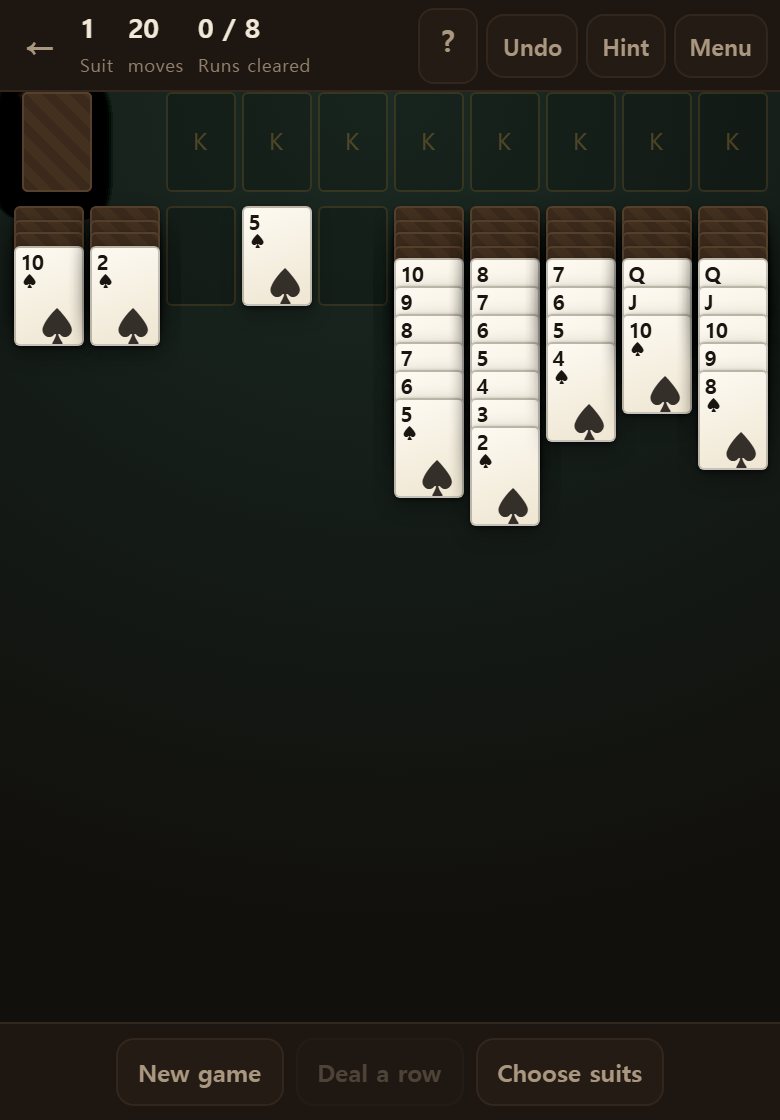
But placing cards carelessly because suits do not matter causes trouble later. Why, is explained next.
Matching suits lets several move together
Moving several cards at once has a condition: they must be the same suit, descending one rank at a time.
So 9♠ 8♠ 7♠ together move as three. But 9♠ 8♥ 7♠, with the suits mixed, moves only the bottom 7♠.
- So when placing a card, look first for a spot in the same suit.
- Mixed suits have to be unpicked a card at a time later, which is slow work.
- Even when a single tap moves the card for you, it looks for a matching suit first.
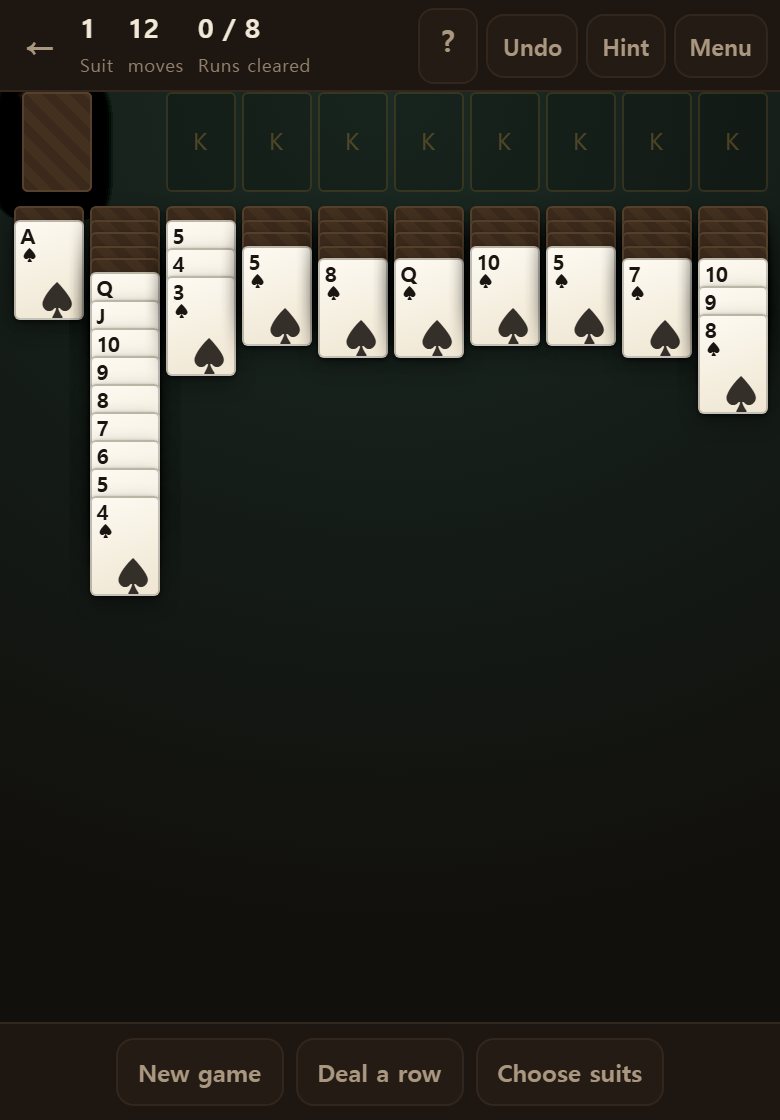
At one suit every card is ♠ and the problem disappears — which is why one suit is far easier.
When everything jams, tap the stock
Sometimes there is nowhere to move at all. Then tap the stock at the top left, and one new card lands on each of the ten columns.
The stock is good for five deals. After that, no more.
- The new cards arrive face up and are immediately playable.
- Every column grows by one, and a card you did not want may land on a run you had built carefully.
- So before tapping the stock, make every move you can.
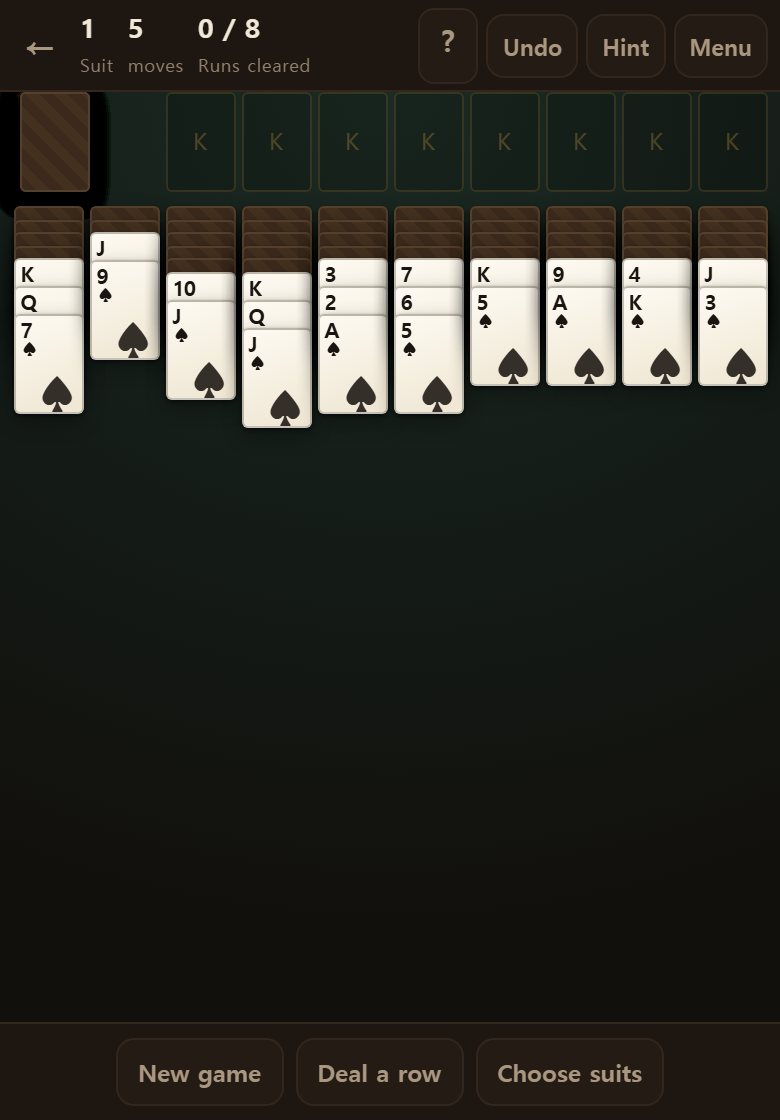
One rule matters here: while any column is empty, the stock cannot be dealt. You have to fill it first.
K down to A comes off the board
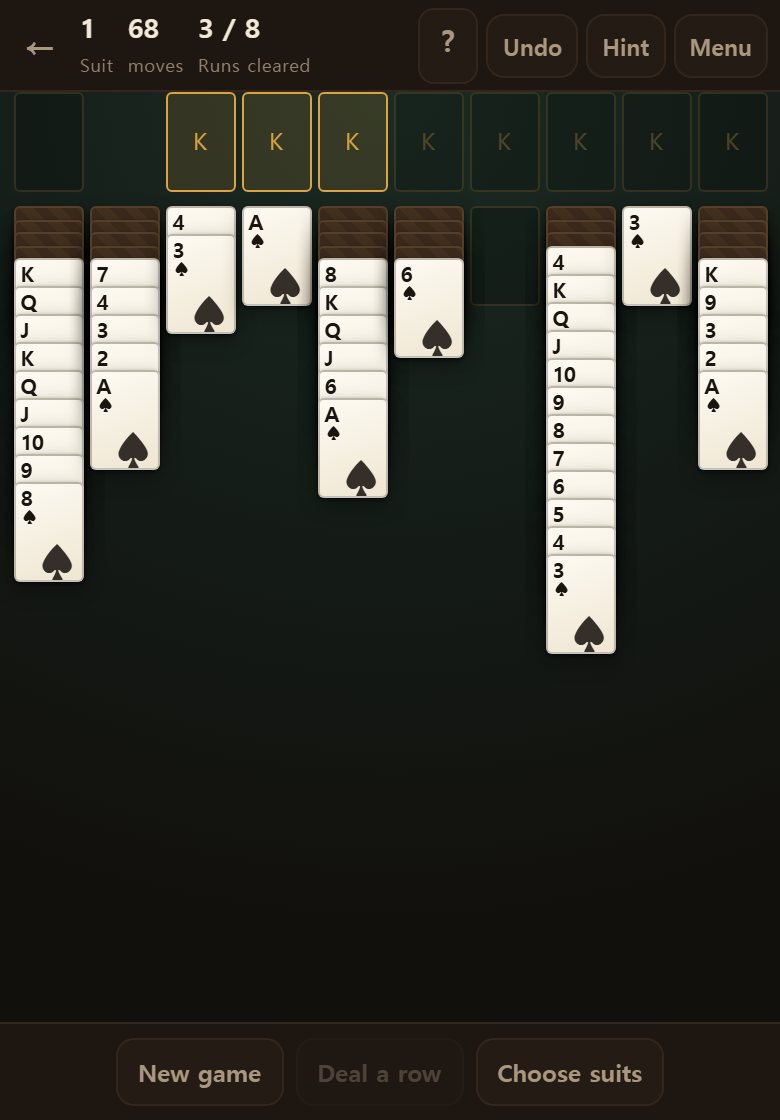
Get K Q J 10 9 8 7 6 5 4 3 2 A in order in a single suit within one column, and those thirteen cards lift away by themselves, lighting one of the eight spaces above in gold.
Do that eight times and you win.
- One mixed suit anywhere in the run and nothing lifts.
- All thirteen have to be face up in the one column. A face-down card in the middle stops it.
- When they lift, the column empties or shortens. The extra room makes everything easier.
- There is a sound as they go, and one of the spaces above lights up.
An empty column is worth most
An emptied column is a fine thing. Any card may go there, so it serves as somewhere to set a blocked card aside.
Say a K is sitting on top of something and blocking the way: there is nowhere for a K to go, nothing being higher. With an empty column, you can move it there.
- Any card goes into an empty column — and it is the only place a K can go.
- It is also where you unpick a mixed run, a card at a time, and set it right.
- With two empty columns you can shift a much larger run whole.
- Put a K there and the column will realistically never empty again. Do it with care.
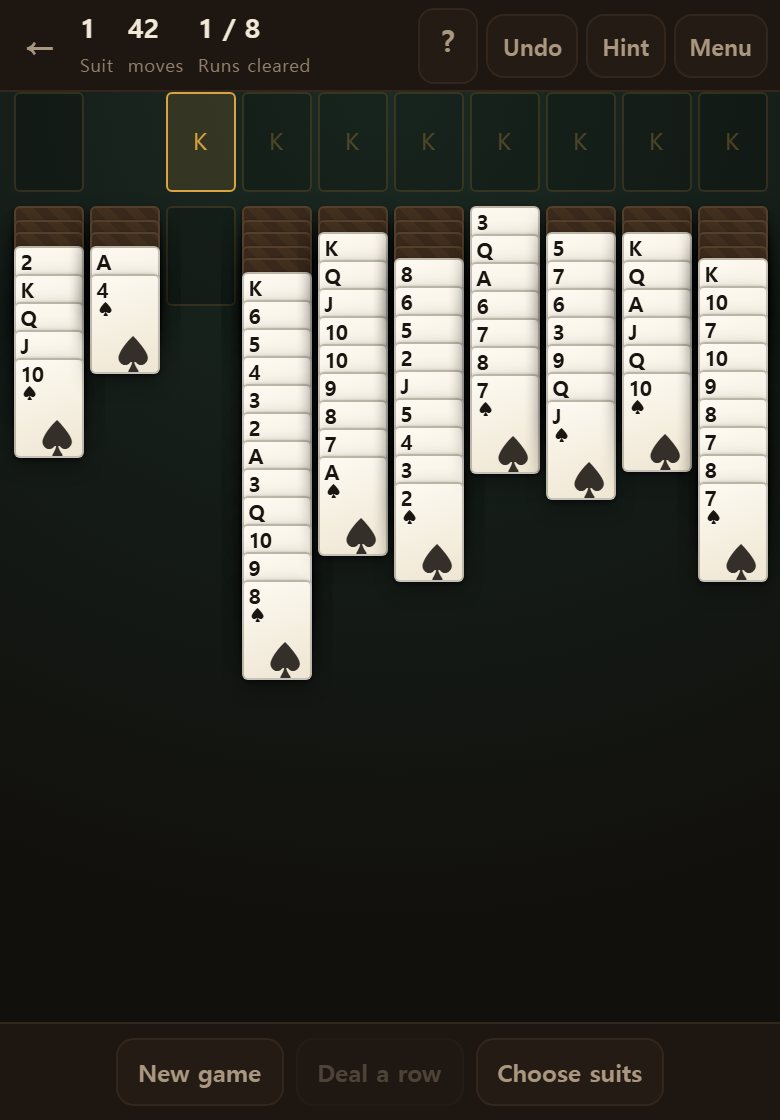
But an empty column blocks the stock. To deal, you must fill it. When to spend an empty column and when to hoard it is the hardest judgement in this game.
How to win
The single most important thing here is turning face-down cards. The more are face up, the more you have to work with.
- Given a choice, take the move that turns a face-down card.
- Dig the column with the most face-down cards. That is where the work is.
- If a matching suit will take the card, that is nearly always the better place.
- Make every available move before tapping the stock.
- Stuck? Press Hint at the top for a move worth making.
- Use an empty column as somewhere to park a run. Simply dumping a card there is a waste.
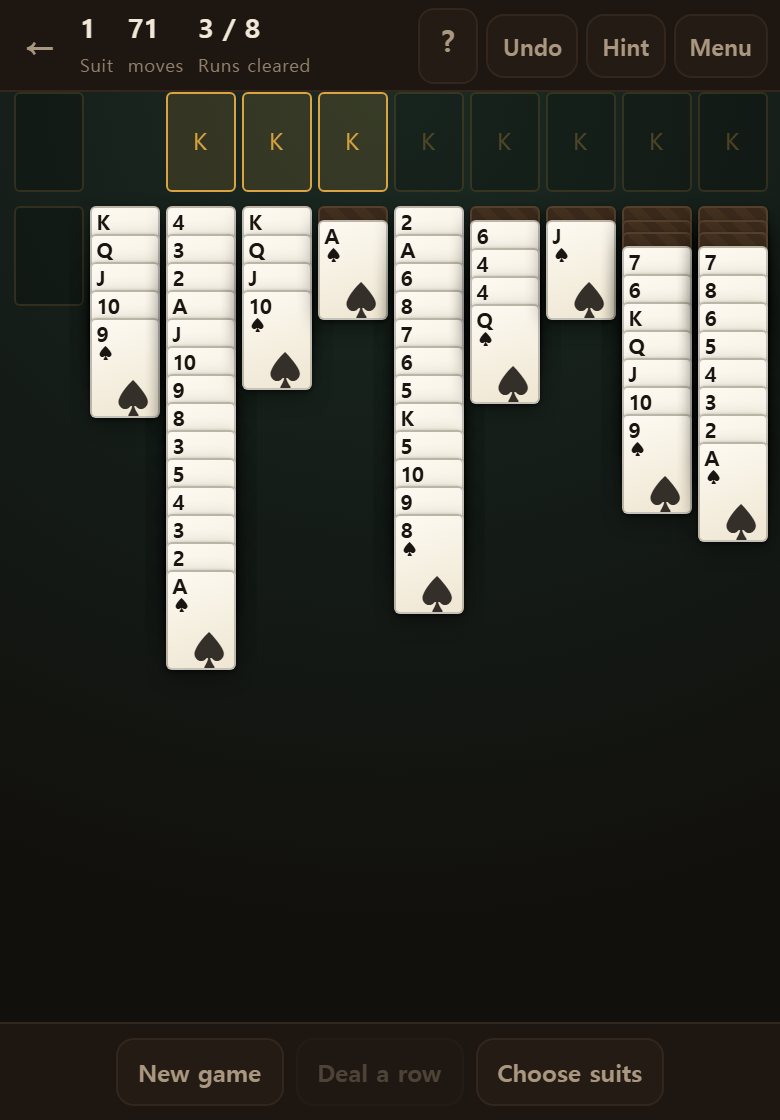
The whole of it in one line: open the face-down cards. Any other move, however handsome, does not advance the deal.
Unsolvable deals never appear
Starting a new game shows a brief wait. During it, the game checks that the deal can be solved through to the end.
So however hard a deal looks, a solution exists. You never lose to bad luck.

Two suits is harder. If this is your first game, start at one. Four suits is not offered yet — there is no way to verify those deals as solvable, so they are not handed out.
The face-down cards are the work remaining
Fifty-four cards are dealt and only ten of them face up. The other forty-four lie face down.
What you actually do in Spider is open those forty-four, one at a time. A column may look beautifully ordered, but if no face-down card turned, you have not moved a step.
- When no face-up card is left in a column, a face-down one turns by itself.
- So digging the columns with the most face-down cards is where the profit lies.
- Before any move, ask whether it opens a face-down card.
- Moves that open nothing are sometimes necessary, but a run of them sets the deal solid.
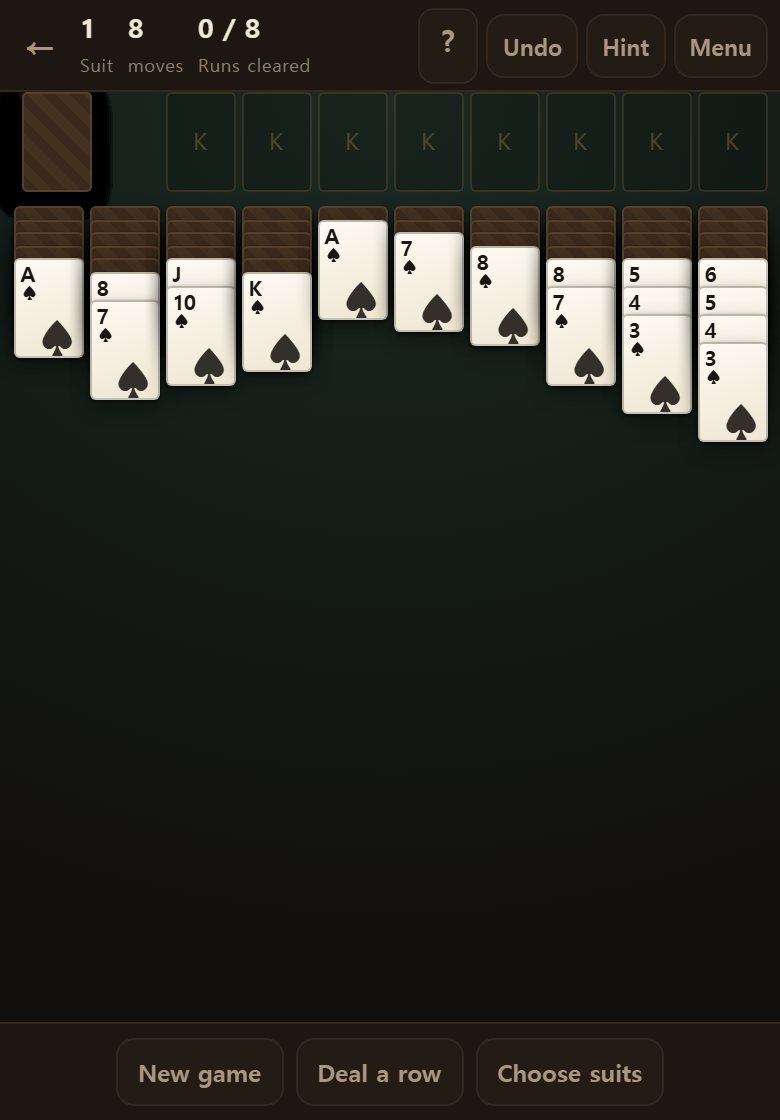
The target is eight runs, but the real difficulty lies in the forty-four face-down cards before them.
Hint
Press Hint at the top for a move worth making. On a keyboard it is H.
- It names the card and where it goes.
- With nothing to play it suggests dealing a row from the stock.
- It never hands you the whole solution — one move at a time.
- Using it leaves your record untouched.
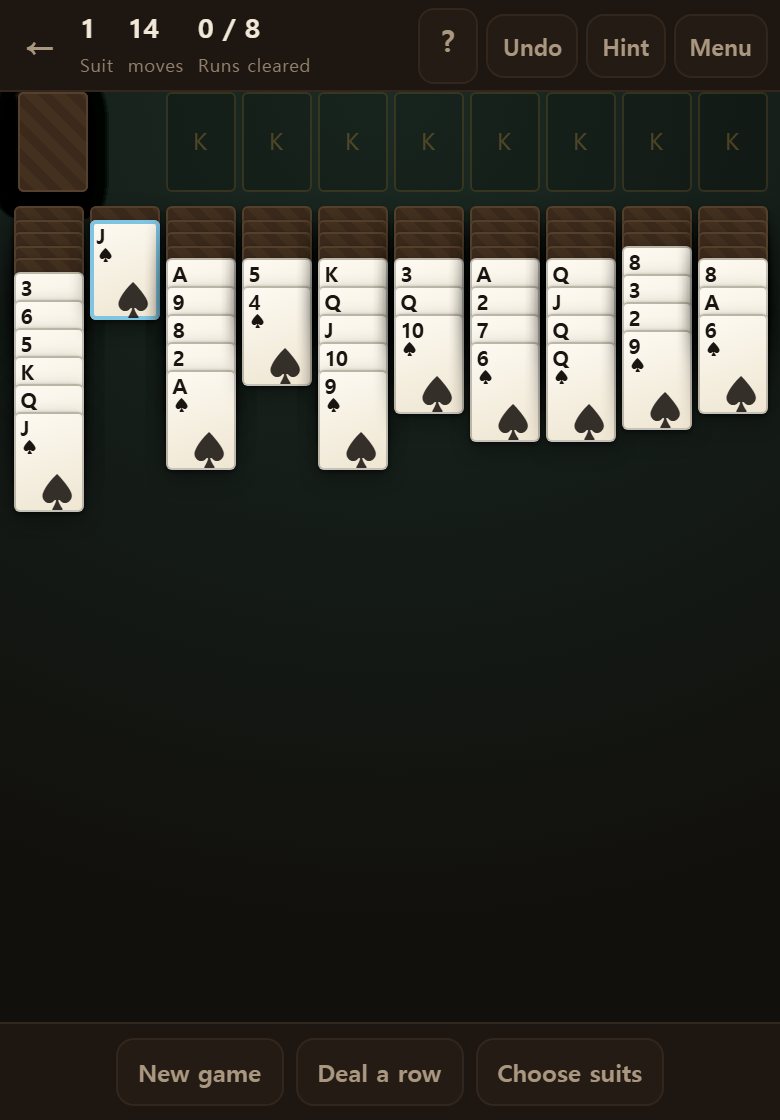
With cards face down, Spider cannot be read to the end. So the hint picks what looks good from here. If its suggestion seems odd, look at what it opens.
Undo
Press Undo at the top and your last move never happened. On a keyboard it is Ctrl+Z.
- A multi-card move undoes as a single move.
- A card that turned over as a result goes back face down with it.
- A row dealt from the stock can be undone too — all ten cards lift at once.
- You can undo as far back as the start.
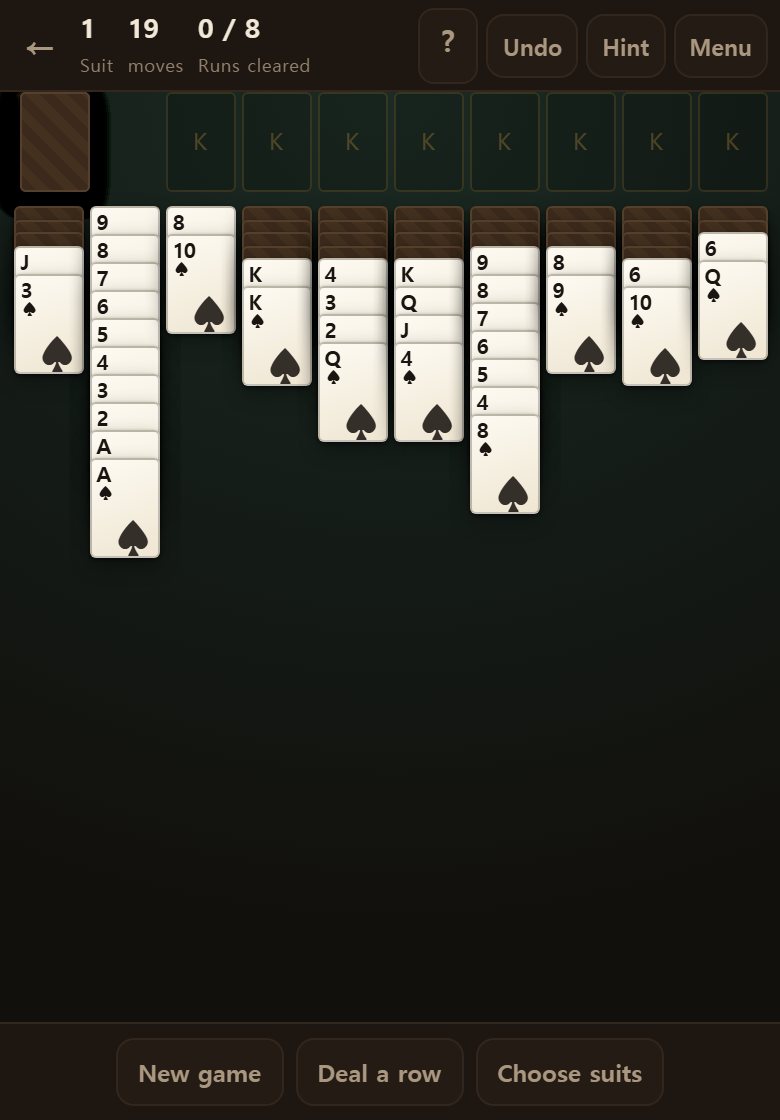
Decide where you would undo back to before dealing. A deal adds ten cards across the columns, which puts everything before it much further away.
Common mistakes
Deals set solid in one of these four ways, nearly always.
- Stacking without matching suits — the commonest of all. Matching the rank alone places the card now, but the run will not move whole later and the column sets.
- Filling an empty column at once — hard-won, then any old card goes in. An empty column pays only when used to park a run.
- Dealing too readily — every column grows and the face-down cards sink further. Deal only when the board truly offers nothing.
- Not counting the face-down cards — play by the face-up ones alone and you arrange a pretty board that will not move.
All four come from watching what will go down now. In Spider what matters is whether it will move again later.
When all eight runs are taken
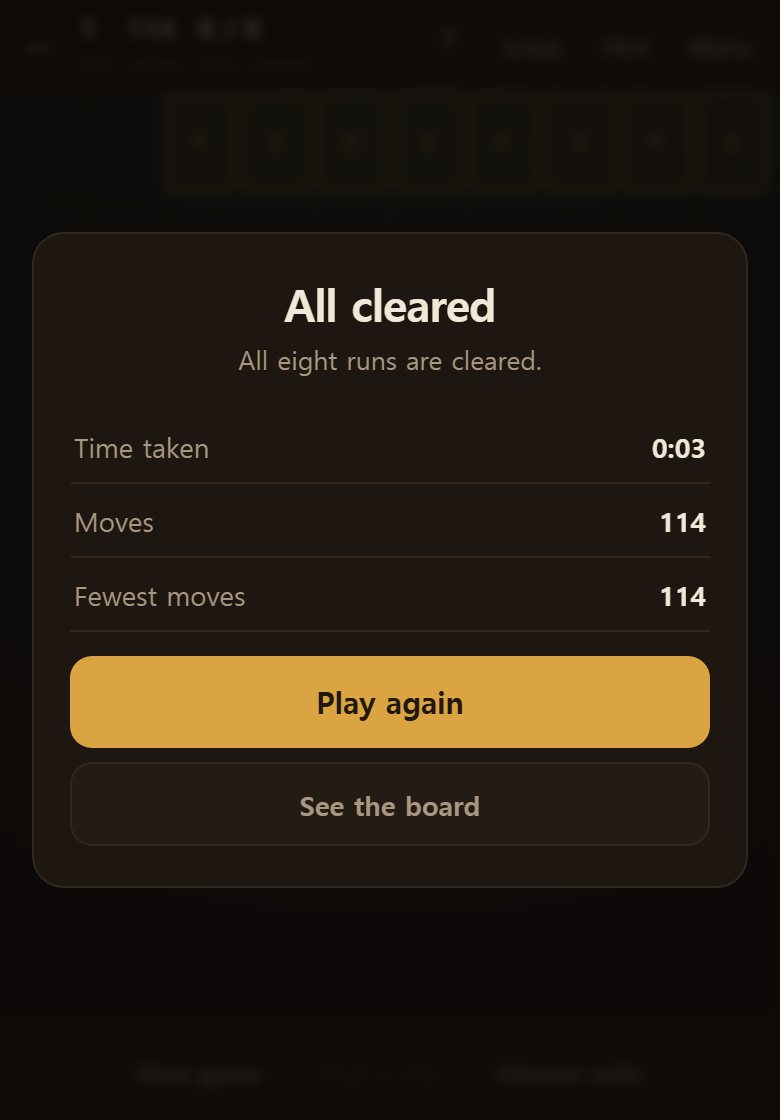
Take all eight and you win. Your time and move count remain.
- The fewer moves, the better the solve. A separate record keeps your fewest moves.
- Records are kept per number of suits. One suit and two suits are counted separately.
- Leave part way through and the deal is kept. Carry on next time.
- Your record stays on this device and is sent nowhere.
Common questions
Press Undo at the top. It steps back a move at a time, as often as you like.
An empty column blocks the stock. Fill it and try again — or you have already used all five deals.
A face-down card cannot be taken, and where the suits are mixed you cannot take the cards above along with it. A brief flash of red means exactly that.
Quite so. Spider uses two decks, and at one suit all eight runs are ♠ — so a rank can appear eight times.
The K is the highest card, so nothing will take it. Only an empty column will.
No. The deal is kept and you can carry on next time you open it. Your record stays on this device and is sent nowhere.
You may — a card accepts anything one rank lower, whatever the suit. But a run built that way will not move whole later; you can only pull off the end card at a time, and the column sets. All else equal, match the suit.
Only when the board truly offers nothing. One deal lengthens all ten columns and buries the face-down cards deeper. Sweep all ten first and be sure no move remains.
Not as a place to put a card, but as somewhere to park a run. With one available you can unpick a mixed run a card at a time and set it right. But any empty column blocks the stock, so when you need to deal, fill it first.
- Clearing the face-down cards is the whole job. When you can join in the same suit, do that first.
- An empty column is the most valuable space there is. Save it unless you must use it.