 MindHub
How to play Klondike Solitaire
You build each suit from A up to K. Send all fifty-two home and you win. This is the most widely played card game in the world. It is quite all right if you have never handled a deck. Read down this page in order, follow it on screen, and you will finish a game.
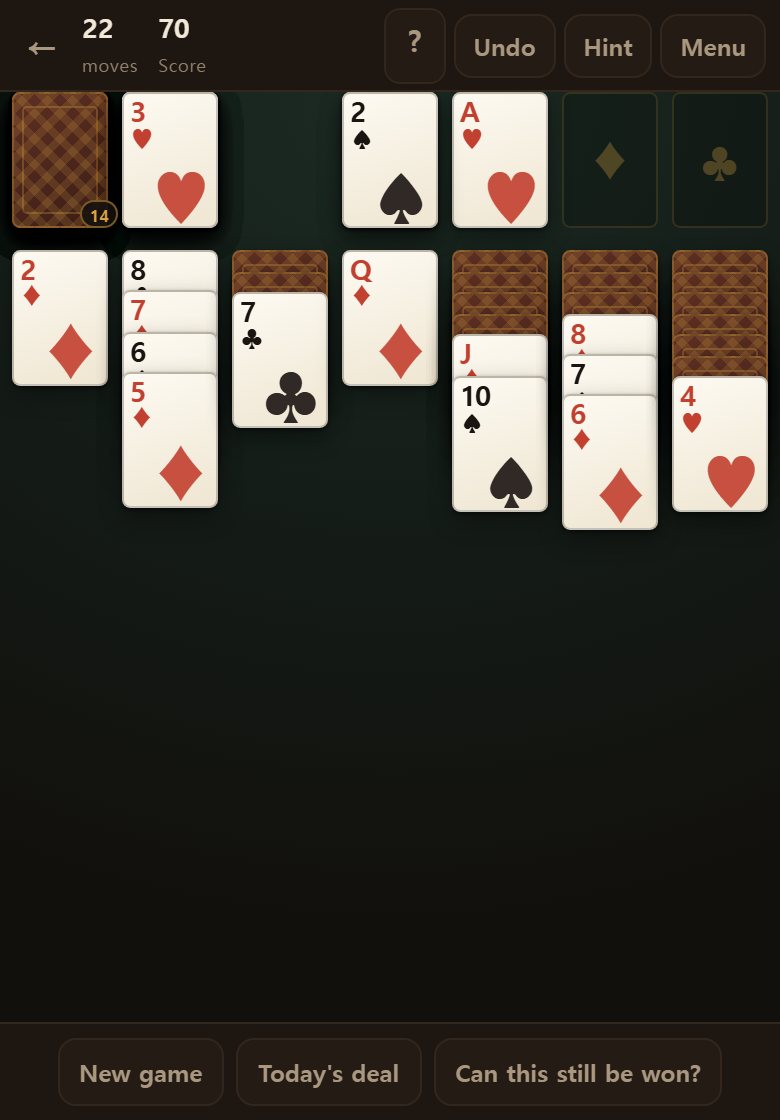
First, a look at the screen
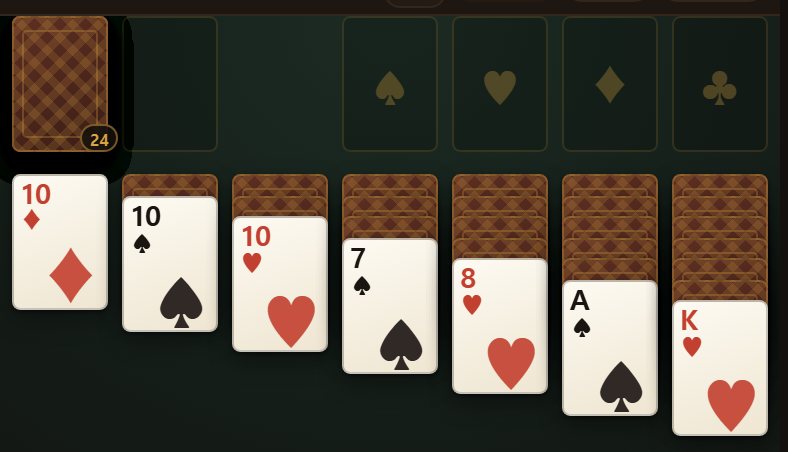
The screen divides into an upper and a lower half. Six places sit above, and the cards are laid out in seven columns below.
- The stock at the top left — cards not yet in play. Tap it and one turns over.
- The space beside it — where turned cards land. Only the top one is playable.
- The four spaces at the top right — the foundations, built by suit from A. Fill them and you win.
- The seven columns below — where you shuffle cards about and put things in order. This is where the work happens.
A card showing its back is not yet in play. Clear what sits on it and it turns over by itself.
This is how a deal looks
The seven columns hold one, two, three … seven cards, growing by one each. 1 + 2 + 3 + 4 + 5 + 6 + 7 is twenty-eight in all.
In each column only the bottom card is face up; everything above it is face down. The remaining twenty-four wait in the stock at the top left. 28 + 24 = 52, the whole deck.
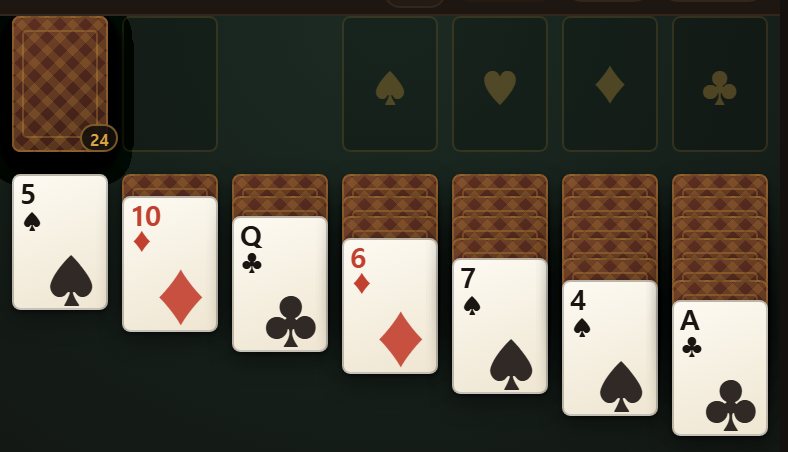
So the leftmost column is fully visible from the start. The further right you go, the more cards lie face down, and the harder that column is to dig.
What a card looks like
The rank sits at the top left with the suit beneath it, and the suit appears again, large, in the middle so you can read it from a distance.
- A is 1, the lowest card. It is called an ace.
- 2 to 10 count exactly as written.
- J, Q and K are 11, 12 and 13. The K is highest.
- So the order runs A, 2, 3, 4, 5, 6, 7, 8, 9, 10, J, Q, K.
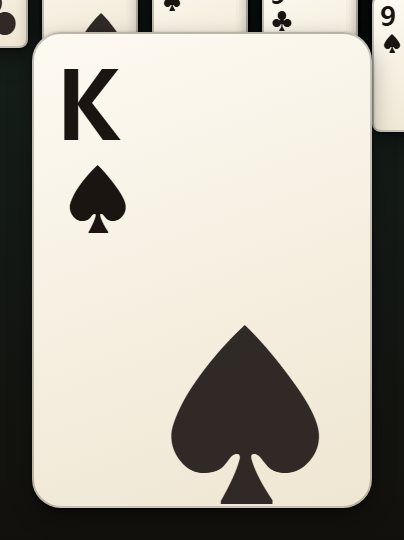
If J, Q and K get muddled, remember them alphabetically — J, Q, K. That is the rising order exactly.
Four suits, two colours
There are four suits — ♠ spades, ♥ hearts, ♦ diamonds and ♣ clubs — and thirteen cards in each, A to K. 13 x 4 = 52.
In Solitaire what matters more than the suit is the colour.
- Black — ♠ spades and ♣ clubs
- Red — ♥ hearts and ♦ diamonds
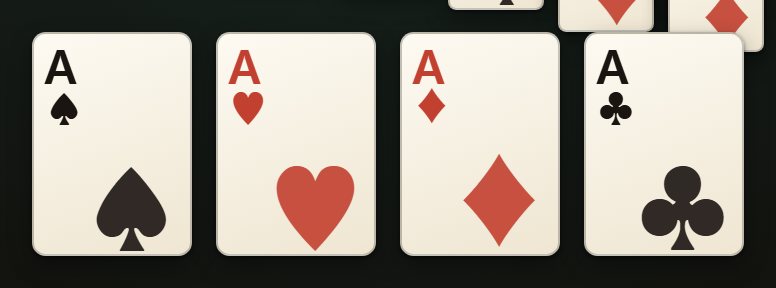
The seven columns care only about colour. Only the foundations care about suit. A great many people mix these two up.
Moving cards
Press and drag a card to where you want it.
If dragging is a nuisance, a single tap will do. Where there is only one sensible destination, it moves the card for you — and if the card can go to a foundation, that is where it goes first.
- A dragged card lifts with a shadow, which means you are holding it.
- Cards already in a run drag as one block.
- Drop a card somewhere it cannot go and it returns to where it was. Nothing is damaged.
- When there happen to be two or more destinations, the card keeps a gold ring. Then simply tap the place you want.
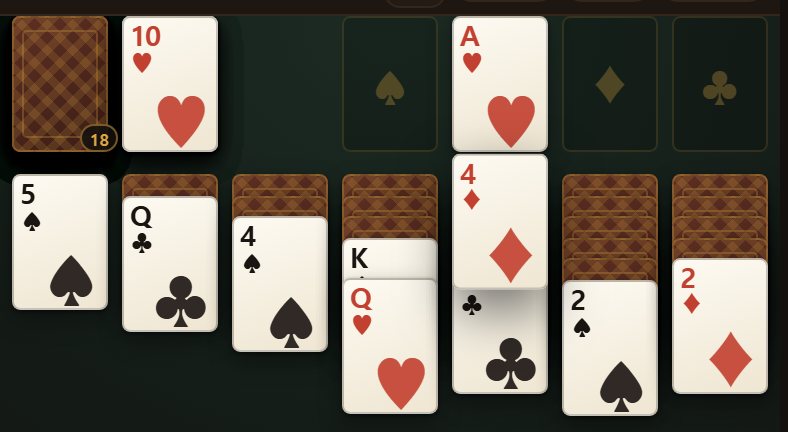
Moved badly? Press Undo at the top. There is no limit — you can go right back to the first move.
The seven columns — colours must alternate
Placing a card in a column needs exactly two things. Learn these and you are done.
- It must be one rank lower. A 6 goes on a 7; a 5 or an 8 will not.
- The colour must differ — red on black, black on red.
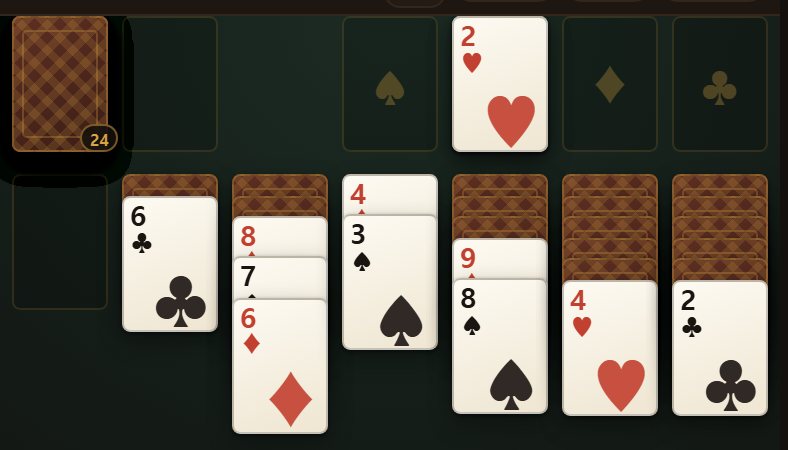
So on a 7♠ you may put the 6♥ or the 6♦. Not the 6♣ — both are black. The suits need not match; only the colours must differ.
Moving several cards together
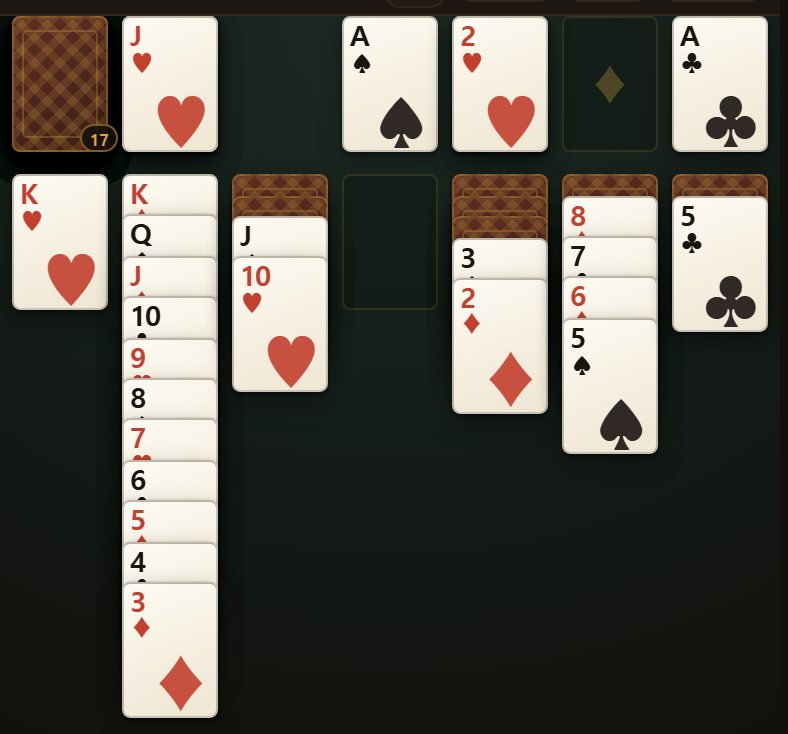
Cards already stacked in alternating colours move as one block. Take the top card and everything beneath it comes along.
So with 9♥, 8♠, 7♦ running together, you can take the 9♥ and set all three on a 10♠ or a 10♣.
- Whether a block can move depends only on whether its top card can go there.
- Take a card from the middle of a block and only that card and what is below it come away.
- The real reason for moving a block is to turn the face-down card underneath it.
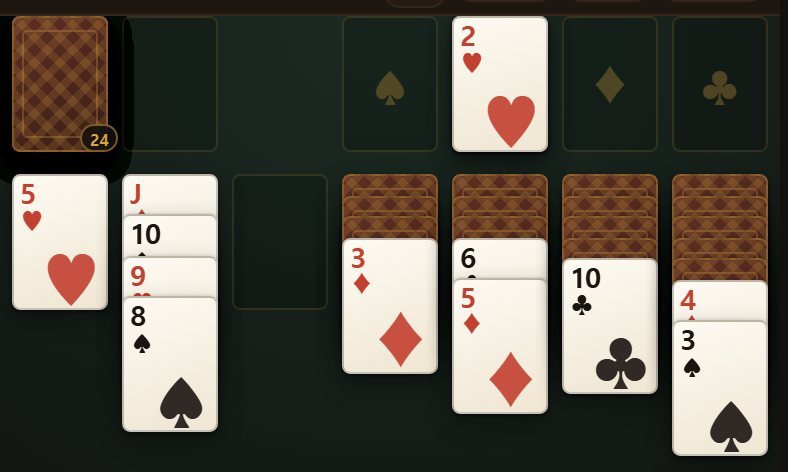
If a block is broken somewhere in the middle, it will not move whole. Then you have to peel it apart from the top, a card at a time.
The real work is turning face-down cards
Think of it this way: the work remaining is the number of cards still face down. Turn them all and the deal is as good as won.
Which gives you one test for every move. Does this turn a face-down card? If it does, it is usually a good move.
- Work the columns with the most face-down cards first — usually those on the right.
- A move that turns nothing is not urgent. It will keep.
- When a card could go in two places, choose the one that turns a face-down card.
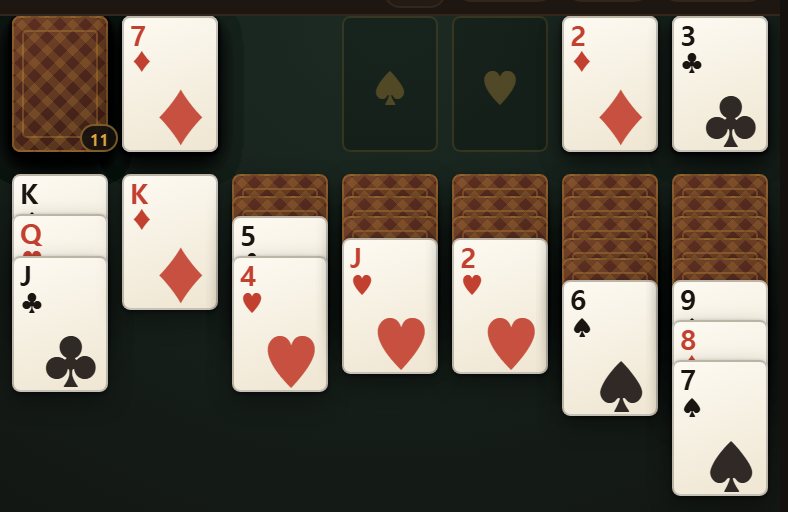
A face-down card turns by itself once everything above it is cleared. There is nothing to tap.
Only a K goes in an empty column
When a column empties, only a K may go there. No other card, ever.
Being the highest card, a K has nothing it can sit on. An empty column is its only home.
- An empty column is very useful — somewhere to set cards aside.
- But before emptying one, check that a K is visible somewhere to fill it.
- Without a K the empty column simply sits idle — and while it does, you are not digging elsewhere.
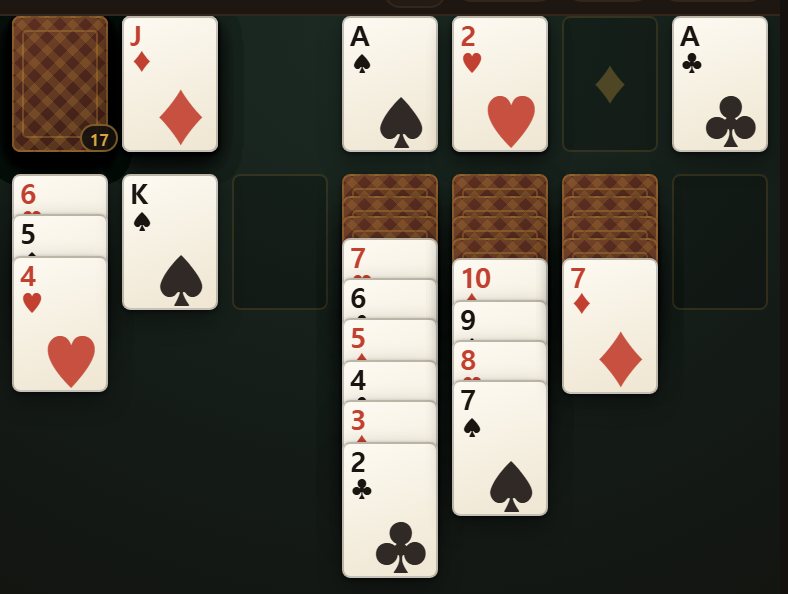
When you do move a K into an empty column, far better that it be a K sitting on top of a face-down card. Moving it turns one over into the bargain.
Sending cards to the foundations
The four spaces at the top right take one suit each, built strictly A, 2, 3 … Q, K, with nothing skipped.
The rule here is the exact opposite of the columns. There the ranks fall and the colours alternate; here the ranks rise and the suit stays the same.
- The ♠ space takes only ♠. A ♣ will not do, even though the colour matches.
- Fill all four to the K and you win — all fifty-two cards.
- A card sent up can be brought back down if you need it.
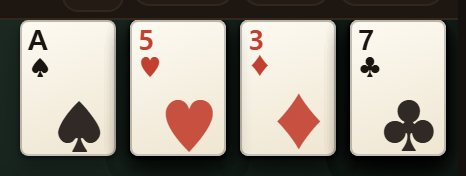
If you cannot spot the next move, look for the card one rank above the top of each foundation. That is what goes up next.
Do not send cards up in haste
This is the commonest beginner's mistake. Send everything up on sight and before long the columns jam solid.
The reason is that those cards serve as landing places down below. Send the 6♥ up and you have lost one of the cards that could have gone on a 7♠.
- Send aces and twos up on sight. They are almost never wanted as landing places.
- Anything higher goes up only when you need it to.
- To judge whether a card is safe to send, check whether both suits of the other colour are already up past the rank below it.
- So the 6♥ costs nothing once ♠ and ♣ are both up to 5.
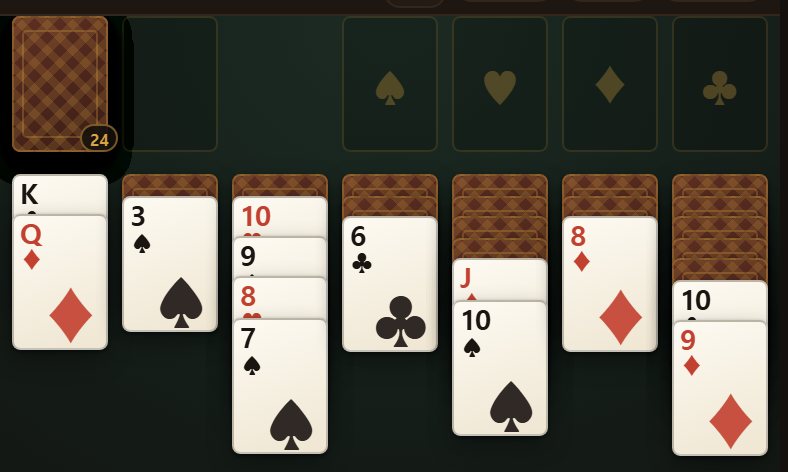
If that is too much bother, here is a rough rule: send them up when the columns have room, hold them back when they are tight.
Using the stock
Tap the stock at the top left and a card turns over beside it. Only the top of the turned cards is playable.
Once the stock is exhausted, the turned cards go back and you can go round again. So there is no hurry, and it is quite worth running one pass through simply to see what is in there.
- Knowing what the stock holds makes it far easier to plan how to dig the columns.
- Playing one card out of the stock shifts everything after it, so a different card comes up next pass.
- So which card you take on this pass changes the next one.
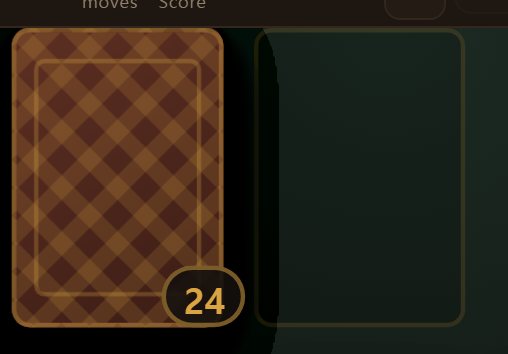
If a move remains among the columns, play that first. The stock is best left until last.
Draw one and draw three
The menu lets you turn the stock one card or three cards at a time.
- Draw one — every card in the stock is individually available. Far easier.
- Draw three — three turn together and only the top is playable. Reaching the ones beneath means changing the order.
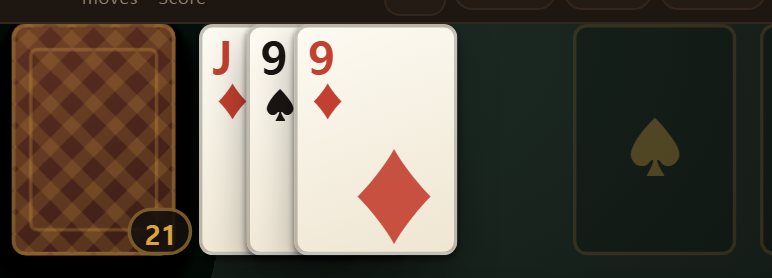
Start with draw one. Draw three is not a rule so much as a difficulty setting. Win a few games at one before moving on.
The top bar
Three figures on the left, three buttons on the right.
- Time — how long since the deal began.
- Moves — how many cards you have moved.
- Score — rises when you send a card to a foundation or turn a face-down card.
- Undo — takes back your last move, as often as you like.
- Hint — points at one move worth making.
- Menu — draw one or three, sound off, and so on.

These figures are there for interest. At first ignore them and simply try to win. Later, finishing the same deal in fewer moves becomes a pleasure of its own.
Stuck? Ask for a hint
Press Hint at the top and it points at one move worth making. It never hands you the whole solution — only the next move.
Ask as often as you like. There is no penalty.
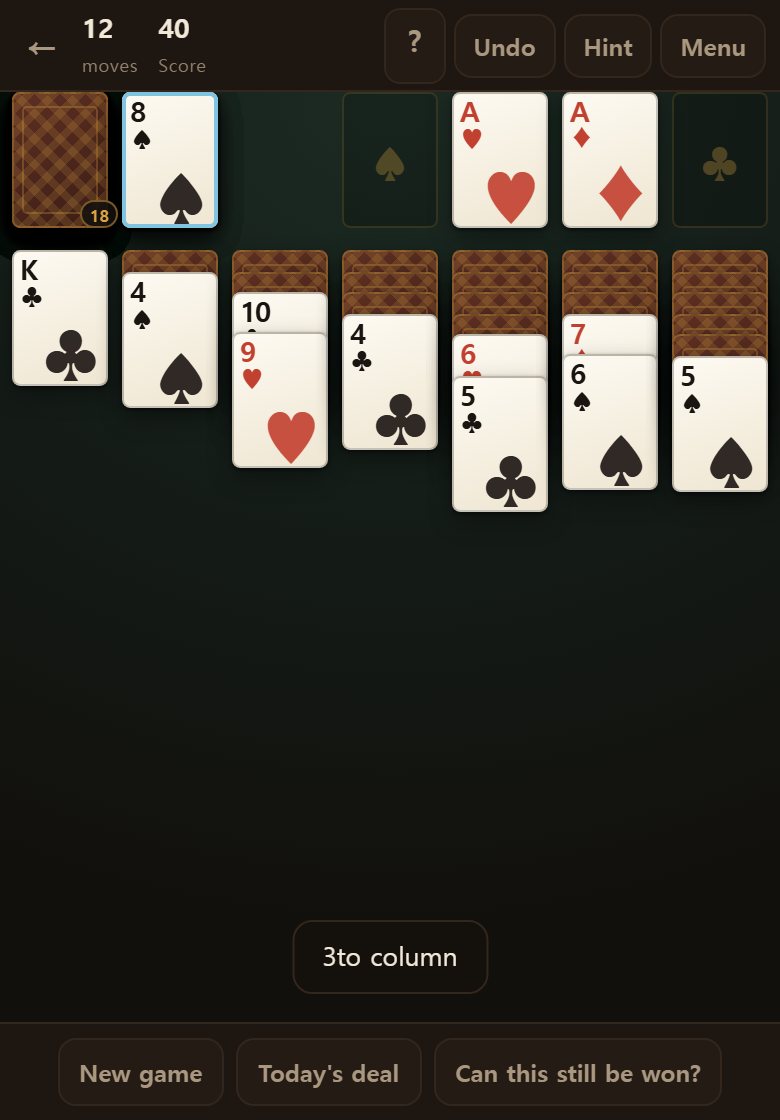
If the hint has nothing to point at, the position really is jammed. Then undo a few moves.
Can I still win?
Press Can I still win? below and it works out whether a path to the end remains from here.
Few versions offer this. It settles the question of whether you ruined the deal by sending a card up too early, or whether a path exists and you simply have not found it.
- Still alive — a path exists. Keep looking, or ask for a hint.
- Too late — the path was lost somewhere. Undo a few moves.
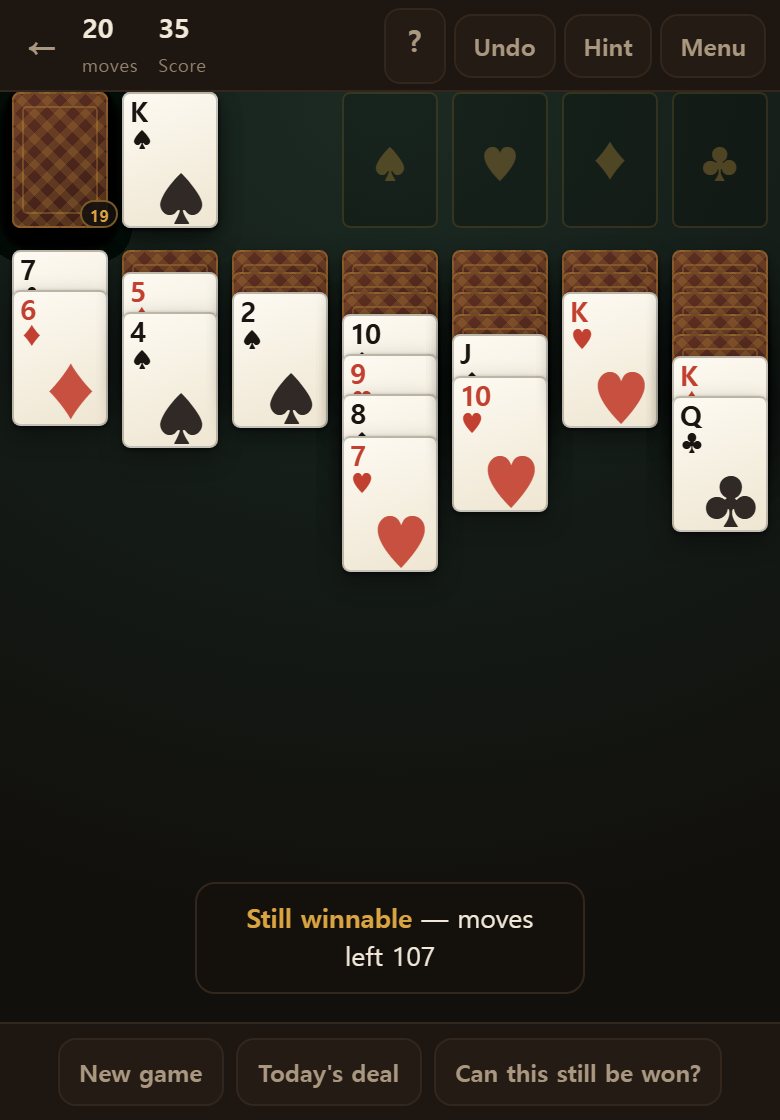
With this button you can play boldly. If you ruin it, you will find out.
Finishing automatically
Once no card is face down and everything left can go to the foundations, a finish it button appears.
What remains is a dull matter of order, so pressing it sends the lot up for you.
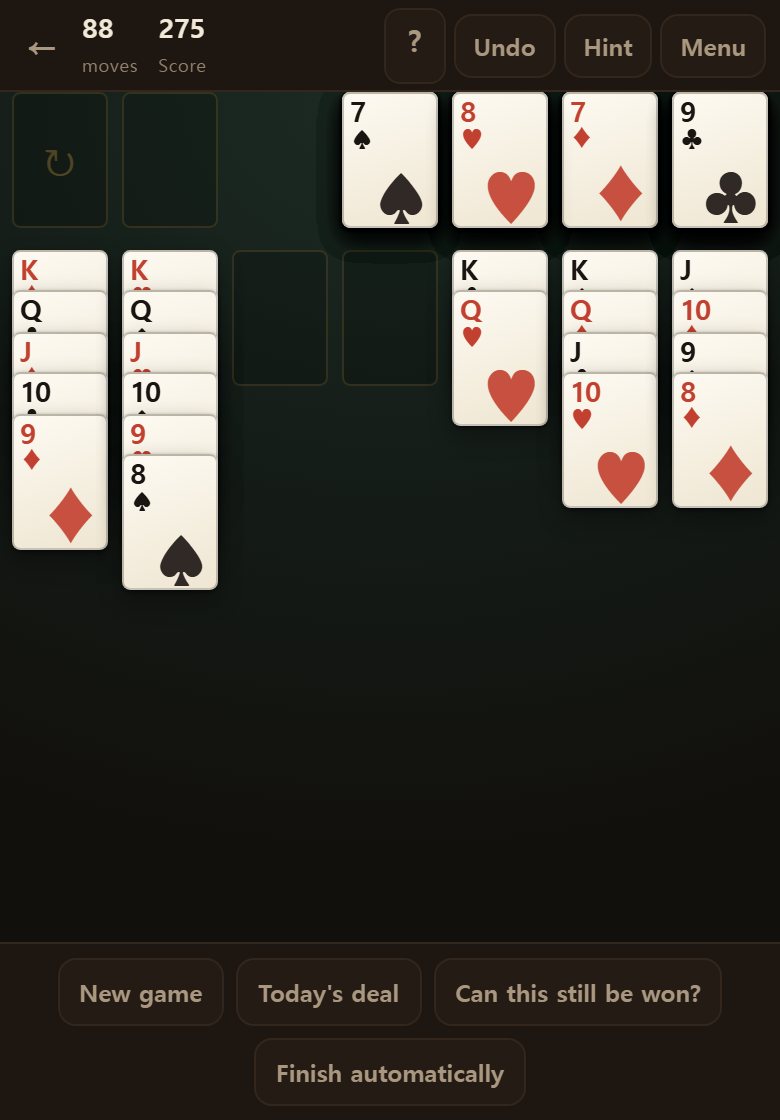
Seeing that button at all means you have won. From there it is no longer possible to lose by mistake.
Only winnable deals are handed out
Shuffle a deck at random for Solitaire and some deals cannot be won at all. Roughly one in eight is beyond anyone. Struggling with one of those is thoroughly unfair.
Here, every deal is solved through to the end before it is handed out. Any that cannot be won is thrown away and rebuilt.
So if you are jammed, there is a move you have not seen. Undo a few and take another route.
How to win
These alone will win you noticeably more deals, most important first.
- Always play the move that turns a face-down card first. It is the only move that reduces the work left.
- Dig the columns with the most cards face down. The further right, the deeper.
- Beyond aces and twos, do not send cards up in haste. The columns need landing places to work with.
- Only empty a column when you have a K for it. If no K is in sight, wait.
- Leave the stock until last. While work remains among the columns, do that first.
- All else equal, choose the move that turns a card. That is the tiebreaker between two similar moves.
- Run one pass through the stock first. Knowing what is in it gives you a plan.
Still stuck? Press Hint, and if that fails, Can I still win?. Between them, most deals come out.
Common mistakes
Deals are lost here in one of four ways, nearly always. Knowing them in advance keeps you out of them.
- Sending everything up on sight — the commonest of all. The columns lose their landing places and jam soon after.
- Playing moves that turn nothing — the move count rises and the deal stands still.
- Emptying a column with no K — the empty column sits idle and the digging was wasted.
- Going to the stock first — the order down below gets disturbed and the next pass is worse.
Think better of a move and press Undo at once — any number of them. If it was some time ago, check with Can I still win? and go back from there.
When you win
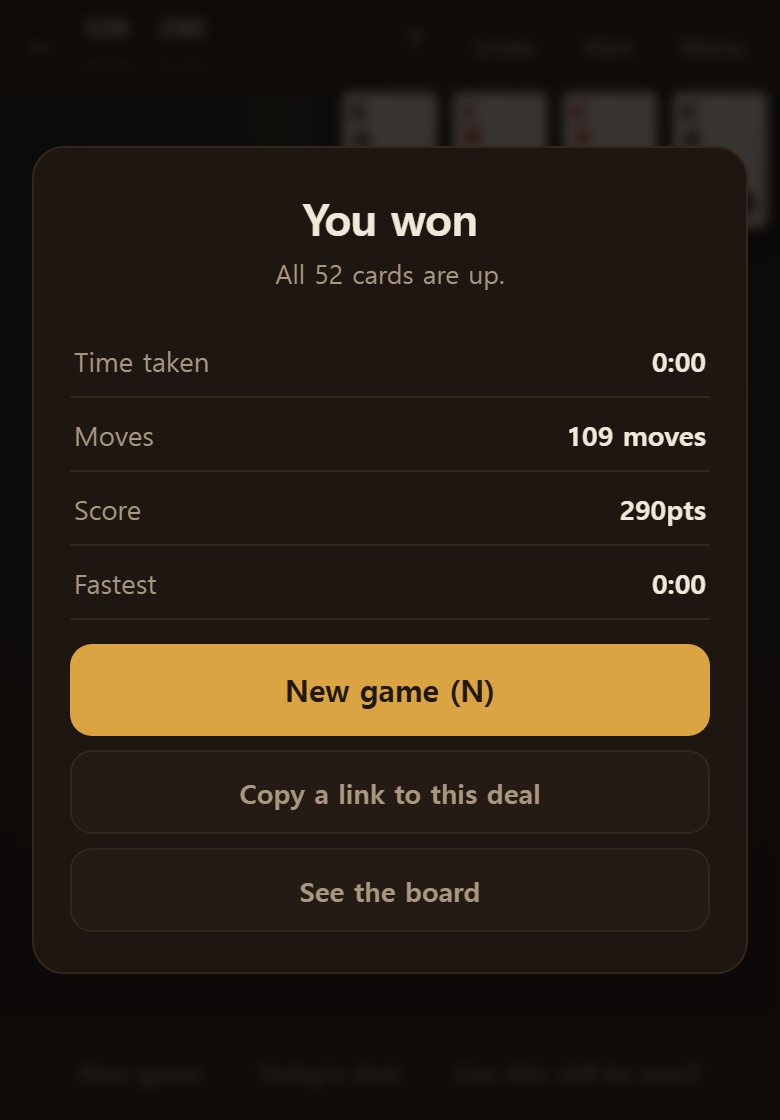
Send all fifty-two home and the cards cascade as the deal ends. Your time, your moves and your score come with it.
From there, New game deals another, and Copy link lets you send that very deal to someone else.
Today's deal is set once per day. Everyone gets the same one, so times can be compared over identical cards.
Common questions
In a column it must be one rank lower and the other colour. On a 7♠ that means the 6♥ or the 6♦; the 6♣ will not do, both being black. In an empty column, only a K.
It depends where. The seven columns want differing colours; the four foundations want matching suits. The rules are exact opposites, which is easy to muddle.
At the end of a pass the turned cards go back into the stock. Keep tapping. If nothing comes, the stock is genuinely empty, or the number of passes has been limited.
Try Hint first. If it has nothing, press Can I still win?. “Still alive” means there is a move you have not seen; “too late” means undo a few and take another route. This site only hands out winnable deals, so an unsolvable one never arises.
You may. It breaks no rule. But it removes a card that could have gone on a 7♠ or a 7♣ down below. Unless you need it up there, leave it.
How many cards the stock turns at a time. With three, the ones underneath are not immediately available, which is much harder. Start with one.
Once no card is face down and everything left can go up. Seeing it means you have already won.
There is no limit — you can go back to the first move. Play boldly.
One deal is set for each day. Everyone gets the same one, so you can compare times or move counts over identical cards.
- Dig into the column with the most face-down cards. Those cards are the work that is left.
- Apart from Aces and 2s, do not rush cards up. They are useful as landing places in the columns.