 MindHub
How to play Pyramid Solitaire
Cards are stacked in a pyramid and you take them away two at a time. There is only one way to choose them: the two must add up to 13. Clear all twenty-eight and you win. Adding to 13 is all you need. Suit, colour and order do not come into it. Read down this page and follow it on screen.
First, a look at the screen
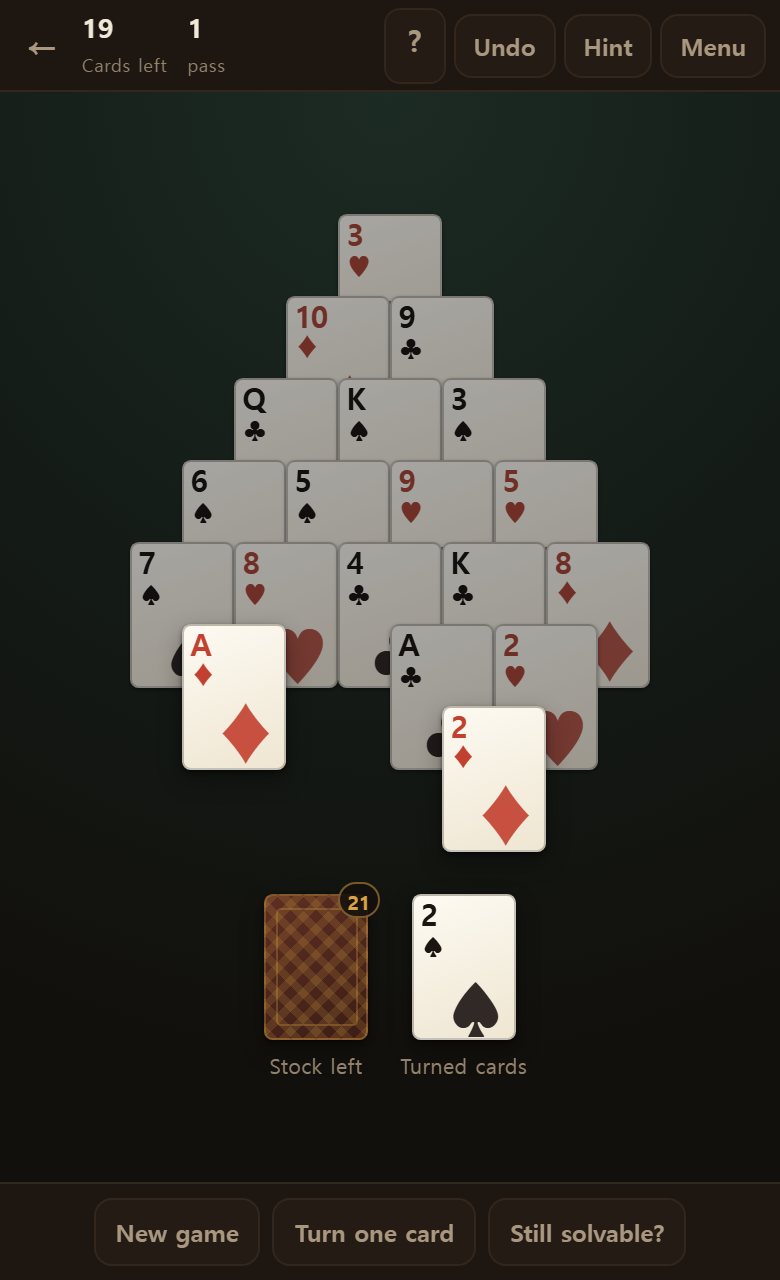
The cards form a triangle above, with two card places below it.
- The triangle — the pyramid. One card at the top, then two, three … down to seven: twenty-eight in all.
- The face-down card at the bottom left — the stock, twenty-four cards not yet used.
- The card at the bottom right — what has been turned from the stock. Only the top one is playable.
- The figures at the top — cards left in the pyramid, time, and which pass through the stock you are on.
A dimmed card is not yet available — it means other cards still sit beneath it.
This is how a board is dealt
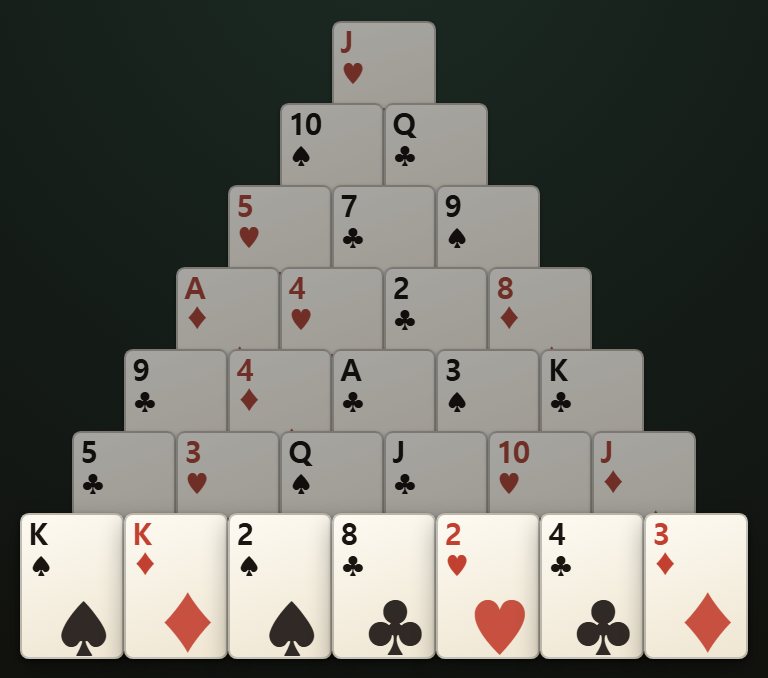
A new board deals all twenty-eight pyramid cards face up. Nothing is hidden.
So Pyramid is a game where what you see is everything. You are not turning cards and hoping; you are working out the order to take the visible ones in.
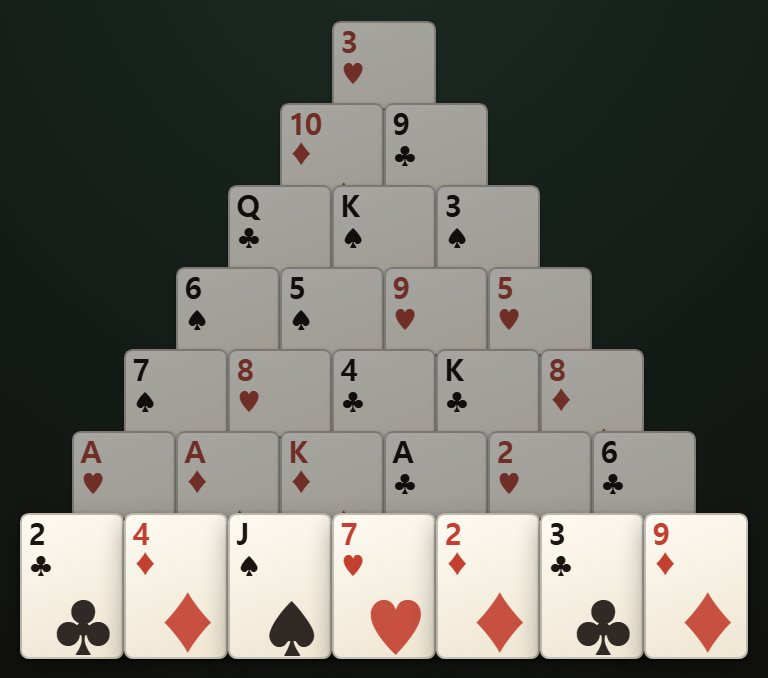
At the start only the seven along the bottom are available. Everything else is covered.
Reading a card's value
In Pyramid a card is only its number. The suit is never used.
- A is 1, the lowest.
- 2 to 10 count exactly as written.
- J is 11, Q is 12, K is 13.
- So the values run evenly from 1 to 13.
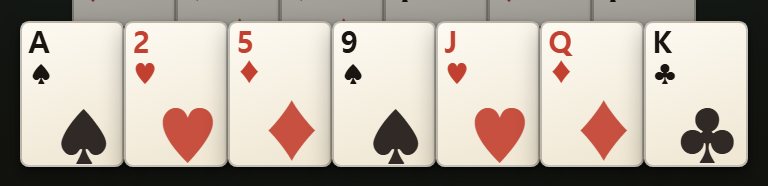
If J, Q and K get muddled, remember them alphabetically — J, Q, K. That is 11, 12, 13 exactly.
Adding to 13 — that is the whole rule
Pick two cards and if they add to 13, both come away. Suit is not considered at all — red or black makes no difference.
The running total of what you have picked shows at the bottom of the screen. At 13 they lift on the spot.
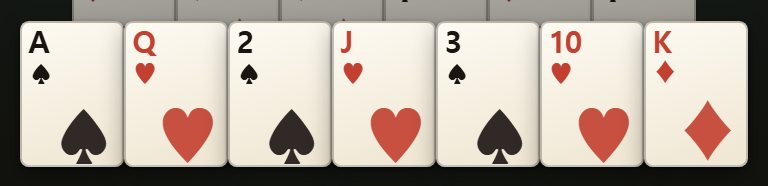
Anything but 13 does nothing at all — no card lost, no penalty. Tap freely.
There are only six pairs to learn
Pair up 1 through 12 and you get six pairs. That is the lot.
- A and Q — 1 + 12 = 13
- 2 and J — 2 + 11 = 13
- 3 and 10 — 3 + 10 = 13
- 4 and 9 — 4 + 9 = 13
- 5 and 8 — 5 + 8 = 13
- 6 and 7 — 6 + 7 = 13
If six pairs feel like a lot, learn them from the middle outwards. The 6 and 7 meet in the centre, and stepping apart one at a time gives 5-8, 4-9, 3-10, 2-J, A-Q. After a few games your hand remembers before you do.
A K comes away on its own
A K is already 13, so it needs no partner and lifts by itself.
On screen, one tap and it is gone. There is no picking stage.
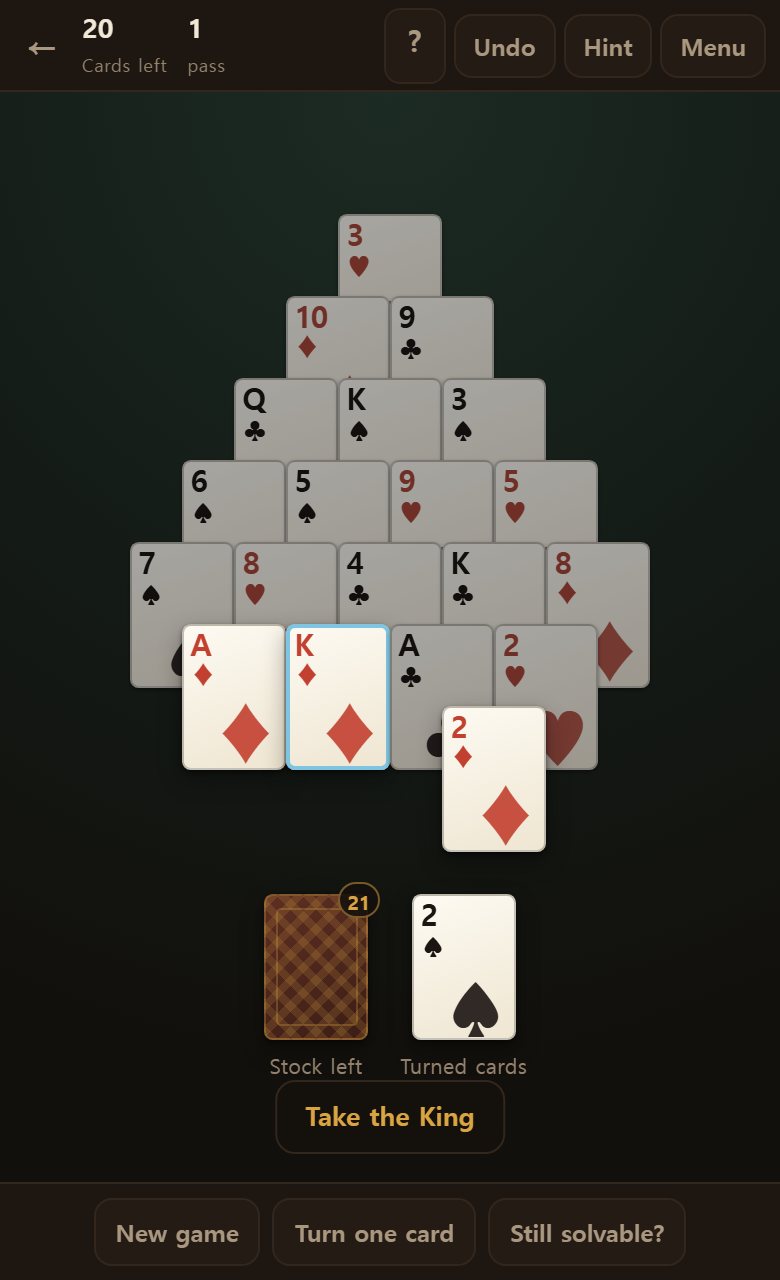
A K is free. Take it the moment you see one — left in place, it keeps the card above it shut forever.
Picking two cards
Tap an available card and it gains a gold ring, meaning it is picked.
Tap another and the two are added. At 13 both lift; otherwise the ring simply moves to the new card.
- Tapping a picked card again unpicks it.
- A K lifts in one tap, with no picking stage.
- Tap a dimmed card and the line below explains why it is unavailable.
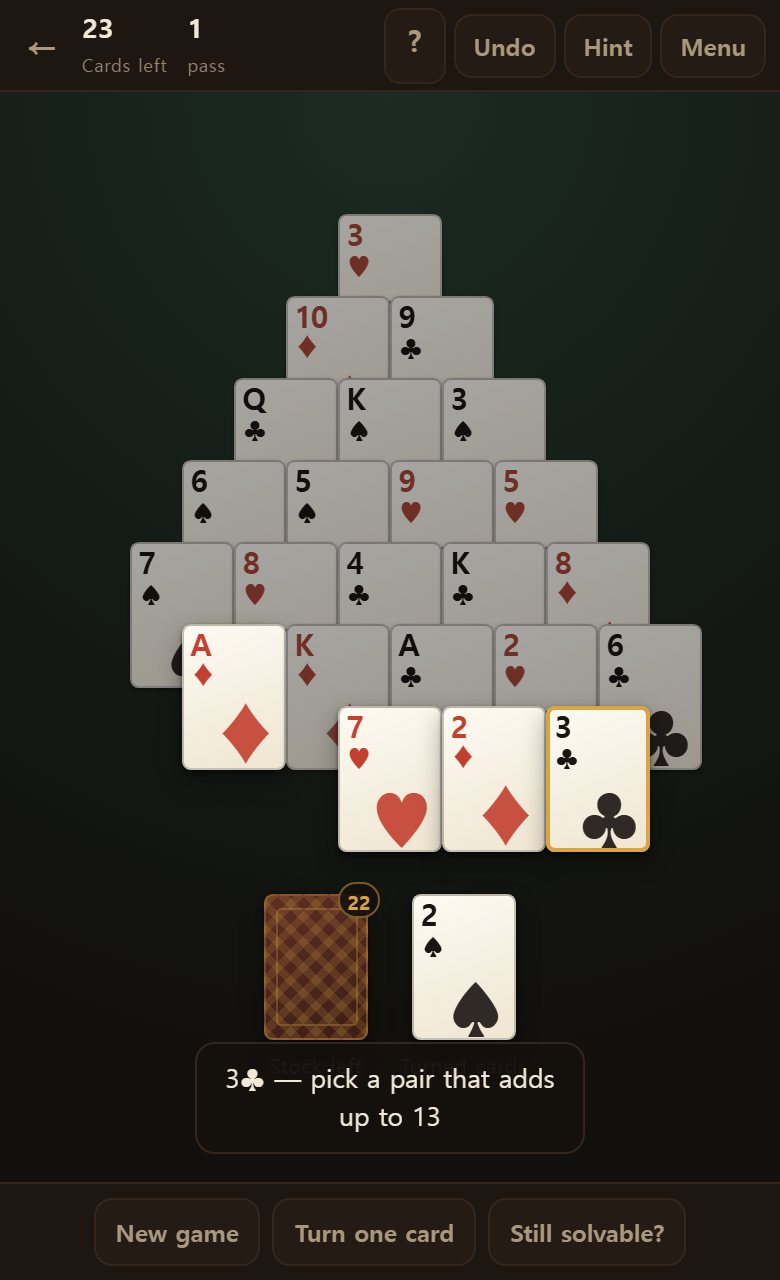
A wrong take is nothing to worry about — Undo at the top reverses as many as you like.
A covered card is unavailable
The cards overlap by half, so two cards always sit beneath any given one.
Both have to go before the card above becomes available. One is not enough.
Which makes Pyramid a game of dismantling from the bottom upwards.
- The seven along the bottom are available from the start.
- Available cards are bright and unavailable ones dim. There is nothing to memorise.
- Taking the single card at the summit means clearing the twenty-seven beneath it first. That is your final move.

So which card covers which is the whole of this game — far more important than spotting matching values.
No pair? Turn a card
When the pyramid offers no pair, tap the stock at the bottom left. One card turns over to the right. The Turn one button below does the same.
A turned card can be paired too — but only the top one.
- Turned cards cannot pair with each other, since only one is visible at a time.
- A pyramid card with a turned card — that pairing works.
- A pyramid card with another pyramid card — that works too, of course.
- A turned K lifts on its own as well.

Turning costs you nothing in itself — but a card once passed will not come round again until the next pass.
Three passes through the stock
Turn the stock through and the button becomes Redeal. Press it and the turned cards flip back into a stock.
But you may redeal only twice. Counting the first time through, that is three passes in all. After the third the button reads stock finished and does nothing more.
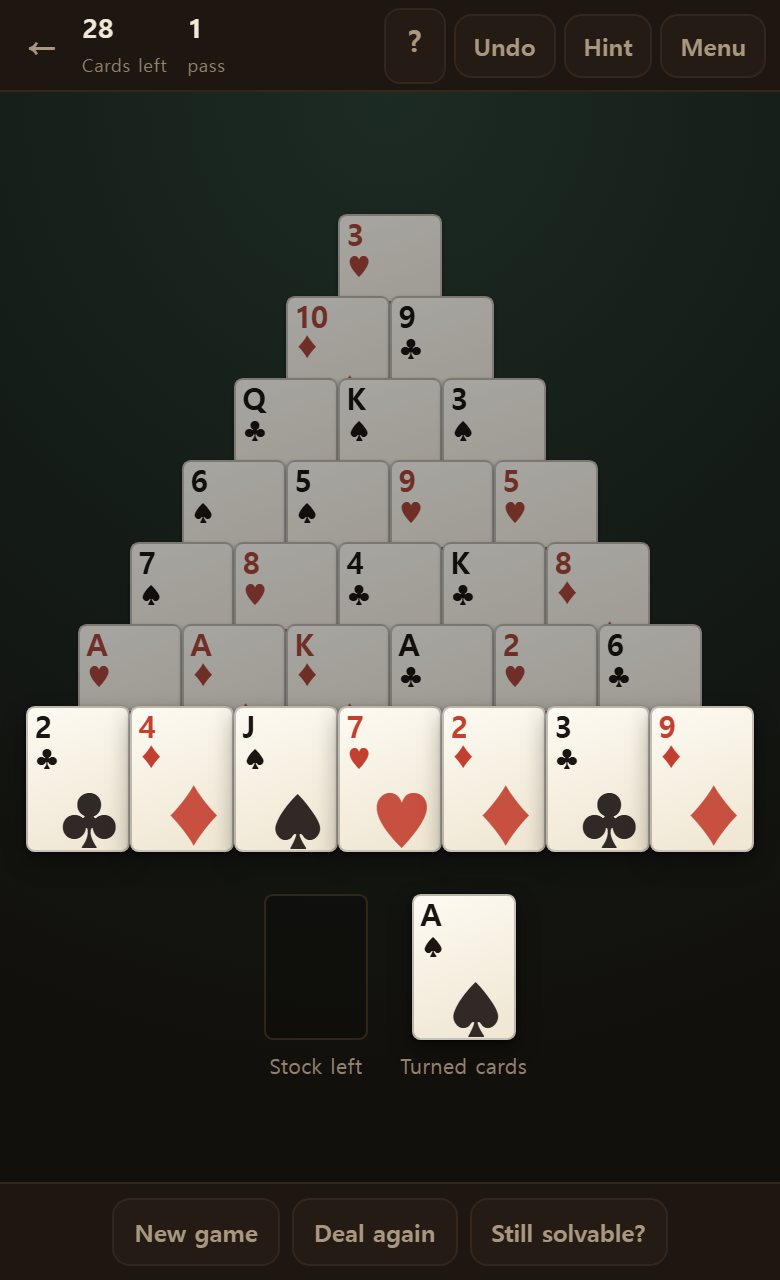
Three passes is less generous than it sounds. Whatever the first pass lets you take, take it.
Reading the figures at the top
Three figures on the left, three buttons on the right.
- Cards left — how many remain in the pyramid, counting from 28 down to 0.
- Time — how long since the board began.
- Pass — which pass through the stock you are on. Three is the last.
- Undo, hint and menu — the three buttons on the right.

Read cards left together with pass. Plenty of cards left on the third pass means you are in trouble.
Dismantling from the bottom up
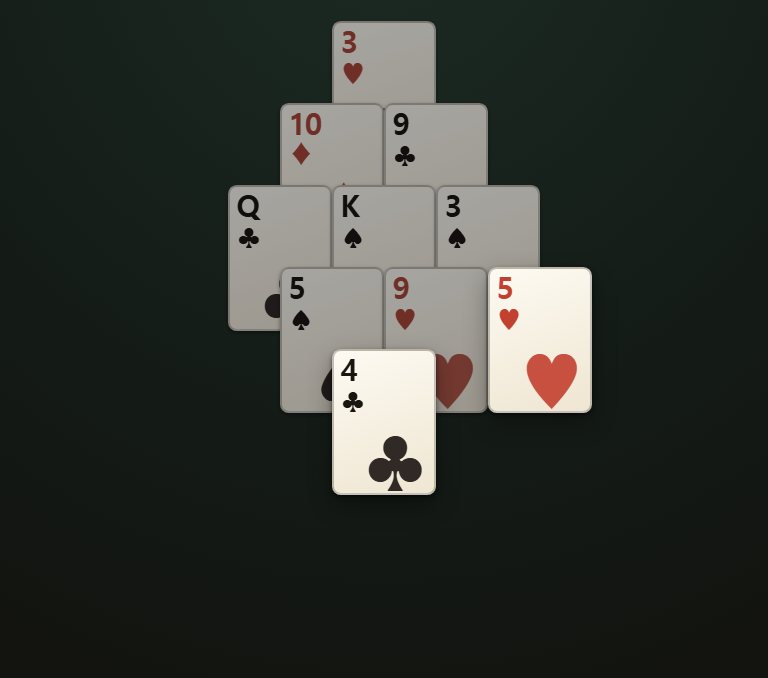
A few moves in and the bottom rows thin out. You will see the cards above each hole brighten.
Peeling a layer at a time from the bottom is the shape of this game.

Dig deep on one side and only that side opens, while the other stands untouched. The trick is bringing both sides down evenly.
Which one to take first
The same value often appears more than once, and which one you take decides the board.
- Take the pyramid card first. A stock card comes round again next pass.
- Take the card covering the most — it opens what is above it that much sooner.
- Take the one higher up. A bottom-row card can be taken whenever.
- Two cards that pair with each other, both in the pyramid, is a gift — two gone in one move.
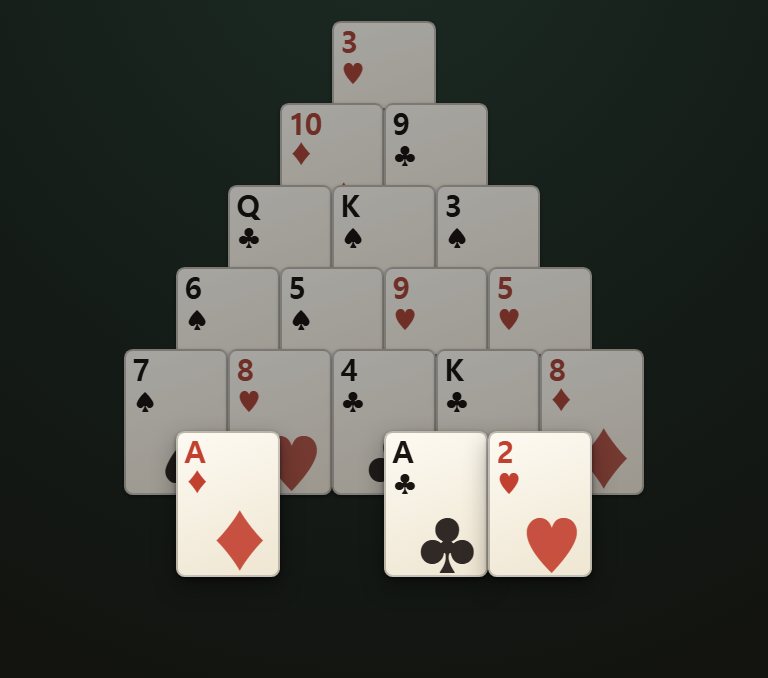
When torn, ask: does taking this open a new card? If it does, that is usually the better choice.
Spotting the knot in advance
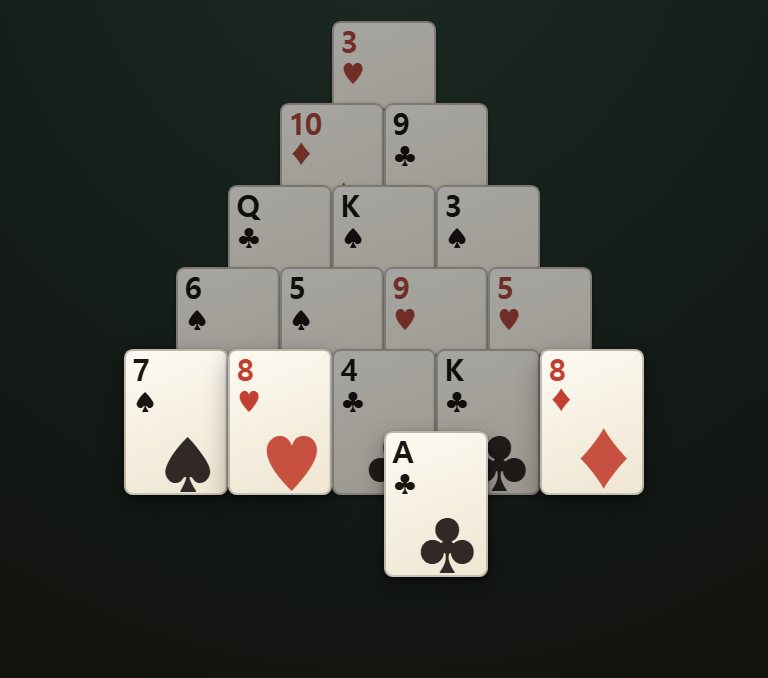
There is usually one reason a Pyramid board will not come out: a pair stacked one directly above the other.
In the picture below, the 8♥ sits directly under the 5♠ in the sixth row. 5 + 8 = 13, so they are a pair. But reaching the upper one means taking the lower first — by which point the lower is already gone. Those two can never be taken together.
Such a pair has to be broken with another card from the stock.
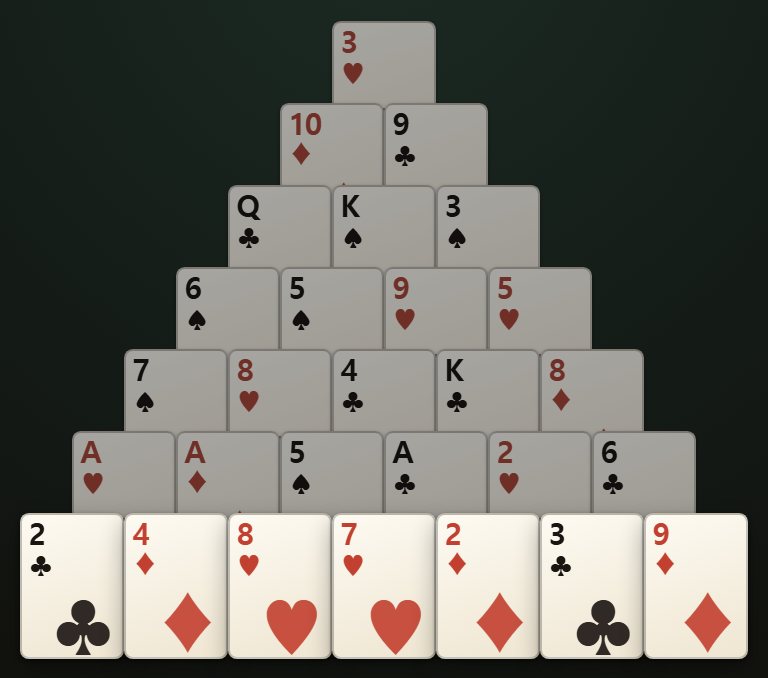
As soon as a board is dealt, scan for pairs stacked over one another. That is the knot of the board.
Took the wrong card? Undo
Press Undo at the top and your last action never happened. Cards taken come back, and a turned card returns to the stock.
There is no limit — you can go right back to the first move.
So take cards boldly. When you cannot read a few moves ahead, trying it and taking it back is quicker than working it out.
Stuck? Ask for a hint
Press Hint at the top and it gives you the first move of a winning line from here — never the whole answer.
- It marks the two cards in blue. Tap them in turn and they lift.
- When it says to take a K, only one card is ringed.
- Sometimes it simply says to turn a card — meaning that is the right move now.
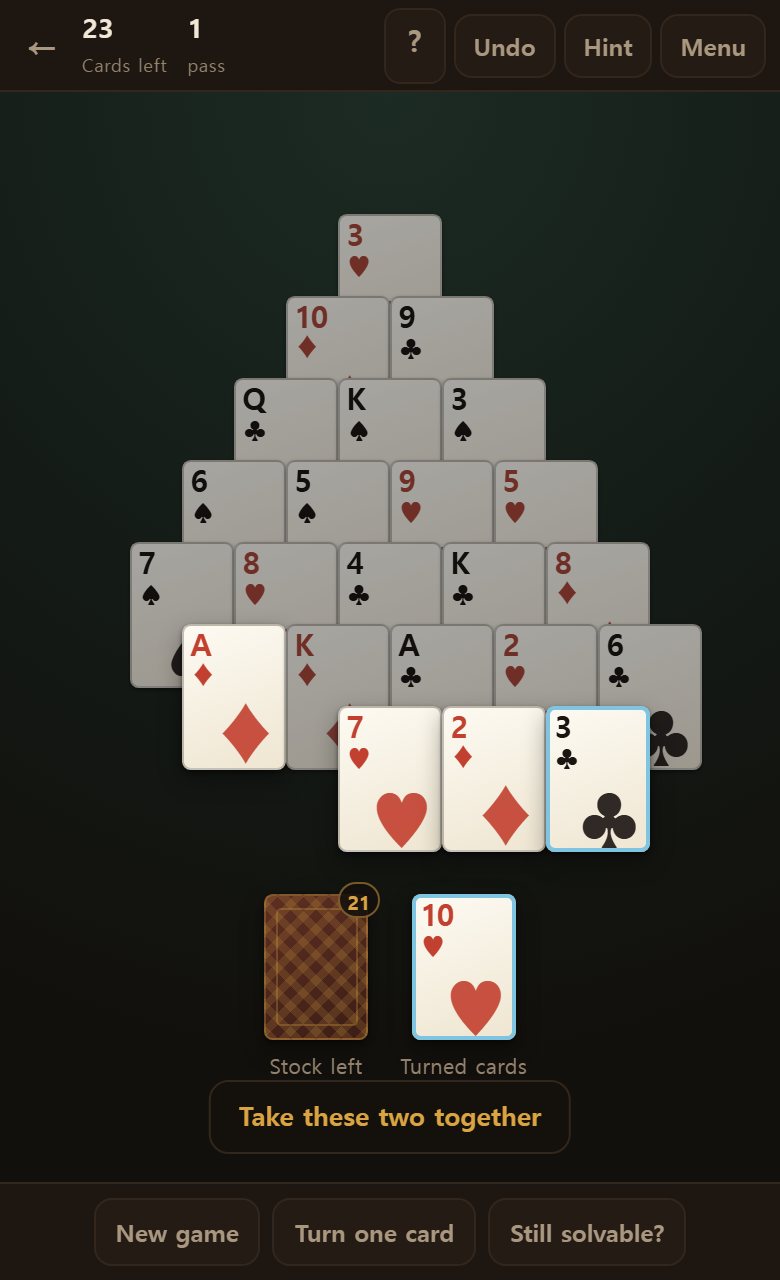
Asking as often as you like carries no penalty, and your record is untouched.
Does it still solve?
Press Does it still solve? below and it works the position through to the end to see whether a path remains.
- Still solvable — a path exists. Look further, or ask for a hint.
- Not from here — the order went wrong somewhere. Undo back.
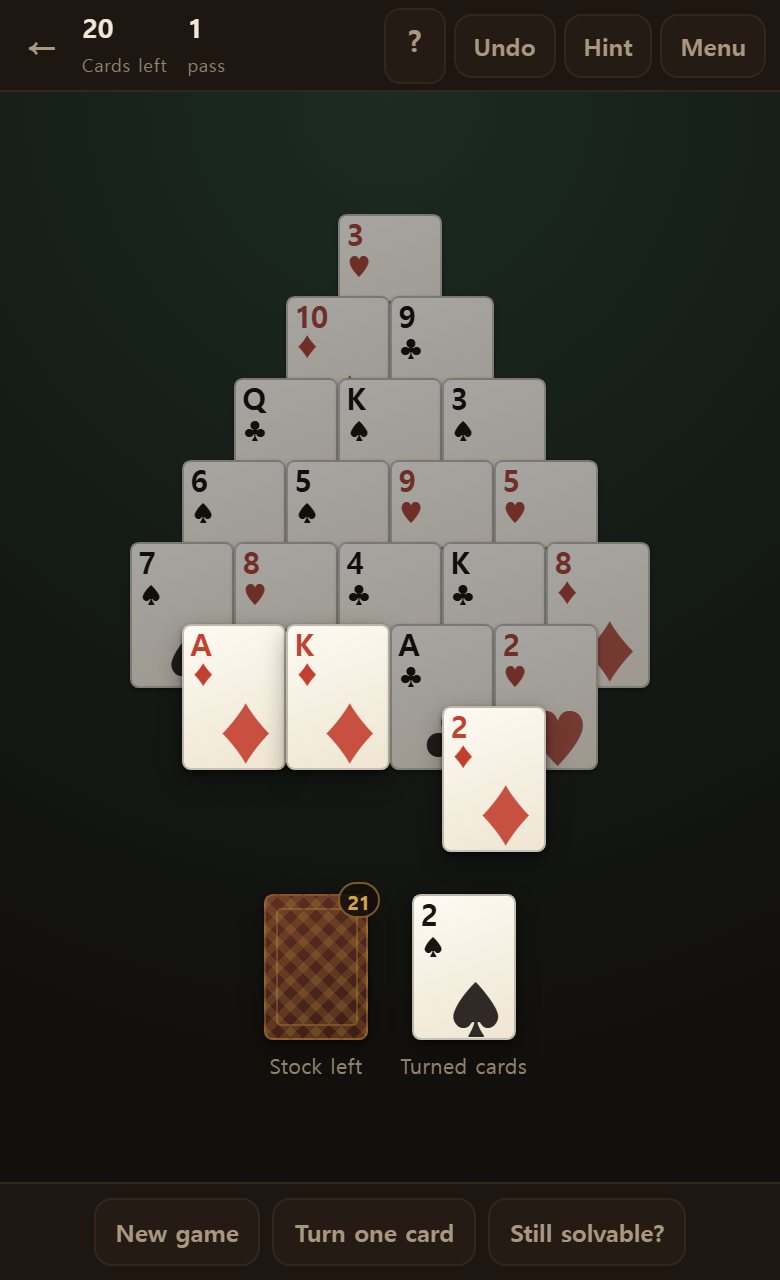
With this button you never waste effort. Ten minutes spent on a board that could not come out simply does not happen.
Only solvable boards are handed out
Shuffle a Pyramid board at random and more than half cannot be solved, however well you play. That is thoroughly unfair.
Here, every board is solved through to the last card before it is handed out. Any that cannot be is thrown away and rebuilt.
So if you are stuck, there is an order you have not seen. Undo a few moves and try another.
How to win
These alone will solve you noticeably more boards, most important first.
- Take every K on sight. It is free, and leaving one blocks what is above it.
- Take the pyramid card first. A stock card comes round again next pass.
- Bring both sides down evenly. Dig one corner and the far side never opens.
- Take from the higher rows first. The bottom row can be taken whenever, so there is no hurry.
- Spend the first pass carefully. Three passes go faster than you expect.
- Find the pairs stacked over one another at the outset. How you break those is the key to the board.
- Stuck? Hint. Still stuck? Does it still solve?
Common mistakes
Boards jam here in one of four ways, nearly always. Knowing them keeps you out of them.
- Digging one corner — the commonest of all. Take down the left and the upper right never opens.
- Putting off a K — a free card that lifts alone, and leaving it blocks what is above.
- Turning the stock first — with a pair available in the pyramid, turning only burns a pass.
- Taking any of several equal values — take the one covering the most.
The moment you suspect a jam, press Does it still solve?. If it says no, undo and take a different order.
When it is all cleared
Clear all twenty-eight pyramid cards and you win. Cards left in the stock do not matter — only the pyramid counts.
When it says the pyramid is down, you are finished. Your time is still at the top of the screen, so try the same board again, faster.

New game deals another. Every board is checked as solvable before it is handed out.
Common questions
A dimmed card is unavailable because cards still sit beneath it. Clear those two first.
They have to add to exactly 13. A is 1, J is 11, Q is 12, K is 13. The running total shows at the bottom of the screen.
Because a K is 13 by itself. It needs no partner — one tap and it lifts.
No. Pyramid ignores suit and colour entirely. Only the values matter.
Three passes — the first time through plus two redeals. Which pass you are on shows at the top.
No — only the top turned card is visible. It has to pair with a pyramid card.
Try Hint first. If it has nothing, press Does it still solve?. “Still solvable” means an order exists that you have not seen; “not from here” means undo a few moves and try a different one.
Yes. Clearing the twenty-eight pyramid cards wins it; the stock is not counted.
There is no limit — you can go back to the first move. Take cards boldly.
- Do not just clear the bottom row — look for where a column will break through. Opening upwards is what solves the deal.
- If the same rank shows in several places, use the pyramid one first. Stock cards come round again.