 MindHub
How to play Memory Match
Cards lie face down and you turn two at a time looking for pairs. A pair is taken; anything else turns back over. The whole game is remembering what was where. If cards are new to you — or to your child — start with Learn Memory Match: ten small steps from flipping a card to a graduation match.
First, a look at the screen
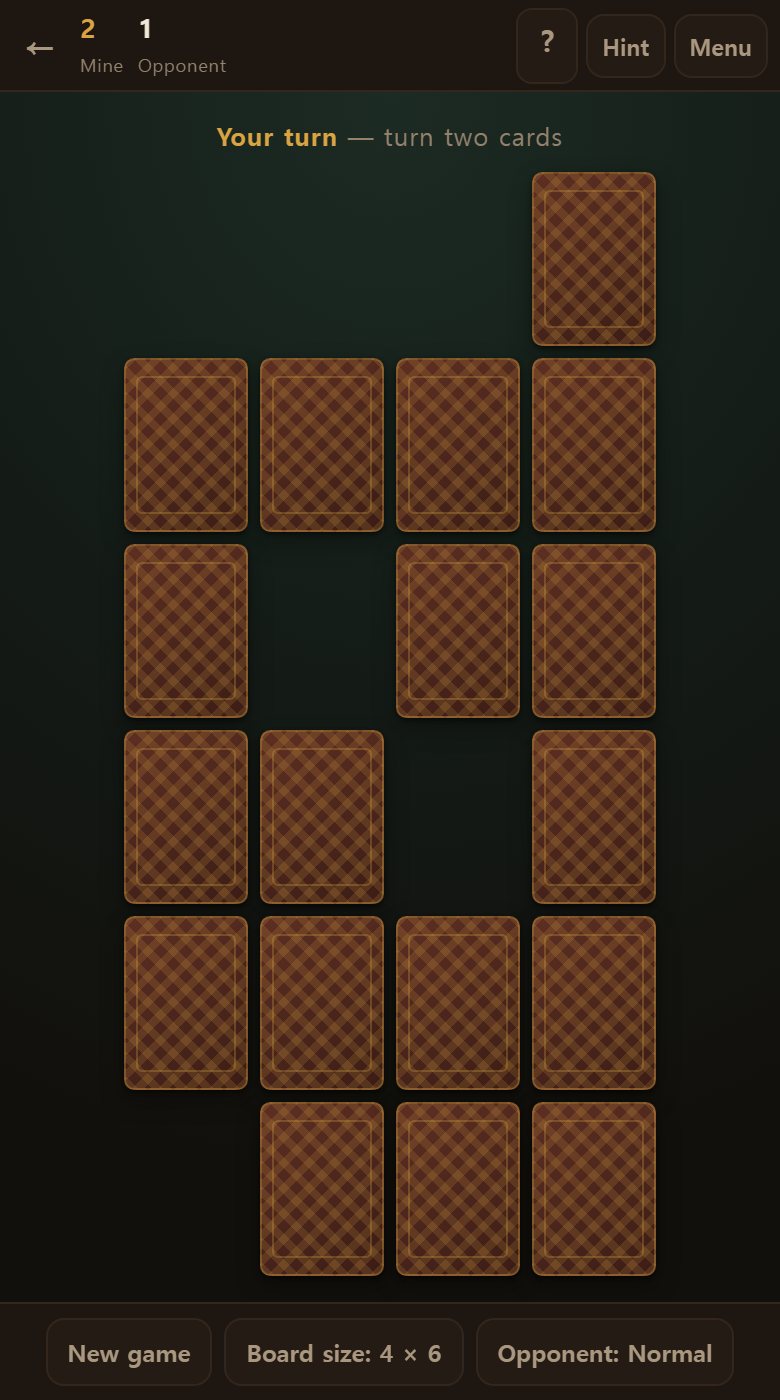
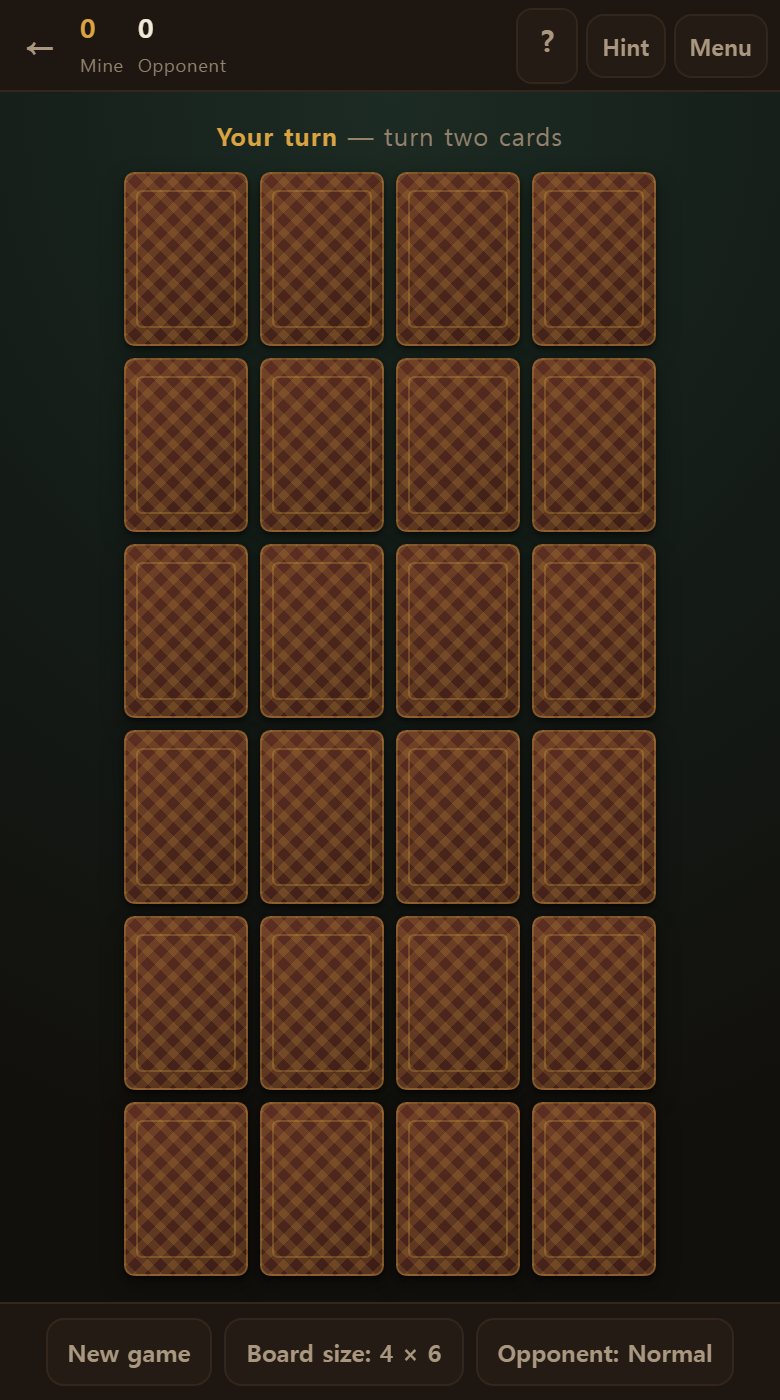
The cards lie face down in a grid, with the pairs each side has taken shown above.
- The grid — the face-down cards. Tap to turn one over.
- The two figures at the top left — your pairs and theirs.
- Whoever's turn it is has their figure in gold.
- The line above the grid — whose turn it is.
- The buttons below — new game, board size, and how well the opponent remembers.
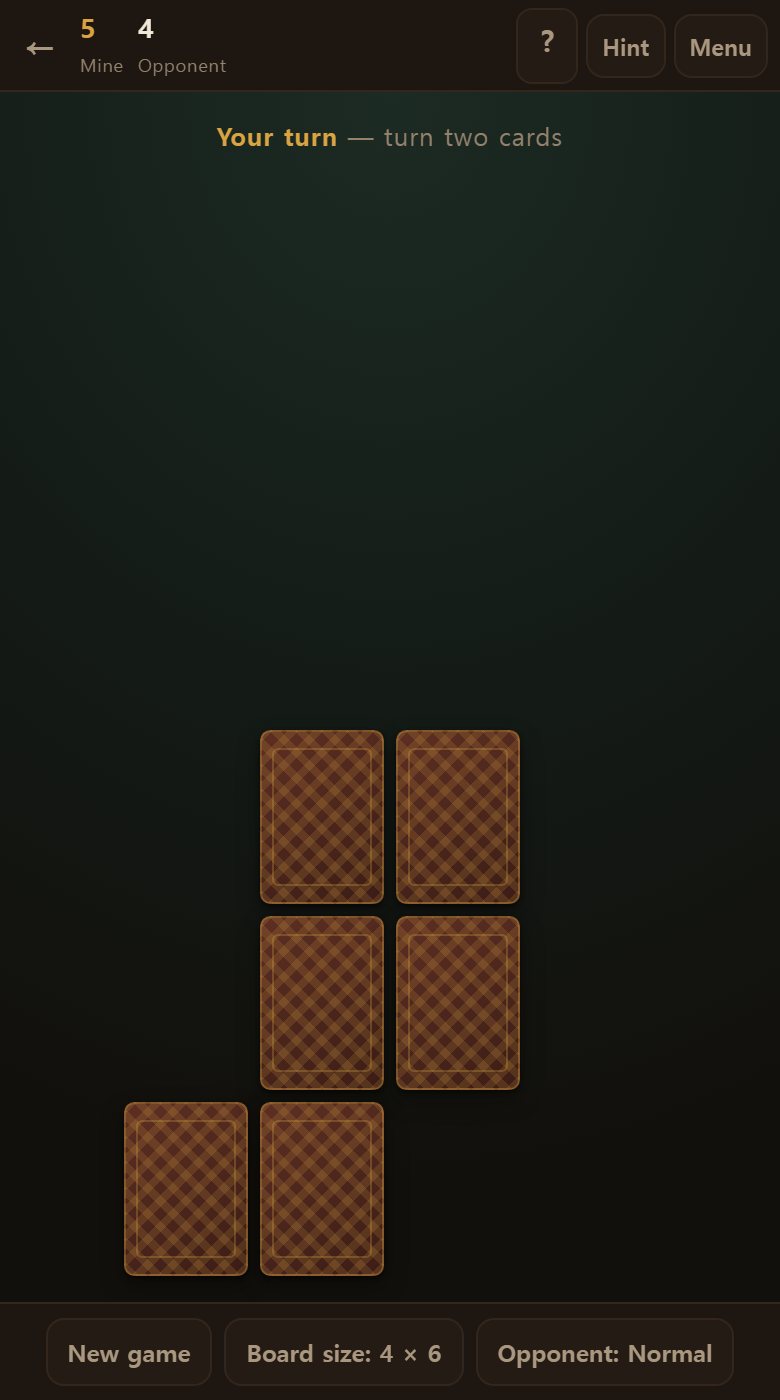
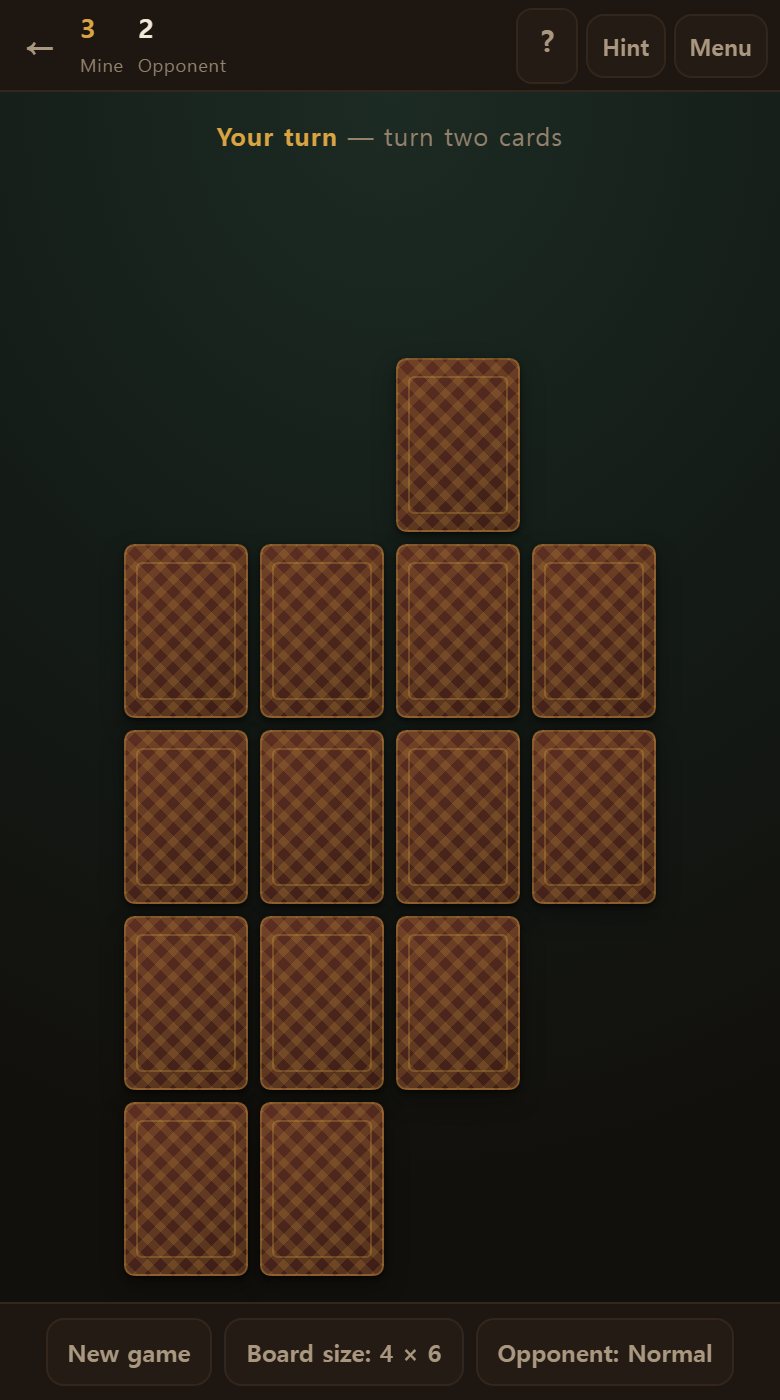
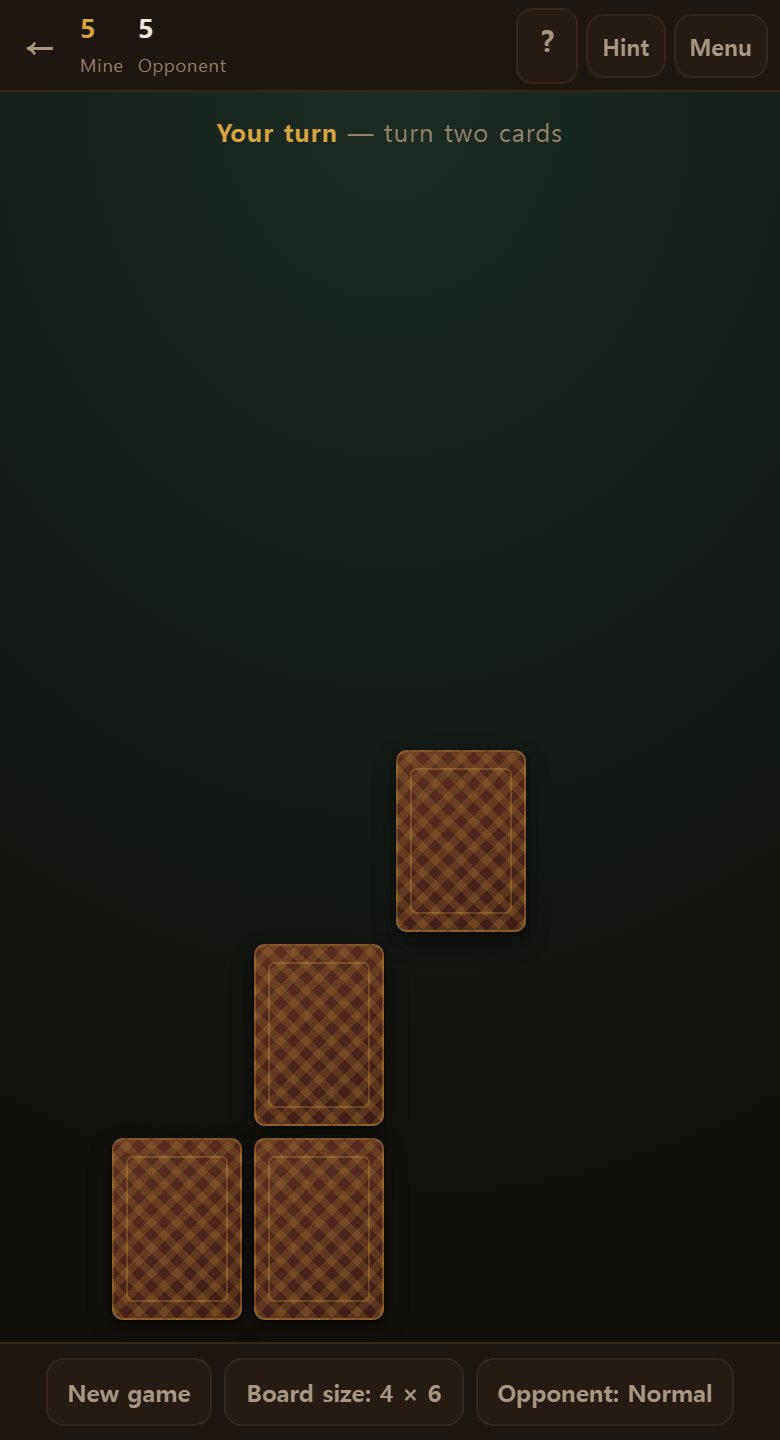
A taken pair leaves an empty space. The grid keeps its shape, so you can see at a glance what has gone.
A pair is the same rank and the same colour
This is where people trip up most. Matching ranks alone is not a pair.
The colour has to match too.
- 7♠ and 7♣ — both black, so they pair.
- 7♥ and 7♦ — both red, so they pair.
- 7♠ and 7♥ — different colours, so not a pair.
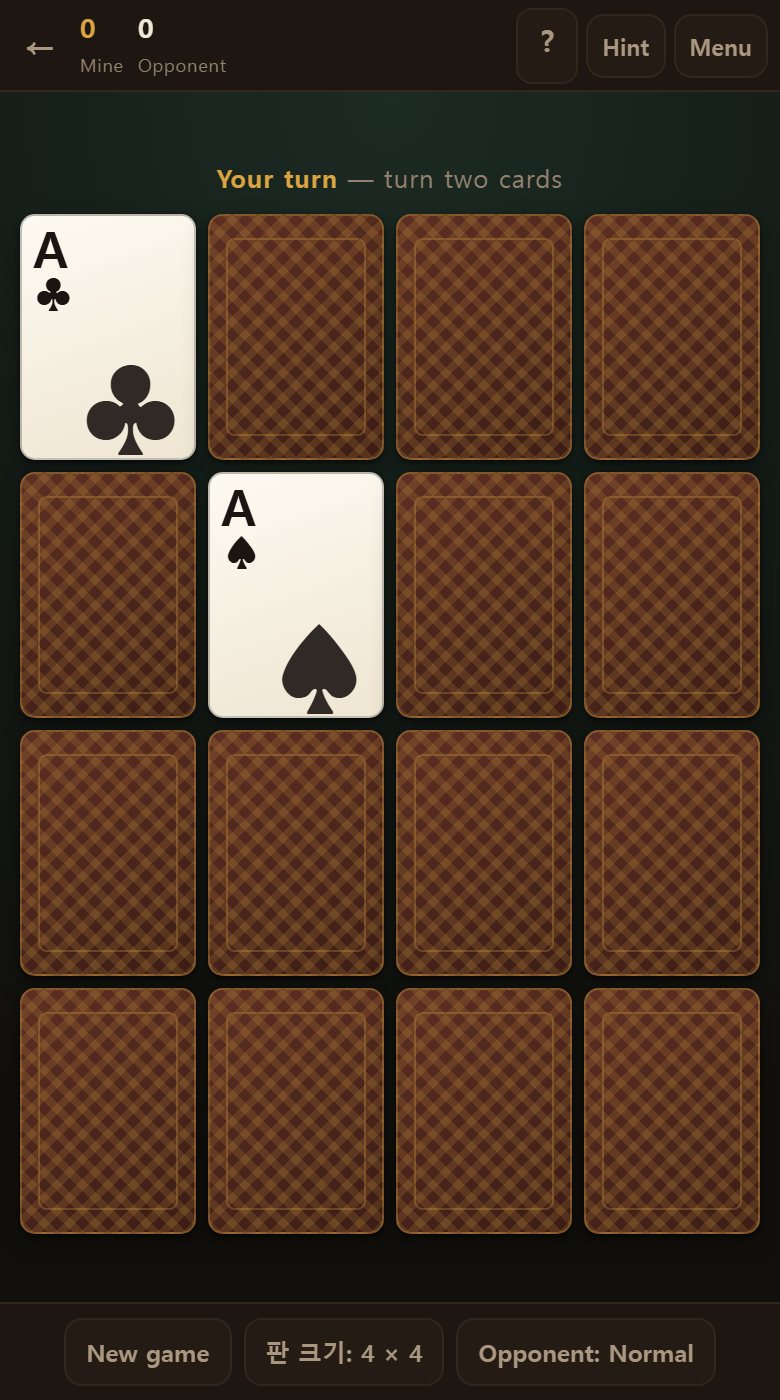
So the four cards of a rank make two pairs. Find a 7 and check the colour before anything else.
Turning two cards
Tap a face-down card to turn the first, then another for the second.
With two up, they stay showing for a moment. Look hard while they do.
- A card already turned up cannot be tapped again.
- Nor can a space already taken.
- While the two are showing, nothing responds to a tap.
- They show for less than a second — short enough that you should not look away.
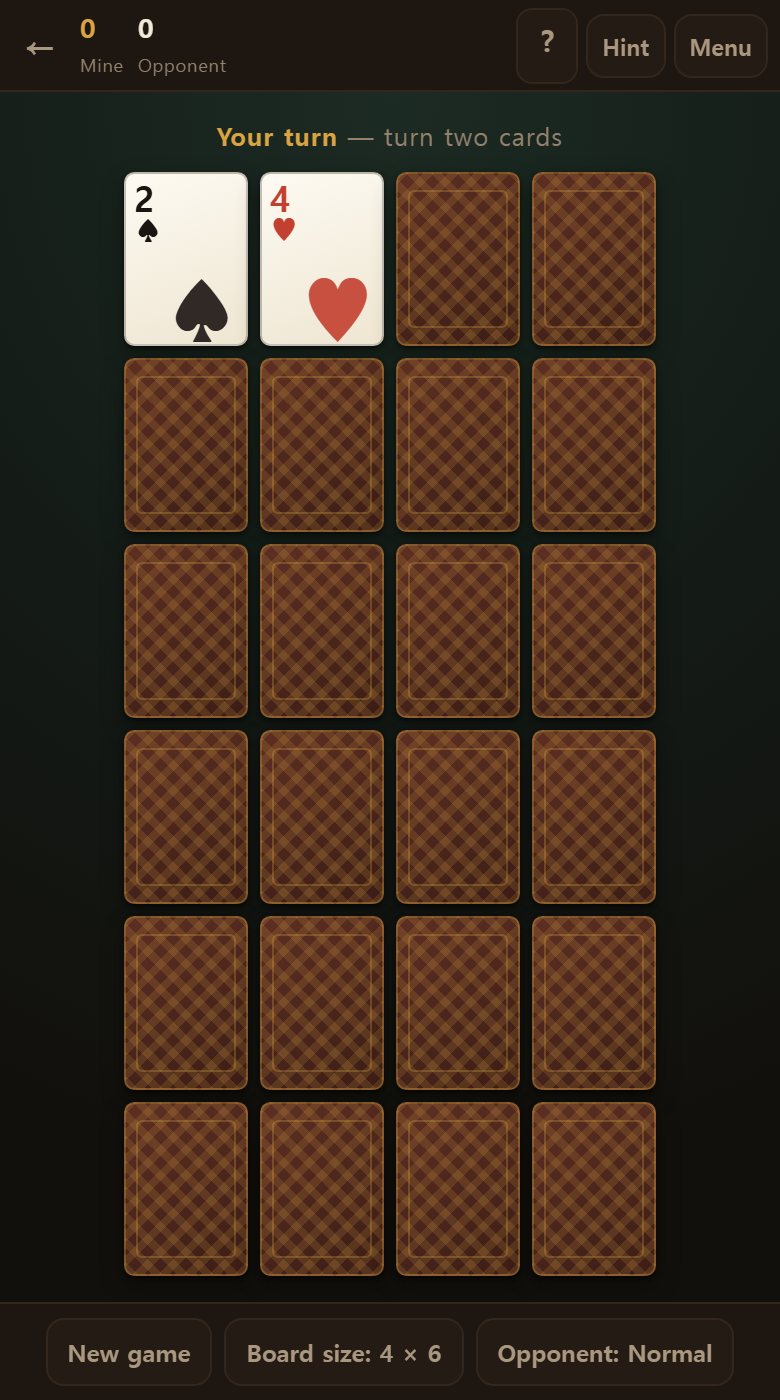
Do not decide both cards at once. Turn the first, see what it is, and only then choose the second. If the first was 7♠, ask yourself where you saw the 7♣. If you remember, go there; if not, go somewhere you have never seen. Half the difference between players is whether they take that one step.
A match lets you go again
Find a pair and you take both cards, then turn again.
Remember well and several pairs come off in a single turn. This is also where the game swings suddenly.
- Every match keeps it going. The turn is yours until you miss.
- So a well-remembered board can shed five or six pairs in one turn.
- The bigger the board, the more a run like that is worth.

So take a pair you know at once — do not save it. Once the turn passes, they take it instead. Within a run, take the certain ones first. Gamble on a half-remembered pair and a miss ends the run right there.
A miss passes the turn
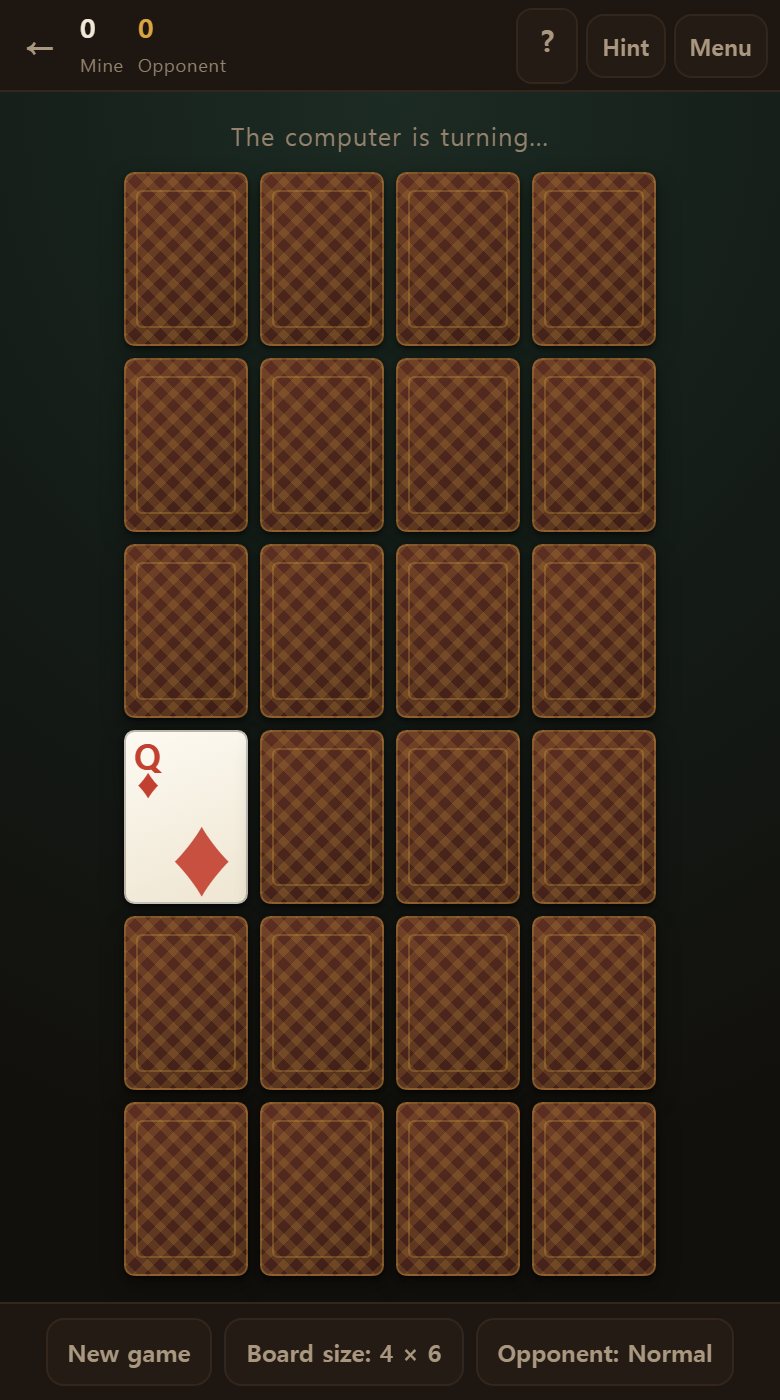
If they do not match, both turn back over and it is their turn.
Do not simply let that pass. Remembering where those two cards were is the whole game.
- Even a miss has taught you two squares. It is not a loss.
- Meet the partner of one of them next turn and you take it straight away.
- Watch what they turn over too. You learn those squares without spending a turn.
How to remember
Try to memorise all twenty-four squares and none of them stick. Try this instead.
- Tie the card to the place — “K, top left”. Remember the rank alone and it is gone in moments.
- Break it up by row. Learn even the top row properly and you will keep taking pairs from it.
- Look after what you have just seen. Older memories fade anyway.
- Once a pair is taken you can forget that place, which leaves less to hold on to.
- When in doubt, turn a square you have never seen. Turning something you already know teaches you nothing.
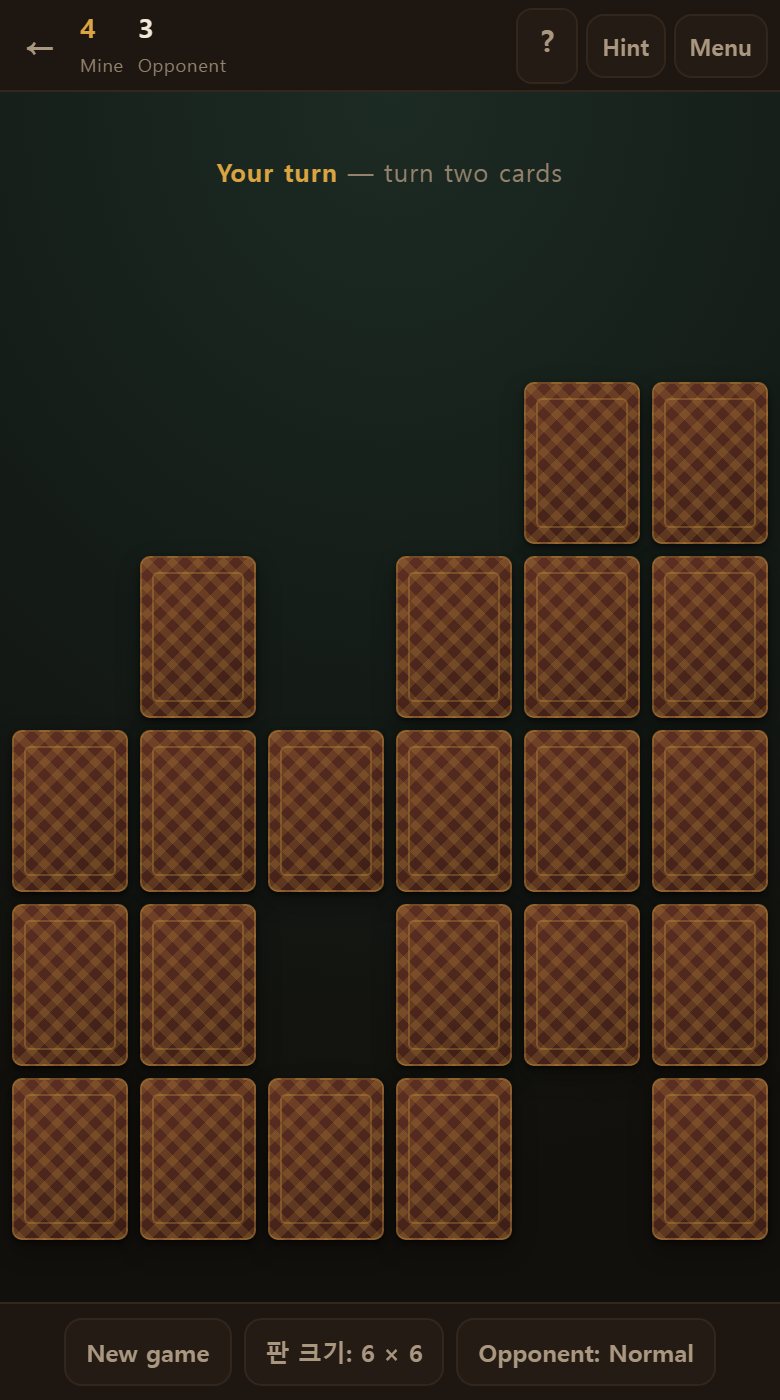
The commonest mistake is turning two cards at random. Make the first a square you have not seen, and choose the second by asking whether you know its partner.
You can set the board size
The board size button below changes it.
- 4x4 — eight pairs. Good for a first game, or for playing with a child.
- 4x6 — twelve pairs. The standard.
- 6x6 — eighteen pairs, and a great deal more to remember.
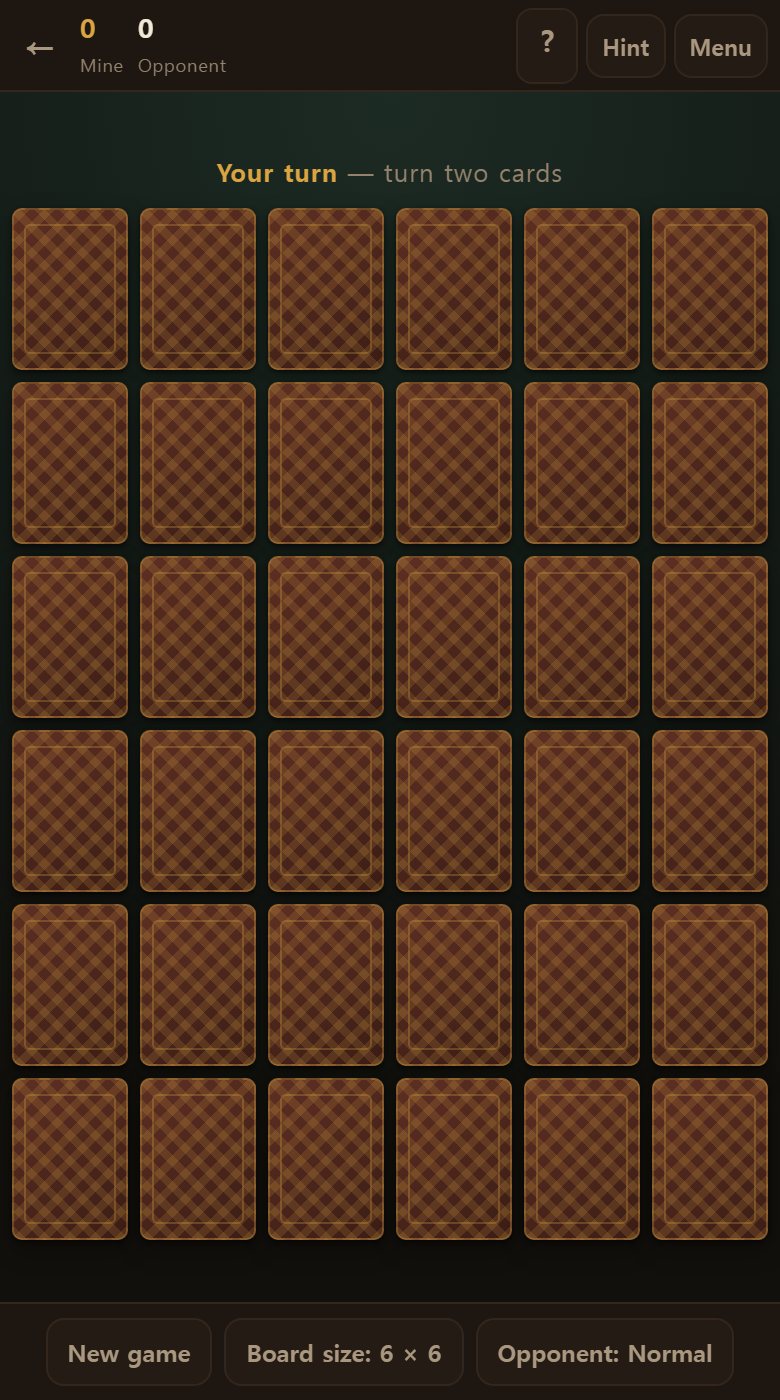
The bigger the board, the more going again is worth. Catch a run and six pairs can come off together. Small boards, by contrast, are heavily down to luck. With eight pairs, two or three early guesses landing is common. For a contest of skill, play big.
The computer forgets too
The computer never peeks. It remembers only cards that have been turned up — and, like a person, it forgets.
Difficulty does not make it cleverer; it changes how well it remembers.
- Easy — holds about four in ten of what it sees, and loses a good deal each turn.
- Normal — holds over seven in ten, and forgets only a little.
- Hard — holds nearly everything and forgets almost nothing. To beat it you have to remember too.
- Either way, a card never turned up is as unknown to it as to you. You are both guessing.
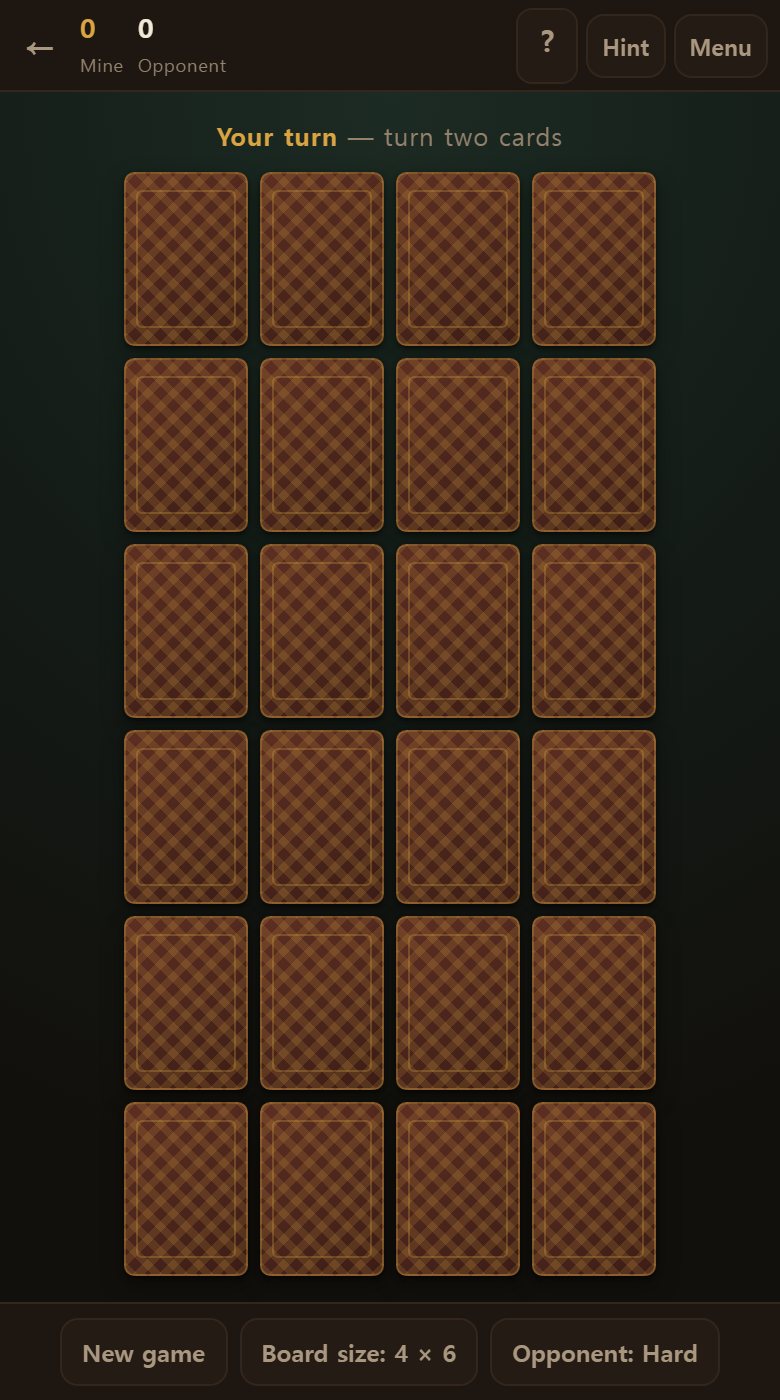
So when it seems to reach straight for a card it knows, that card was turned up earlier. You saw it too.
Hint uses only what you have seen
Press Hint at the top and it points at a pair — but only among squares you have already seen.
Pointing at what you have never seen would not be a game; it would be an answer sheet.
- A card you have never seen is unknown to the hint as well.
- Cards turned up by the computer count as seen by you.
- So to get value from the hint, you first have to have watched.
- On a keyboard it is H.
If it says no pair is known yet, then there truly is none. Turn a fresh square and add to what you know. Leaning on the hint stops your memory improving. Use it only when stuck.
It ends when every pair is taken
When no pair is left, it is over. Whoever took more wins; equal is a draw.
On a twelve-pair board, seven wins it. A single pair decides it remarkably often.
- When it is over, press New game to start again.
- The board size and the opponent's strength carry over. There is nothing to set again.
- The cards are reshuffled each game, so everything you memorised is wiped.
- Your record stays on this device. Nothing is sent anywhere.

How a game unfolds
Early on, nothing much happens. Both sides turn squares they do not know, and only knowledge accumulates.
- The first three or four turns nearly all miss. That is normal.
- But every one of those misses becomes something remembered.
- By halfway, enough is known that several pairs come off in one turn.
- Which is why this game is decided abruptly, in the middle.
Do not be discouraged by early misses. How well you watched shows up exactly then.
Do not rest your eyes on their turn
There is free information in this game: the cards the computer turns.
Two cards appear without costing you a move. Remember them and you take them on your turn.
- The two cards they miss are the most valuable of all — two squares learned for nothing.
- Cards they match are taken off, so there is nothing to remember there.
- Looking away during their turn throws away half the game.
- That brief moment while their two cards show is a chance handed to you.
- It is worth most when they guess at squares nobody has seen — two new cards at once.
This is where the gap between players is widest. Good players watch harder on the other side's turn.
How to win
Five habits will win you a great many more games.
- Make the first card a square you do not know. Turning a known one teaches you nothing.
- Make the second a square you do know, if you can. Ask first whether you know the partner of the card you just turned.
- Take a pair you know at once. Save it and they take it.
- Watch their turn. Two squares, learned for nothing.
- Tie the card to the place. Remember the rank alone and you forget where it was.
All five are really one: do not let go of anything you have seen. Skill here is not memory so much as the habit of watching.
Common mistakes
Games are lost, more often than not, in one of these four ways.
- Turning two cards at random — the commonest of all. You choose the second after seeing the first; you do not settle both at once.
- Looking away on their turn — throwing away half the game.
- Ignoring the colour — find a 7 and turn any other 7 and you are wrong half the time.
- Saving a pair you know — put it off to next turn and they take it first.
All four come from letting information slip. What you lose in this game is not cards but squares you had seen.
Can I play on my own?
This one is built as a contest against the computer. Set the opponent to Easy, though, and it works much like solo practice.
- An easy opponent holds about four in ten of what it sees. You win by exactly as much as you remember.
- Down at 4x4 it is eight pairs — manageable even for a young child.
- 6x6 is eighteen pairs, which is no small thing for an adult either.
- Board size and opponent strength are set separately, so a small board with a strong opponent is perfectly possible.
- To measure yourself alone, set 4x4 and Easy and count the pairs you take.
To build the memory, raise the board size gradually. Once you can clear 4x4, move to 4x6, then to 6x6.
Whose turn it is
The line above the grid says whose turn it is, and the figure at the top turns gold for whoever is to play.
- Your turn — turn two cards means the board is yours to tap.
- The computer is turning… means tapping does nothing. Watch instead.
- Nothing responds while two cards are showing, either.
- If they match, they turn again. The turn does not come straight back to you.
Sitting through a run of theirs is frustrating, but it is when you learn most — everything they turn is in plain sight. Rest your eyes while you wait and you will usually lose that game.
Common questions
The colour has to match too. The 7♠ pairs with the 7♣, and the 7♥ with the 7♦.
It is already turned up, or already taken — or two cards are currently showing.
A match lets you turn again. It keeps going until you miss.
No. It remembers only cards that have been turned up — the same ones you saw.
Use the Opponent: Normal button below to set it to Easy.
Drop the board size below to 4x4. Eight pairs is within reach.
You each took the same number. It happens fairly often on boards with an even number of pairs.
- Do not try to memorise the whole board. Tie a card to a place — “K, top left” — and it stays with you far longer.
- Watch what the computer turns over too. You learn those squares for free.