 MindHub
How to play Lights Out
Tap a square and its light flips together with the four around it. Put every light out and you win. That one line is the whole rule. But a few taps in you find out what it means — you put one square out and its neighbour comes on, and putting that one out lights another. What this page teaches is how to tap in order instead of at random. Learn that one method and no board can beat you.
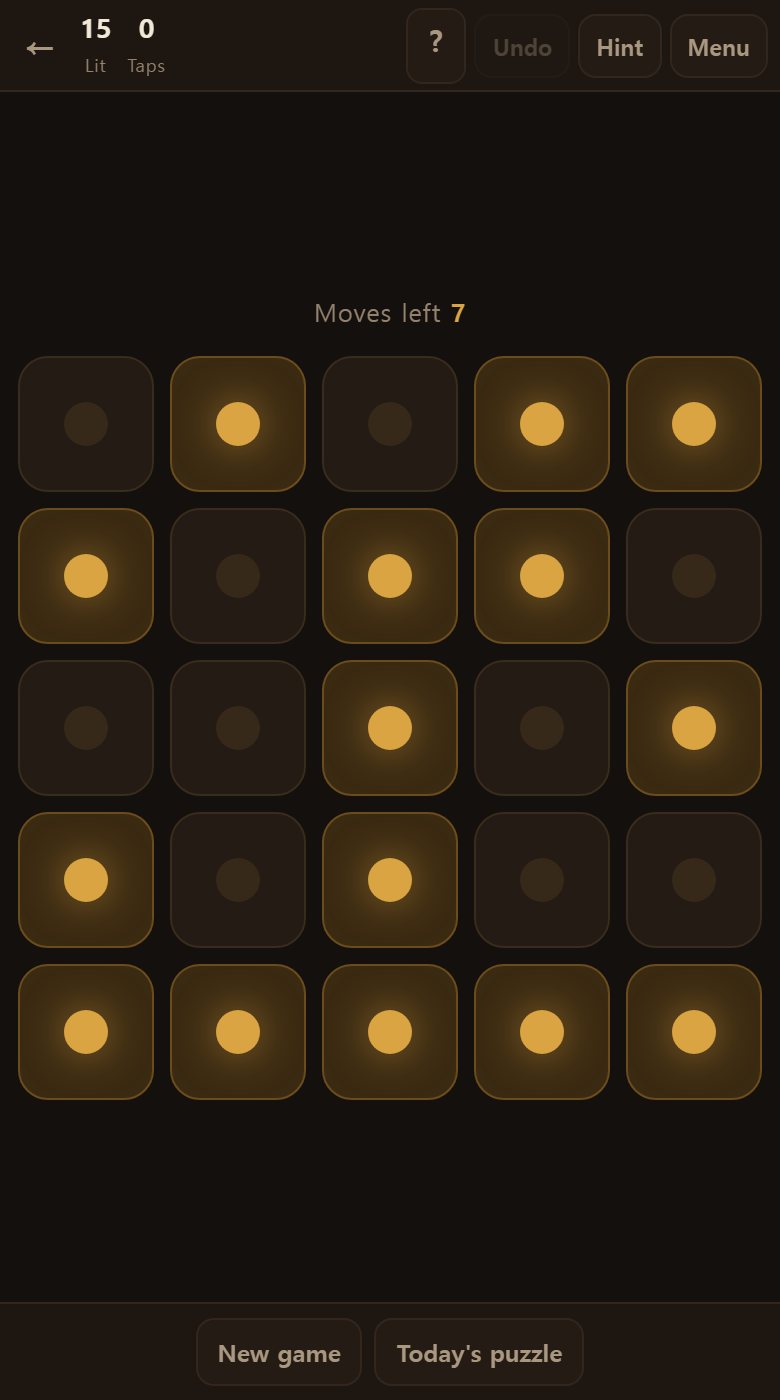
First, a look at the screen
The square board sits in the middle, with buttons above and below it.
- The board — one light to a square. The bright ones are lit.
- The line above the board — how many taps it takes to finish from where you are.
- Top left — lit squares, time, and taps so far.
- Top right — how to play, undo, hint and menu.
- Bottom — new game and today's puzzle.
When lit squares reaches 0 it ends on the spot. There is no confirm button to press.
One tap flips five squares
Tap one square and five flip together — that square and the four above, below, left and right. A cross shape.
Flip means lit goes dark and dark goes lit. It does not turn things on, and it does not turn things off — it turns them the other way.
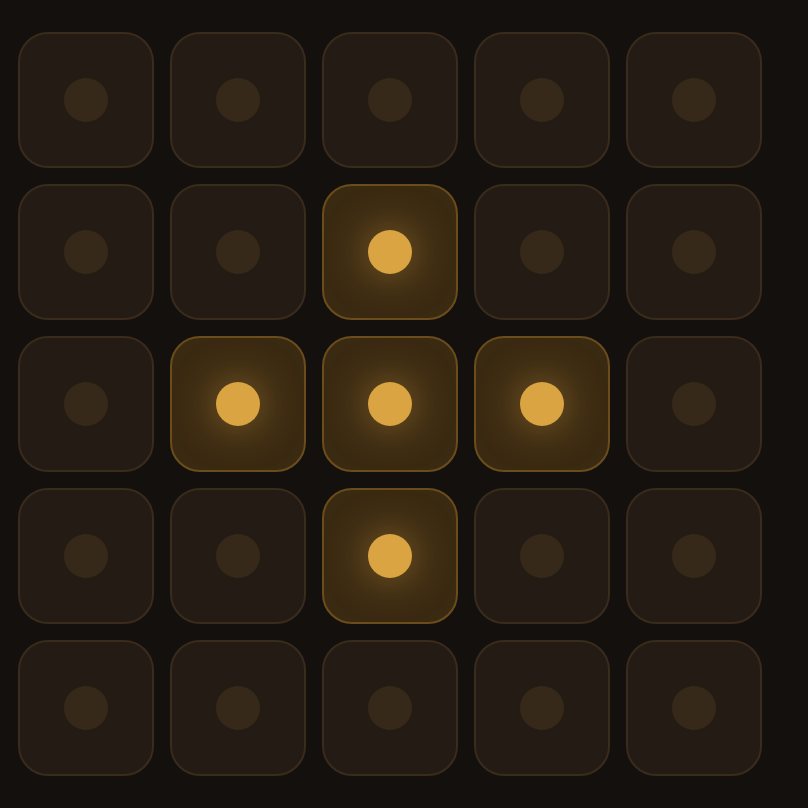
That is what makes this hard. Tap a lit square to put it out and the four around it change with it. Fix one and four wobble.
Four on an edge, three in a corner
There are no squares off the board. So an edge square flips four, and a corner square flips three.
- A middle square — five flip.
- An edge square — four flip, because one of them is off the board.
- A corner square — three flip, because two of them are off the board.
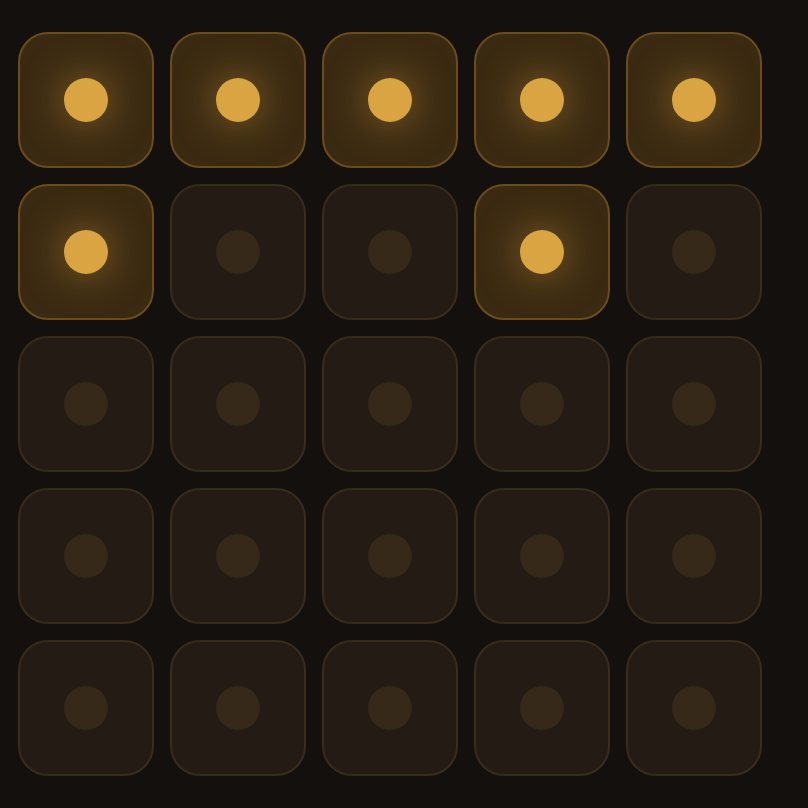
That makes corners and edges easier to handle — fewer squares wobble. You lean on this when tidying a board up.
Tap the same square twice and nothing happened
Tap a square, think better of it, and tap it again. Flip a flip and you are back where you started.
Something important follows from that. Tapping the same square twice is wasted work. So no square appears twice in the answer.
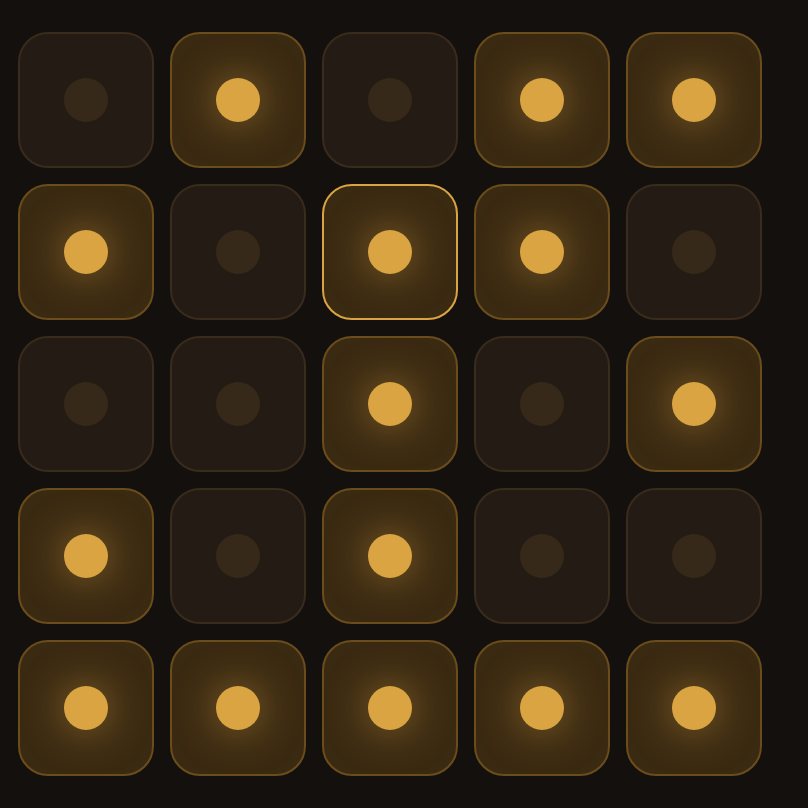
Which means all you have to decide is which squares to tap. How many times is not a decision — each square is either tapped or it is not.
The order makes no difference
Tap A then B, or B then A, and the board ends up the same.
Flipping does not care about order. If a square was flipped three times, the result is the same whatever order those flips came in.
That is what makes this a game you can plan. Decide every square you will tap, then tap them in any order you like.
A row at a time from the top — this one method is enough
There is really only one method here. It is not hard, so do learn it.
Where the top row has a lit square, tap the square directly below it.
That puts the top-row square out. The row below scrambles, of course — but that is fine, because the row below is next.
- 1. Look at the top row. Where a square is lit, tap directly below it.
- 2. Once the top row is dark, move down to the second row and do the same.
- 3. Carry on like that down to the bottom row.
- 4. Now every row above is dark and only the bottom row is left.
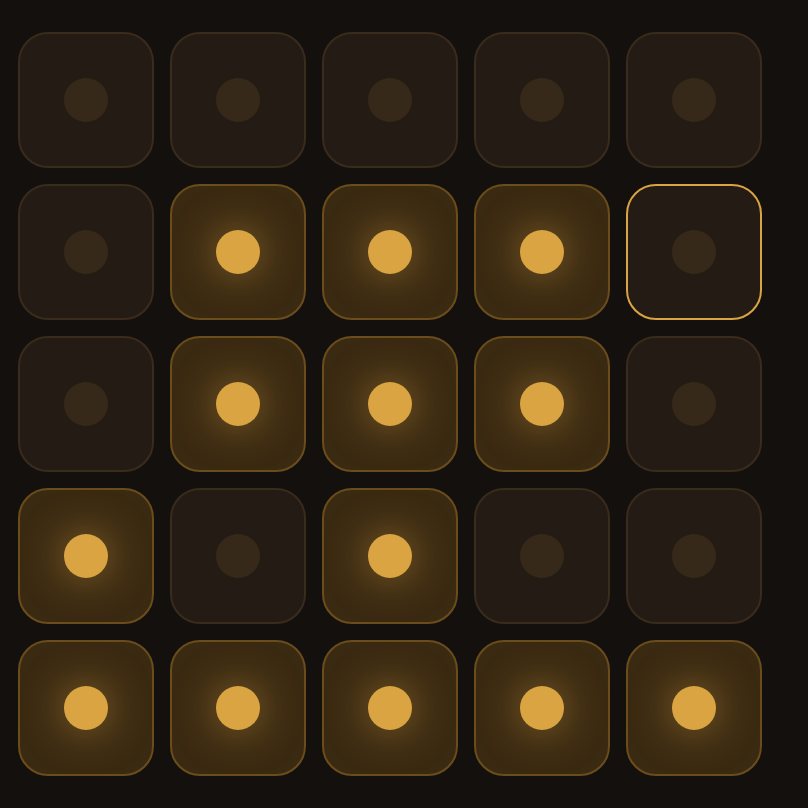
This is called chasing the lights. Up to here you can work like a machine, without thinking. The real thinking is in that last row.
When one row is left
When the chase is done, every row above is dark and the bottom row remains. You finish by tapping a few squares in the top row.
A tap up there sends a ripple down the board that ends by changing the bottom row. Which squares to tap is fixed by the pattern along the bottom.
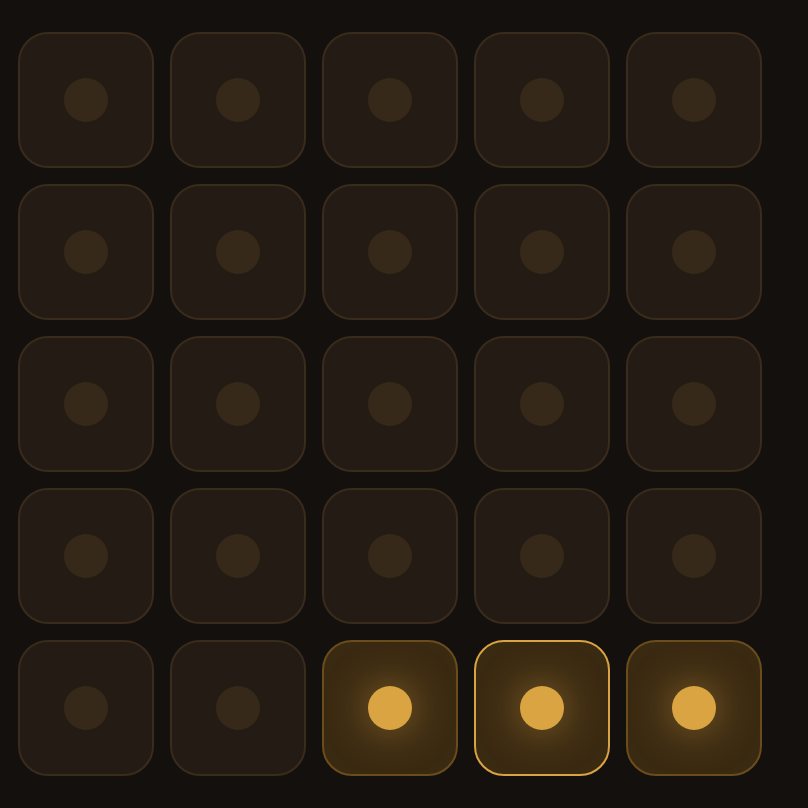
If memorising that feels like a chore, just press Hint — it marks the square for you. After a few games it settles into your eye by itself.
The moves left are always on show
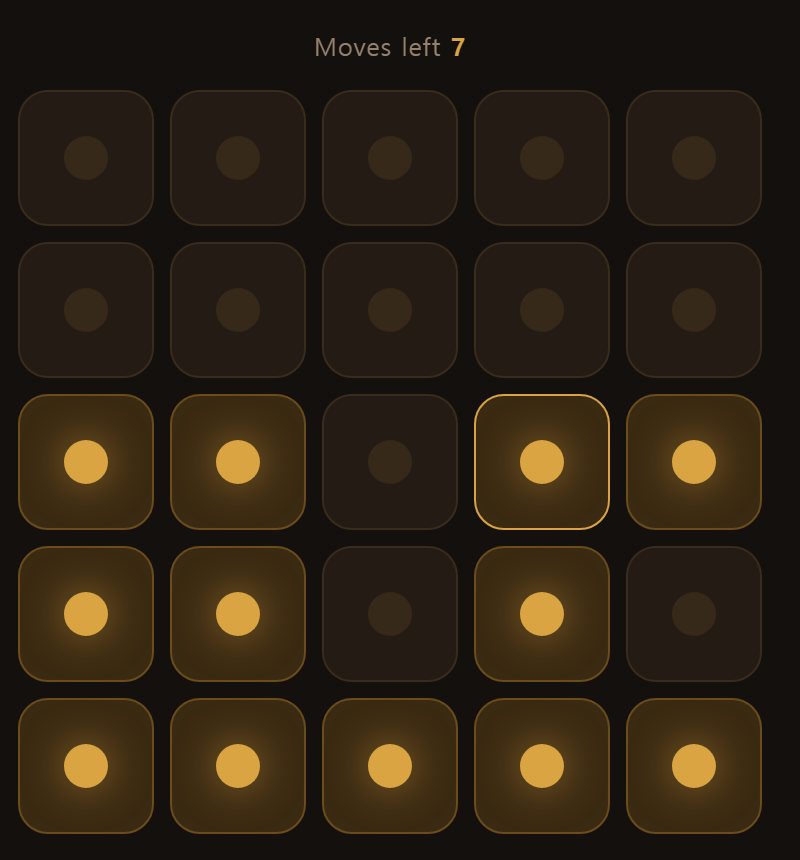
Just above the board it says moves left: N — how many taps it takes to finish from here, by the shortest route.
Playing with that number in view is a great comfort. A good tap takes it down by one; a bad tap puts it up.
- If the number drops by one after your tap, you are on track.
- If it goes up by one, that tap was wasted. Press undo.
- When it reaches 0, you are done.
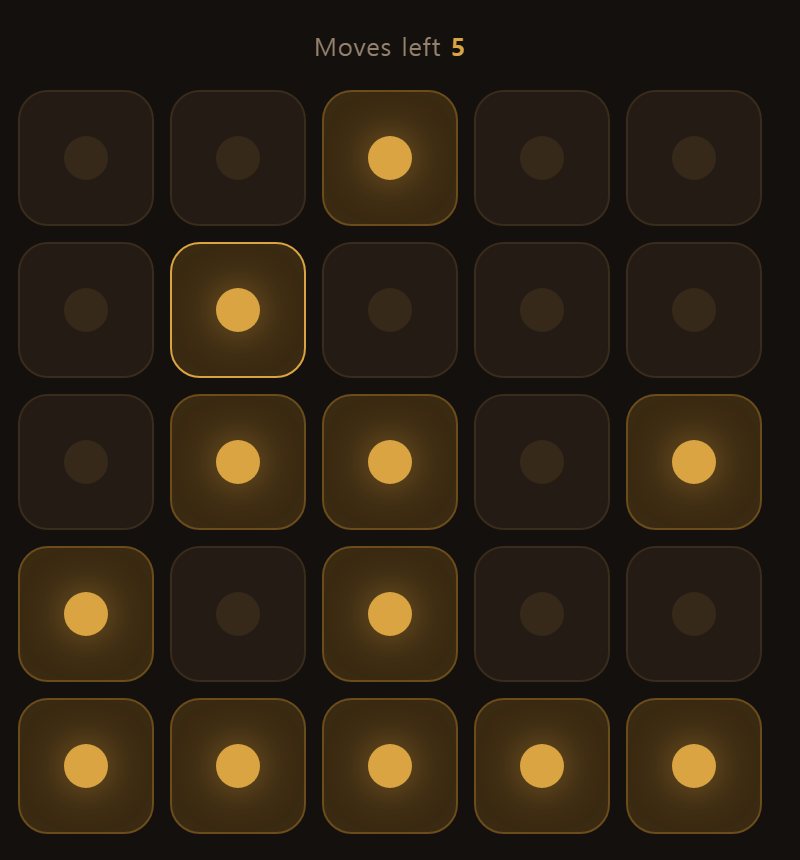
Most versions do not show this number. Since every board here is solved through before it is handed out, there is no reason to hide the answer.
Hint marks one square only
Press Hint at the top and one square gets a blue ring, with its row and column named below.
It never hands you the whole answer. That one square lies on the shortest route, so tapping where it points always takes the moves left down by one.
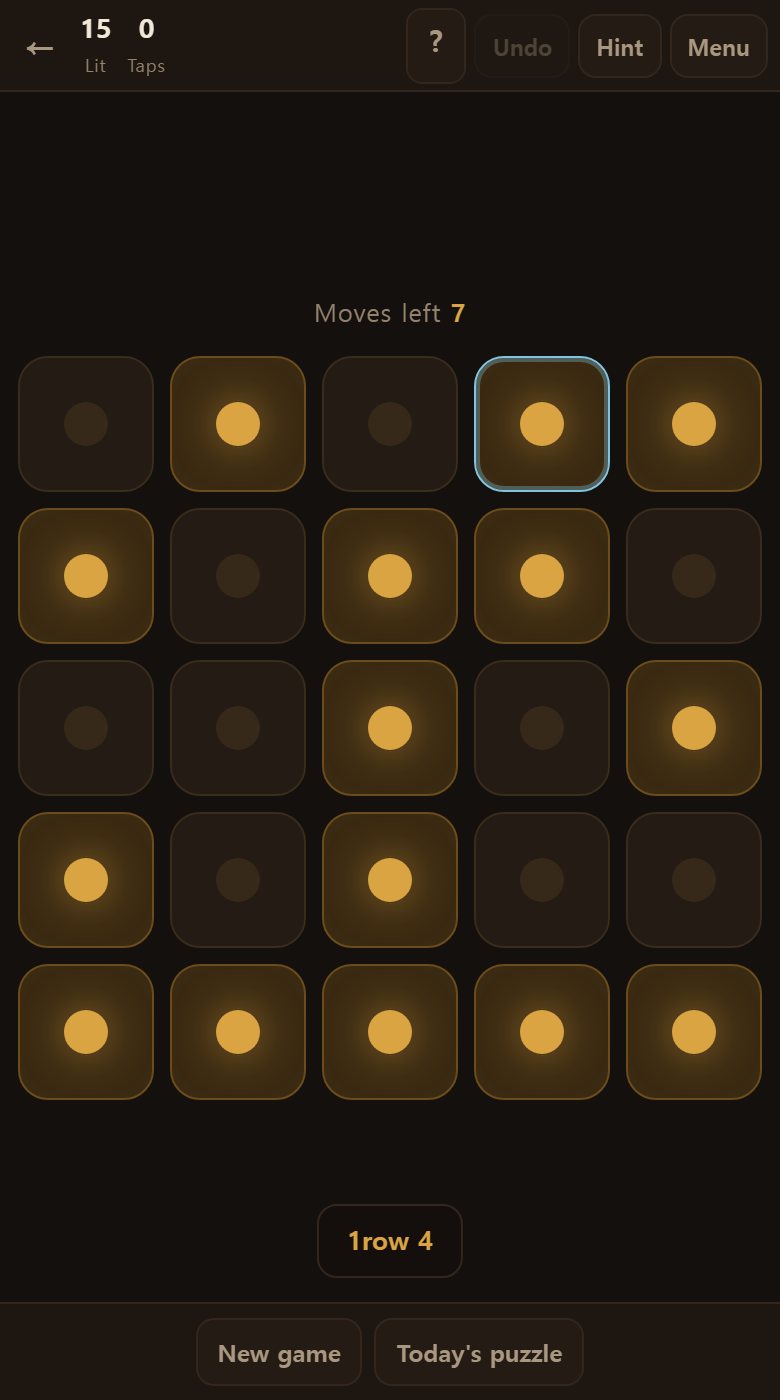
There is no penalty for asking as often as you like. On a keyboard it is H.
Undo
Press Undo at the top and your last tap never happened. There is no limit, so you can go back to the very first move.
Undo is especially useful here. Try it and take it back beats working it all out in your head, by a distance.

On a keyboard it is Ctrl+Z.
Choosing the board size
The menu offers four sizes: 3x3, 5x5, 7x7 and 9x9.
- 3x3 — nine squares. Every board solves. Good for learning.
- 5x5 — twenty-five squares. The size most people play.
- 7x7 — forty-nine squares. Worth trying once chasing is second nature.
- 9x9 — eighty-one squares. A board takes over twenty taps.
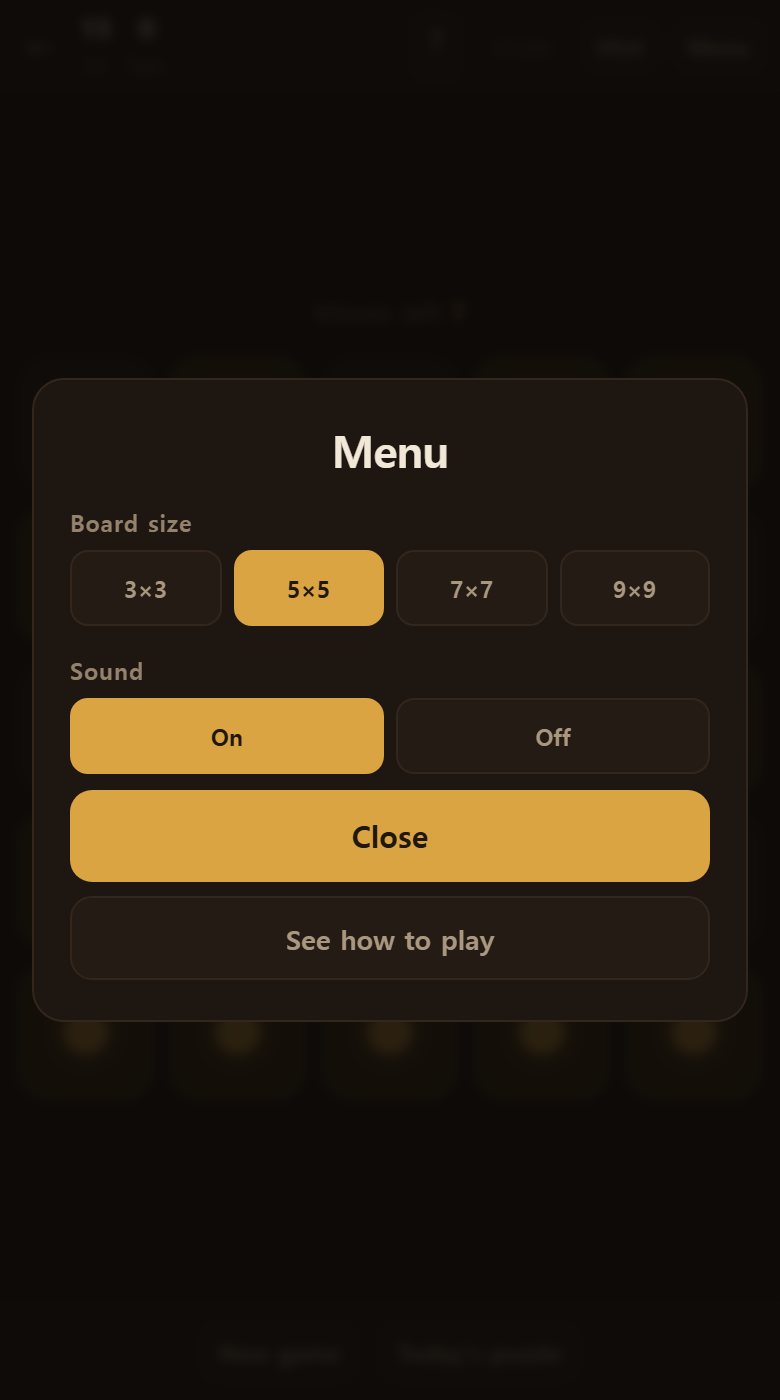
Each size keeps its own best — taps used and time taken.
Every 3x3 board solves
On a 3x3 board you can always clear it, however the lights happen to be set. Of the 512 possible patterns across nine squares, not one is unsolvable.
And there is exactly one answer, which means the squares to tap are settled from the start.
- That makes 3x3 an excellent practice board.
- Learn chasing here. It is only two rows down.
- If you get stuck here, the method is going wrong — not the board.
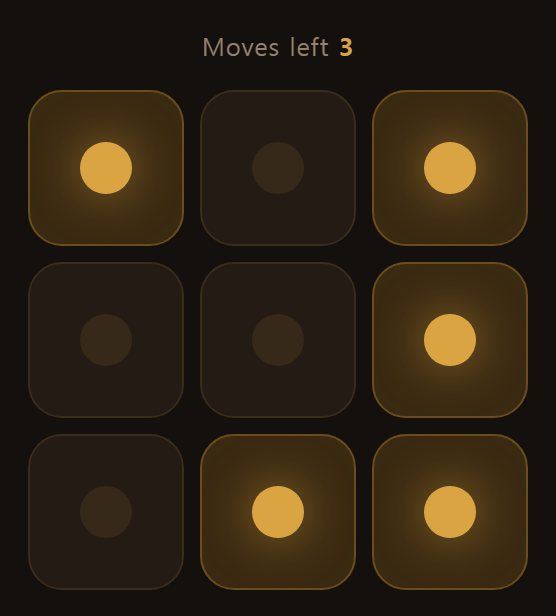
From 5x5 it is a different story. Light one at random there and three boards in four cannot be cleared. The next section takes that up.
Only clearable boards are handed out
This game has boards that simply cannot be cleared — a great many of them. Set the lights at random on a 5x5 and only one board in four solves. The other three will not go, however well you play.
So boards here are built like this. Start from an all-dark board and tap squares at random to light it. Retracing those taps always clears it, so an unsolvable board cannot arise.
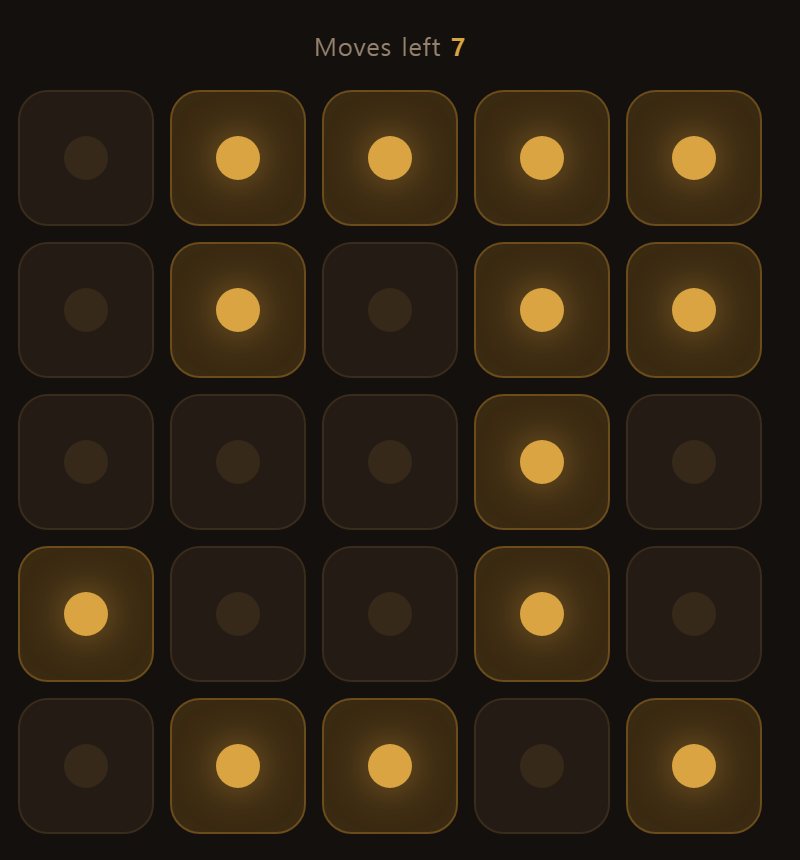
A board someone sends you is solved again at your end. Hand-editing the link to send an unsolvable board will not open.
Unsolvable boards really do exist
Take a 5x5 board with a single lit square. Of the twenty-five places it could be, only five can be cleared. The other twenty cannot.
Those five sit in an X. If that is hard to believe, try it — no order of taps will do it.
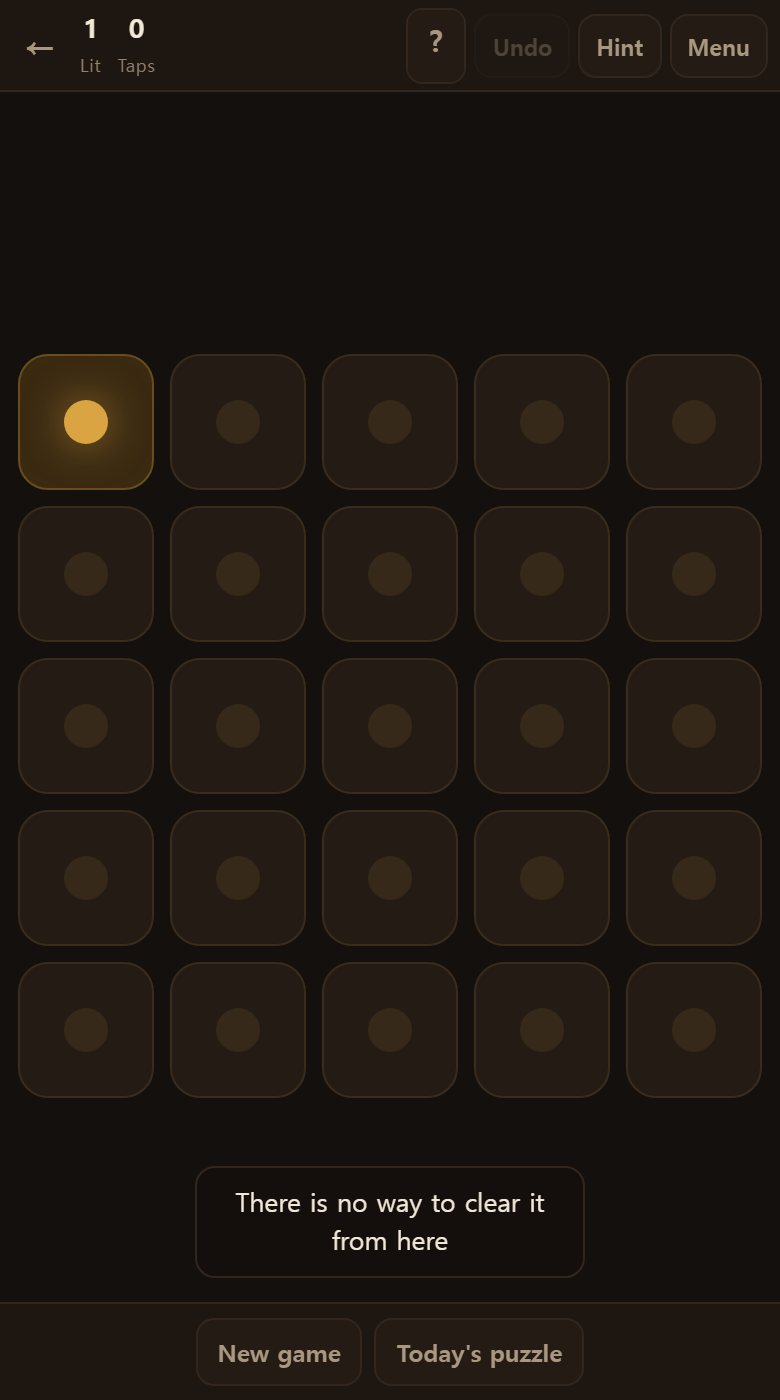
Because of this, sites that build boards carelessly leave you struggling for ages with something that was never going to work. That cannot happen here.
Replay and sharing
Once it is clear, Replay gives you the same board again. There is real pleasure in finishing it in fewer taps.
Copy link packs the board into a URL. Send it on and the very same board opens for them.
Their end checks again that the board is solvable. Editing the link gets you nowhere.
Today's puzzle
Today's puzzle at the bottom opens the board set for that day. It is built from the date, so everyone gets the same board.
With one board between you, you can see who used fewer taps and who was quicker.

It uses whichever size you have chosen, so agreeing on 5x5 makes for a fair contest.
How to win
Know these and no board can beat you, most important first.
- Learn the chase first. Tap directly below each lit square in the row above — that is the whole of it.
- Do not look at another row until this one is finished. The row below scrambling is fine.
- Watch the moves-left number. Dropping by one each tap means you are on track.
- If it goes up, undo at once. It stops you paying for the same mistake twice.
- Handle corners and edges first. Fewer squares wobble, so they are easier to work with.
- Play a few 3x3 boards. Every one solves, which makes them ideal for learning the method.
- Stuck? Hint. Tapping where it points always saves you a move.
Common mistakes
Boards that leave people floundering are nearly always one of these four.
- Tapping the lit square itself — the commonest of all. It goes out, but four around it come on. What you tap is not the lit square but the square below it.
- Tapping wherever you happen to look — going at whatever lit square catches your eye keeps the board in a muddle. Always work a row at a time from the top.
- Panicking when the row below lights up — chasing is supposed to scramble the row below. That is what it looks like when it is working.
- Tapping the same square twice — nothing happens. Wasted work, and your tap count goes up.
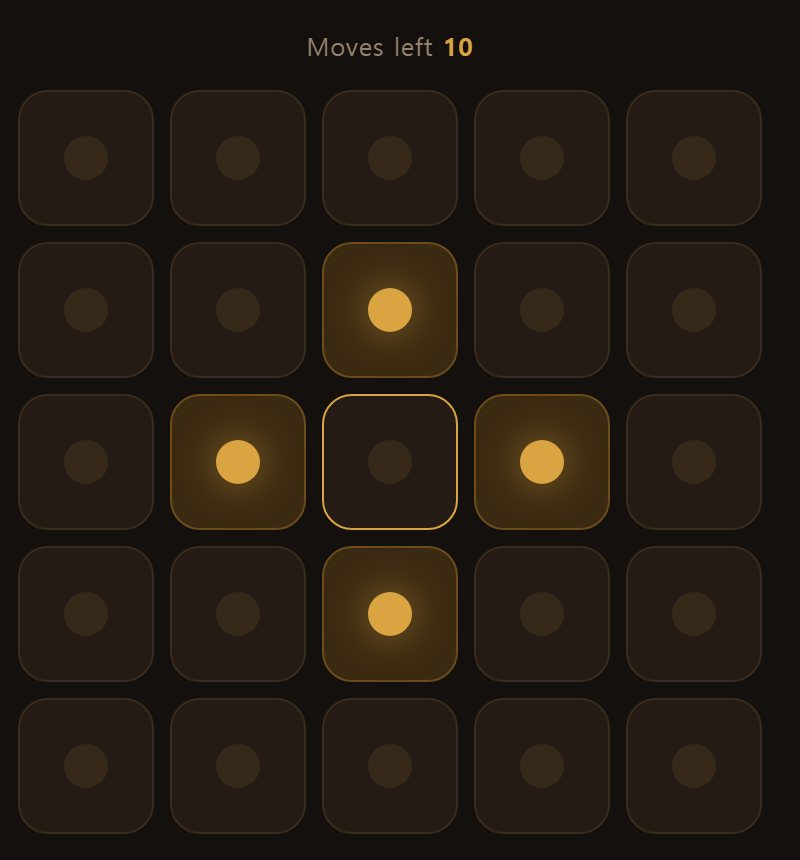
Think better of a tap and undo straight away. If the moves-left number went up, that tap was wasted.
When it is all out
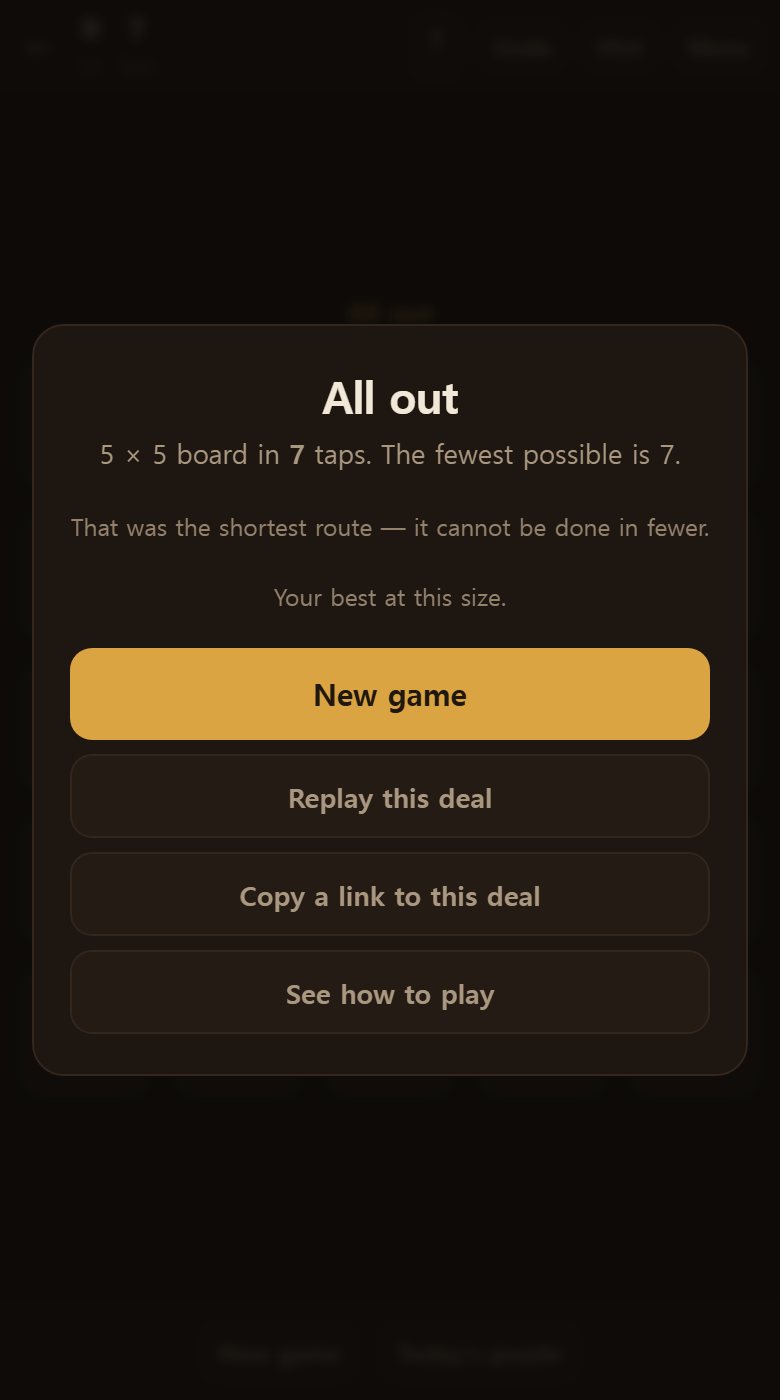
When the lit count reaches 0 it ends there. You are shown the taps you used and the fewest possible.
If the two match, you took the shortest route there is.
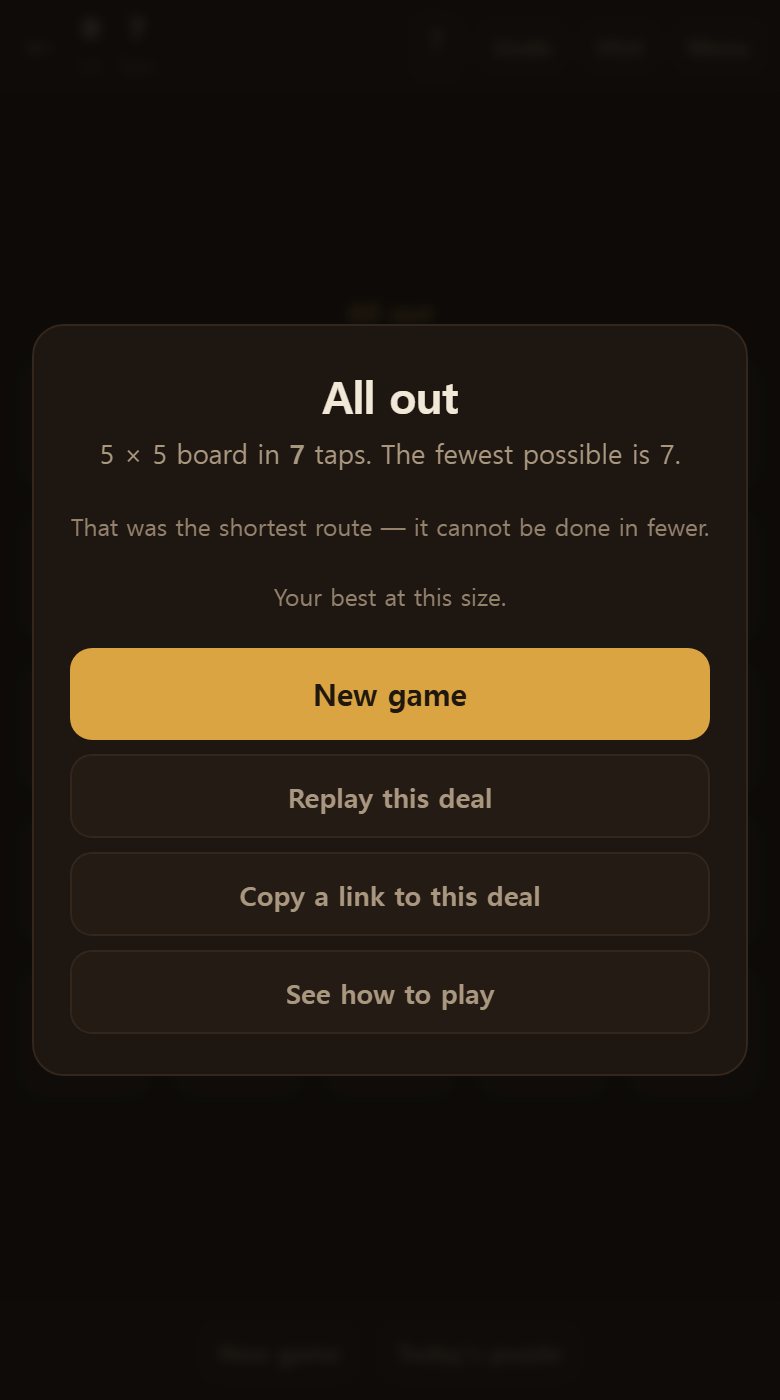
Each size keeps its own best. Open the same board with Replay and try to do it in fewer.
Common questions
That is the rule. The square you tap flips together with the four above, below, left and right — five in all. Tap a lit square to put it out and its neighbours come on.
Usually by tapping directly below it. That puts the upper square out. The row below scrambles, but you deal with that row next.
Tapping about with no order never finishes. Clear a row at a time from the top: tap directly below each lit square in the row above, all the way down to the bottom.
At that point you have to tap a few squares in the top row. Which ones is fixed by the pattern along the bottom — and if memorising that is a chore, press Hint.
No. Boards here are built by tapping out from an all-dark board. Retracing those taps always clears it, so an unsolvable board cannot arise. The moves left number above the board is the proof.
That means your last tap was wasted work. Press Undo and look elsewhere.
Nothing. Flip a flip and you are back where you started — only your tap count goes up by two.
In the menu at the top, choose 3x3, 5x5, 7x7 or 9x9. Each size keeps its own best.
Yes. Once it is clear, press Copy link. Their end checks the board is solvable before opening it.
- Clear one row at a time from the top. Tap directly below a lit square in the row above and it goes out.
- Work down to the bottom row and only that row is left. Then tap a few squares in the top row to finish it.
- Press Hint when you are stuck. It points at one square to tap.