 MindHub
How to play FreeCell
Every card is dealt face up. Nothing is hidden, so this is a puzzle solved by thinking, not by luck. Build each suit from A to K at the top right, and send all fifty-two home to win. Nearly every deal comes out — so when one does not, the fault is in the order you played, not in the deal.
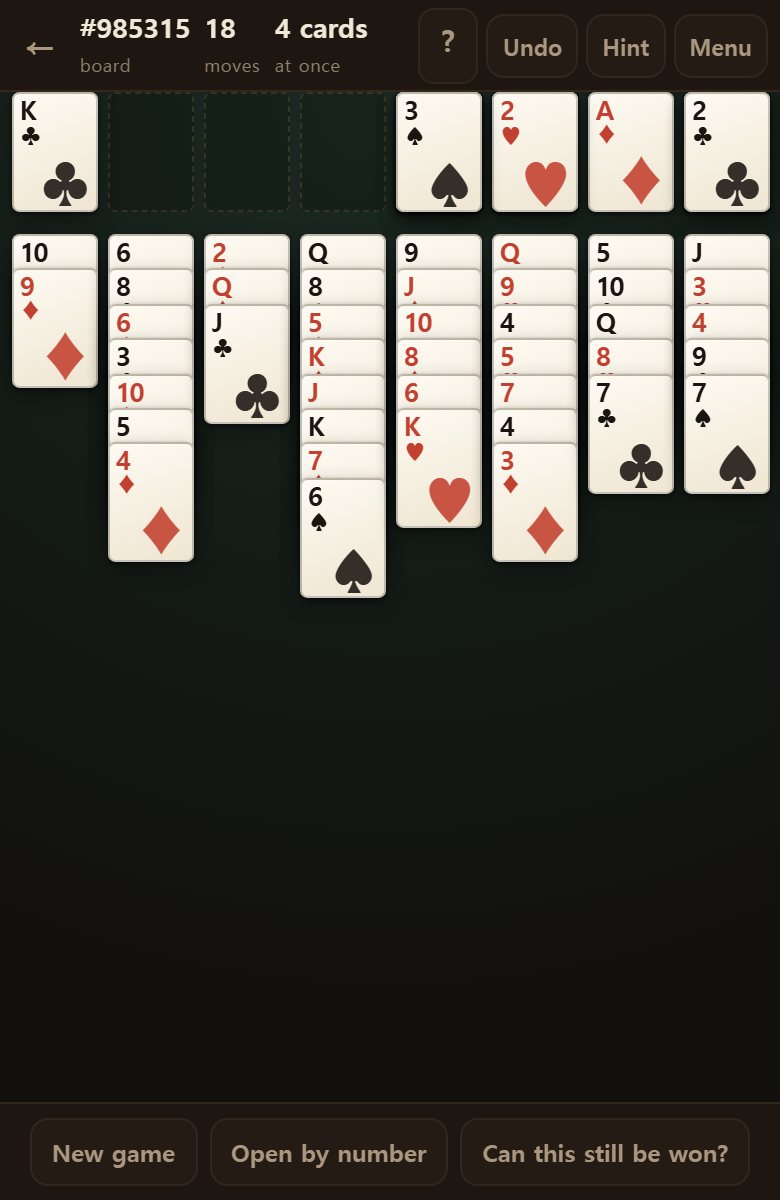
First, a look at the screen
Eight spaces above, and the cards laid out in eight columns below.
- The four spaces at the top left — the free cells — where a single card can be parked for a while.
- The four at the top right — the foundations, built by suit from A. Fill them and you win.
- The eight columns below — all fifty-two cards, face up.
- The figures at the top — deal number, time, moves, and how many cards you can move at once.
Not one card is face down. Everything is visible from the start, which makes this a game of working it out rather than of luck.
This is how a deal looks
Fifty-two cards go into eight columns — seven each in the first four, six each in the last four.
All face up, so you can see where every card is from the very start.
- There is no stock to turn. What is dealt is all there is.
- There is nothing to redeal, either. One layout carries you to the end.
- So luck has nowhere to enter. The answer is on the board from the beginning.
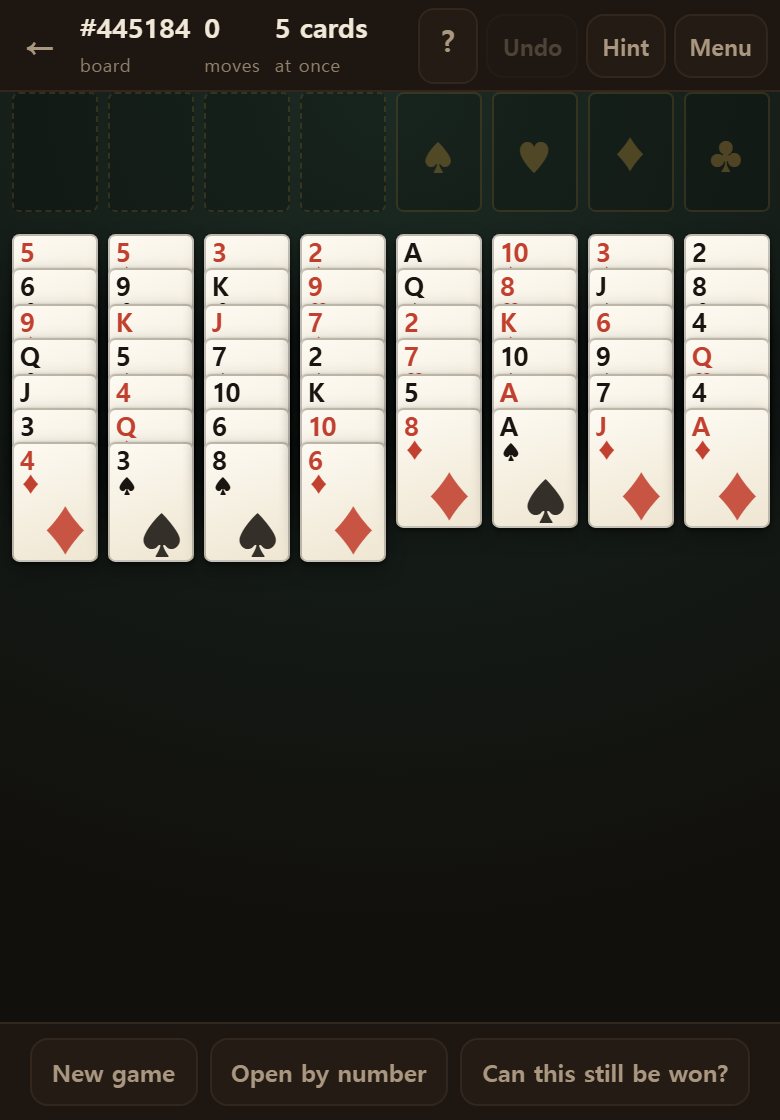
This is the great difference from Solitaire. There you have to turn a card to know; here you know everything before you start. Which is why nearly every deal comes out.
Moving cards
Press and drag a card where you want it. A single tap, without dragging, moves it for you when there is only one place it can go.
When there are two or more, the card stays picked and it asks you to tap where you want it. Then tap the place.
- The bottom card of a column is always available.
- A card further up comes along whole if everything below it runs down in alternating colours.
- A card parked in a free cell can be taken out again at any time.
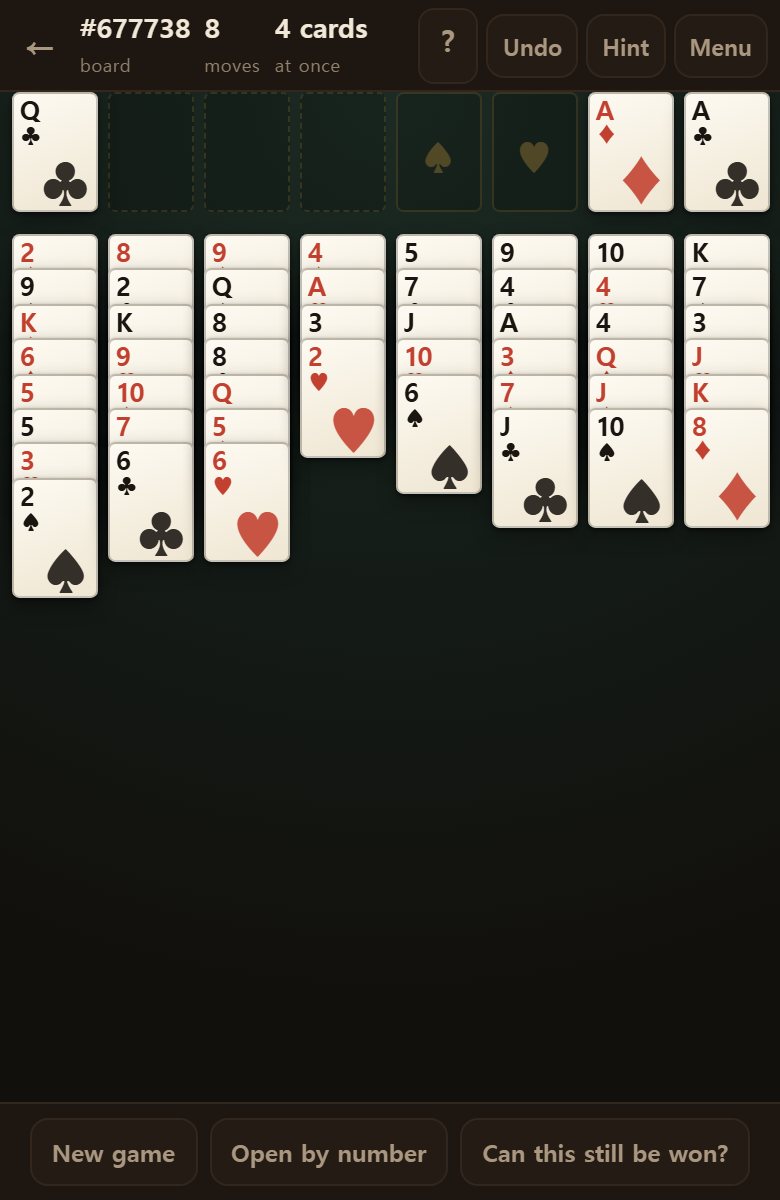
Moved badly? Undo takes it back, as many times as you like, right to the start.
The rule for the columns
Placing a card in one of the eight columns needs only two things.
- It must be one rank lower. Only a 6 goes on a 7.
- The colours must alternate — red on black, black on red.
- On a 7♠, only the 6♥ and the 6♦ will do.
- Same colour will not do — a 6♣ cannot go on a 7♠.
- Nor will an equal rank. A 7 cannot go on a 7.
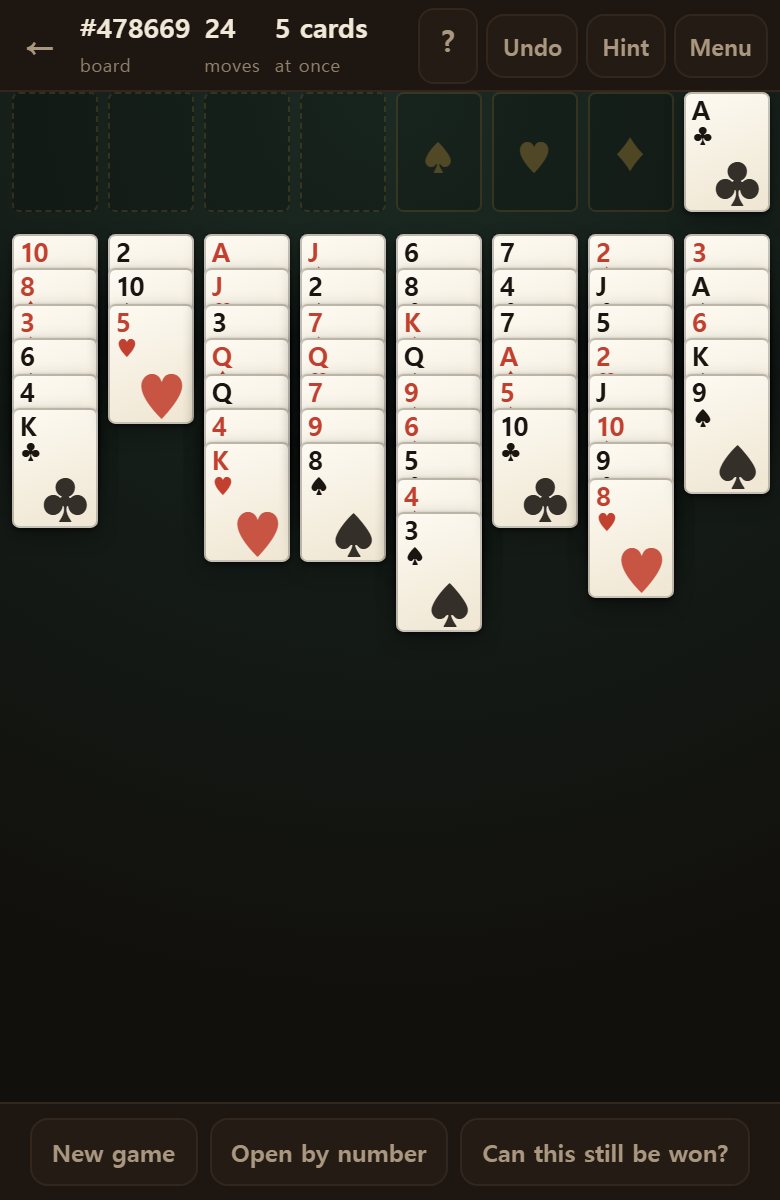
Any card may go into an empty column. This differs sharply from Solitaire, where only a K may.
The foundations — A to K, by suit
The four spaces at the top right are the foundations. Send all fifty-two there and you win.
- One space to a suit — ♠, ♥, ♦ and ♣ each build in their own.
- The A comes first. Without it, the 2 cannot go up either.
- Then A, 2, 3 and on to K. Nothing may be skipped.
- A card sent up can come back down. If a column needs it as a landing place, take it out again.

So sending everything up in haste costs you. Beyond the aces and twos, send a card up when the columns have no more use for it.
The four free cells
Each of the four spaces at the top left holds one card — any card at all.
Whatever you park there can be taken back at any time. Think of it as somewhere to set aside a card that has nowhere to go just now.
Say the A♥ you need is buried under a 5♠: park the 5♠ in a cell and lift the A♥ out.
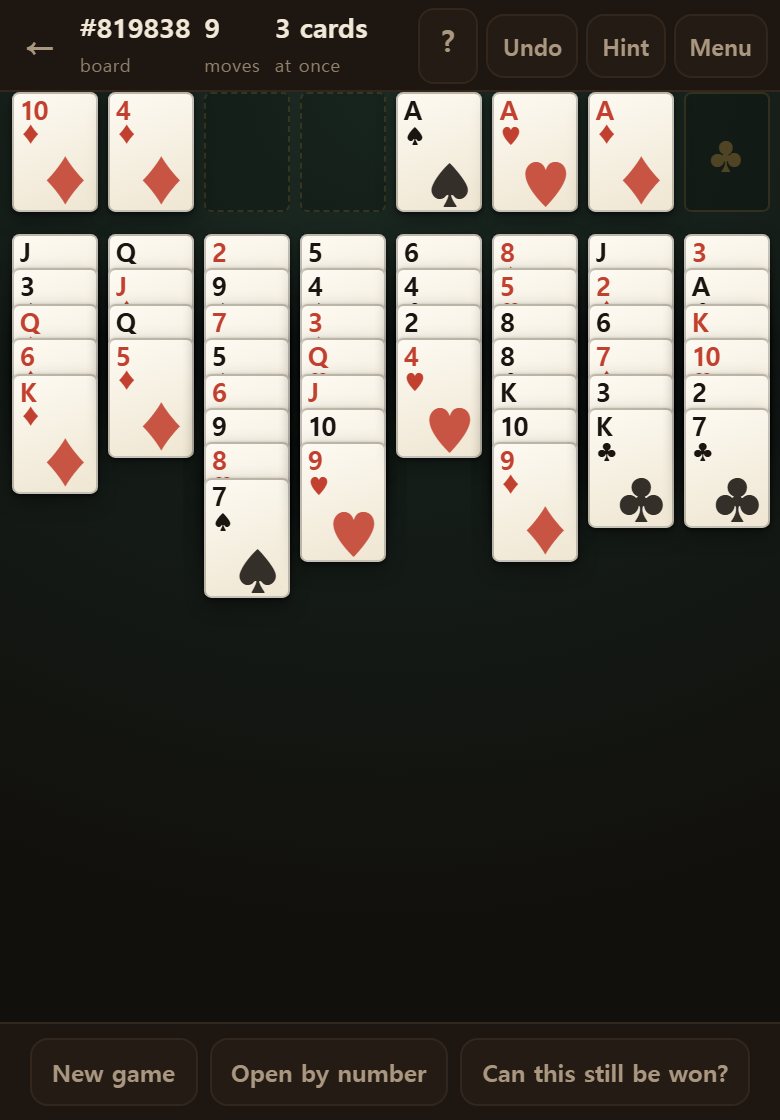
A free cell is only powerful while it is free. Fill all four and you can barely move anything. Keep one empty at all times.
How many cards can move at once
It looks as though several cards move together, but really the game is shuttling them one at a time through the free cells on your behalf.
Which is why there is a limit.
- You can move (free cells + 1) x 2 to the power of empty columns cards.
- Four free cells and no empty column gives five cards.
- Four free cells and one empty column gives ten.
- Two free cells and no empty column gives only three.
- The current figure shows at the top, under at once.

Raising that number is the whole of FreeCell. Be sparing with cells and empty columns.
An empty column is worth most
Emptying a column outright doubles how many cards you can move — far more than freeing a cell does.
So work the short columns and aim to clear one. The last four hold six cards rather than seven, which makes them the place to start.
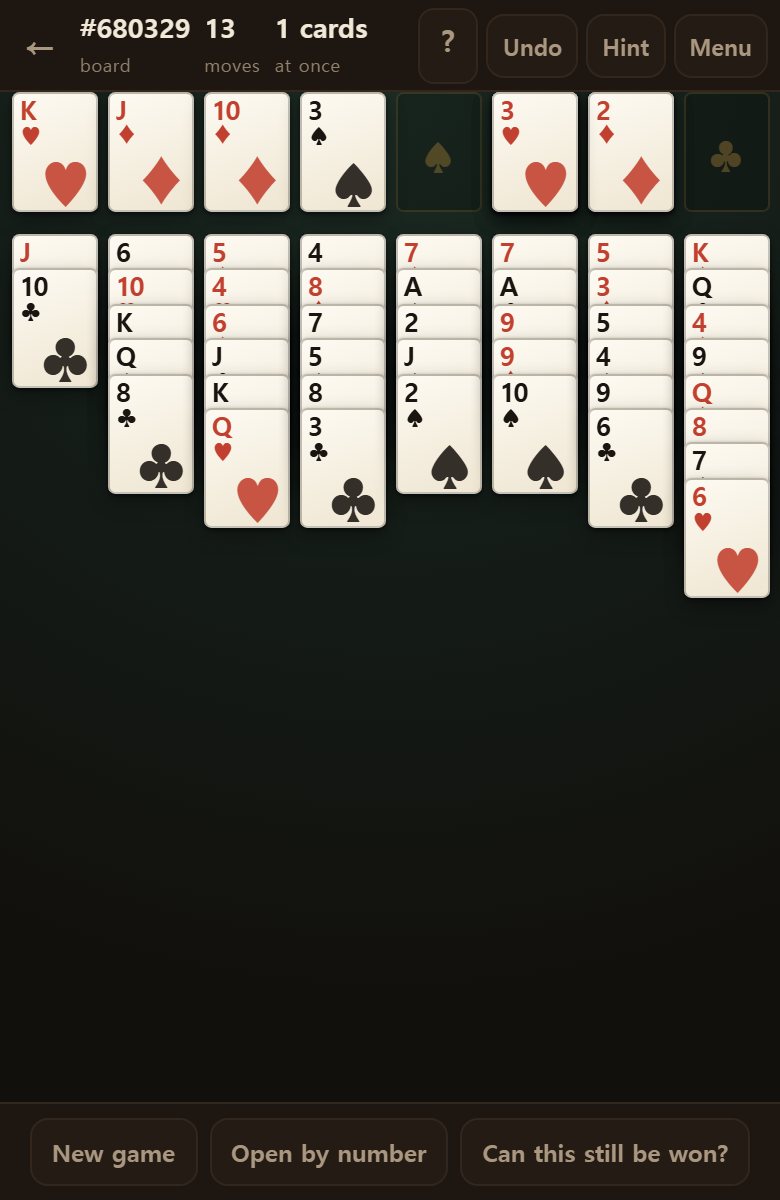
Since any card may go into an empty column, it is in effect a very large free cell. But the instant you put a card there, that power is gone. Keep it empty until you truly need it.
Send up everything that can go
A button below sends everything currently playable to the foundations at once, sparing you the dragging.
- It only sends cards that cost you nothing. Ones still useful as landing places stay put.
- Near the end, a finish it button appears and clears the rest in one go.
- You can press it whenever, and undo it afterwards.
- With nothing to send, nothing happens — pressing it costs you nothing.
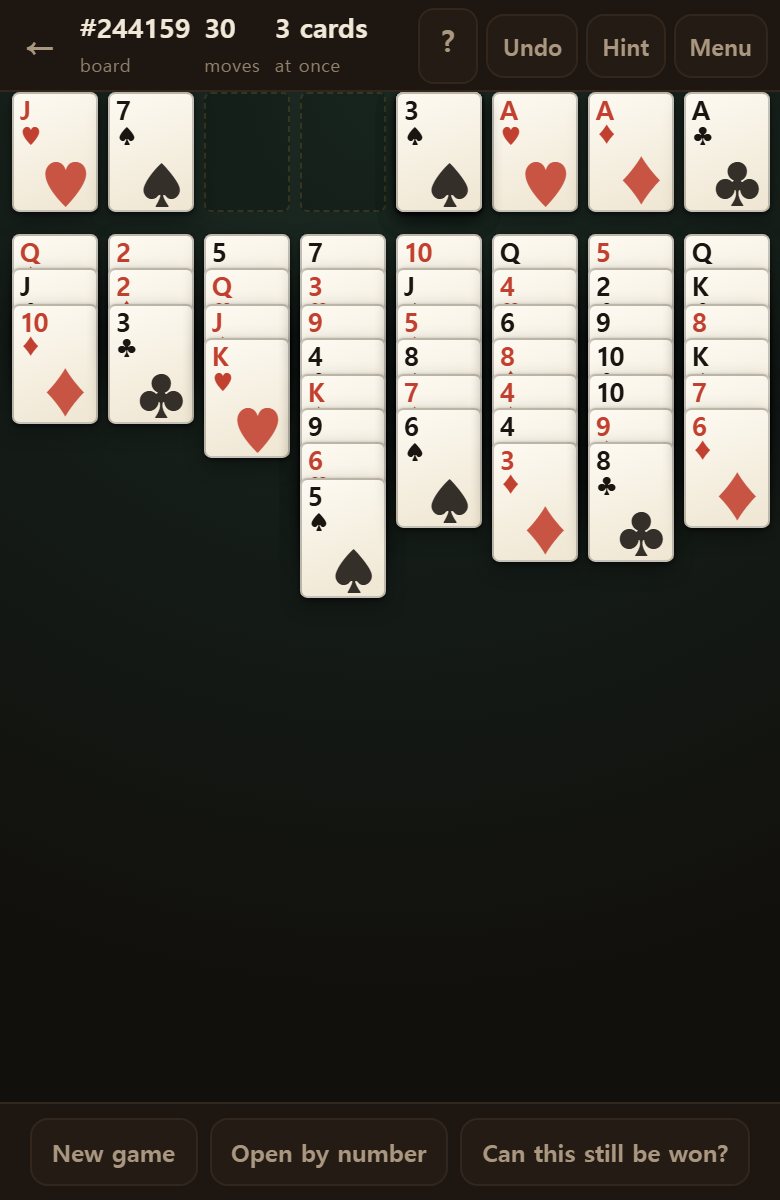
How it knows a card costs nothing: if both cards one rank lower in the other colour are already home, that card can never serve as a landing place again. Then it goes.
The order to solve in
Moving cards at random rarely works. An order helps enormously.
- First find the aces and twos and send them up.
- Work out how to clear whatever sits above an ace. Use the cells, but not all of them.
- See whether a column can be emptied, starting with the short ones.
- Build an alternating run inside a long column. It moves as a block later.
- Always keep in mind where a parked card will come back down.
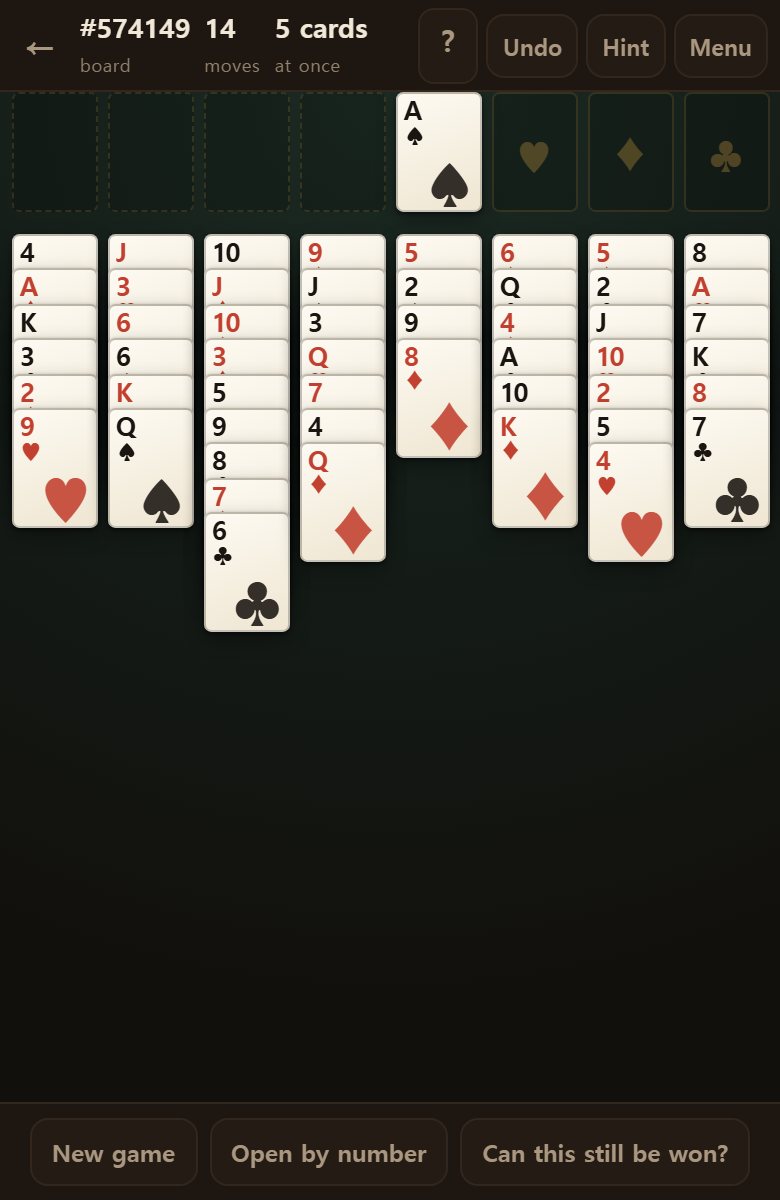
The most valuable habit is reading the whole board once before you touch it. Every card is visible; if you choose to, you can read it to the end.
Undo
Press Undo at the top and your last move never happened. There is no limit — you can go right back to the start. On a keyboard it is Ctrl+Z.
Do not be sparing with it here. With no hidden cards, taking a move back and trying again is the honest way to solve.
- One press, one move. A multi-card move undoes as a single move too.
- Cards parked in cells and cards sent to the foundations undo the same way.
- An undone move comes off your move count as well, so the record does not inflate.
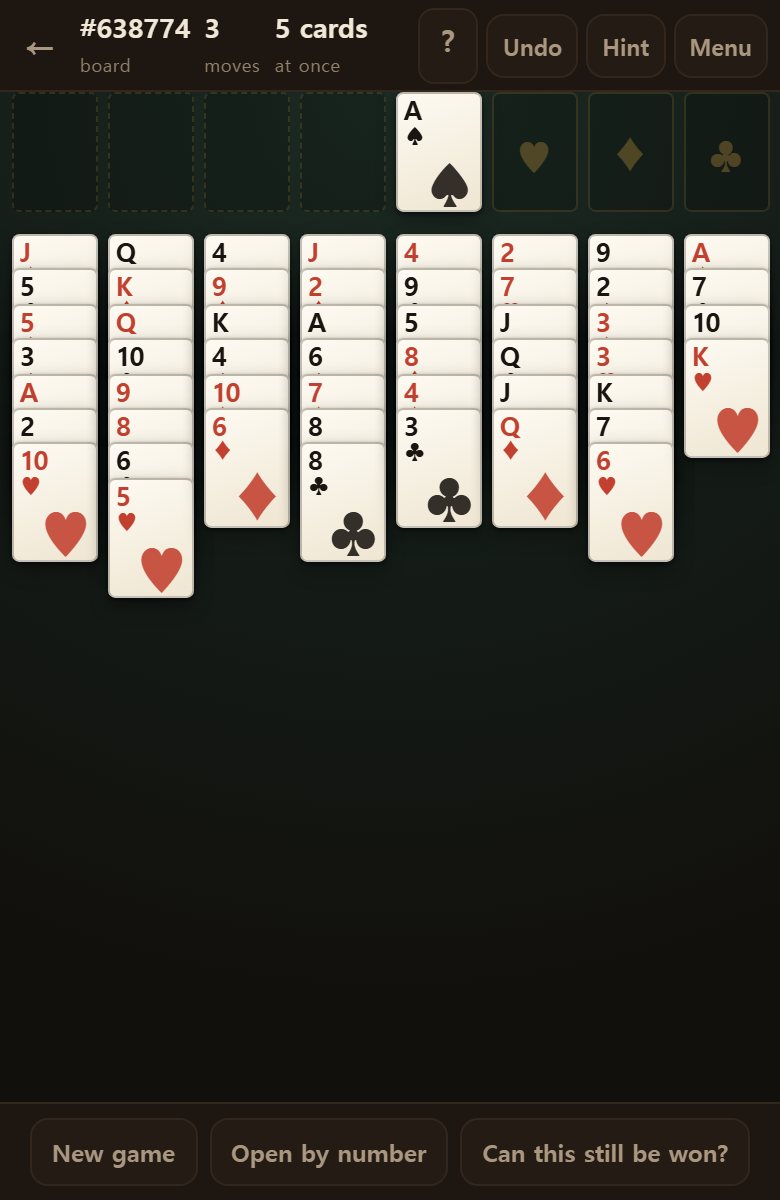
When you jam, do not undo one or two moves — go back to the fork. The path usually divided a long way earlier. If you cannot tell where, press Can I still win? after each undo: the point where it turns back to still winnable is the fork.
Can I still win
Press Can I still win? below and it genuinely solves the position through before answering. Nothing is estimated.
- Still winnable means a path remains. Keep looking.
- Too late means you cut the path somewhere. Undo back.
- It may take a few seconds. The board stays as it is meanwhile.
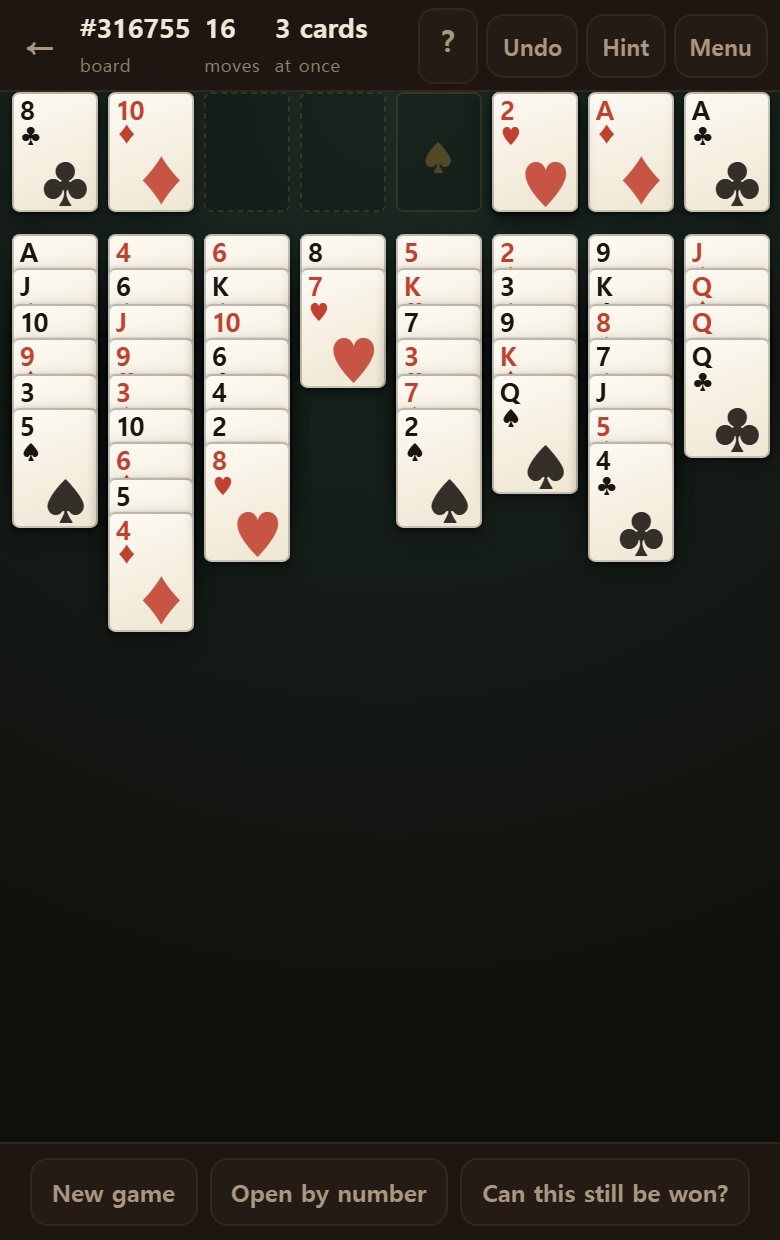
With this you never have to flounder. Press it when you suspect a jam, and undo at once if it is too late. A lost deal in FreeCell is usually decided long before it feels lost. It ended the moment the last cell filled, while the hand kept moving for some time afterwards. This button finds that moment for you.
The deal numbers match other programs
FreeCell deals have carried numbers for a long time, and the numbers here are the same as in other FreeCell programs.
So deal 1 wherever you saw it is deal 1 here. Open by number below takes you straight to any of them.

A few are famous — deal 11982 has long been known as the one that cannot be solved. Note a number down and you can return to that deal whenever you like.
How to win
Nearly every FreeCell deal comes out. Do not hurry — look ahead.
- Think one move further before you move. If you spend a cell, see what it blocks next.
- Do not fill every cell. Keeping one free is nearly always right.
- Digging out the aces comes first, always. Without them nothing builds.
- An alternating run built inside a long column later moves as a block and clears it in one go.
- When jammed, undo several moves and look for another route.
- Replaying a deal is perfectly fine. Note the number and you can open it again whenever.
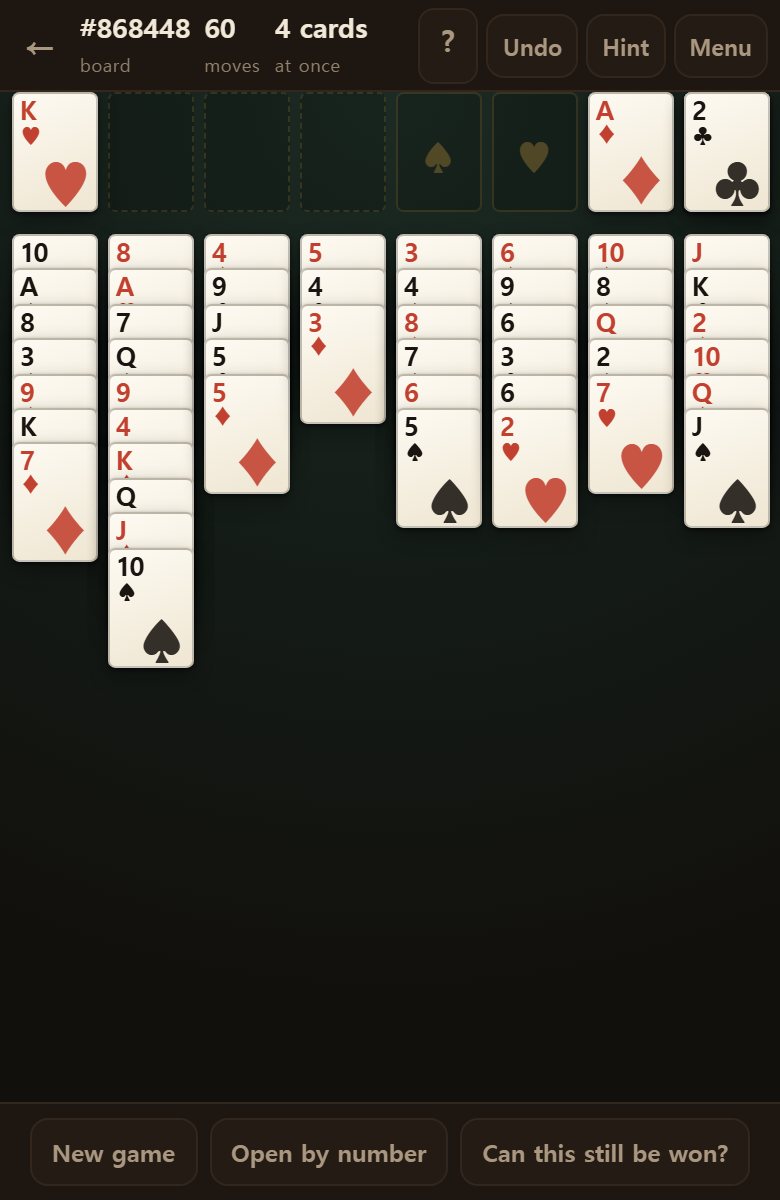
Four free cells and an empty column moves ten cards at once. That single move sometimes turns an entire deal.
Common mistakes
Deals that jam here are nearly always one of these four.
- Filling every cell — the commonest of all. With four full, you can move one card at a time. Always keep one free.
- Filling an empty column at once — clearing one is hard work, and then any old card goes in. An empty column doubles what you can move. Save it.
- Sending everything up — feed the foundations on sight and the columns lose their landing places. Beyond aces and twos, do not hurry.
- Playing only the move in front of you — moving a card because you can often buries the one you need next. Look two moves ahead.
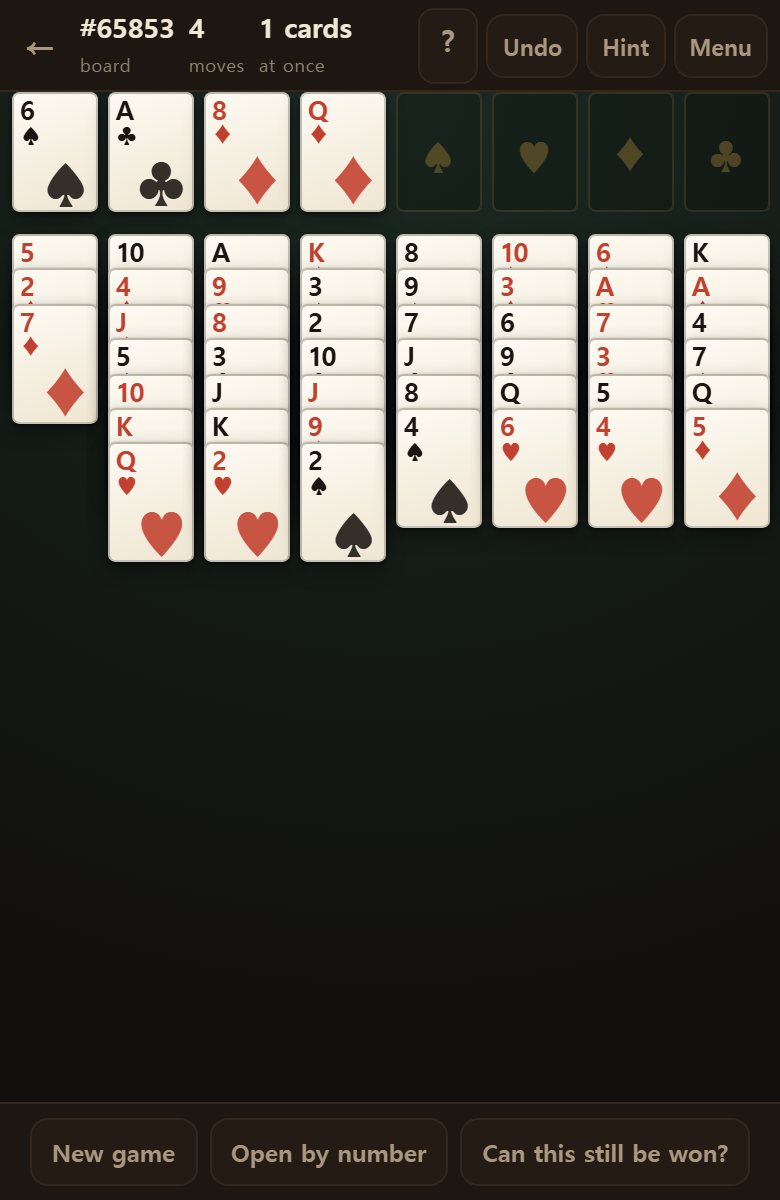
All four come from spending your slack in advance. In FreeCell, slack means free cells and empty columns.
When it is all home
When all fifty-two are at the top right it ends there, and your time and move count remain.
The deal number stays with them, so a deal you solved well can be noted down and passed on exactly.
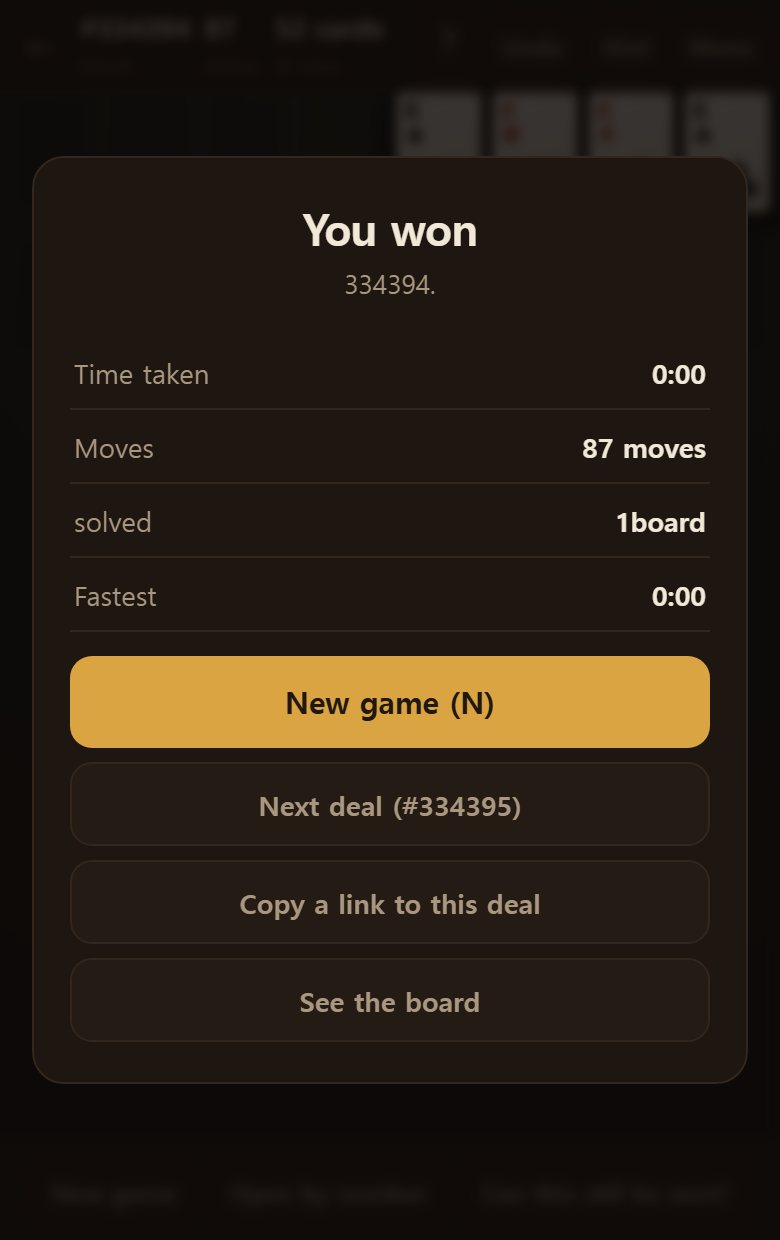
The fewer moves, the better the solve. Reopening the same number and cutting the move count is a pleasure of its own.
Common questions
You are short of free cells or empty columns. Look at the at once figure at the top. Freeing one cell raises it.
That means the move is not allowed — usually because it exceeds how many cards you can move at once.
Enter it under Open by number below. The numbers match other FreeCell programs.
Press Can I still win? below. It does not estimate — it actually solves the position through before answering.
No. In FreeCell any card may go there. That restriction belongs to Solitaire.
Yes. If a column needs it as a landing place, take it back. Which is why sending cards up in haste can cost you.
No. With every card visible, taking a move back and trying again is how the puzzle is meant to be solved. Use it freely.
Every card is face up, there are four free cells, and any card may go into an empty column. So there is almost no luck — you solve it by thinking.
- Fill every free cell and your moves shrink sharply. Always keep one open.
- Emptying one column is worth more than all four free cells.