 MindHub
How to play Cheat
Cards go down face down, and what they are is announced out loud and nowhere else. You have to play even without the right card, so you end up lying. Smell one and you call it. Whoever empties their hand first wins.
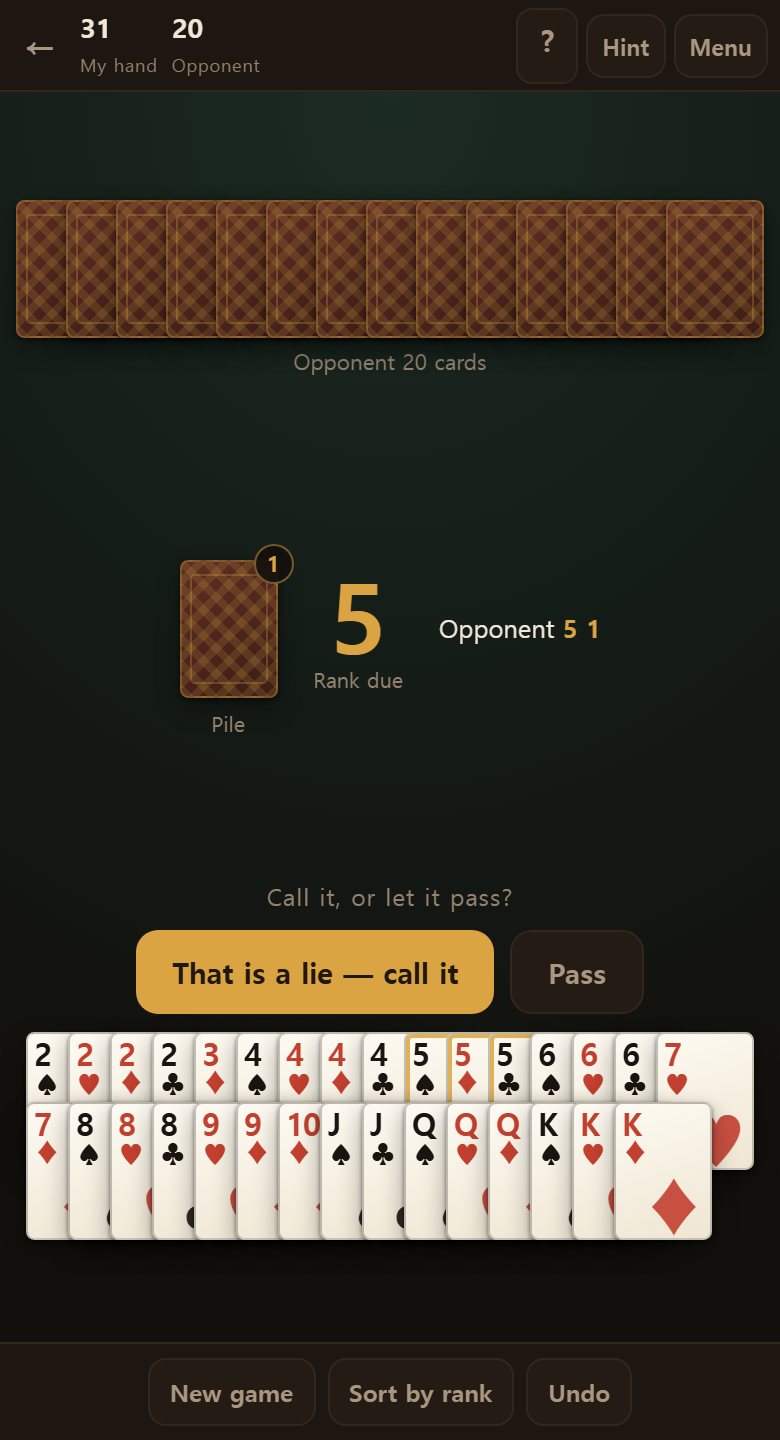
First, a look at the screen
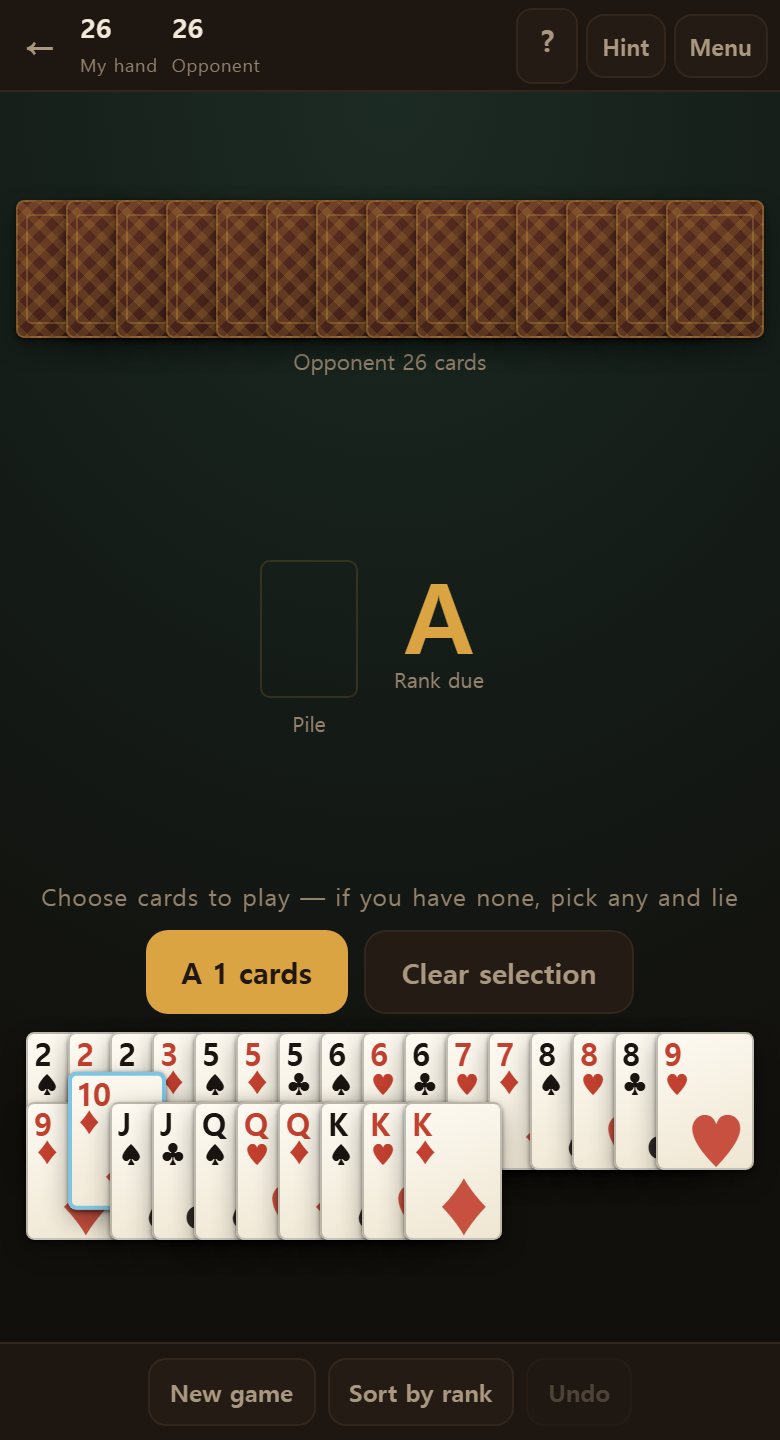
Their cards lie face down above; the pile and the rank due sit in the middle; your hand is below.
- The face-down cards at the top — their hand. You see only how many.
- The stack in the middle left — the pile. Every card played face down so far is in it.
- The large character in the middle — the rank due, stepping A, 2, 3 and on.
- The line beside it — what they have just claimed.
- The bottom — your hand. Cards with a gold ring genuinely are the rank due.
The pile shows only its backs. You know its size and nothing more — which is why a wrong call lands the whole heap on you.
Fifty-two cards, split in half
You and the computer start with twenty-six each. There is no stock left over.
So cards neither appear nor vanish in this game. They only pass between you, according to who takes the pile.
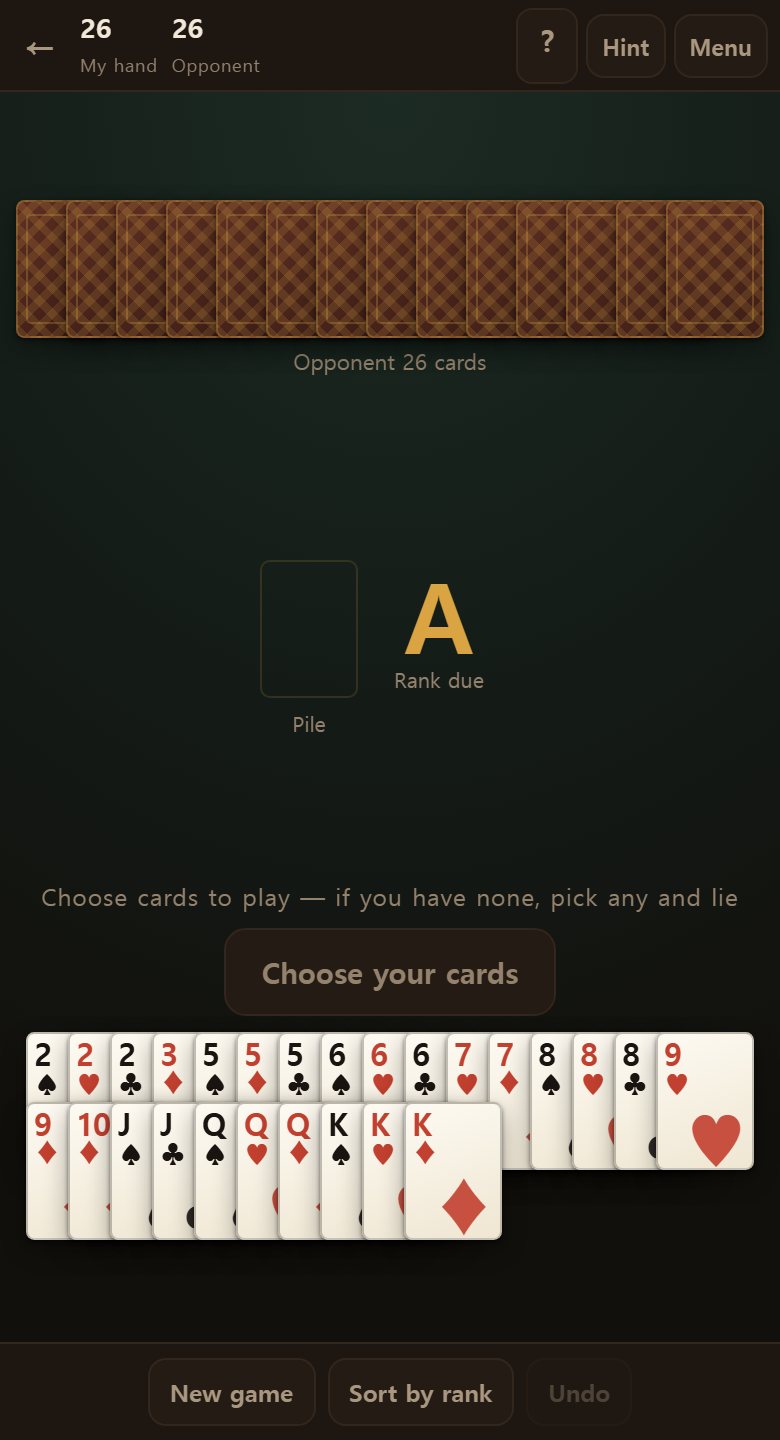
Twenty-six cards in one row would not fit a phone, so they are laid out in two. Sort by rank below gathers matching ranks together.
The ranks go round in order
The first play is an A, then a 2, then a 3 … up to K, and back round to A.
It advances one step with every play, whoever made it.
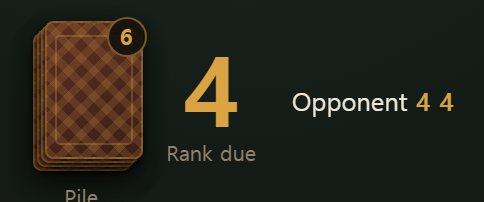
So you can work out that in three turns you will owe a 5 — and keeping a card back for it is the trick.
Face down, announced out loud
Tap the cards you want and they lift. Then press “play two aces” and they go onto the pile face down.
All they learn is how many, and what you claimed. What the cards actually are stays hidden.
- You may play one to four cards at a time.
- More cards empties your hand faster, and raises the odds of being called.
- Changed your mind about a card? Tap it again to drop it.
- The button reads back what you picked — “play two aces”, and so on.
- You can mix truth with a lie — one genuine ace with any old card on top of it.
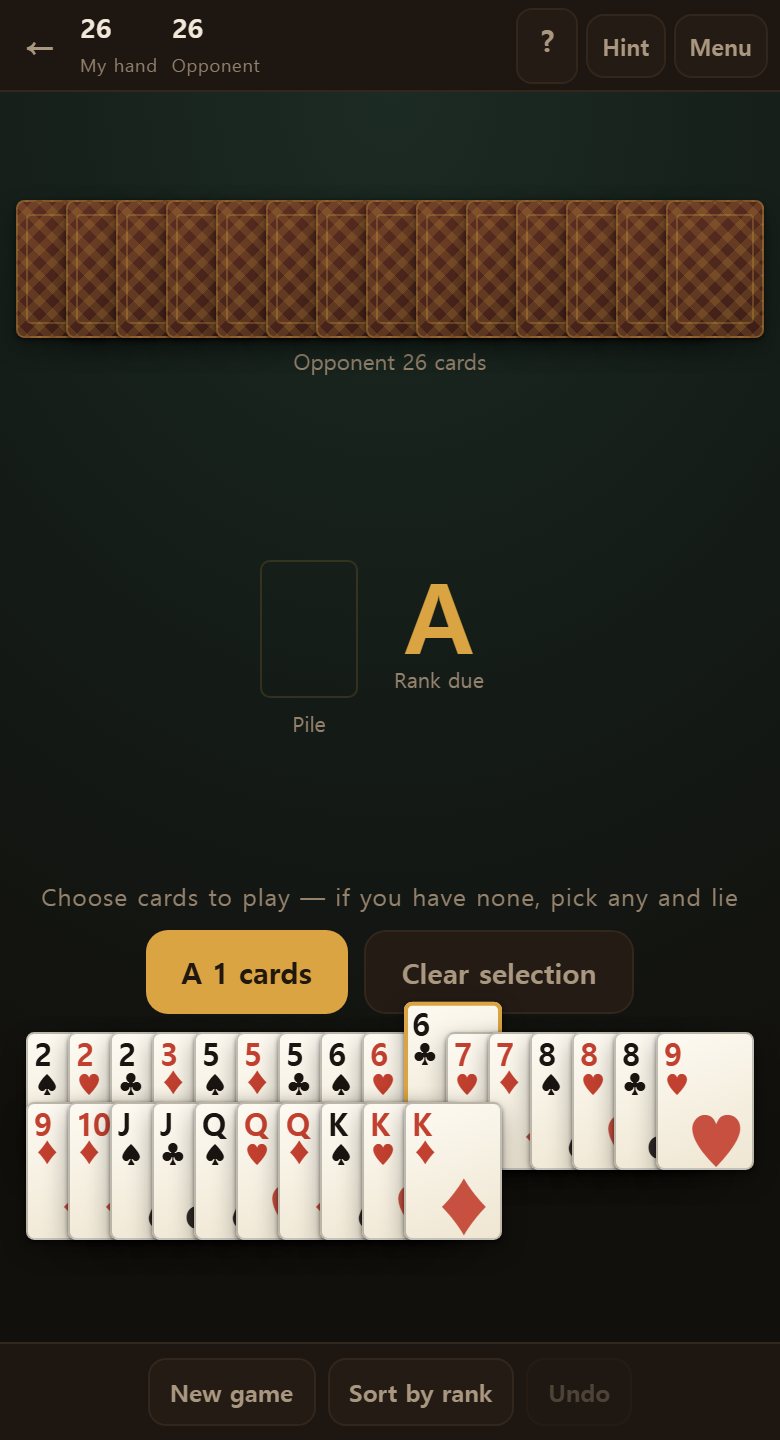
Mixing is the delight of this game. Even caught, half of it was true, and their counting goes astray from then on.
With nothing to play, you have to lie
Sometimes you hold none of the rank due. You still cannot pass. You put any card down face down and claim it is that rank.
That is why the game is called what it is. The lie is written into the rules.
- When lying, one card is the safe amount. Caught, you lose only that.
- Lie while the pile is small. Being caught then hardly hurts.
- Caught with twenty cards on the pile, the whole game turns over.
- So it is safest to do your lying early in the game.
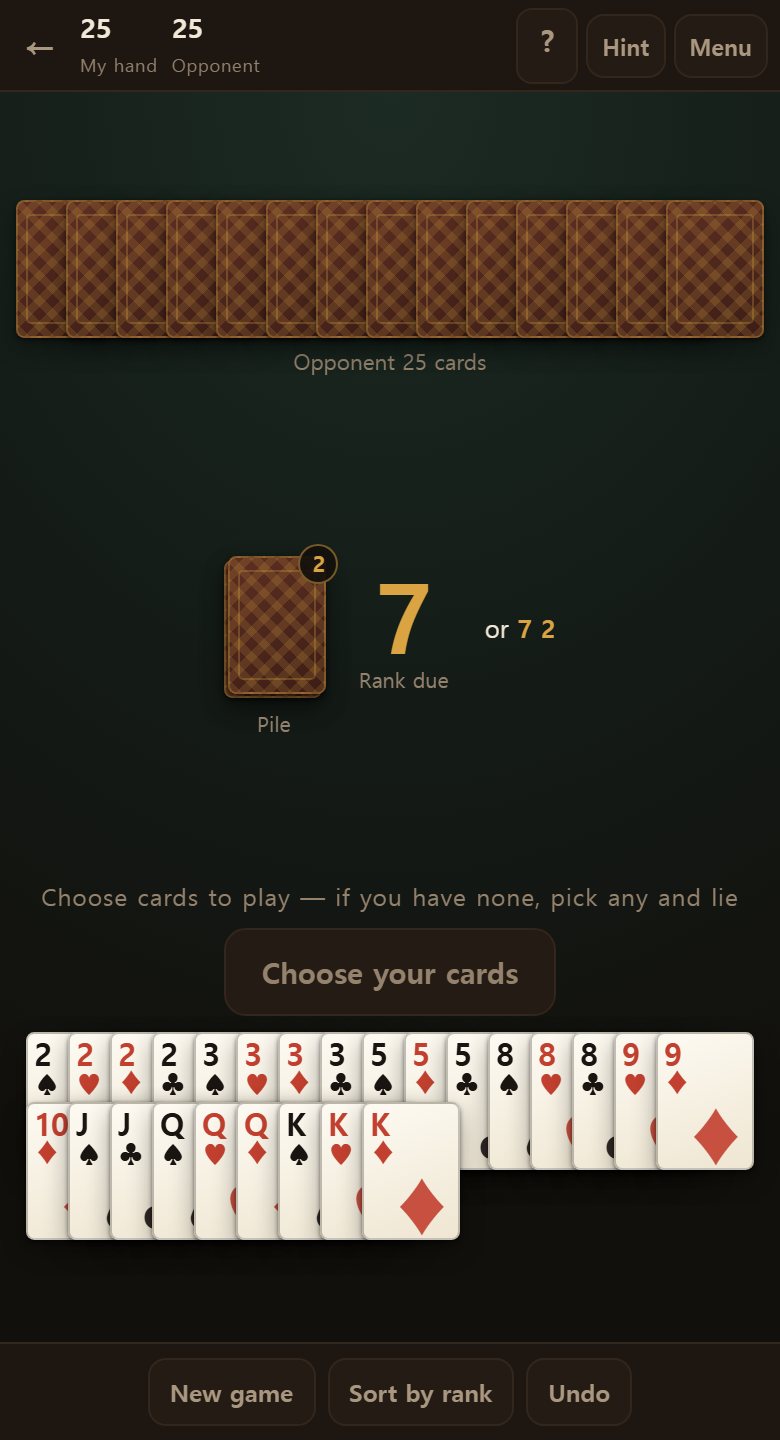
They sometimes call a true claim — and then they take the pile. Which makes a large, honest play a fine move in itself.
Calling a lie
After they play, you have two options.
- That is a lie — call it, and the cards are turned over.
- Let it pass, and play moves on.
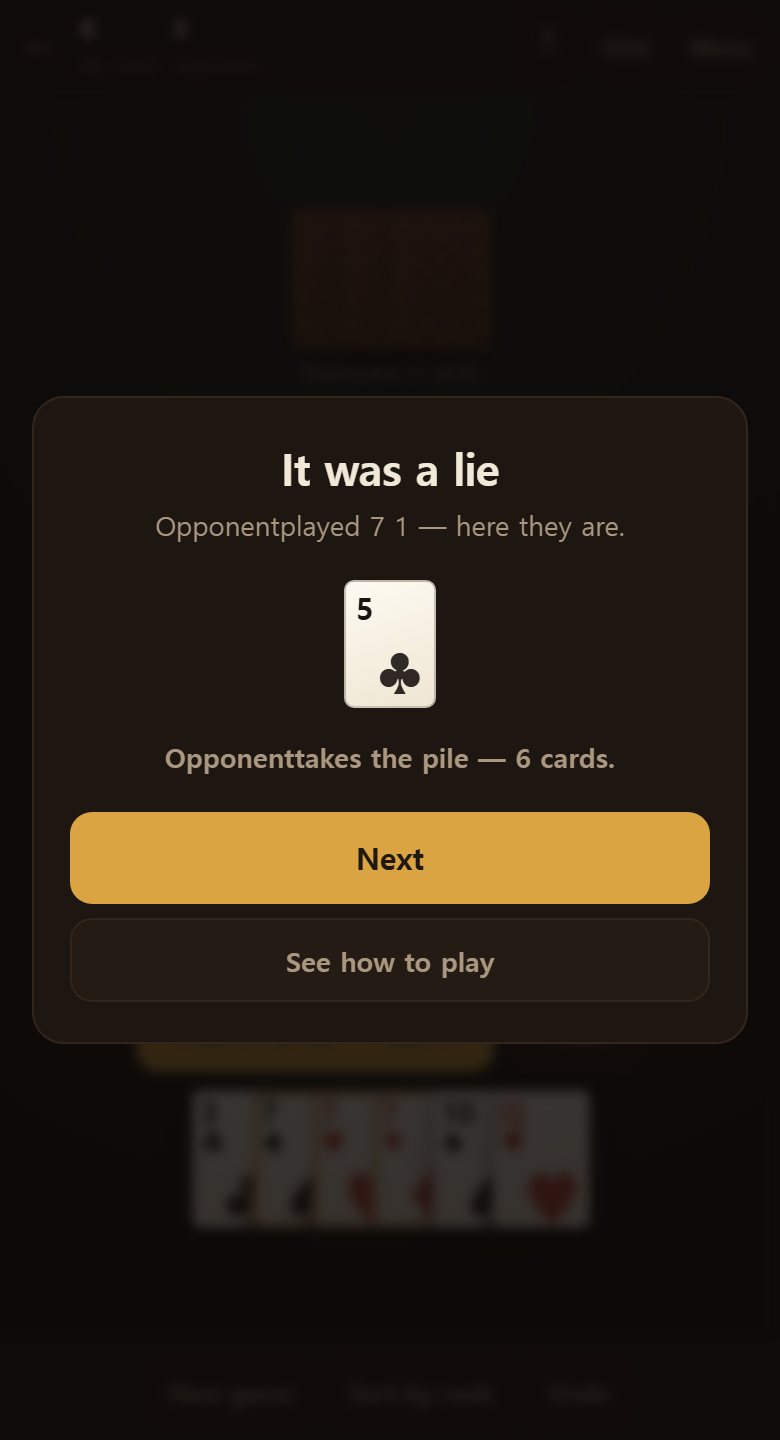
A call turns the cards face up. If it was a lie, they take the pile; if it was true, you do. Then whoever did not take it plays next.
When to call — count to four
There is one way to catch a lie with certainty: counting.
There are only four cards of each rank. If you hold three aces, they hold at most one. So if they claim two aces, at least one of them has to be a lie.
- Hold all four and whatever they play of that rank is a lie.
- Hold two and they claim three — a lie.
- This is not a guess but a certainty. Do not let it pass.
- Counting the cards turned up out of the pile as well sharpens the arithmetic further.
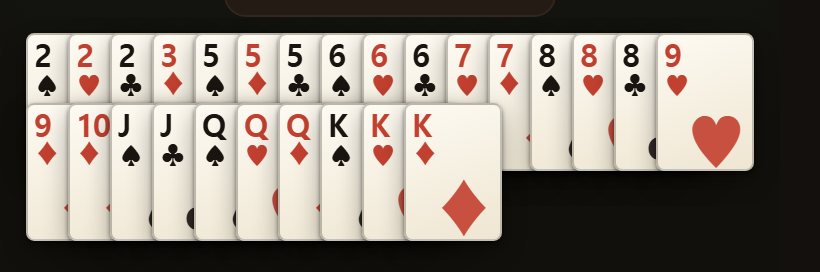
So this game is played by arithmetic, not by faces. All you have to read is your own hand.
When you cannot be sure
More often the counting does not settle it. Then look at these.
- The more cards, the more suspicious. Three or four are hard to hold honestly.
- The smaller their hand, the less likely it holds that rank.
- A large pile calls for restraint. A wrong call lands all of it on you.
- With a small pile, call freely. It costs a few cards at worst.
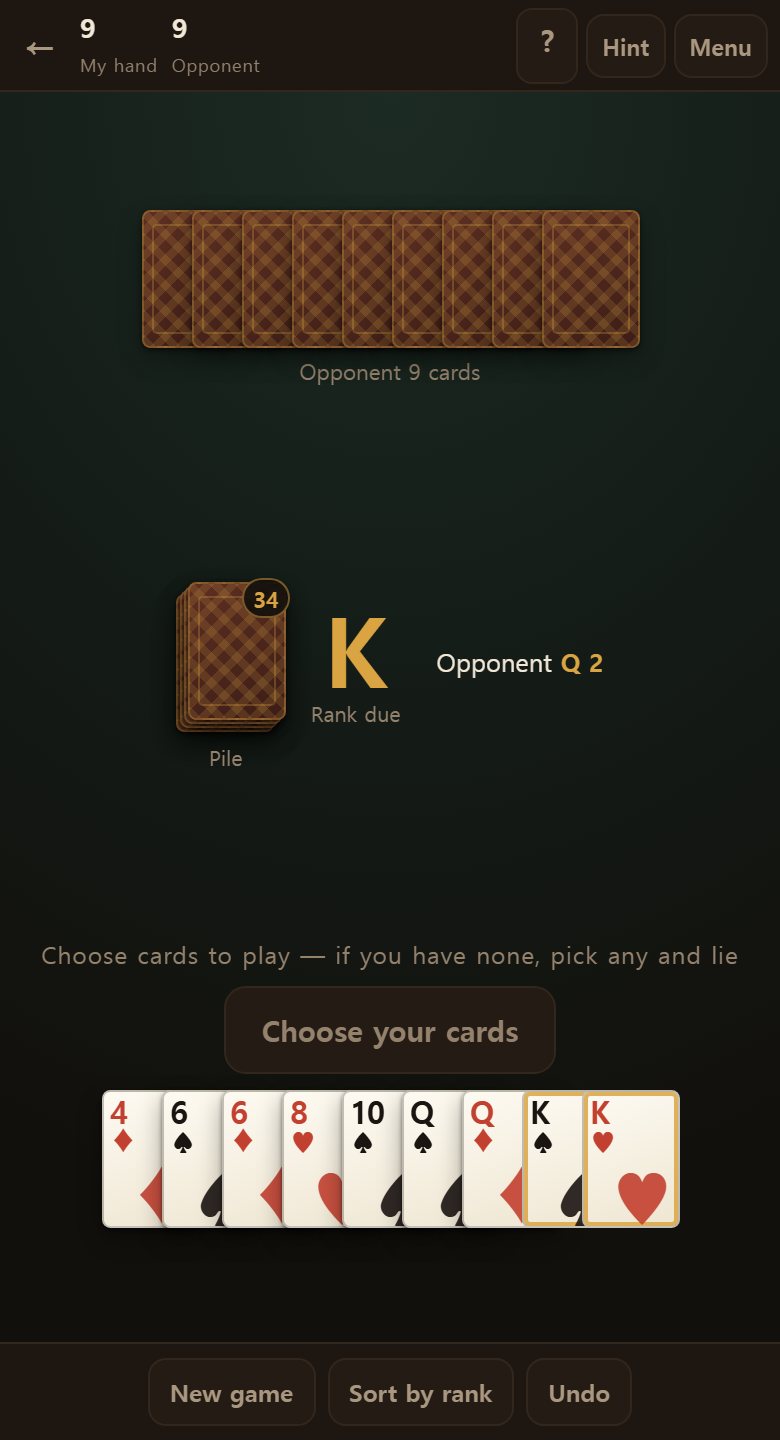
The moment that matters most is when they are down to one or two. Let it pass and you lose. Call, even at a cost.
How you win
Play out your hand first and you win — with one caveat.
Even on your last card, if they call and are right, you take the pile and the win evaporates. So it is safest to finish on the truth.
- Keep your last card or two as genuine cards for the ranks they will owe.
- The smaller your hand, the more often they will call. Expect it.
- Conversely, when they play their last card, call without fail. Let it go and you lose there.
- So whether your last card is honest is the final gate of this game.
From about five cards left, count the ranks ahead and decide what you will finish on. The ranks step one at a time, so it can be worked out. Try to finish on a lie and get caught, and the whole pile lands on you — that game is effectively back at the start.
The computer cannot see your hand
This is the most important promise the game makes. The computer sees its own hand and what the game has revealed, and nothing else. It does not know what you hold.
So when it calls, it has not read your face — it has done the arithmetic, counting how many of that rank sit in its own hand.

A test guards that boundary. Let a single card of yours reach the computer and the test fails.
Undo and hint
Played badly? Press Undo below. Their reply comes back too, returning it to your turn.
If you cannot decide, press Hint. Using the same reasoning the computer uses, it picks cards to play, or tells you whether to call.
- The cards it picks lift by themselves. Play them as they are.
- “Call it” means the count says something is off.
- Esc clears your selection.
- On a keyboard, undo is Ctrl+Z and hint is H.
The hint too is arithmetic on your own hand. It cannot see theirs either. So it may say to let it pass and a call would have landed — this game always keeps a corner where no certain answer exists.
What the menu keeps
Beyond games played and won, two more figures are kept.
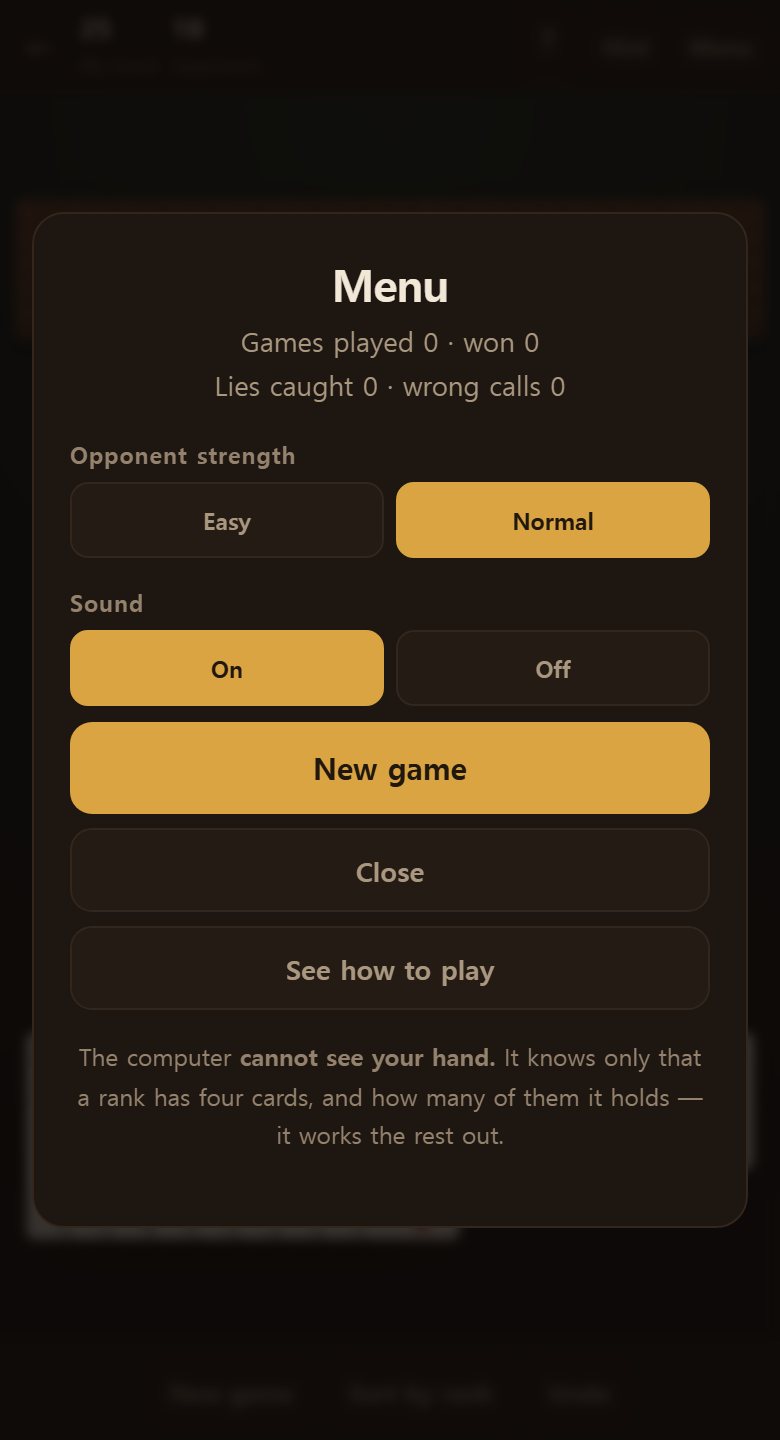
Lies caught and wrong calls. The ratio between them is your skill at this game.
Too many wrong calls means you are calling too readily. Try calling only where the count is certain.
- Plenty of lies caught means you are watching well.
- Plenty of wrong calls means you are calling on instinct.
- Few of either means you are not calling at all — which loses too.
- Your record stays on this device. Nothing is sent anywhere.
The thicker the pile, the higher the stakes
Every card played so far sits on the pile in the middle. Nobody takes it until a call settles the matter.
- The thicker it is, the more a wrong call costs.
- And equally, the more a caught lie costs them.
- So call lightly early and heavily late.
- The pile figure at the top tells you how many are on it.
- Since nobody takes it until a call is made, it keeps growing while neither of you calls.
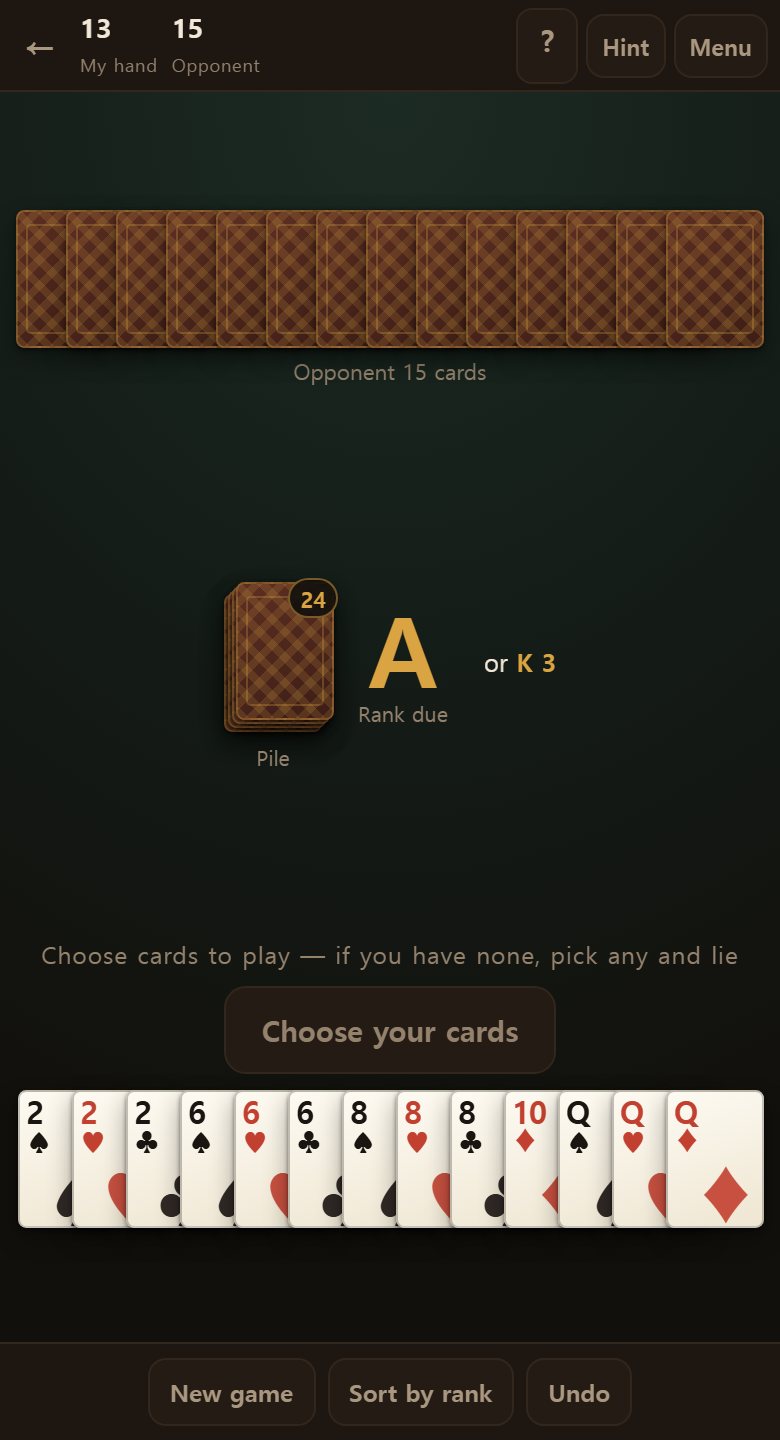
Past twenty cards, one wrong call can end the game. At that point, call only when certain.
Undo
Press Undo at the top and your last action never happened. Yours and theirs come back together. On a keyboard it is Ctrl+Z.
- Cards played, calls made and piles taken all revert.
- You can undo as far back as the start.
- Undo and play it differently and you learn whether you should have called.
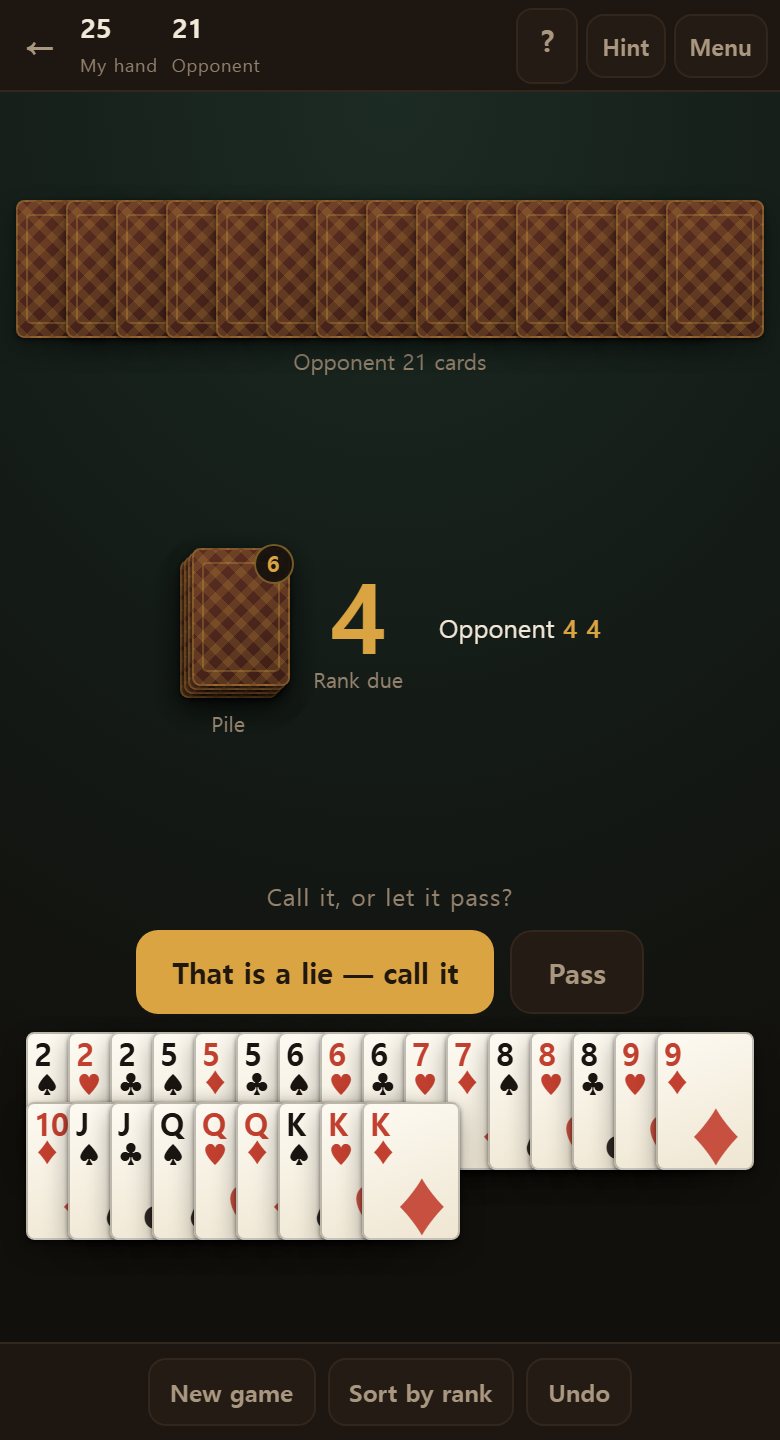
With the other hand hidden, undoing cannot show you the future. But it does tell you whether your count was right.
How to win
Five habits will win you a great many more games.
- Count to four. Each rank has four cards. Subtract what is in your hand and what the pile has shown, and you have what they could possibly hold.
- Hold all four and any claim of that rank is a lie, without exception. Call it.
- Watch the large plays. Three or four at once is often a lie.
- Call experimentally while the pile is thin. Being wrong costs little.
- Call more often as their hand shrinks. Leaving them alone simply loses.
All five are really one: call by counting, not by feel. This looks like a game of reading people; it is really a game of counting to four.
Common mistakes
Games are lost, more often than not, in one of these four ways.
- Never calling — the commonest of all. Call nothing and they lie freely and shed cards at will. An uncalled lie is free.
- Calling on instinct — a hunch against a thick pile, twenty cards taken, and the game is over.
- Not counting your own hand — letting a claim pass while holding all four of that rank happens more often than you would think. That is a lie you could have caught for nothing.
- Playing too many at once — three or four to empty your hand quickly, and they will be waiting for exactly that.

All four come from not counting. Hold on to the single fact that a rank has four cards and half the game becomes visible.
Common questions
You still have to play. Put any card down face down and claim it is that rank. That is the lie.
Up to four.
No — only its size. So a wrong call means taking on however much is there.
You take the whole pile, and they play next.
No. It reasons from its own hand and from the fact that a rank has four cards.
They will have called it, and been right. You take the pile, and the game is not over.
No. Because whoever did not take the pile plays next, no position arises where one side is caught over and over.
- There are only four cards of each rank. Count how many you hold and the lies show up.
- When they are down to a card or two, call even at a loss. Letting it pass loses the game.