 MindHub
How to play Bingo
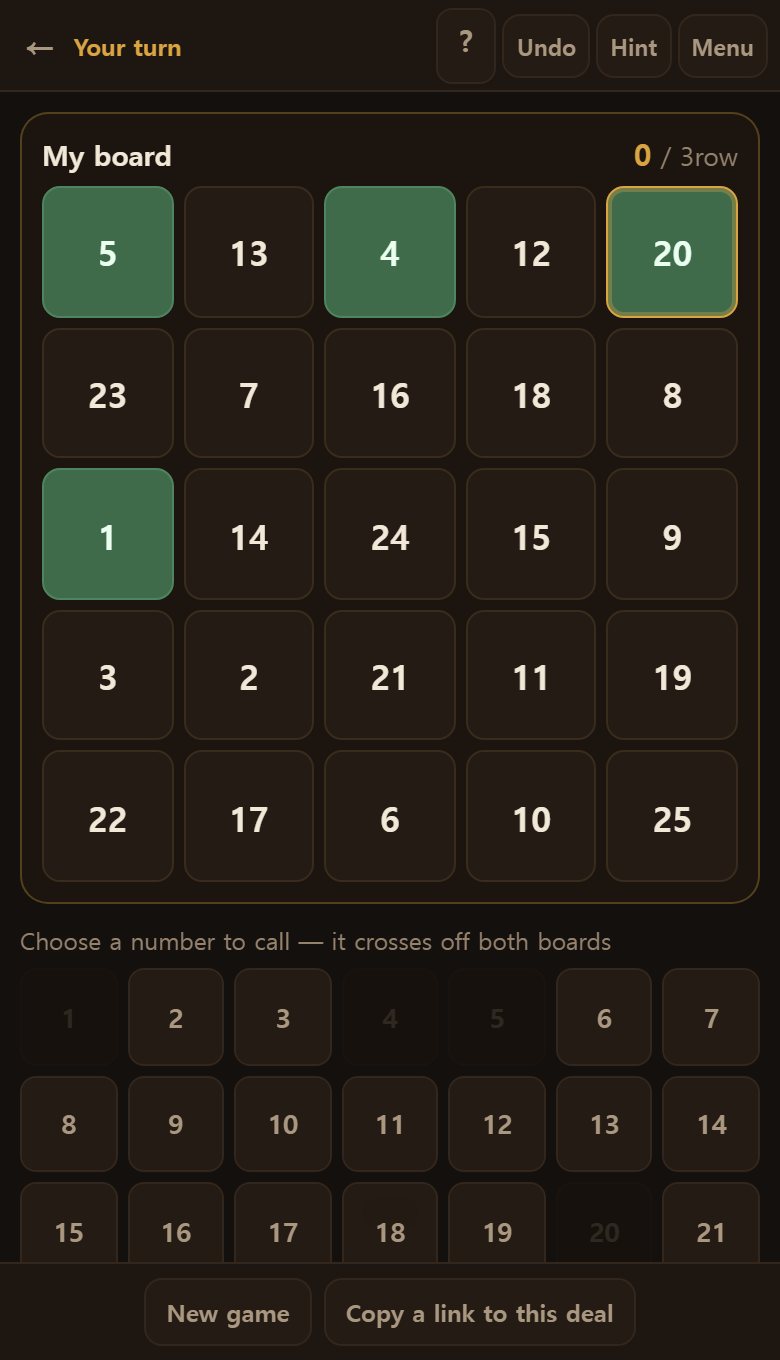
Take turns calling numbers and completing lines. First to fill three lines — across, down or diagonally — wins. It is the bingo you played at school, except that here it is not luck but how well you choose.
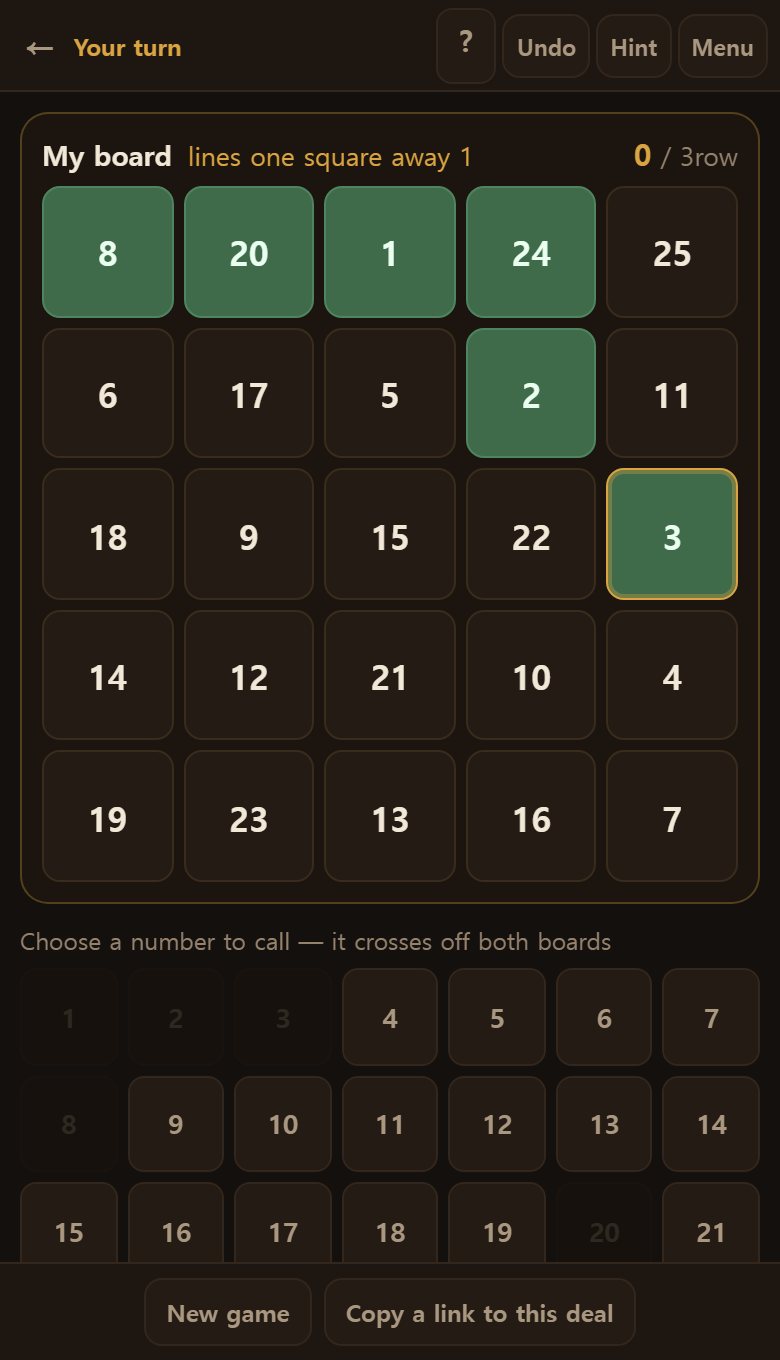
First, look at the screen
You see two cards: yours and your opponent’s.
- Each card is 5 × 5 = twenty-five squares, holding 1 to 25 in a shuffled order.
- The numbers sit in different places on the two cards. This matters a great deal.
- Squares whose number has been called change colour to show they are struck out.
- The top shows how many lines each side has completed so far.
- Below are the numbers not yet called. You pick from there.
- Each card also shows how many lines are one square from done. Watch that figure above all.
Seeing both cards side by side is the whole point of this version. Call a number without looking at your opponent’s card and it becomes a game of luck again.
How it starts
Open a new game and both cards are blank. No number has been called yet.
Both hold 1 to 25, but shuffled into different places. A number in the middle of your card may sit in a corner of theirs.
- Both cards hold 1 to 25 once each. Nothing is missing and nothing repeats.
- Only the arrangement differs. So the same number can be precious on one card and worthless on the other.
- The cards are reshuffled every time you open the game. To play the same pair again, copy the link.
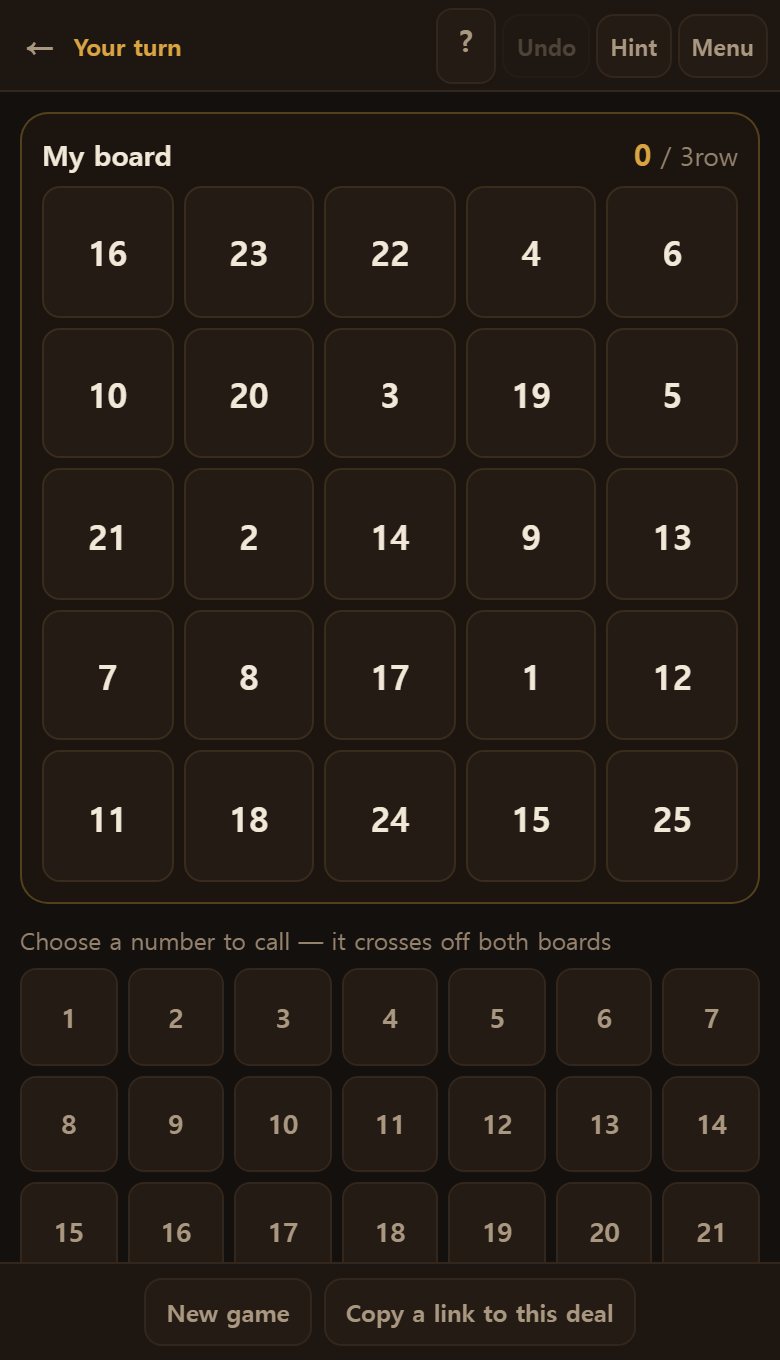
So one called number affects the two players differently. That is the heart of this game.
The rule that matters most
A called number is struck out on both cards at once. Not only on yours.
Which makes this not a game of luck but a game of choosing what to call. Call with only your own lines in mind and that number may fill your opponent’s lines too.
- A number already called cannot be called again.
- Whether it is your turn or theirs, both cards are struck out just the same.
- So what you call is also what you give away.
- There are only twenty-five numbers and the two of you share them. There is no saving them up.
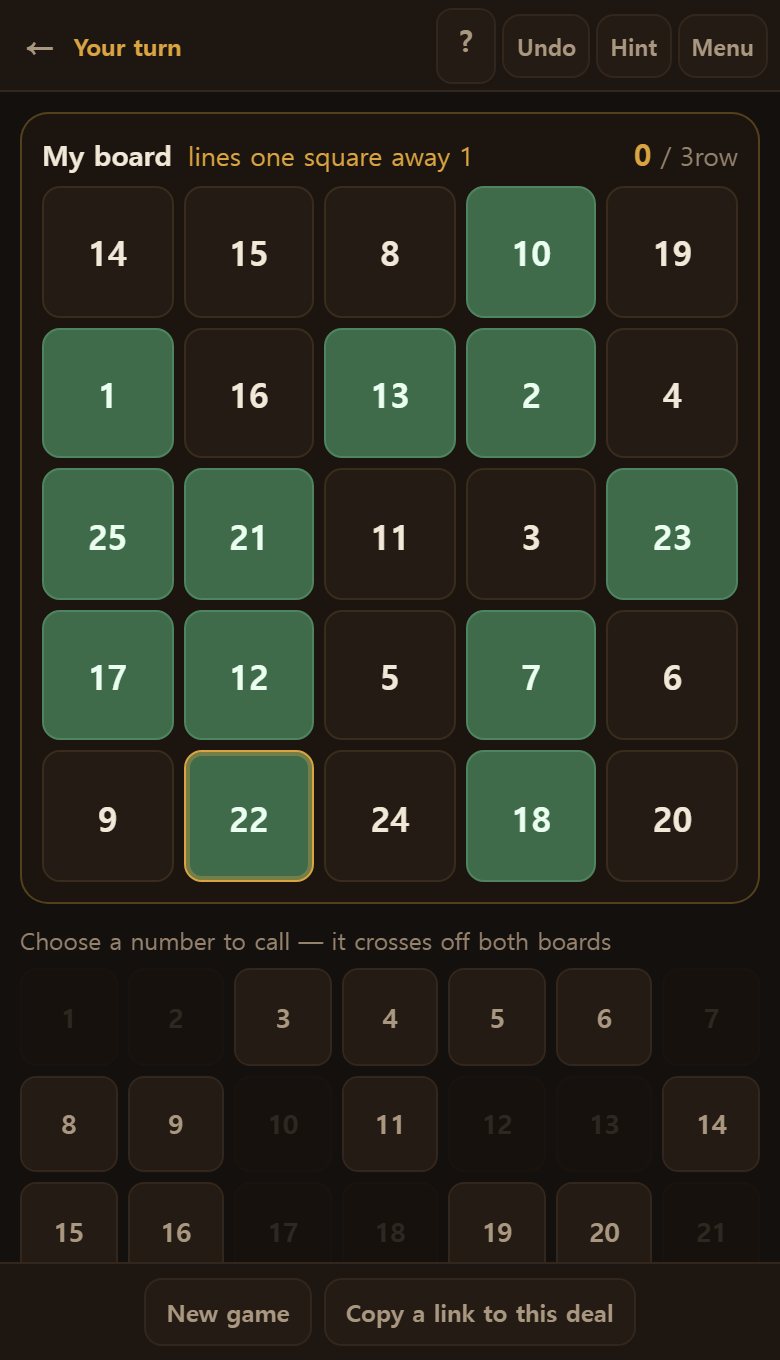
This is where it parts from school bingo. There a draw decides the numbers, so luck is everything; here a person chooses. That makes it a game of skill.
There are twelve lines in all
Here are all the lines you can complete.
- Five rows
- Five columns
- Two diagonals (top-left to bottom-right, top-right to bottom-left)
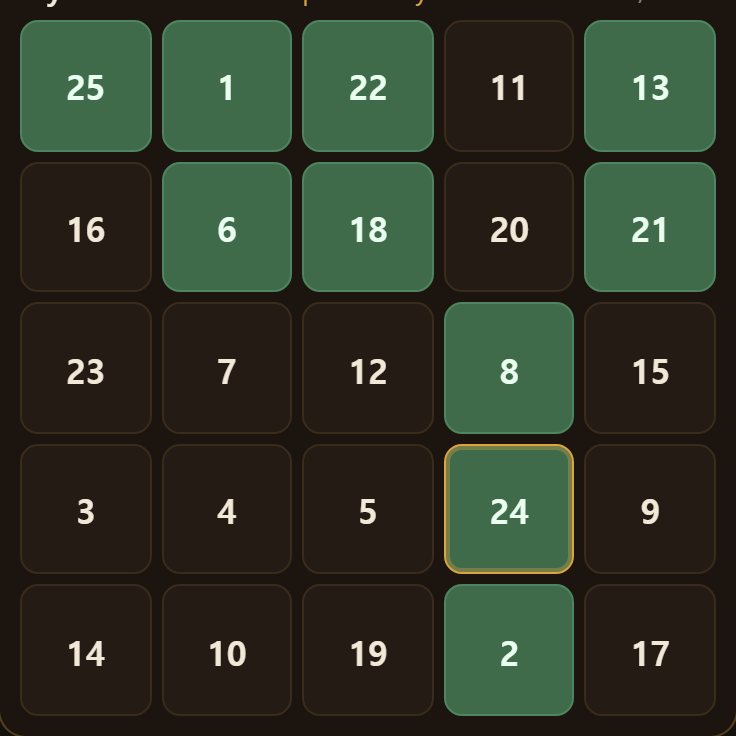
Twelve lines in all. Complete three of them first and you win — you can set this anywhere from one to five in settings. The centre square lies on four lines at once — a row, a column and both diagonals — which makes it the most valuable square.
How to choose
Before picking a number, look at two things.
- How much this number fills your own lines
- Whether it also fills your opponent’s lines
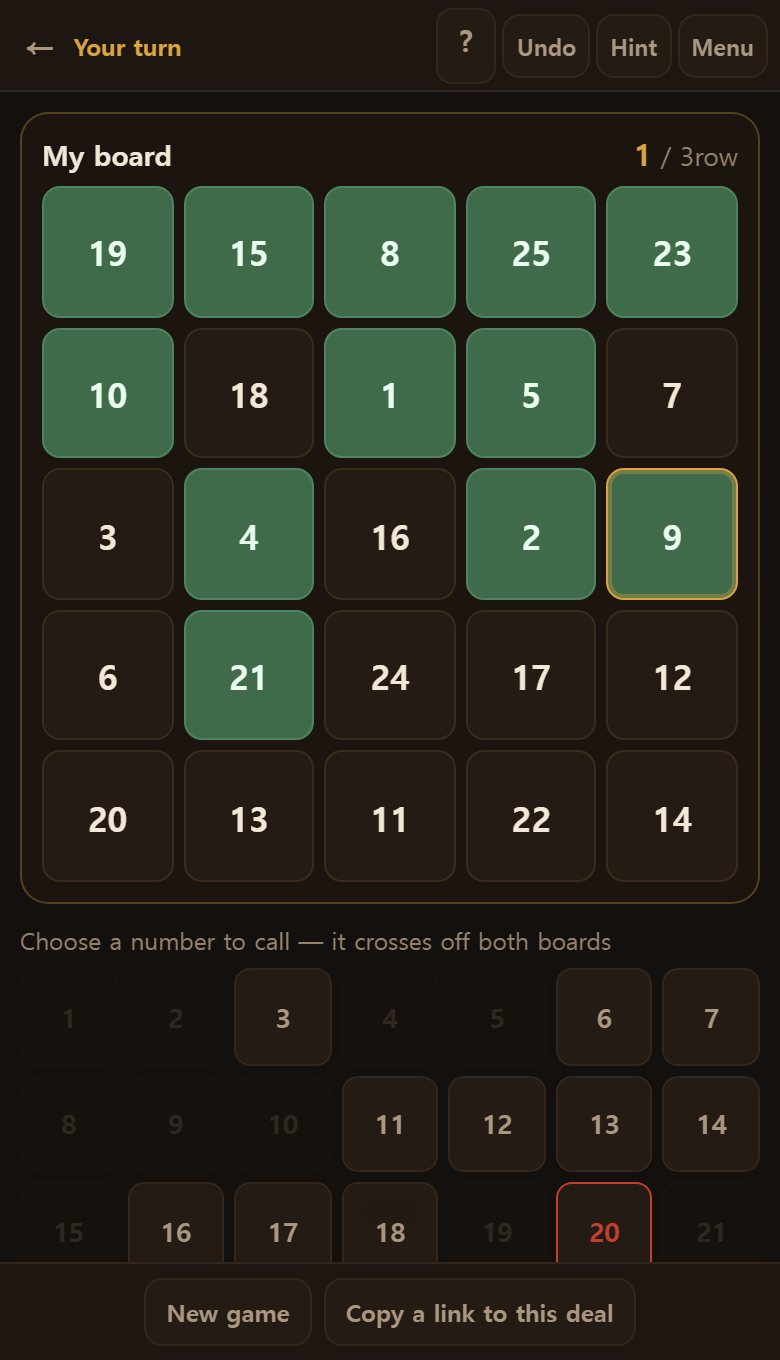
The best number is one that fills your lines and not theirs. Turn on Hint at the top and it separates them by colour — gold for numbers that only help you, red for numbers that help them too. Hint does not decide for you. It only shows how each side would grow; the choice stays yours. After a few games you see it without the hint.
When blocking is more urgent than winning
It is dangerous when your opponent has several lines one square from done. Often it is better to spend the number they need first than to complete one more line of your own.
Say they have three lines one square away while you lead by a line: in the time you take to finish yours, they may complete all three.
- With two lines one square away, a single call can complete both.
- It is worse when those lines are waiting on the same square — one number completes both.
- When blocking, spend the squares that several lines are waiting on first.
- And if that square fills a line of yours as well, so much the better. Look for those first.
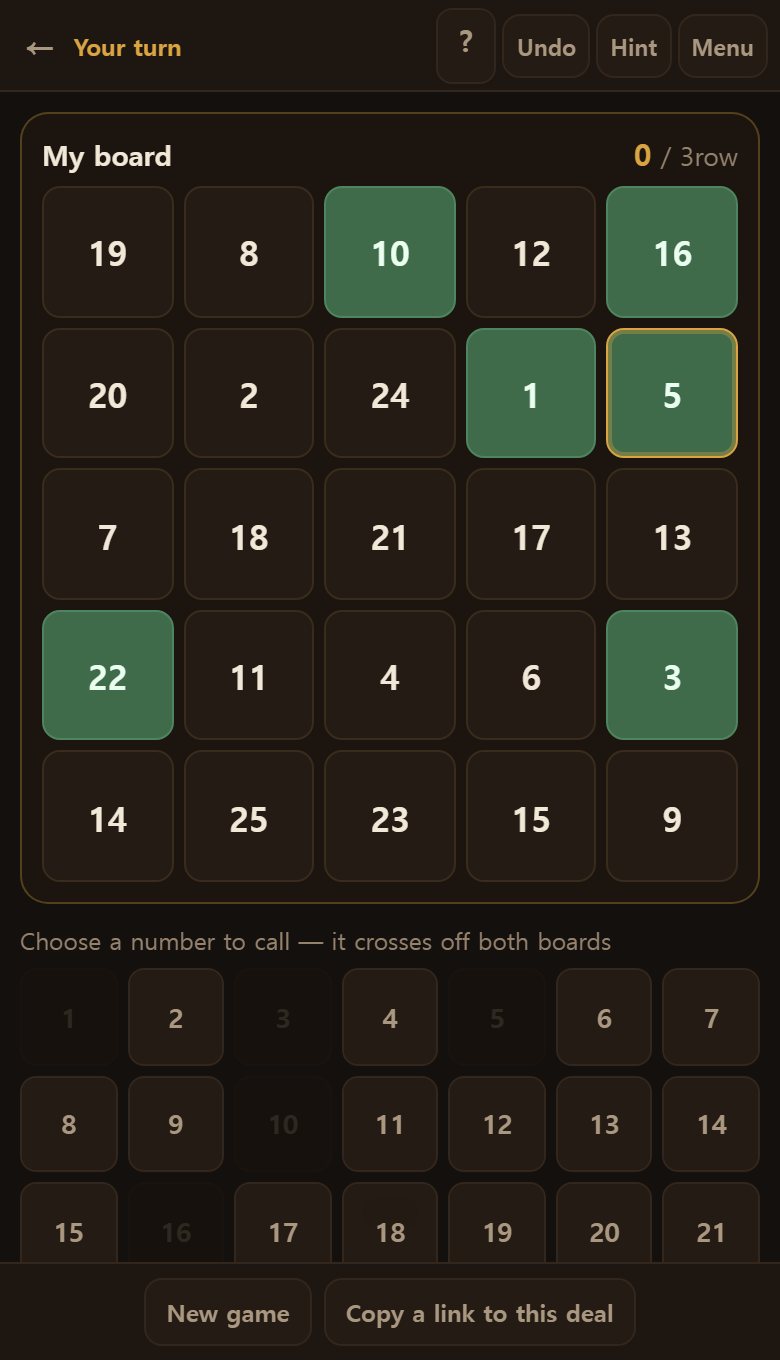
This is where real skill shows. Watch only your own card and you will lose.
Near the end the computer reads it all out
With about twelve numbers left the computer calculates all the way to the end, working through every order the remaining numbers can be called in.
From there it is not an estimate but the exact answer. So you must be ahead before that.
- Twelve numbers left sounds like hundreds of millions of orders, but in practice it is far fewer.
- Lines that are already dead need not be counted, which cuts the branches sharply.
- So in the endgame there are no mistakes. Only best play.
A person can count the last five or six numbers too. Build the habit of counting once when few remain and you gain a great deal at the finish.
How to get good
A few habits will improve your play markedly.
- Take the number on your centre square early. It lies on four lines.
- Put your effort into lines already three or more squares full. Lines with one or two are still far off.
- Always keep count of their lines that are one square from done.
- Numbers that lie on several lines at once are good. They fill more than one.
- Called the wrong one? Undo takes it back.

In one line: watch only your own card and you will lose. Get into the habit of sweeping their card once before every call.
You can see their card too
This is the biggest difference from school bingo. Here you can see exactly where every number sits on their card.
- Hide it and there is no way to choose what to call — it becomes pure luck.
- Because it is all visible, you can count how much a number helps them.
- How many of their lines are one square from done is shown above their card.

So this bingo is not a game of luck but a game of counting. Whoever counts better wins. With two players both cards are visible as well. Each side sees everything, so nothing is hidden — like go or chess.
How many lines are one square from done
Above each card is the number of lines that are one square from done. It is the most important figure in this game.
- With two or more, a single call can complete two lines at once.
- Two of yours is good; two of theirs is dangerous.
- Calling well means picking numbers that increase your count of near-complete lines.
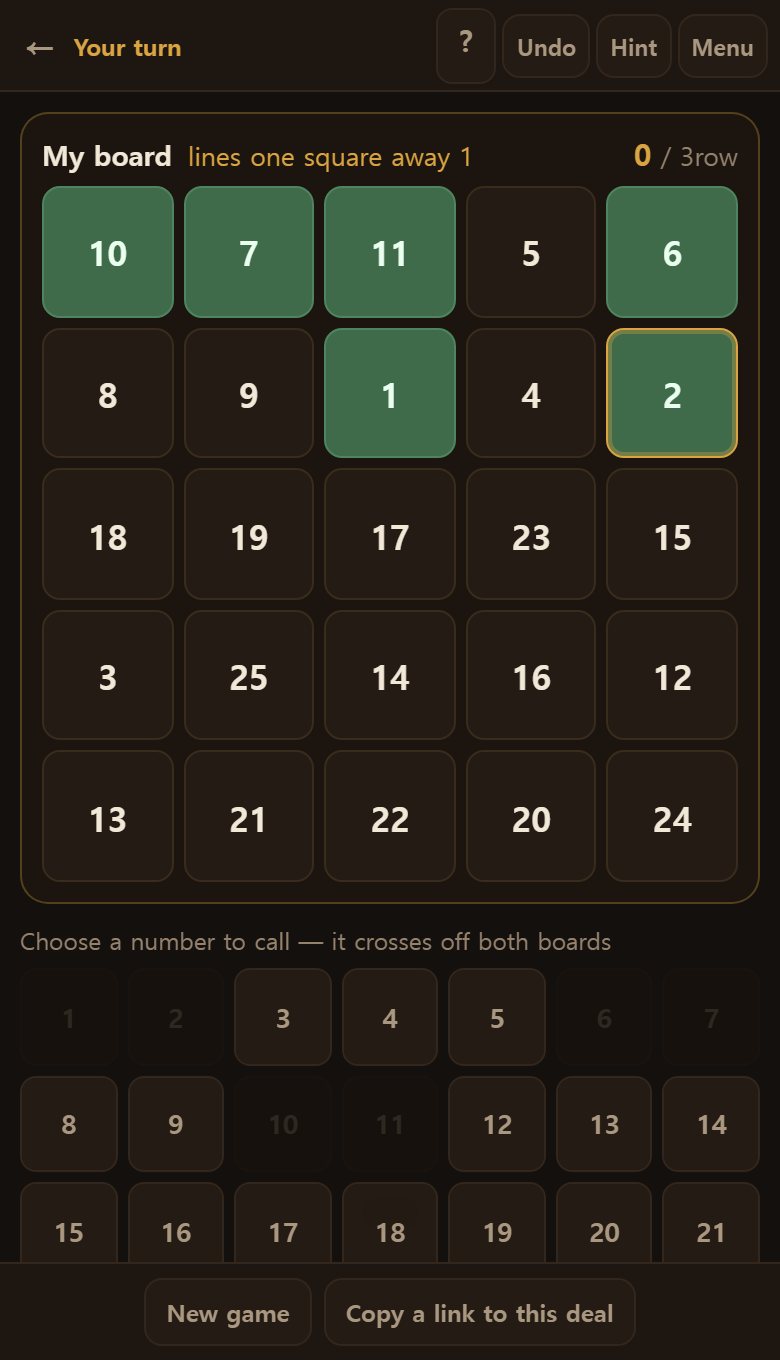
Read the near-complete count before the completed count. Completed lines are settled; near-complete lines are what is about to happen.
Reading the number pad
1 to 25 are laid out below. Pick one and press it to call that number.
- Numbers already called fade and cannot be pressed.
- Whoever called it, a number once called is spent.
- There are only twenty-five numbers, so a game runs at most twenty-five calls.
- The pad locks when it is not your turn — you wait for the computer to call.
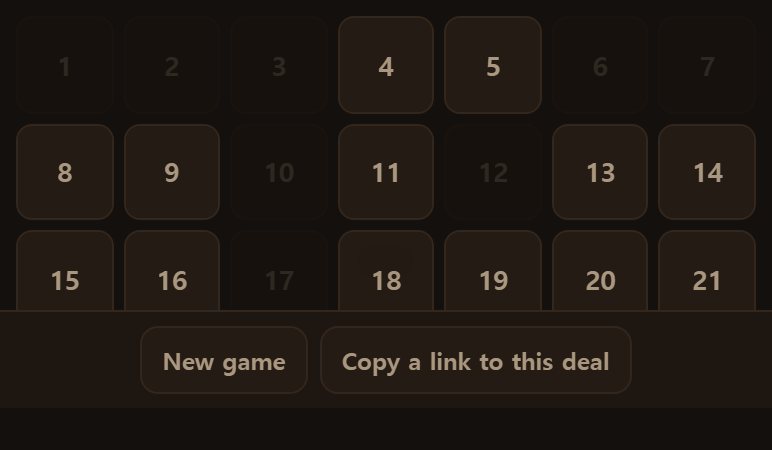
So your choices keep shrinking. Call carelessly early on and later there is nothing left but numbers that help your opponent. Since the choice narrows towards the end, whatever edge you built earlier becomes the result.
The centre square is worth most
On a 5 × 5 card the centre square lies on four lines — a row, a column and both diagonals.
- Centre — on four lines. Worth most.
- The four corners — on three lines (a row, a column and one diagonal).
- The other edge squares — on two lines.
- Each square you strike out grows a different number of lines.
So the same single call can be worth more than twice as much depending on which square it strikes. Take the squares that lie on several lines first. But a square that is precious on your card may be precious on theirs too. Then it can be better not to call it and let them spend it first.
Undo
Press Undo at the top and your last call never happened. Your call and the computer’s step back together.
- Use it when you mis-tap. You can go all the way back to the start.
- An undone number becomes callable again.
- On a keyboard it is Ctrl+Z.
- Calling a different number from the same position teaches you why the first one was bad.
- The computer answers the same position the same way every time — undoing and recalling does not disturb the flow.
Sharing a game
Press Copy this game’s link below and you get a link holding the current game exactly. Open it and the same game appears again.
- The arrangement of both cards comes back unchanged.
- Keep a game you found hard and try it again later.
- Send it to someone and you can compete on the same game.

Bingo reshuffles every time it opens, so without copying the link you can never see that game again. Save the ones you are sorry to lose, as you go.
Common mistakes
Lost games nearly always come down to one of these four.
- Calling with only your own card in view — the most common. That number fills their lines too.
- Not counting near-complete lines — once they have two set up, a single call completes both, and by then it is too late.
- Spending effort on shallow lines — a line with one or two squares filled is still far off. Concentrate on those with three or more.
- Saving a good number — save it and your opponent calls it first. The numbers are shared, so there is no saving them.
All four come from forgetting that the numbers belong to both of you. What you call is also what you give.
When the game ends
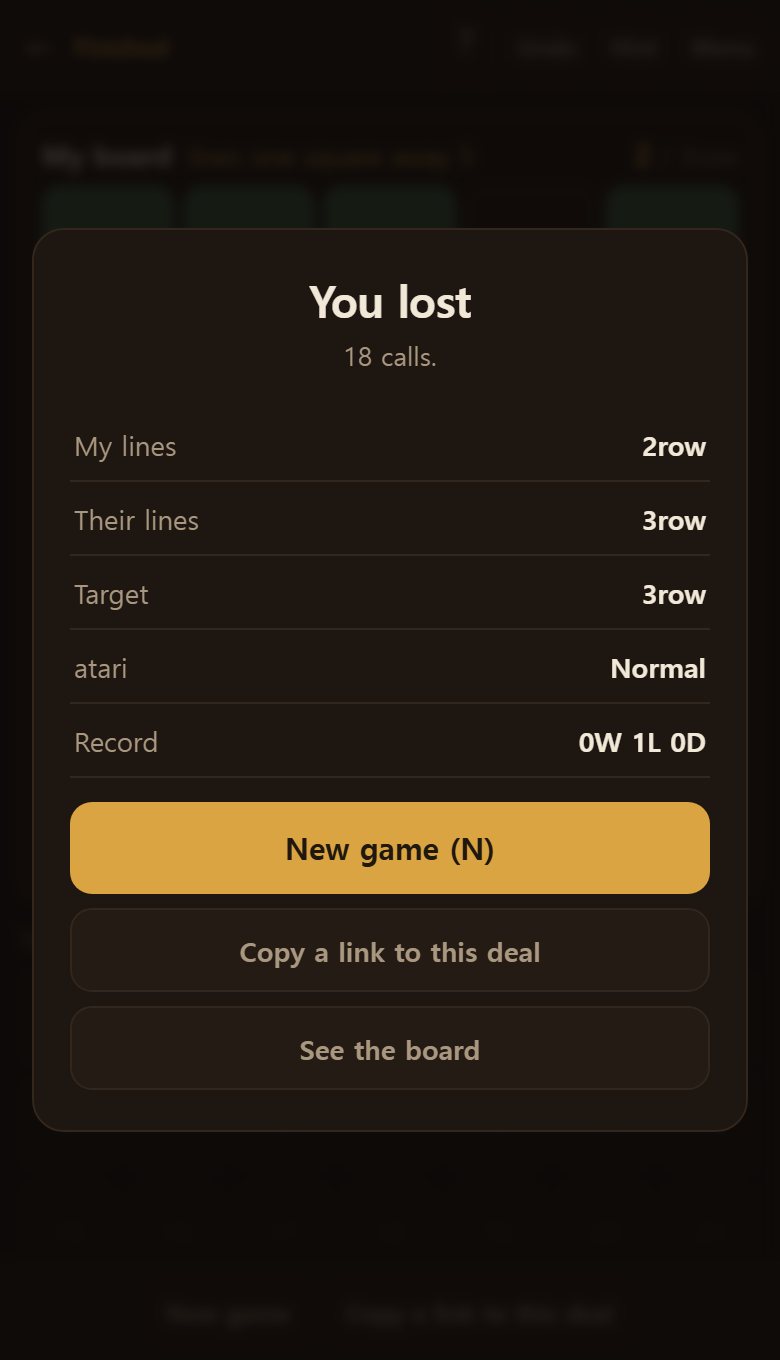
Complete the set number of lines first and it ends there. How many lines each side made, and in how many calls, is kept.
- If one call takes both players to the target at once, it is a draw.
- If all twenty-five are called and neither side reaches it, the game ends there and whoever has more lines wins.
- The games you lose are the ones worth replaying — you can see which number turned it.
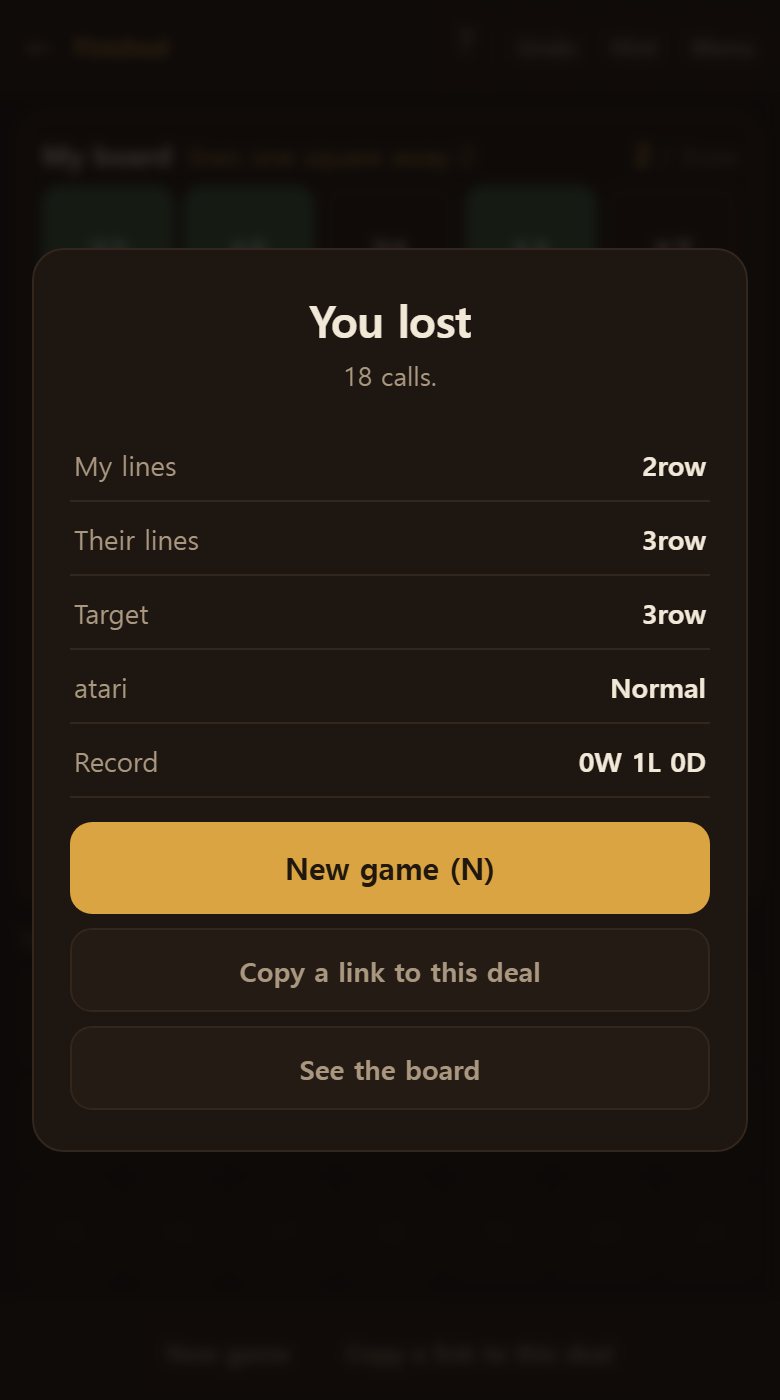
It usually turns on a single number — the one you called to finish a line of yours, which finished two of theirs. Open the game again and find that moment.
Common questions
Press Undo at the top to take it back.
It separates by colour the numbers that fill only your lines from those that fill your opponent’s too. It does not simply give you the answer.
If they matched, every call would fill both identically and there would be nothing to choose. They differ so that what to call becomes a question.
Three. Rows, columns and diagonals all count. You can set it from one to five in settings, and it shows above the card as 0 / 3 lines.
Yes. Without it there is no way to choose what to call. That is the difference from school bingo, and what makes this a game of skill.
Lower the difficulty in settings. It reads the endgame out in full, so what matters is getting ahead in the middle.
Ones that fill many of your lines and few of theirs. Best of all is a number sitting on several of your lines while sitting, on their card, in a line that is already dead or still far off. Turn on Hint and it separates these by colour.
No. The twenty-five numbers are shared between you, so anything you save your opponent calls first. If it looks good, call it then.
The number of lines that one more strike would complete. Read it before the completed count — it tells you what is about to happen. Two or more on their side means you are in danger.
Choose Two players in settings and you can take turns calling on one device. Both cards are visible, so you simply play it out.
- Do not watch only your own lines. Cutting off a line they are one square from is often worth more.
- Turn on hints and numbers that help only you are coloured apart from those that help them too.