 MindHub
How to play Bulls and Cows
A few digits are hidden, and you call out numbers without seeing them. Each call is answered only with so many strikes, so many balls. Work out the hidden digits from that alone and you win. This is not a guessing game. Reason through what you are told and the answer narrows itself. This page teaches that reasoning.
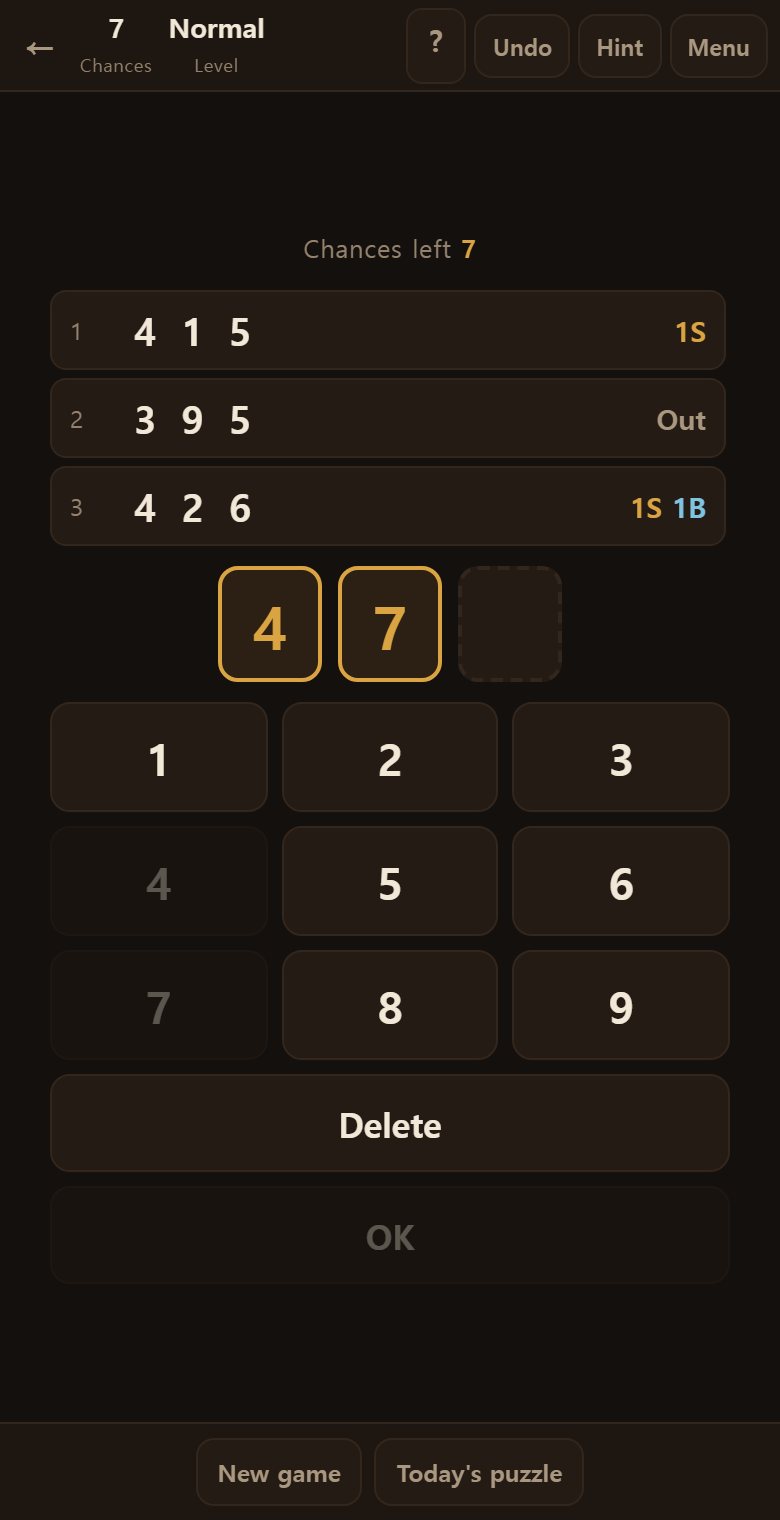
First, a look at the screen
The screen divides into three, from the top down.
- The top — chances left, time and difficulty.
- Above the middle — the calls you have made and what they returned.
- The boxes — the number you are building to call.
- The keypad — 1 to 9. Tap here to build the number.
In the results, S is strikes and B is balls.
The answer has no repeated digits
The answer is built from 1 to 9. Two things to remember.
- There is no 0 — which is why the keypad has none.
- No digit appears twice. There is no answer like 447.
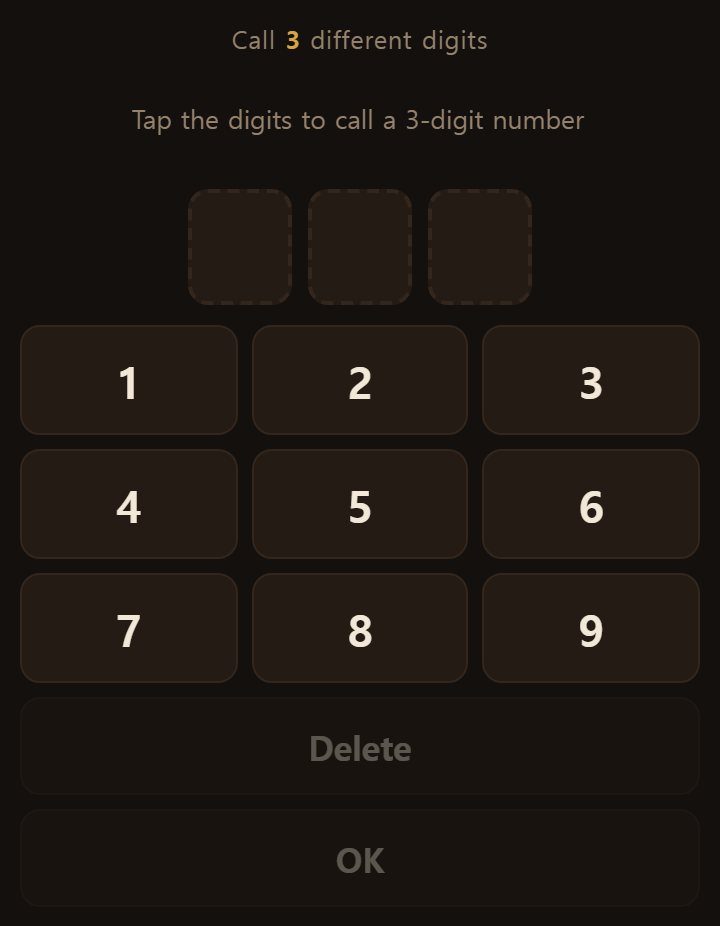
Those two make the reasoning far easier. At three digits there are only 504 possible answers.
Tapping digits to call
Tapping the keypad fills the boxes above from the left. Fill them all and the submit button lights up.
- Tapped wrongly? Clear removes just the last digit.
- On a keyboard, 1 to 9 enter and Backspace deletes.
- Enter submits.
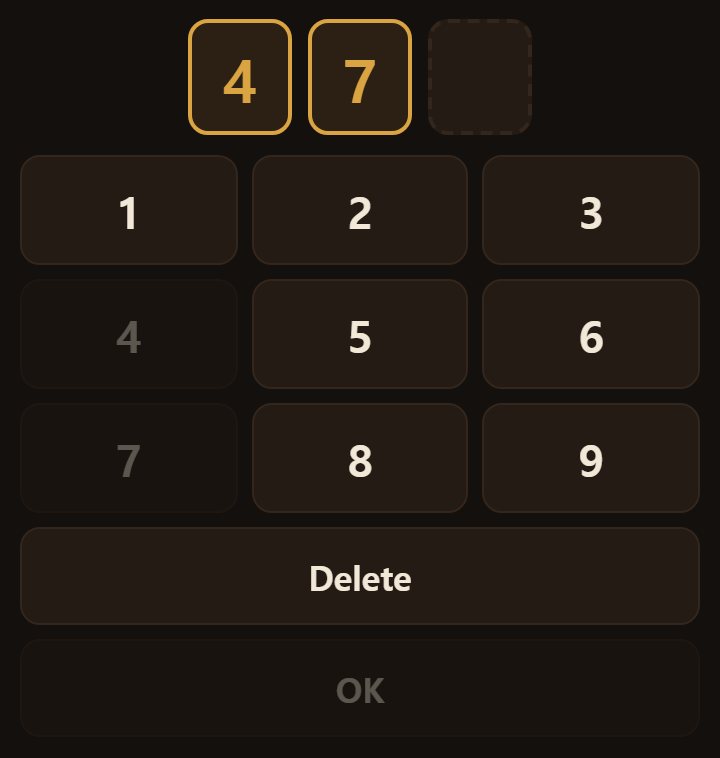
Your call must also have no repeated digits. Any digit already entered dims on the keypad and cannot be tapped.
A strike — right digit, right place
A digit that is in the answer and in the same position is a strike.
Say the answer is 4 7 2 and you call 4 1 5. The 4 sits first in both, so that is one strike.
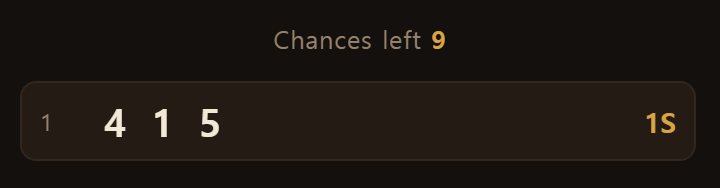
As many strikes as there are digits wins it on the spot — three strikes at three digits.
A ball — right digit, wrong place
A digit that is in the answer but in a different position is a ball.
With the answer 4 7 2 and a call of 7 1 5, the 7 is in the answer but elsewhere — one ball.
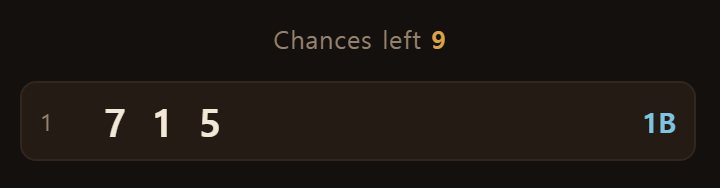
A ball means you have the digit. All that is left is the position.
An out — none of them
When none of the digits you called is in the answer, that is an out.
Do not be disheartened. An out is the biggest clue there is — it strikes three digits off at once.
- All three digits are absent from the answer, not merely one of them.
- Those three are out for good. Do not include them in another call.
- Three of the ten digits gone at once — you have cut nearly a third in one call.
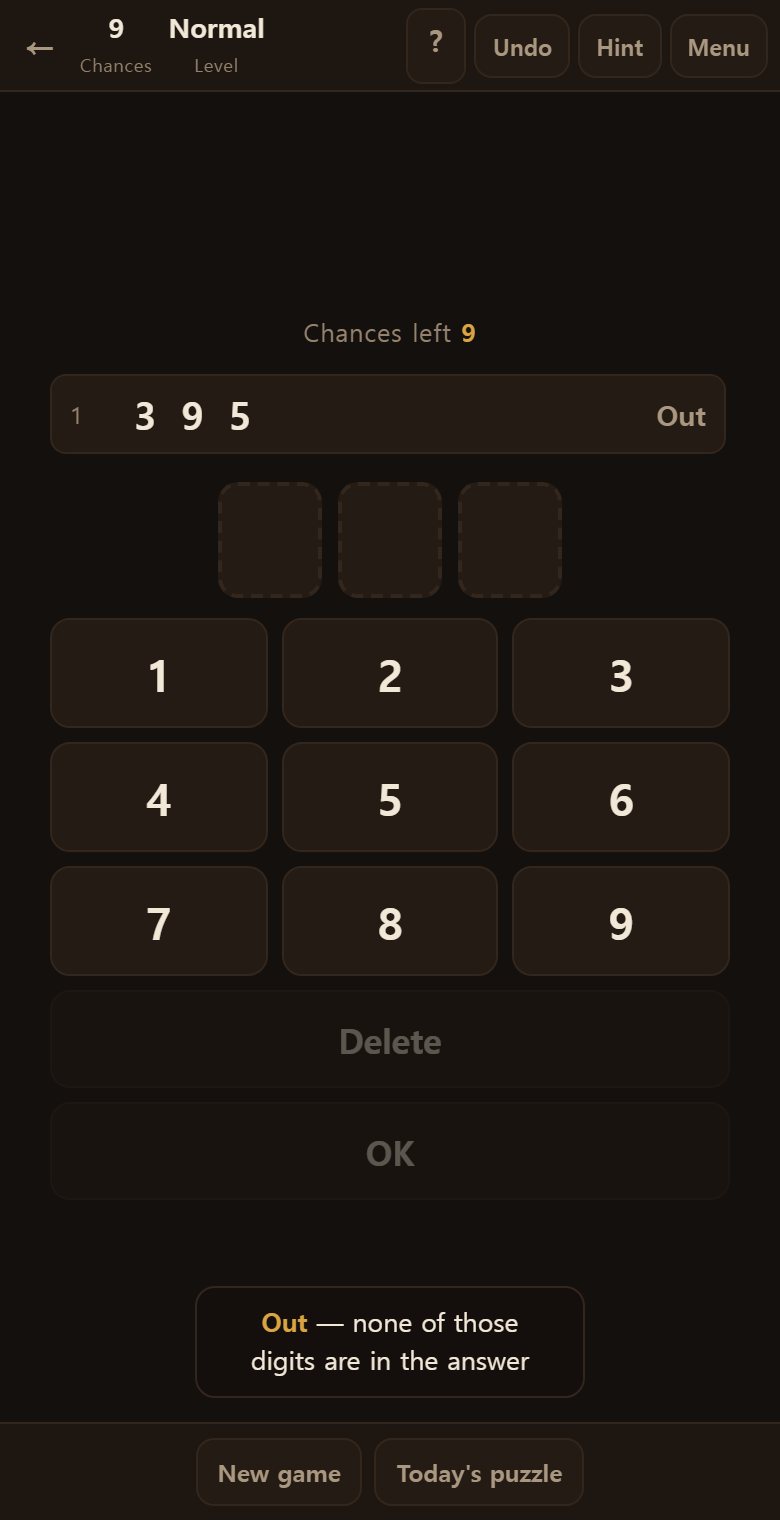
Two outs at three digits removes six, and the three that remain are the answer — only the order is left. So do not fear an out. Beginners take one for a wasted call, when it has in fact narrowed things further than a strike would have.
Add them and you know how many you have
This is the most useful piece of arithmetic in the game.
Strikes plus balls = how many of the digits you called are in the answer.
One strike and one ball means two of the three you called are in the answer, and the third is not.
- 0 — none of the three are in the answer (an out).
- 1 — exactly one of the three is.
- 2 — two are, and one is not.
- 3 — all three are in the answer, and only the order remains.
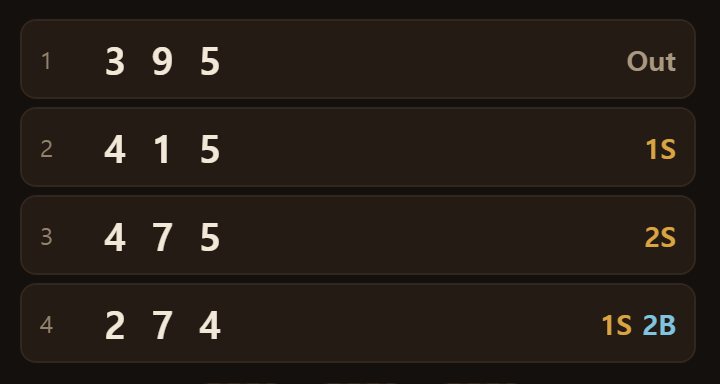
Strike or ball is a question of position; their sum is a question of which digits. Keep the two apart in your head.
You cannot enter a digit twice
The answer has no repeats, so there is no reason to call one. A digit already entered dims on the keypad.
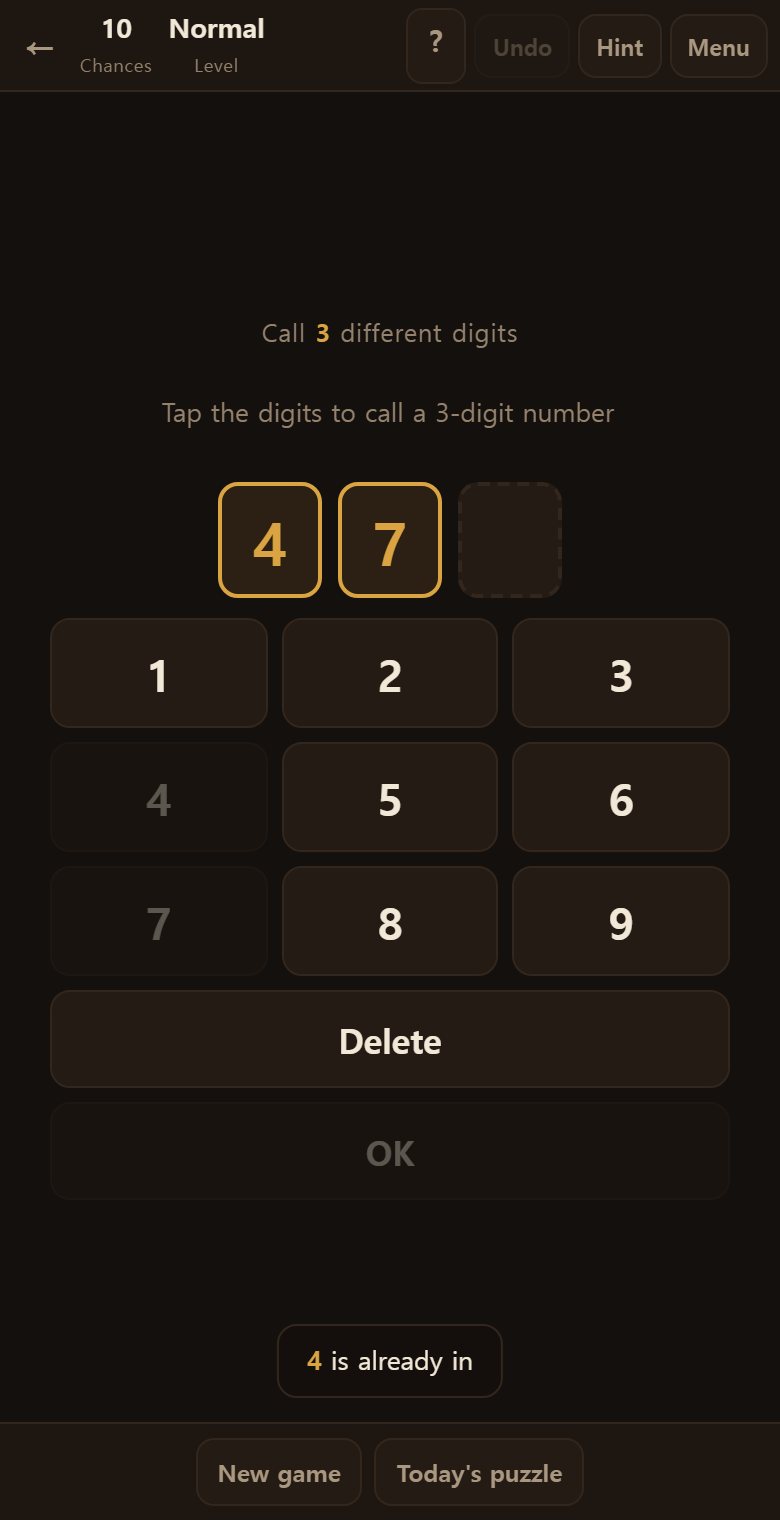
Even from the keyboard it is refused, telling you the digit is already in.
A number once called cannot be called again
Calling the same number returns the same answer and spends a chance for nothing.
So submitting one you have already called is refused, with a note saying so.
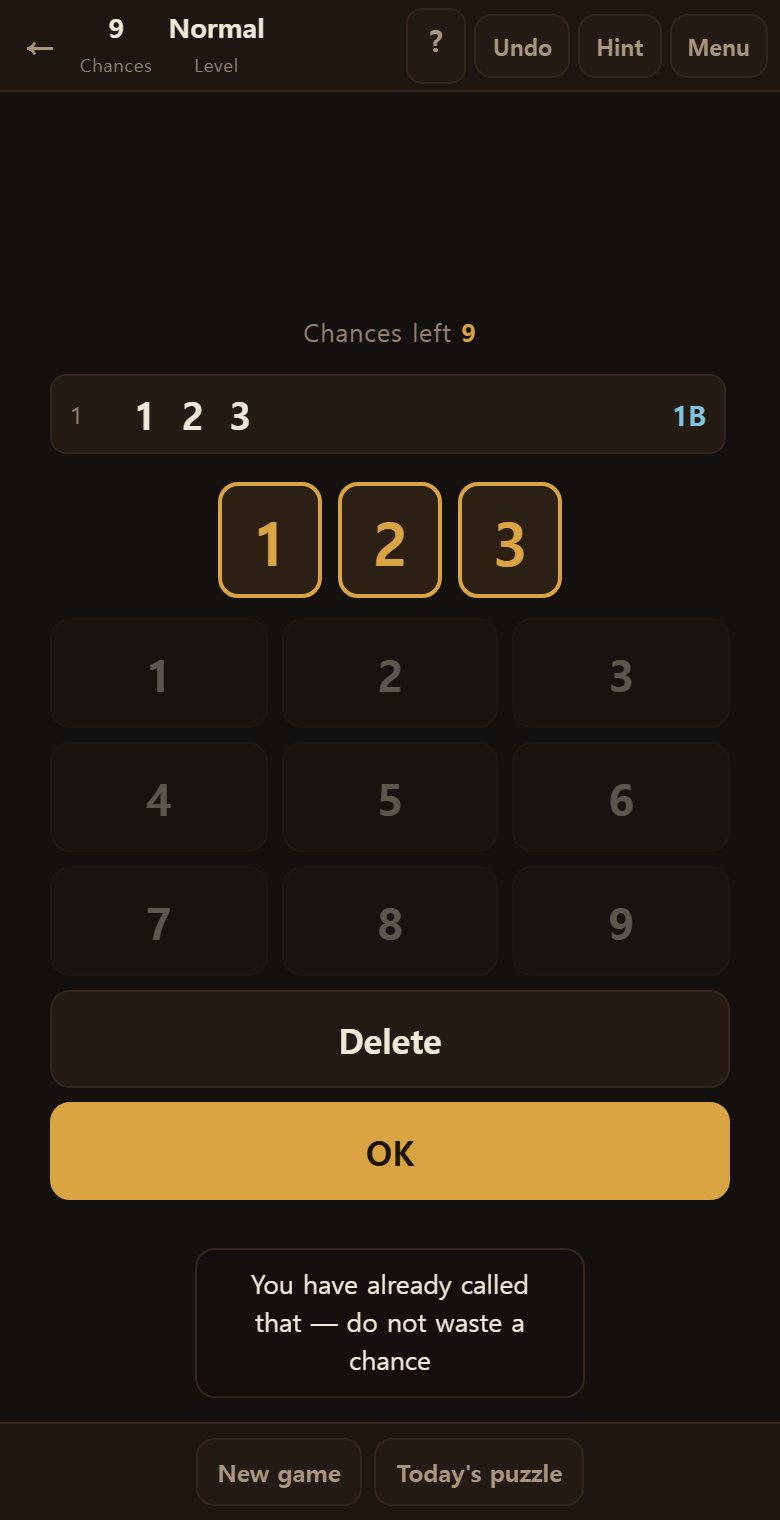
A rearrangement is a different number. Having called 4 7 2, you may still call 7 4 2. And the two answer differently. The digits being the same, strikes plus balls holds steady — but how many of them are strikes changes. That difference is exactly what you use to find the order.
You have a set number of chances
Chances left shows at the top, varying with the number of digits and the difficulty.
- Three digits — 12 on Easy, 10 on Normal, 8 on Hard
- Four digits — 14 on Easy, 12 on Normal, 10 on Hard
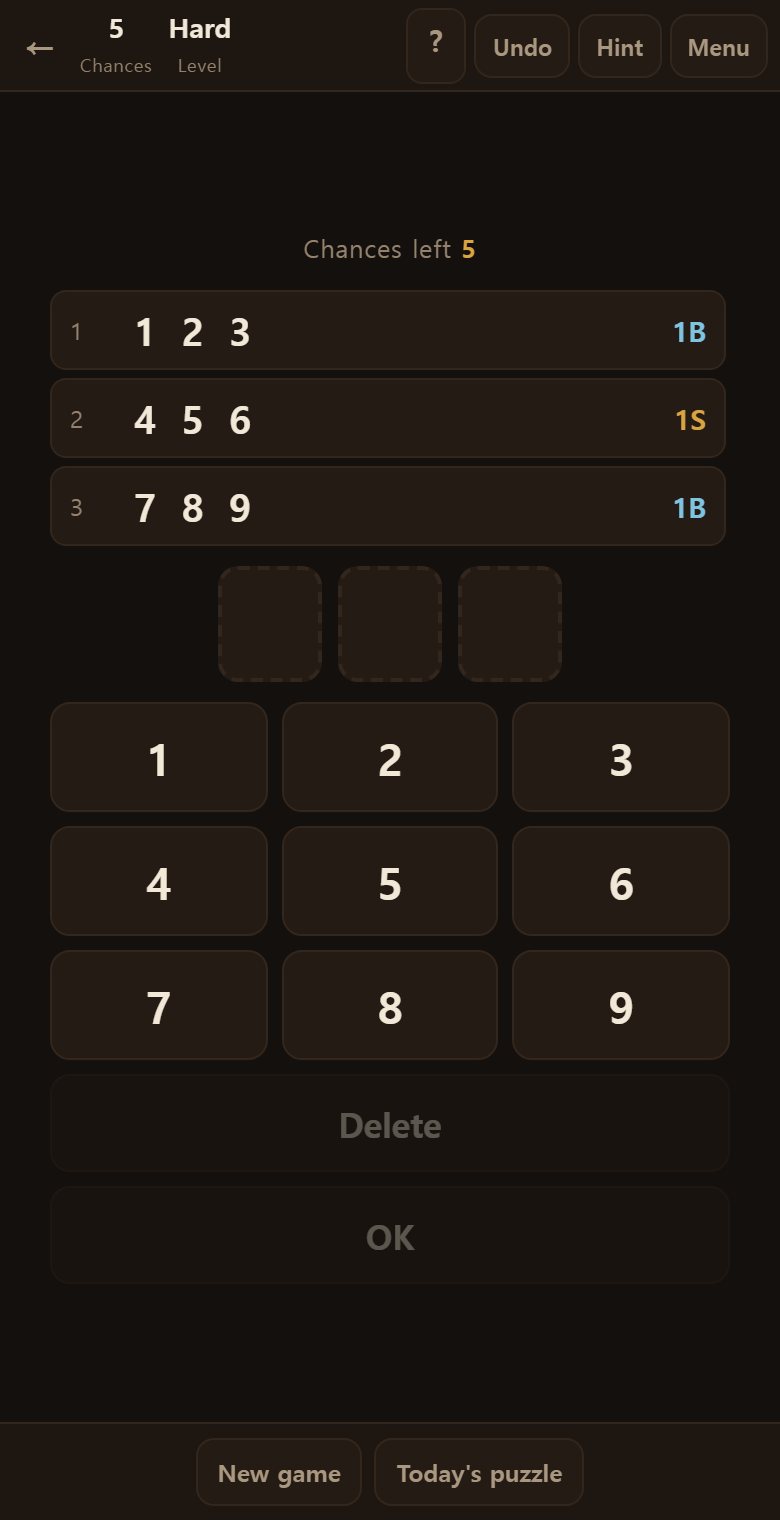
Reasoned properly, three digits fall in five or six calls. The allowance is generous. Down to two or three chances, stop calling for information and call something that fits everything you have heard. With few candidates left, guessing is the better play.
Open wide
At the start you know nothing, so covering as many digits as possible is what pays.
Call 1 2 3, then 4 5 6, then 7 8 9 — three calls sweep all nine.
- The three results must add to 3, since the answer has three digits.
- So two calls are enough — the third group's result follows by arithmetic.
- Settle how many digits each group holds first, and find the order afterwards.
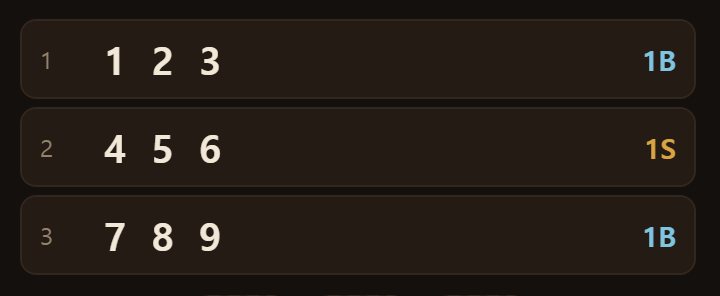
Calls that reuse digits amount to asking the same question twice.
Digits settled? Now rearrange
Once you know which three digits are in the answer, you are halfway. Only the order remains, and there are just six of them.
Now call the same digits in a different order. The number of strikes that comes back tells you about the positions.
- Three strikes and you are done.
- One strike means exactly one is in its place.
- No strikes and three balls means all three are misplaced — which leaves only two possible orders.

Call one of the six and hear the answer, and it usually falls to two — and the next call finishes it.
Strike out the digits that gave an out
Digits that returned an out are never in the answer. Cross them off in your head and the field shrinks sharply.
On Easy that is done for you — such digits are struck through on the keypad.

It merely does bookkeeping you could do from what is already on screen; it gives nothing away. On Normal and Hard, keep track yourself.
Hint
When stuck, press Hint at the top. It gathers every answer consistent with what you have heard and enters one of them into the boxes.
- It also tells you how many consistent answers remain.
- With only one candidate left, it says so.
- It only enters the number; it does not call it. Submit is yours to press.
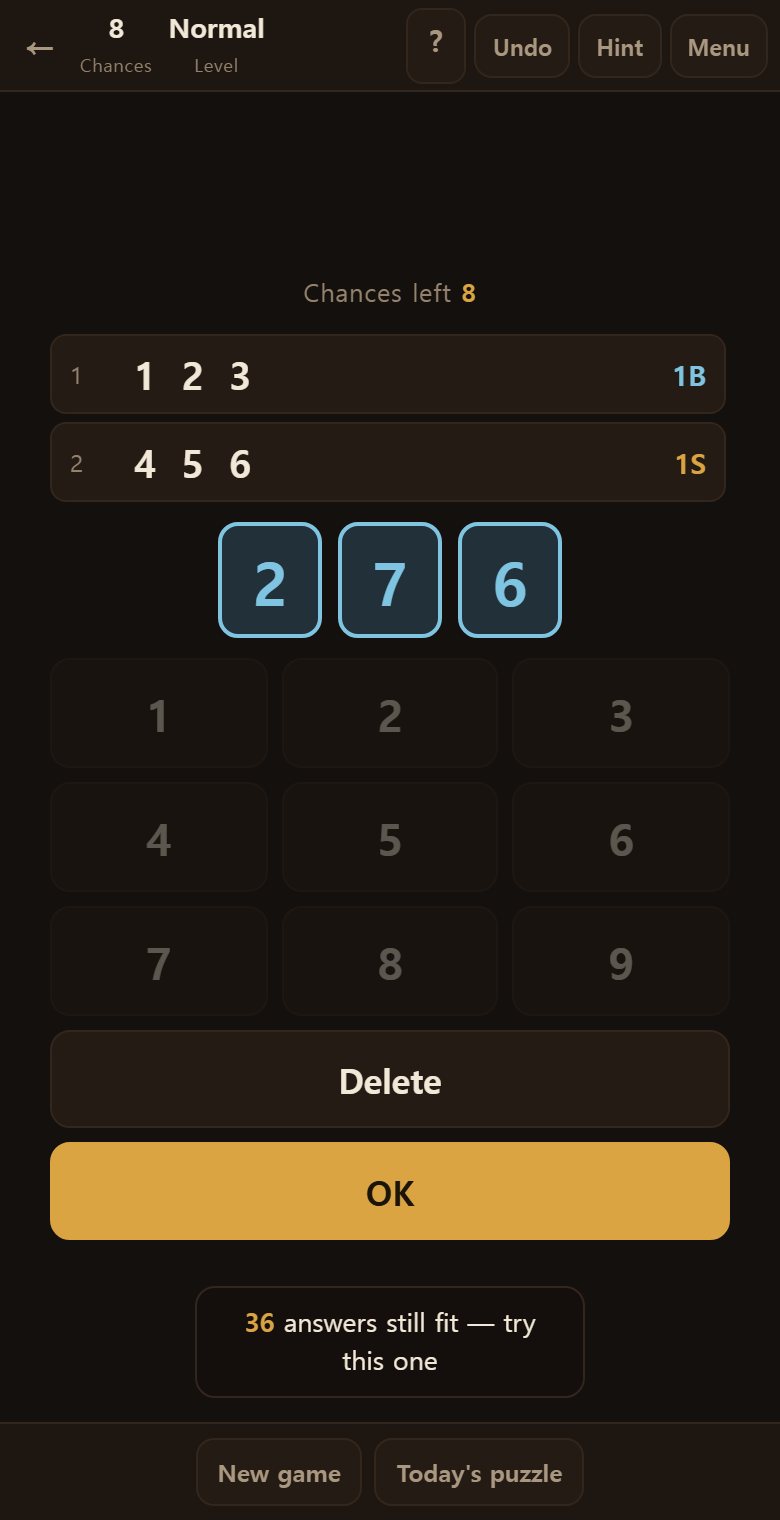
With few candidates it chooses the call that leaves the fewest in the worst case — not simply any of them.
Following the hint alone will solve it
Call whatever the hint enters, every time, and you will always reach the answer — within seven calls, at three digits or four.
If the reasoning has not settled in yet, follow it through one whole game. Watching the candidate count fall teaches a good deal by itself.
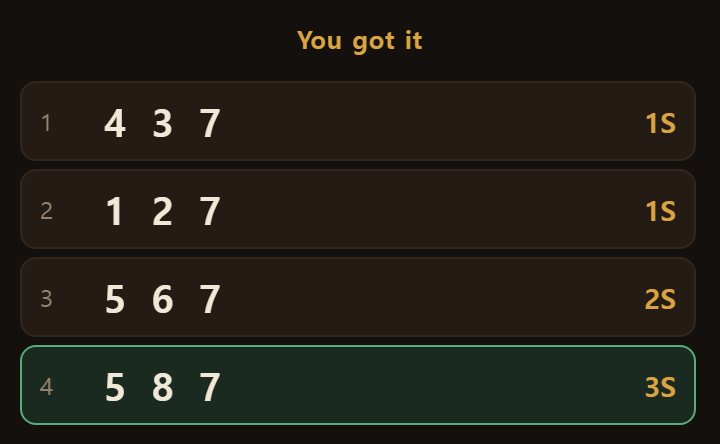
Every puzzle here is solved by the hint alone before it is handed out.
Undo and start over
Undo makes your last call never have happened — for when your hand slips. On a keyboard it is Ctrl+Z.
Start over in the menu clears the history and returns you to the beginning. The answer stays the same.
- Undo — takes back one call, and returns the chance with it.
- Start over — clears every call. The answer is unchanged, so you solve the same puzzle again.
- New game — draws a fresh answer as well.
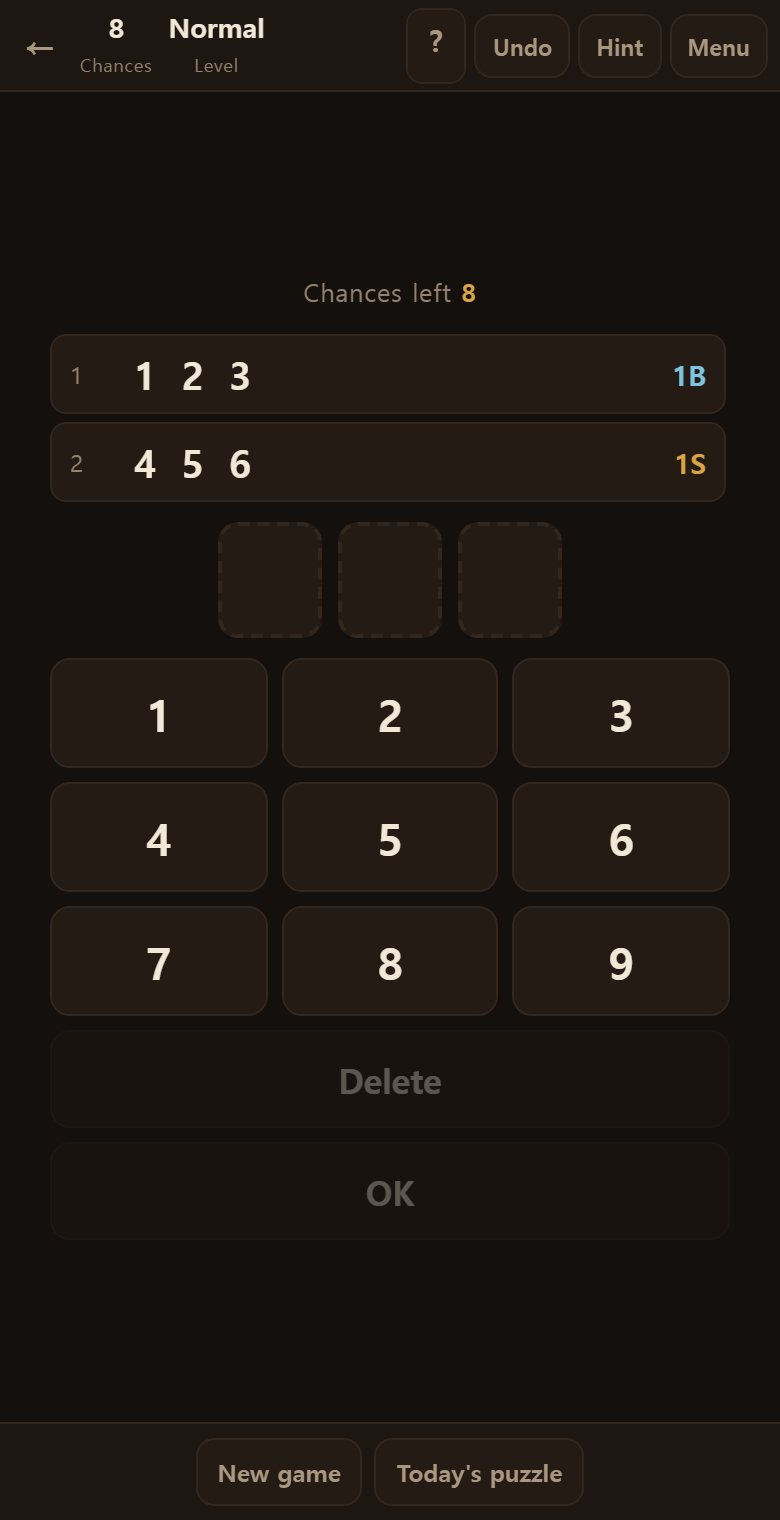
To change the answer too, press New game. Solving the same puzzle repeatedly with Start over shows you how few calls it can be done in. Reasoning backwards while knowing the answer is the fastest way to improve.
Digits and difficulty
Both are set in the menu.
- Three digits — 504 possible answers. The place to start.
- Four digits — 3,024. Each call also tells you more, so it is not as hard as it sounds.
- Easy, Normal, Hard — they differ in how many chances you get.
- Easy also strikes through the digits that returned an out.
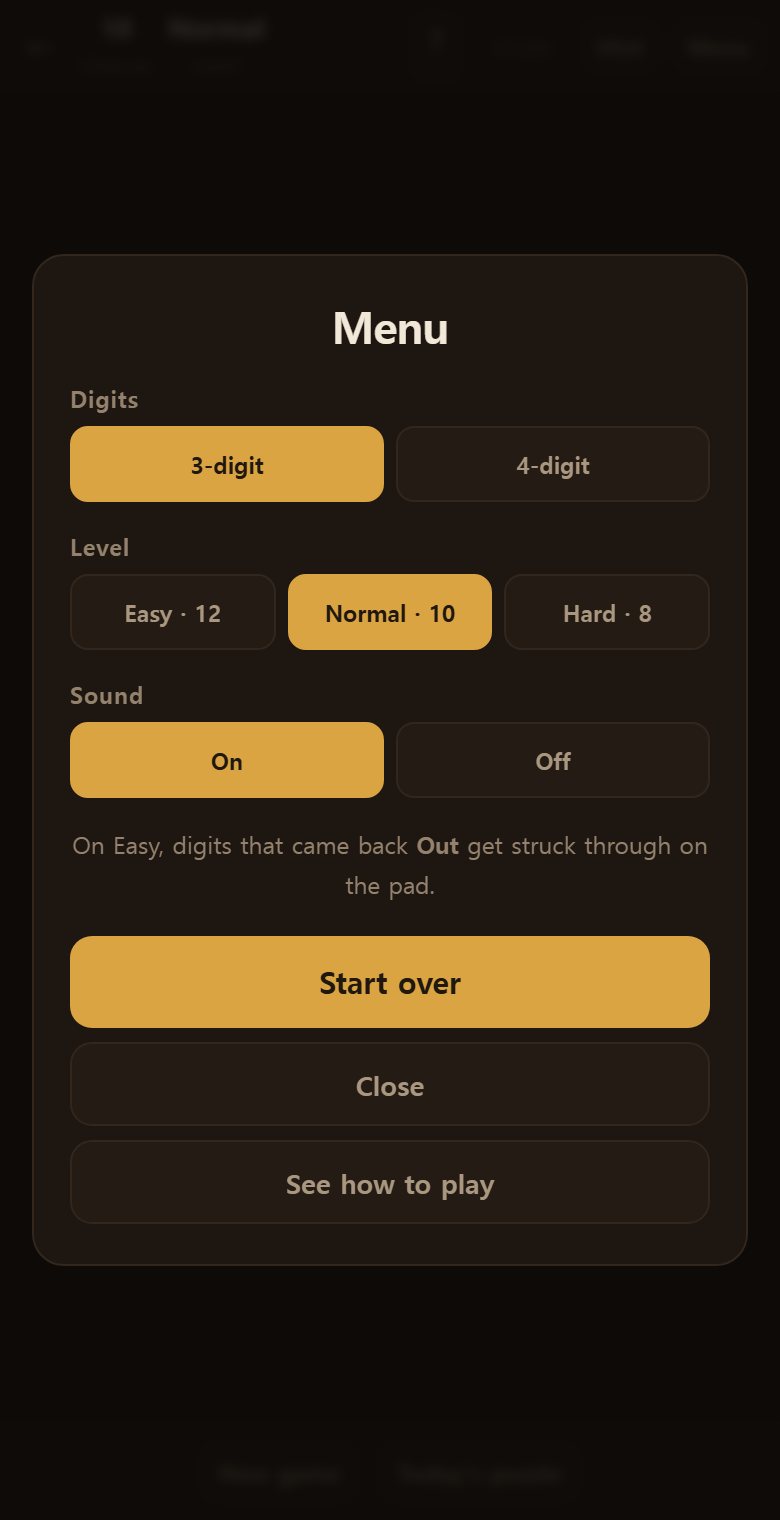
A fewest calls record is kept for each combination of digits and difficulty.
How to win
In this order it usually falls in five or six calls.
- Ask wide with no overlap — 1 2 3, then 4 5 6. Two calls all but sort the nine digits.
- Add strikes and balls to settle how many digits each group holds.
- An out is a gift. Three digits gone at once.
- With the digits settled, ask again in a different order. There are only six.
- Zero balls is a large clue too — none of those digits belongs where you put it.
- When stuck, pressing the hint merely to see the candidate count is worth doing.
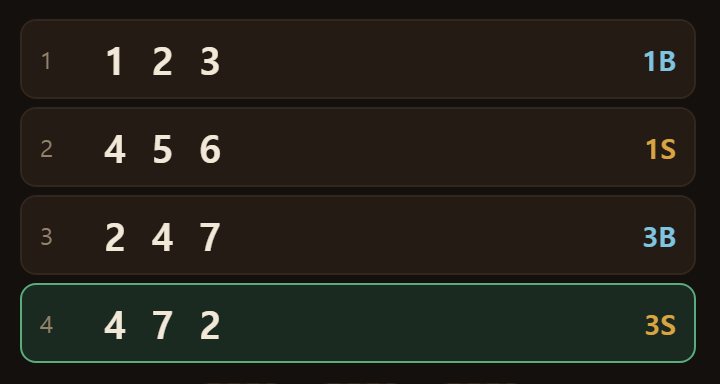
Common mistakes
Chances are thrown away here in one of four ways.
- Calls that reuse digits — following 1 2 3 with 1 2 4 teaches you almost nothing new.
- Not adding strikes and balls — miss that the sum is the digit count and you throw away half the information.
- Passing over an out — it is the most informative answer there is.
- Guessing at the order once the digits are known — there are six. Narrow them by ruling out the orders that returned no strikes.
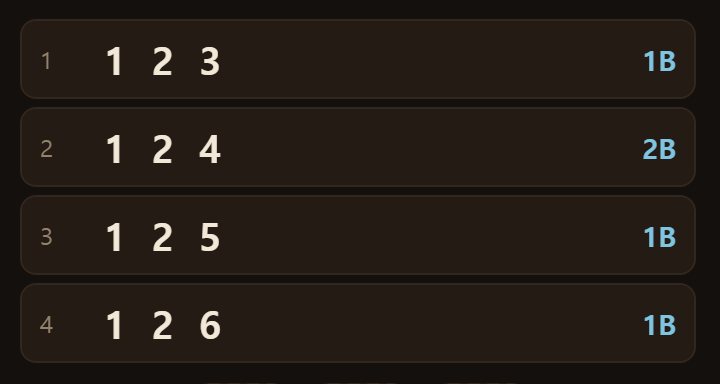
And one more: do not try to call a number you have already called. It is refused — but the attempt itself means you have lost track.
Getting it, and not getting it
As many strikes as there are digits ends it there. You are told how many calls it took, and a new best is kept.
Run out of chances and the answer is revealed. Reading back through your calls shows where the reasoning went astray.

Copy link sends the same puzzle to someone else. The answer itself is not written into the link.
Common questions
No. The answer is built from 1 to 9 only, which is why the keypad has no 0.
No. Neither the answer nor your calls may repeat a digit.
How many of the digits you called are in the answer — the most useful piece of arithmetic in the game.
Not at all — it is the best answer going. Three digits are ruled out at once, which narrows things considerably.
Anything will do — 1 2 3, say. What matters is that the next call does not overlap: 4 5 6, then 7 8 9.
There are six orders. Call one and read the strikes, and it usually falls to two — and the next call finishes it.
No. It enters a number consistent with what you have heard, and no more. Calling it is up to you.
It is refused, since the same answer would come back and a chance would be wasted. But a rearrangement is a different number and may be called.
The answer is not written into the link. It carries only the seed, from which the other end rebuilds the same puzzle.
- Open wide with digits that do not overlap — 123, then 456.
- An out is the biggest clue there is. It rules out several digits at once.
- Strikes plus balls is how many of your digits are in the answer.
- Call the same digits in a different order and you can work the places out.
- The hint also tells you how many answers are left. Watch how far it has narrowed.