 MindHub
How to play Sudoku
Fill a 9 × 9 grid with the numbers 1 to 9. No number may appear twice in any row, any column, or any 3 × 3 box. That single line is the whole rule; everything else is working it out. This is not a guessing game.
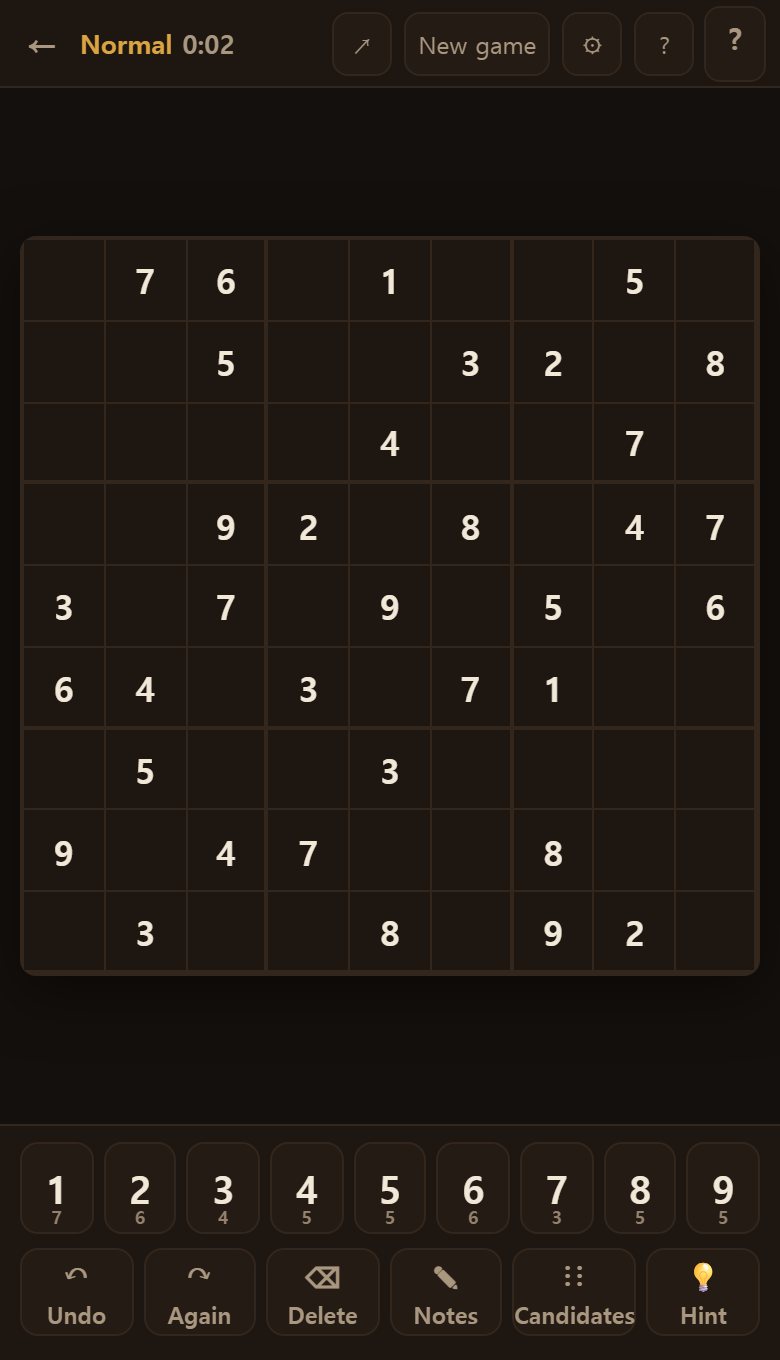
First, look at the screen
There is one square grid, with a number pad below it. To begin with, that is all you need.
- The thick lines — they split the grid into nine pieces. One piece is called a box.
- The bright numbers — these were there from the start. They cannot be erased.
- The number pad below — 1 to 9. Pick a square first, then press a number here.
- The buttons under the pad — Undo, Redo, Erase, Notes, Candidates, and Hint.
- The top bar — your time, how many squares are left, and the difficulty.
The first time you open it, you start on Easy. Press New board at the top to choose a difficulty.
The rule is a single line
Fill the empty squares with 1 to 9, but no number may repeat in three places.
- In a row of nine squares, 1–9 once each
- In a column of nine squares, 1–9 once each
- In a 3 × 3 box of nine squares, 1–9 once each
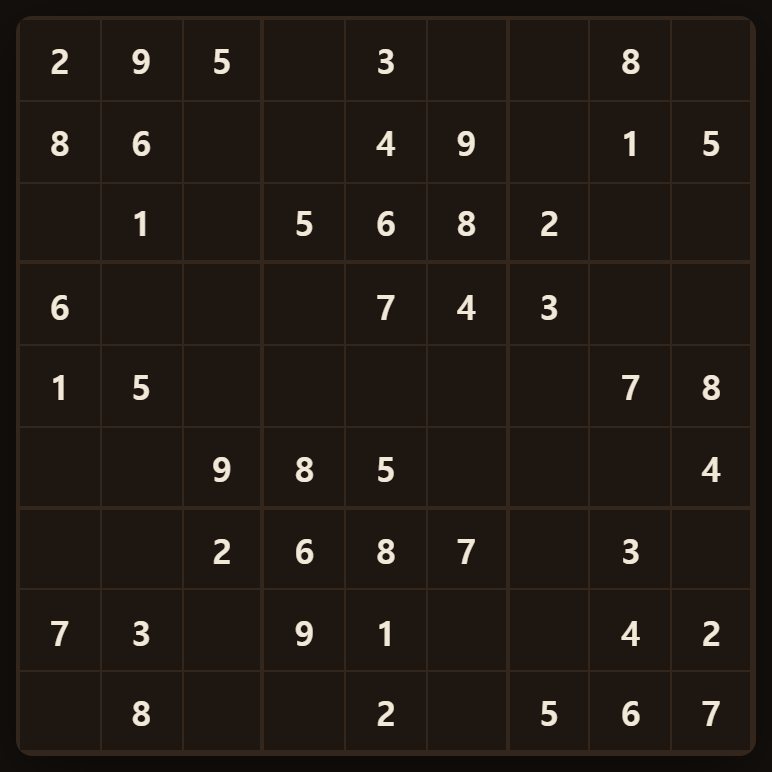
So to know what can go in a square, just look in three directions. Sweep across the row, sweep down the column, and check the box the square sits in. That is all there is to it.
Pick a square, then press a number
Tap an empty square once and it lights up. With it lit, press a number on the pad below and the number goes in.
- The same row, column and box as the chosen square tint faintly. Where to look shows itself.
- Put the wrong number in? Press the same number once more and it comes out.
- The Erase button clears it too.
- On a computer you can move with the arrow keys and type with the number keys.
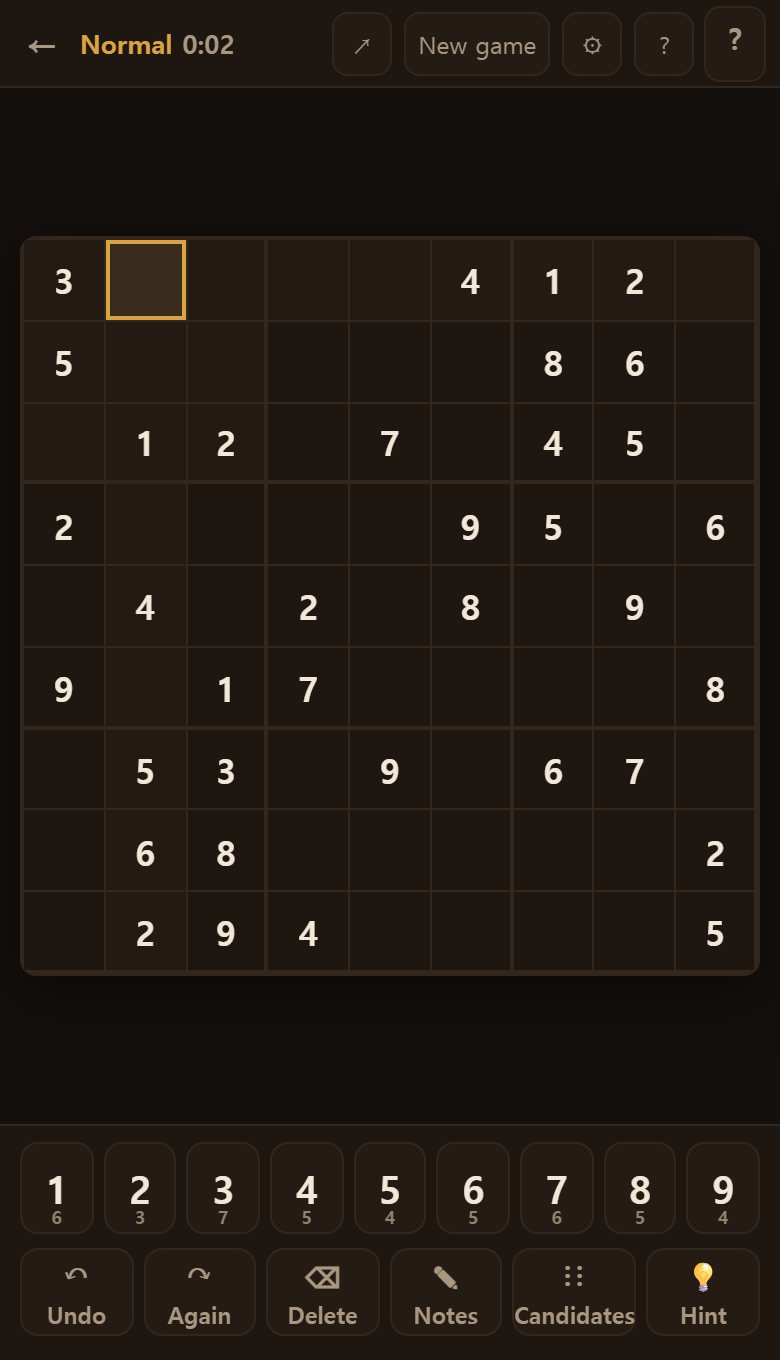
The numbers that were there from the start do not change when pressed. They are the skeleton of the board.
See every copy of a number at a glance
Tap a square that holds a number and every matching number on the board tints.
This is the most used eye in sudoku. Tap a 7, say, and all the 7s stand out — and you can see, as a picture, that no more 7s can go in those rows, columns and boxes.
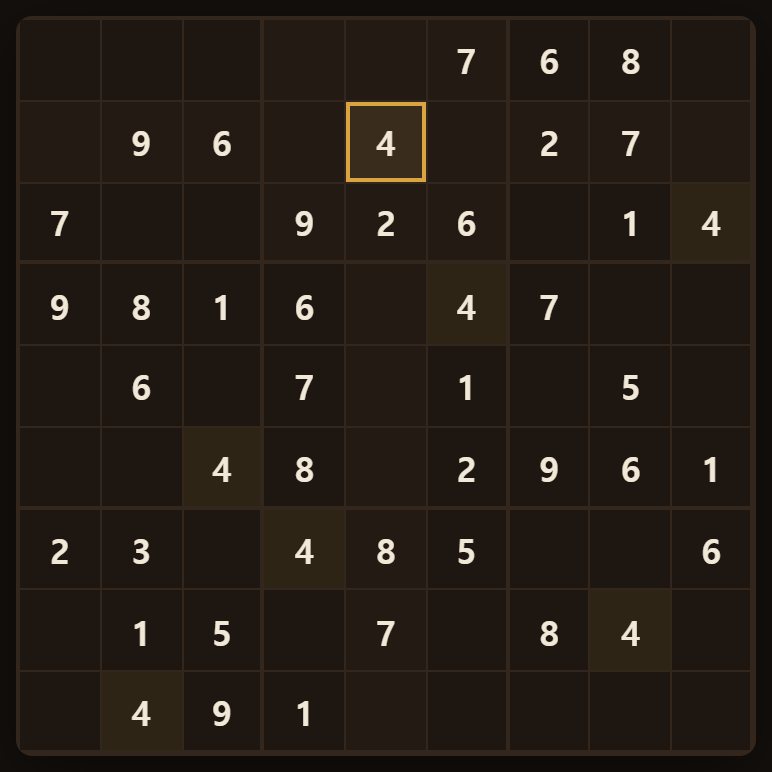
This is how you answer “where does the 7 go in this box?” Tap a 7, look at the box, and very often only one place is left.
Reading the number pad
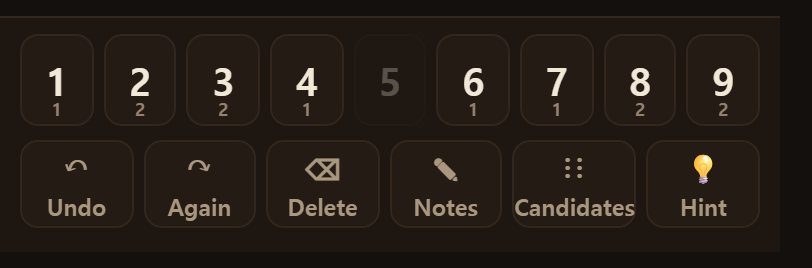
Each key on the pad carries a small figure telling you how many are left.
- A small 2 beside the 7 means two more 7s still have to go on the board.
- A number you have finished placing fades. You will not need it again.
- Filling in the numbers with fewest left first is far quicker.
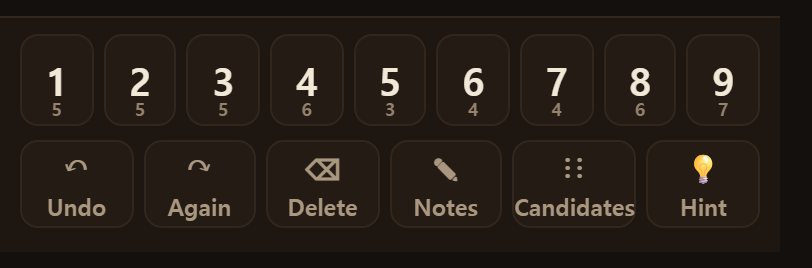
This is what separates a beginner from an old hand. The old hand does not look at the empty squares — they look first at the number with fewest left.
The easiest method — only one left
Sometimes exactly one number can go in a square. Then that is the answer.
Sweep the square’s row, column and box, and cross off the numbers already there. Once eight are crossed off, the one left is the answer.
- Start with the fullest rows. There is more to cross off, so it narrows fast.
- The same goes for the fullest boxes.
- This method alone solves nearly all of an Easy board.
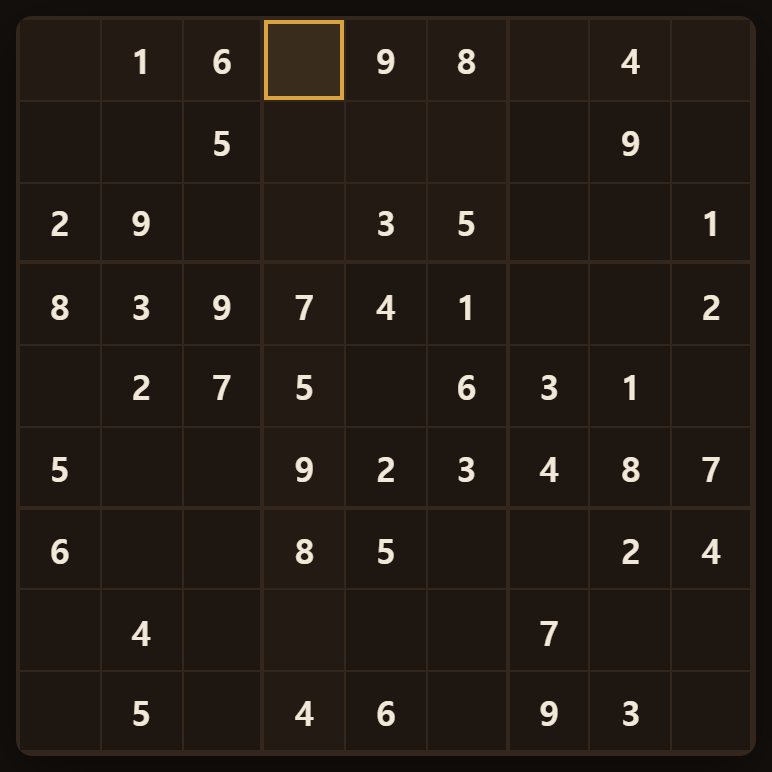
It works the other way round too — “in this box there is only one square where a 7 can go” is just as good an answer. Narrow from square to number, and from number to square; use both.
Look at box and line together
When square-by-square runs dry, take a whole box at once. This is the most-used method in sudoku.
Say a box has no 7 yet. It might have four empty squares. Now look at the three rows and three columns that pass through it. Wherever one of those lines already holds a 7, no 7 can go in the squares that line passes through.
- A 7 in a row rules out the three squares that row crosses, all at once.
- Columns work the same way, ruling squares out up and down.
- When only one square is left after the crossing off, that is where the 7 goes.
- Tap a square with that number first so all its copies tint — it shows up far faster.
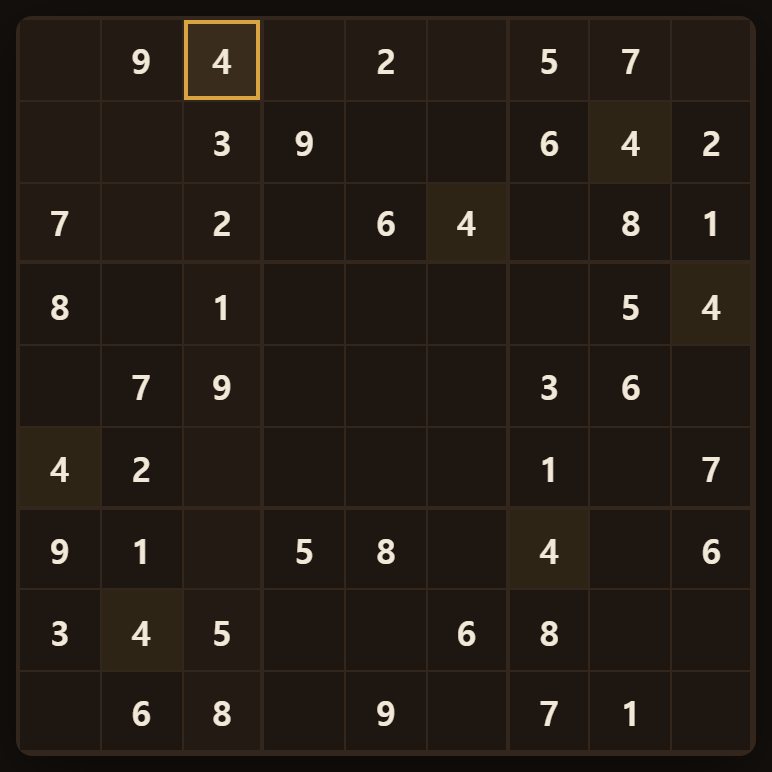
This is called crossing off by line. Run 1 through 9 against a single box and one or two placements almost always fall out.
Squares down to two are useful too
Some squares narrow to two candidates rather than one. Do not leave those alone either.
If a row holds two squares that are each “3 or 7”, those two squares share the 3 and the 7 between them. Which means no other square in that row can hold a 3 or a 7.
- You only see this if you write notes. Doing it in your head, you miss it.
- When you spot such a pair, cross both numbers off every other square in that line.
- After crossing off, another square often narrows to one.
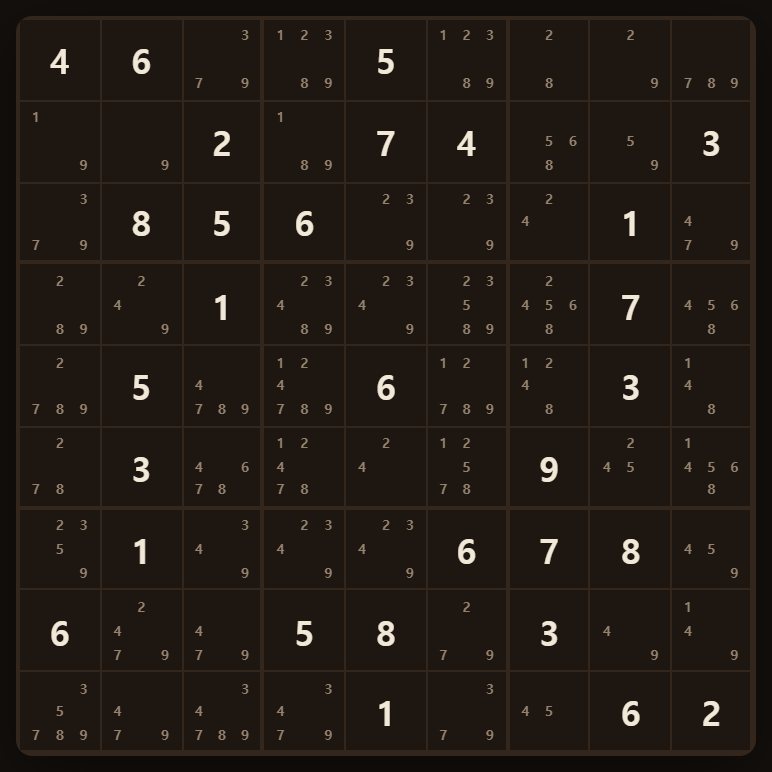
From Hard upward, boards rarely fall without this. The harder the board, the more notes are essential.
Writing candidates as notes
Trying to hold it all in your head wears you out fast. Turn the Notes button on and pressing a number writes it small inside the square.
- You can write several notes in one square — “3 or 7 here”, for instance.
- With Notes on, pressing the same number again rubs it out.
- To enter a real number, turn Notes off first.
- While Notes is on, the Notes button below turns gold.
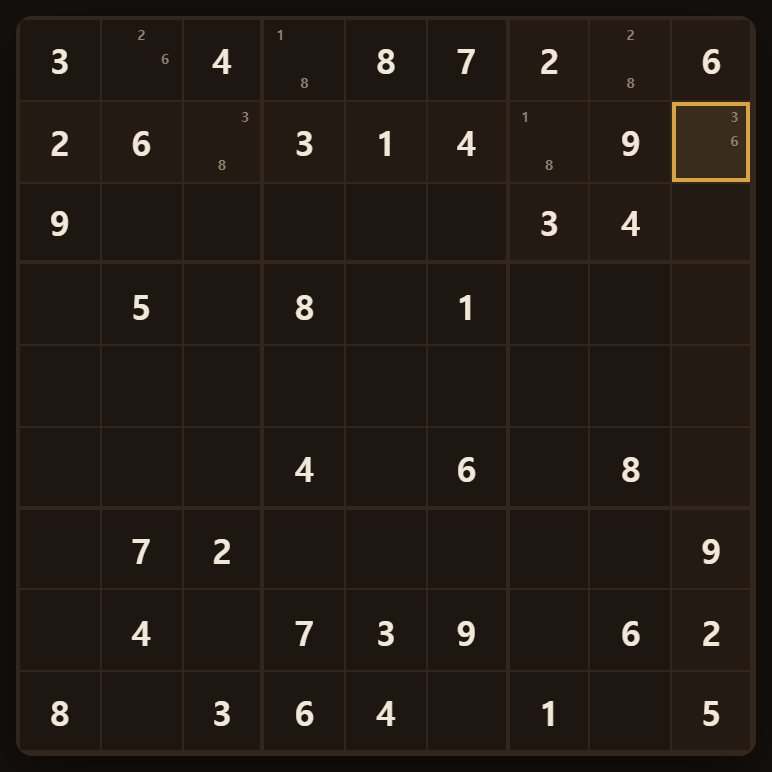
A note is not an answer, it is your thinking. Nothing happens if it is wrong. Write freely.
Fill in the candidates all at once
With many squares empty, writing notes one by one is tedious. Press the Candidates button and every empty square is filled at once with the numbers the rules currently allow.
- This does not tell you the answer. It only does the sweeping of rows, columns and boxes for you.
- Squares with only one candidate jump straight out. Start there.
- Put one number in and the candidates along that line shrink by themselves.
- Press it again to clear them.
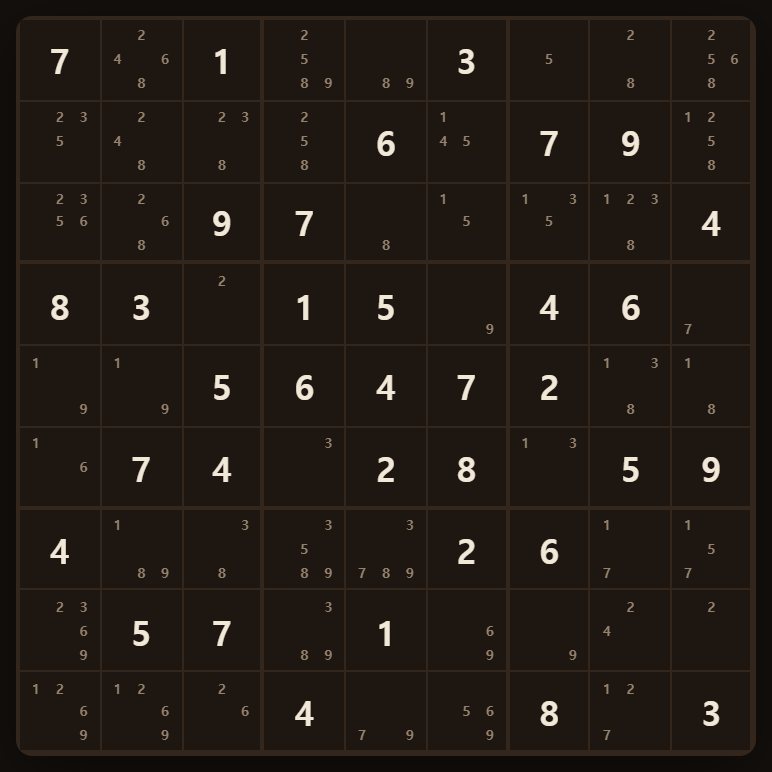
On a hard board it is far easier to start with this on. Save the sweeping time and spend it thinking.
What it looks like half filled
The numbers you enter are a different colour from the ones that were there at the start, so you can see at a glance how far you have got.
The fuller the board, the easier the rest becomes. A square that looked hopeless at first solves itself once its neighbours fill in.
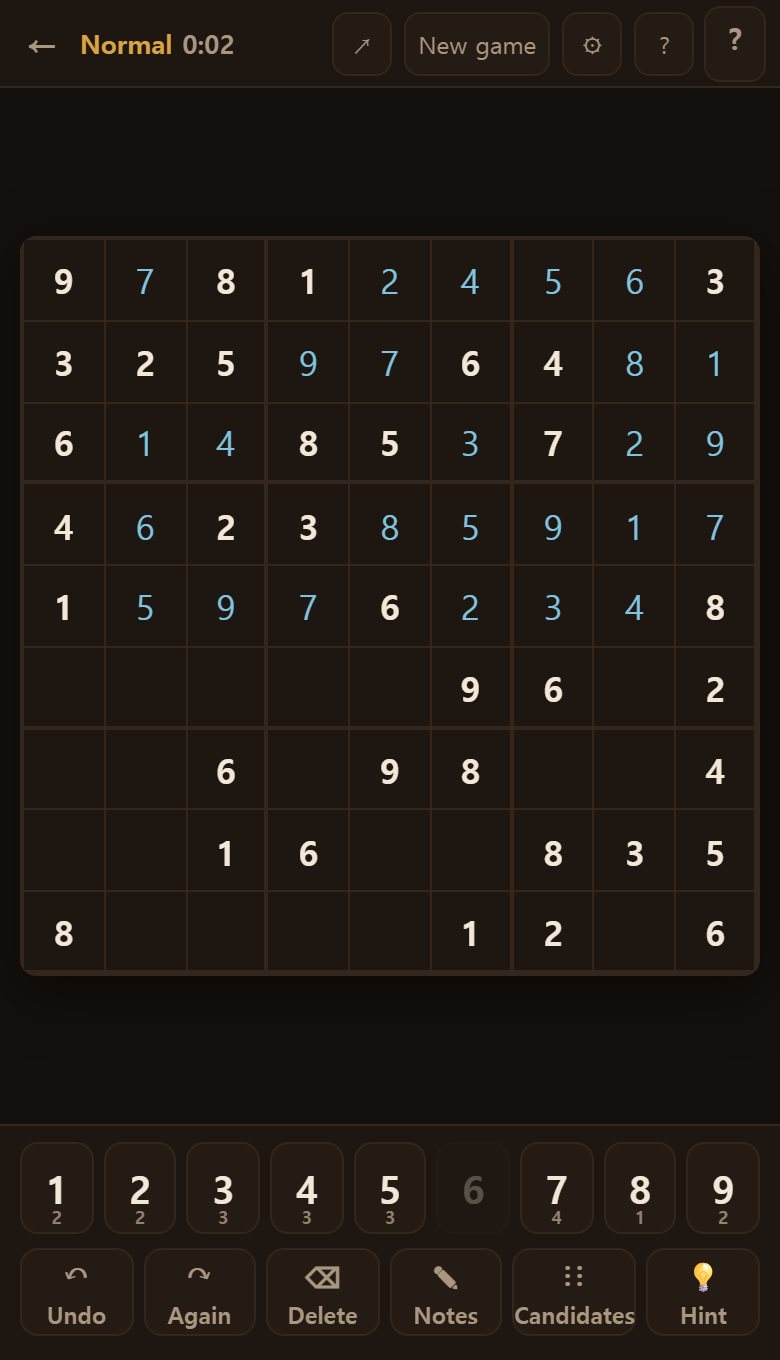
So when you are stuck, look elsewhere. Filling the easy places first and coming back beats staring at one square.
You are told at once if it is wrong
Enter a number that breaks the rule and the square turns red.
Knowing the moment you enter it beats filling the whole board and only then being told “something is wrong somewhere.”
- Erase the red square and think again.
- You can also step back with Undo, as many times as you like.
- You can switch this marking off in settings — for people who would rather find it themselves.
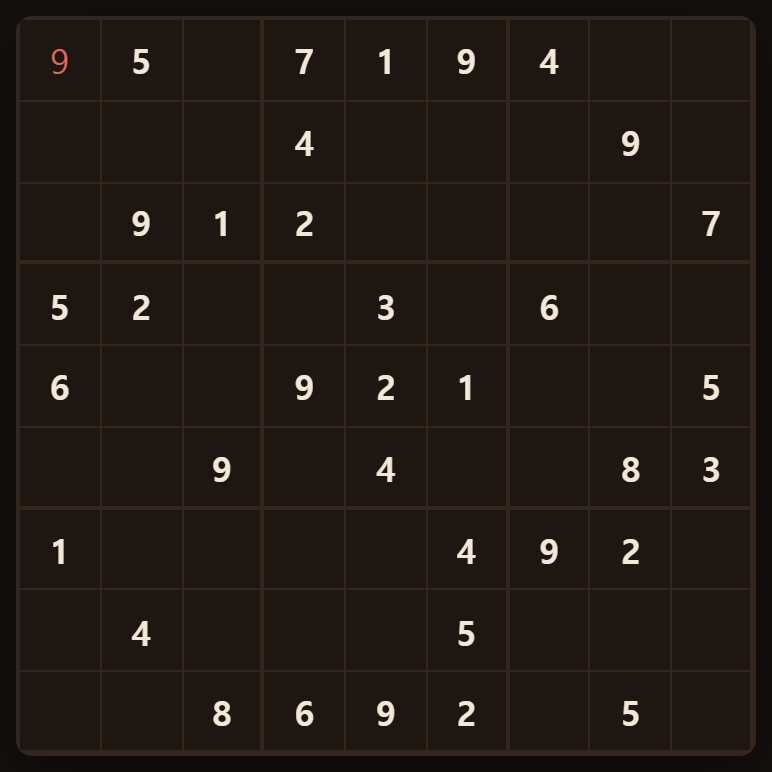
A red square means that square is wrong, not that everything before it is. Just fix that square.
Stuck? Take a hint
Press Hint below and it points out one square that can be known for certain right now.
It does not hand you the solution. It points only at what the rules already give you, and tells you why.
- It comes with a reason, such as “only a 3 can go here.”
- Read the reason and next time you will find it yourself.
- A board where you took a hint does not count for a best time. In exchange, use hints freely.
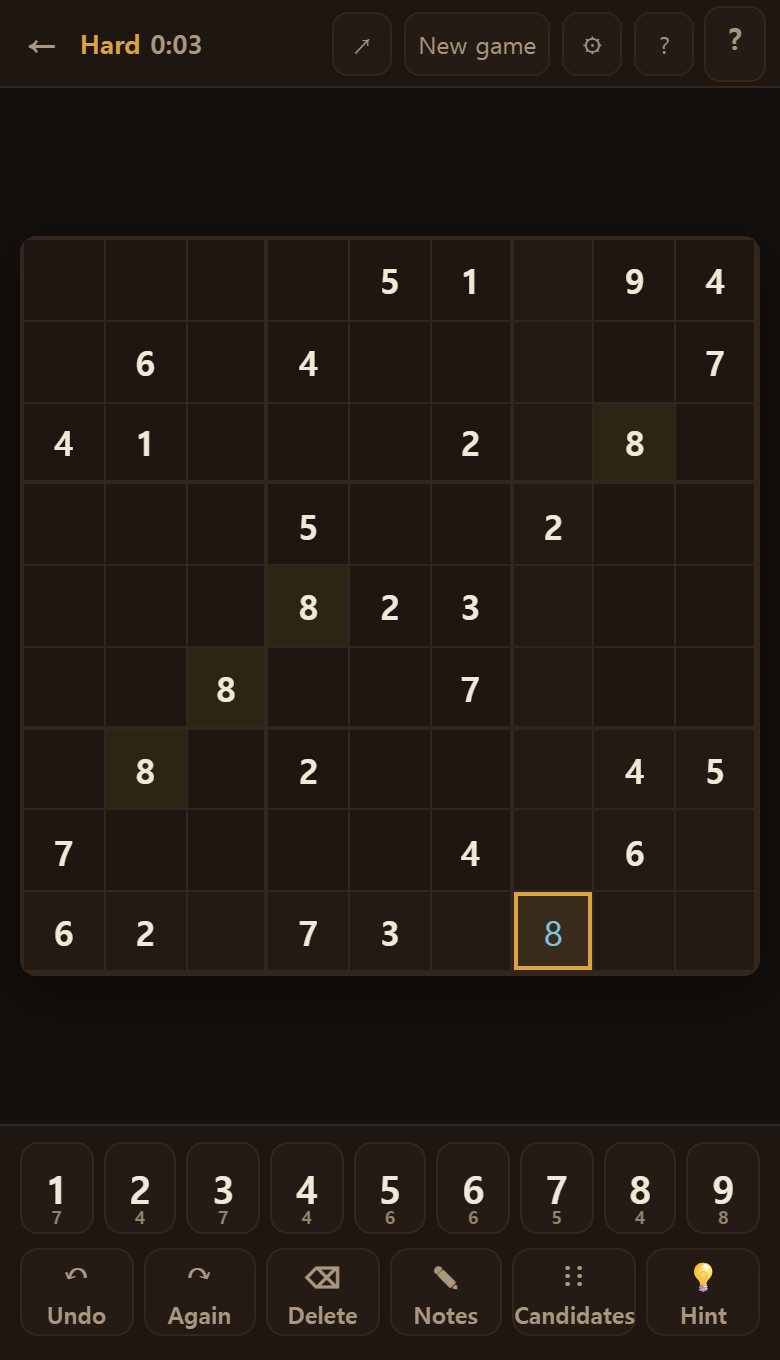
There is nothing to be ashamed of. Early on, learning the shapes the hints point at is the quickest way in.
Only boards that never need a guess
Not every sudoku board is the same. More places than you would think mix in boards with two solutions, and those force a guess at the end.
Here, before a board is dealt, we count that it has exactly one solution. If there is more than one, the board is thrown away and built again.
- That brief “checking” message when a new board is made is this work.
- So if you are stuck, it is not a place to guess — there is a clue you have not spotted.
- Press Hint and you will find out what that clue is.
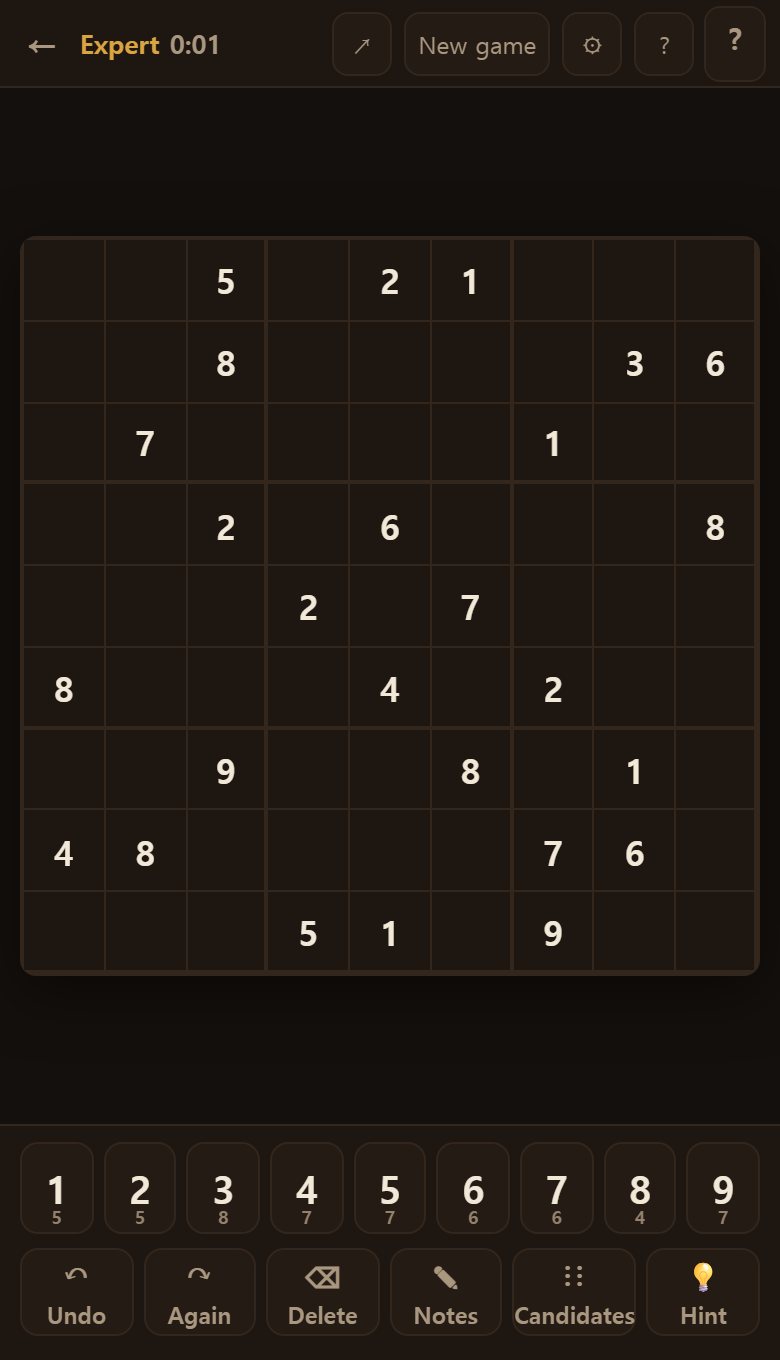
This is where this site differs from the rest. If you lose, it is not the board’s fault — there is something you have not seen yet.
How the difficulties differ
Press New board at the top to choose a difficulty. What changes is how many numbers you start with and how far up the methods you have to go.
- Easy — “only one left” alone solves nearly all of it. Start here if you are new.
- Medium — places appear where you must read box and line together.
- Hard — you must write candidates down and narrow them. Use notes.
- Very hard — you will need to read two squares as a pair. It takes time.
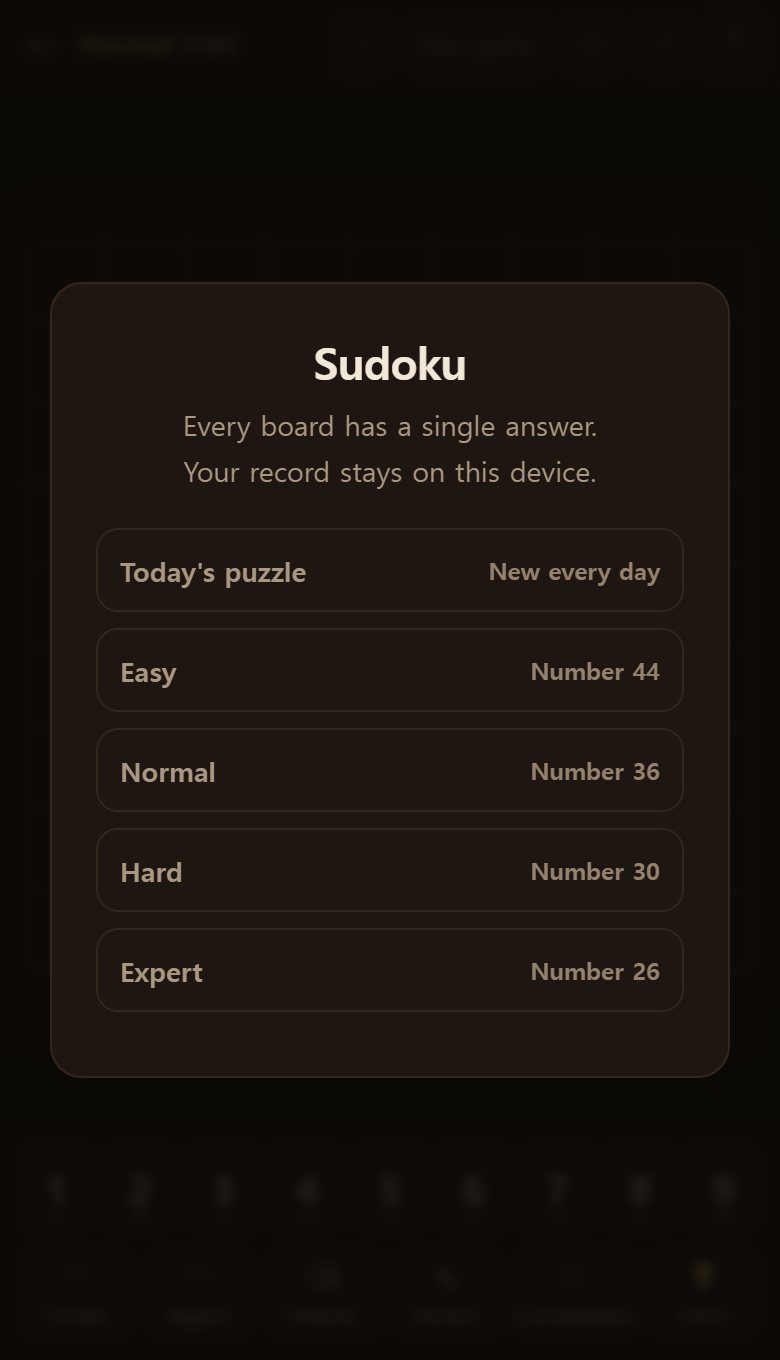
At every difficulty, no guess is ever needed. A hard board simply asks for a harder method; it is never decided by luck.
Today’s puzzle
Each day has one set board. Everyone who opens it gets the same one.
You can race a friend on it. Press ↗ at the top to copy this board’s link.
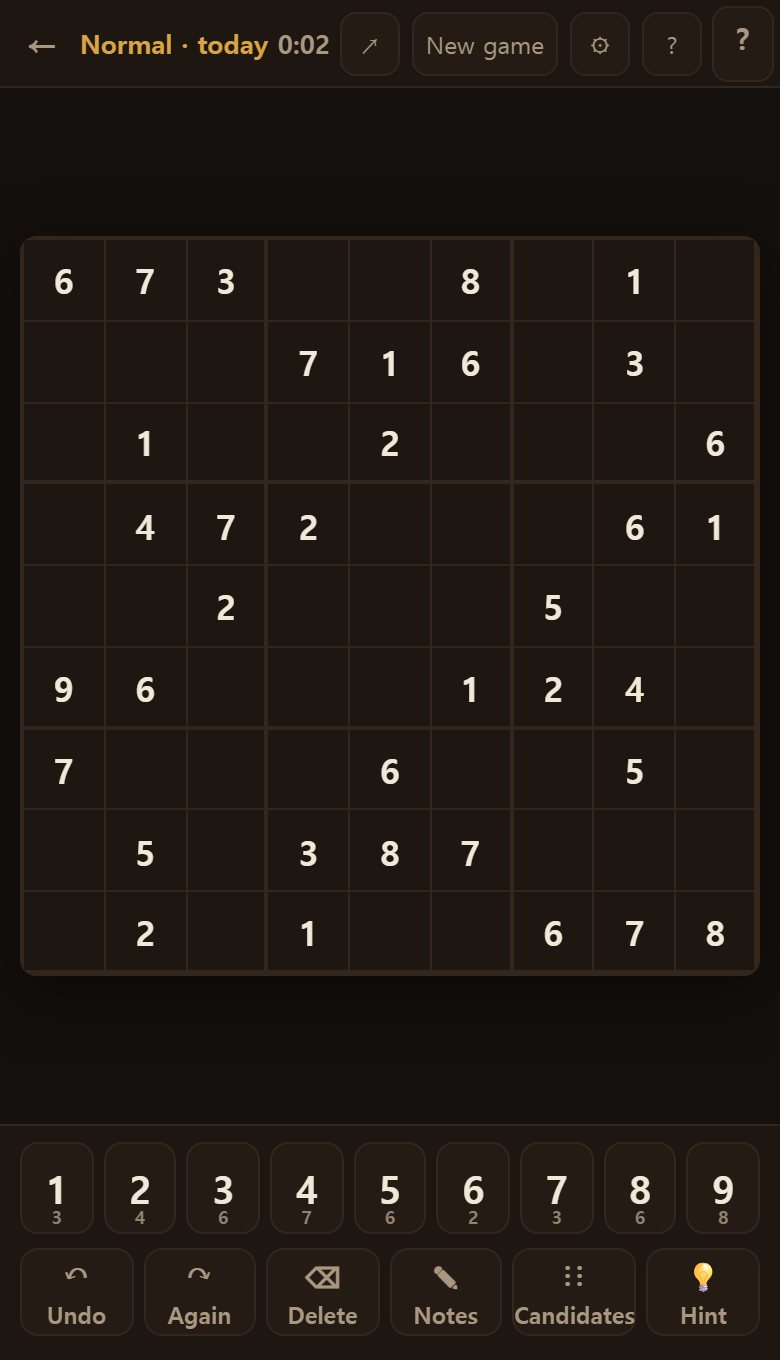
Open the copied link and the very same board appears. It need not be today’s puzzle — you can pass on whatever board you are on.
How to get good
Change just a few habits and your solving time halves.
- Pick one number and sweep the whole board with it — hunt “where the 7 goes” through all nine boxes.
- Start with the number that has fewest left. The pad tells you how many that is.
- Look at the fullest rows and boxes first. More to cross off means faster narrowing.
- Do not stare at one square. Fill in elsewhere, come back, and it solves itself.
- On hard boards, start with Candidates on. Save the sweeping time for thinking.
Fast solvers are not quicker thinkers — they have a fixed order of looking. Those five are that order.
Common mistakes
People who get stuck nearly all get stuck in the same places.
- Only looking at boxes. If the box does not show it, look along the lines. All three — row, column, box.
- Not using notes. Do a hard board in your head and you will work out the same square ten times over.
- Not clearing notes. Once a number goes in, rub it out of the notes along that line.
- Guessing. These boards never need it. If you guessed, there is a clue you have not spotted.
- Clinging to one square. If it will not solve, its turn has not come yet.
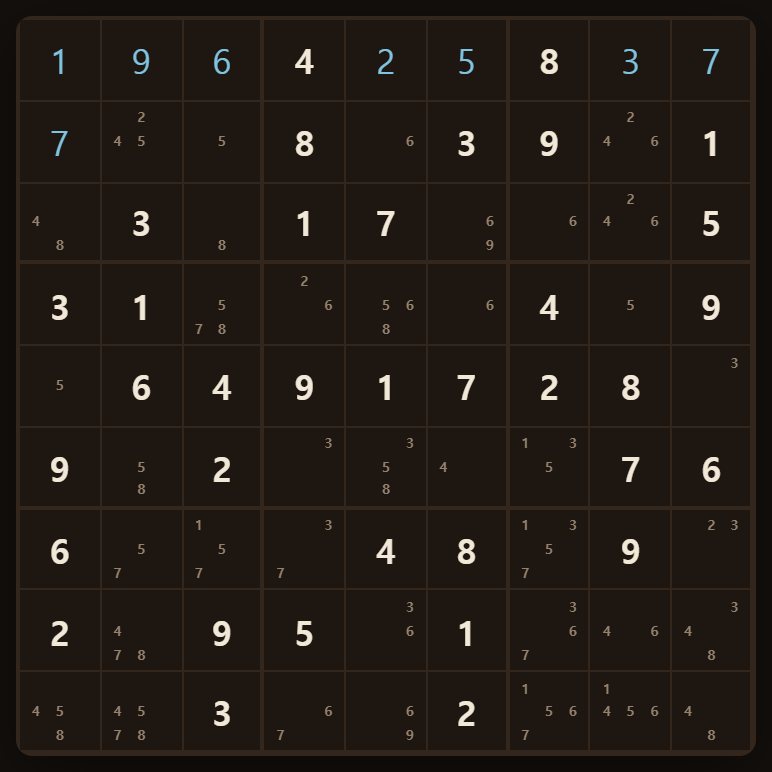
The third matters most. Notes left uncleared mean you reason from candidates that are no longer true, which confuses you further.
When you finish
Fill the last square and the board brightens in a ripple to finish. Your time and the number of hints used appear together.
A best time is kept separately for each difficulty. Boards where hints were used do not count.
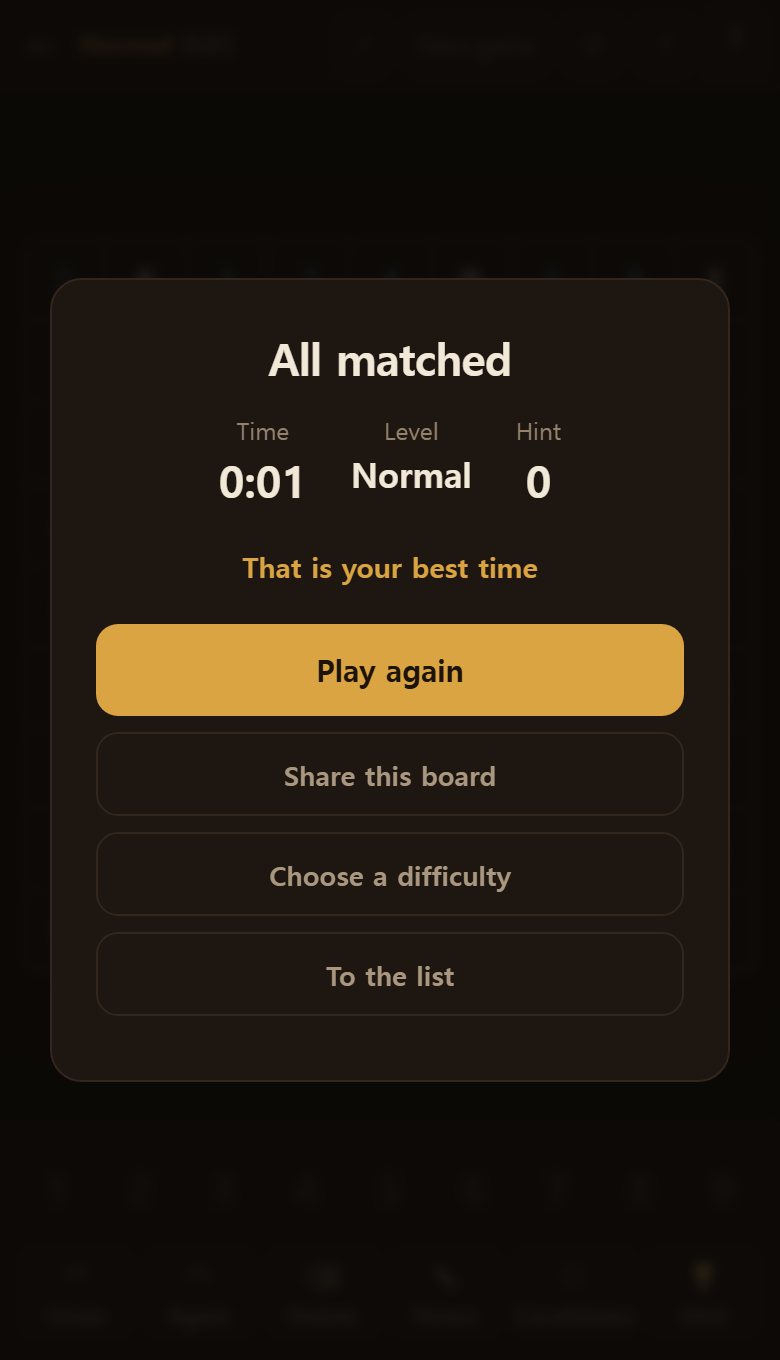
Records stay on this device only. You can clear them in settings.
Common questions
You have to tap the square first, then the number. The bright numbers from the start never change.
That number is already in the same line or box. Erase it and look again.
Press Notes below to turn it on, then press a number and it is written small. Turn it off and numbers go in for real again.
No. It only does the sweeping of rows, columns and boxes for you. It never says which one is the answer.
Never. Every board is counted for a single solution before it is dealt. If not, it is thrown away and built again.
Only in that the board will not count for a record. Early on, learning the shapes hints point at is the quickest way.
It does not disappear. Open it again and Continue appears. It is kept on this device only.
Press ↗ at the top to copy this board’s link. Opening that link gives exactly the same board.
Turn on Notes and Candidates. A hard board is not solved in your head — it is solved by writing as you go.
- Start by finding squares where only one number can go.
- Then work the other way — a line where a number has only one square left to sit in.