 MindHub
How to play Drop and stack
A game of sliding and spinning the pieces that fall from above. Fill a line and it clears; stack to the ceiling and it's over. Pieces start at three squares — chunky jelly pieces that kids pick up in no time. Once you're comfortable, switch to five squares for a harder game.
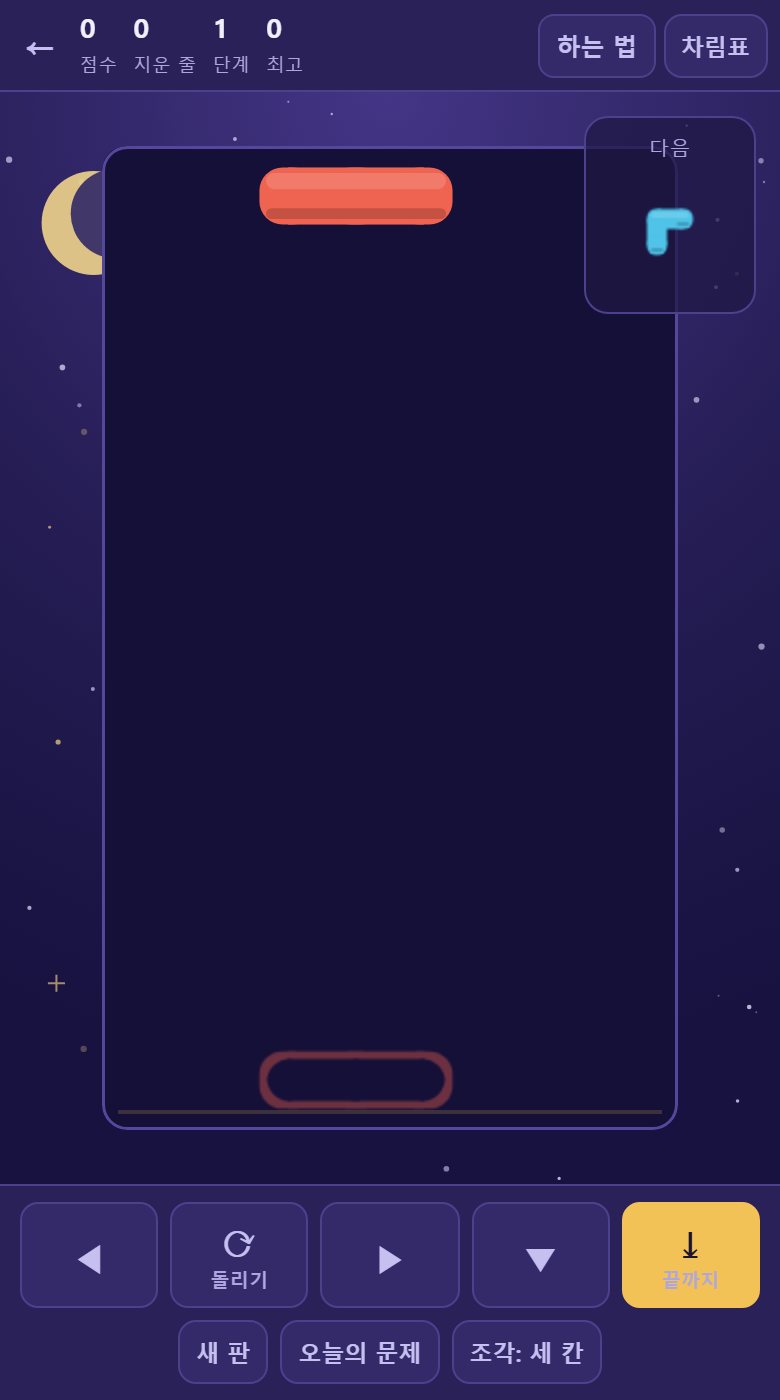
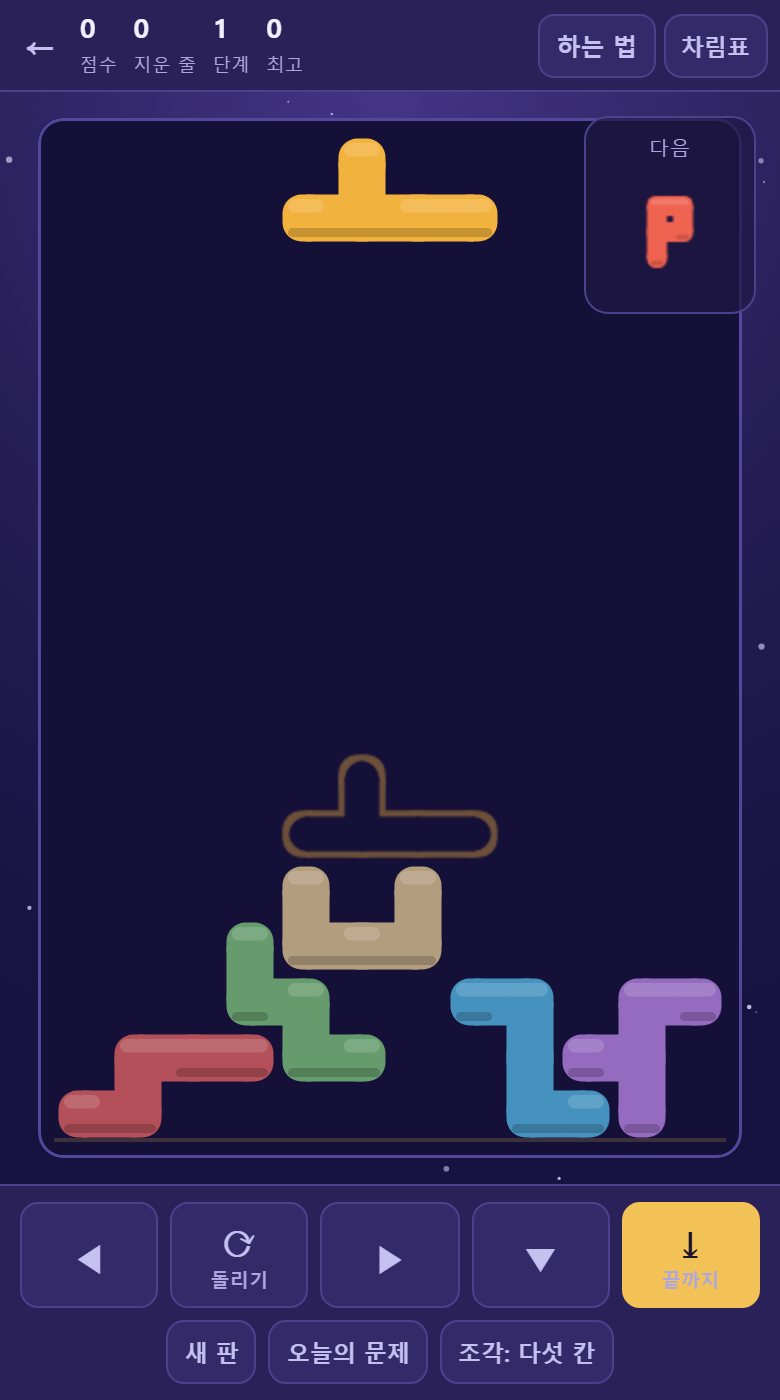
Start with the screen
Under the night sky sits one tall board. Pieces fall from the top of it.
- The board in the middle — where pieces fall and stack.
- The numbers at the top — score, lines cleared, level, and your best.
- 'Next' at the top right — a preview of the piece coming after this one.
- The buttons below — new game, daily board, and piece size.
The gold line at the very bottom is the floor; pieces stack up from there. The stars and crescent moon are decoration — same board number, same sky, no effect on play.
Pieces start at three squares
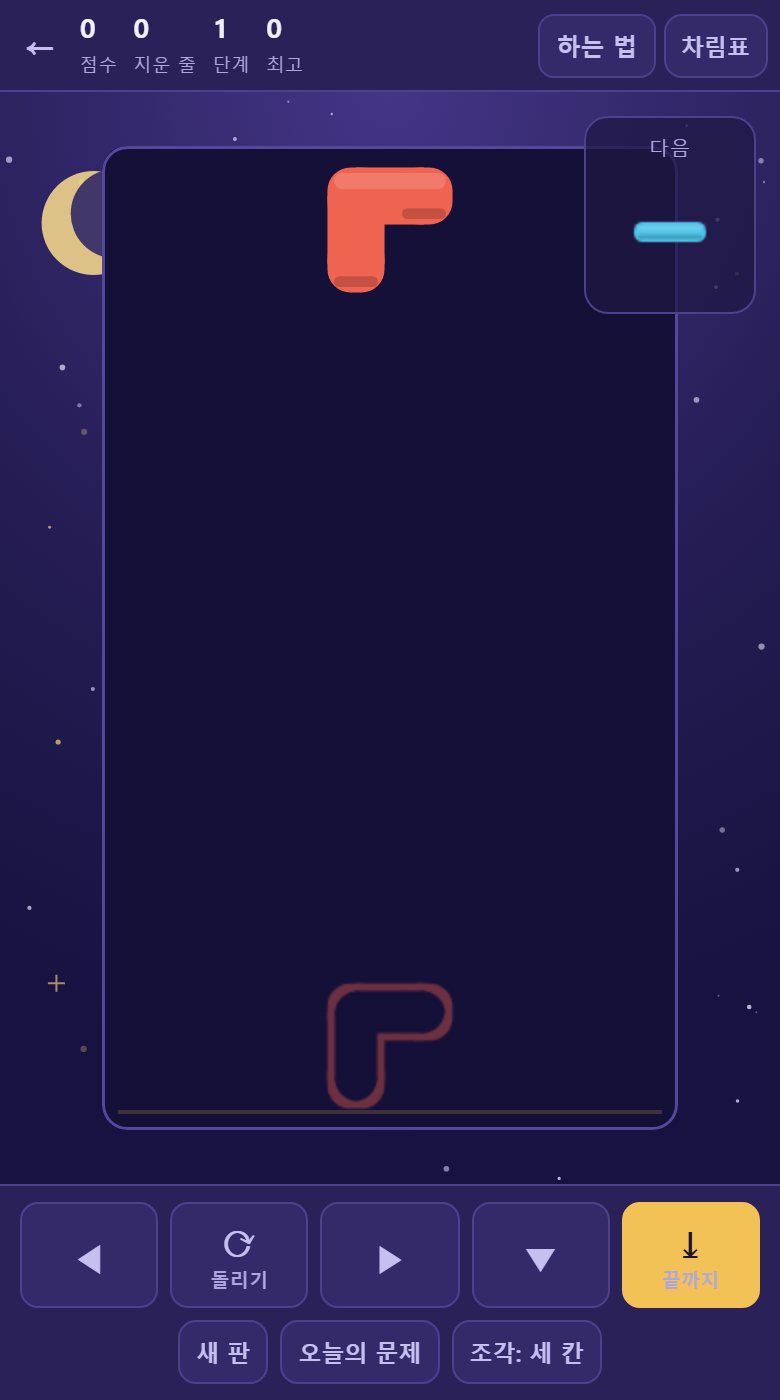
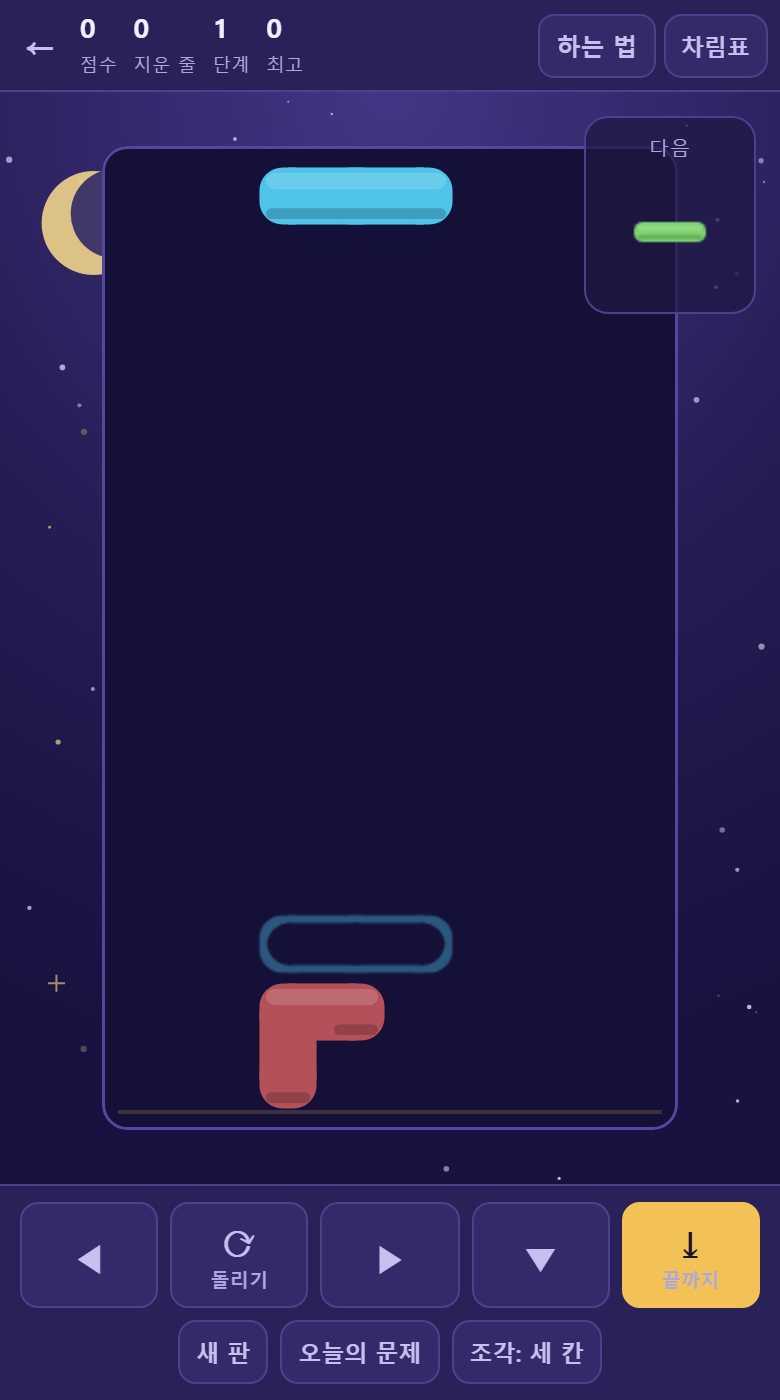
The default pieces are two three-square shapes — a long bar and an L. With so few kinds there's nothing to mix up, and the chunky pieces make it obvious where they fit.
- The bar — three squares wide lying down, three tall standing up.
- The L — spins to face four ways. Great for filling corners.
- Each piece takes the next colour in turn. Colours are decoration — they don't affect the rules.
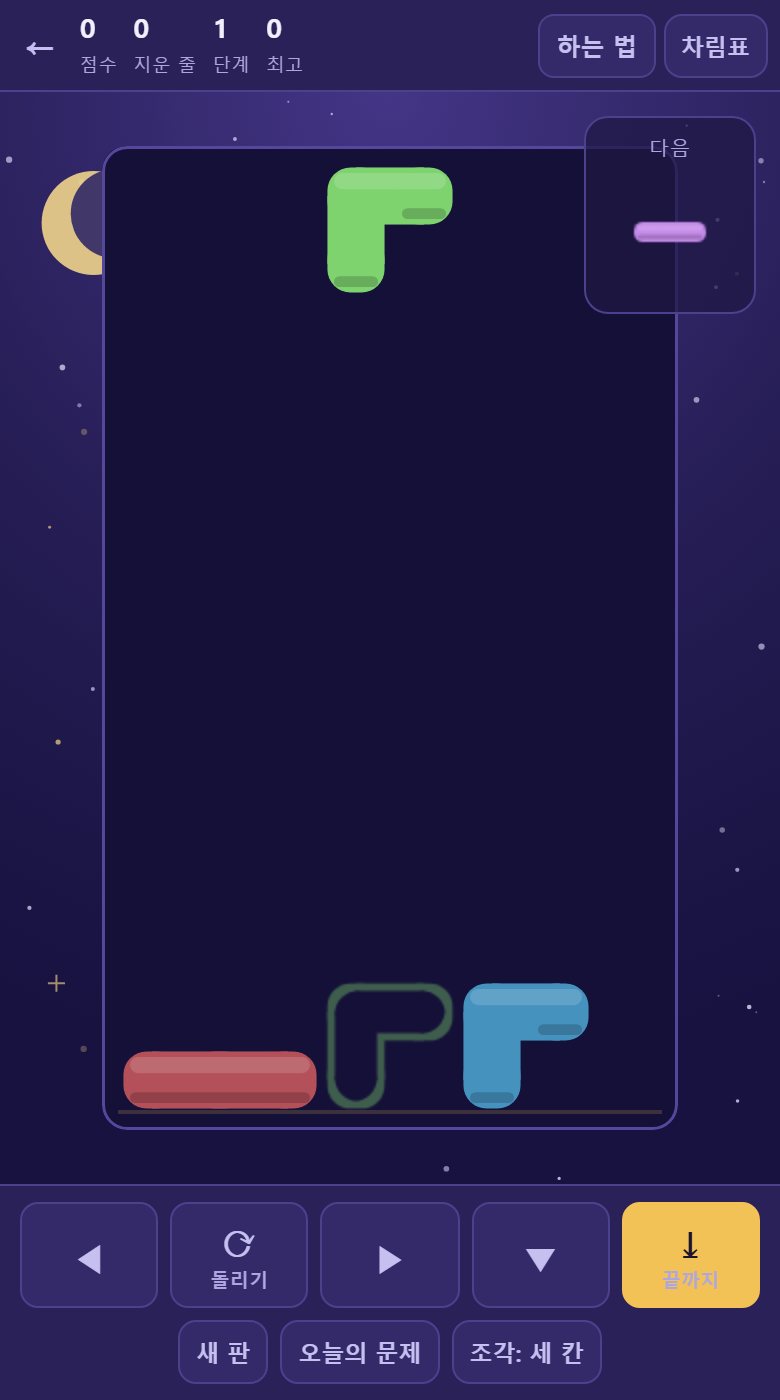
There are no four-square pieces in this game. Learn on three, then move up to five. Three-square pieces are palm-sized — even on a phone you can see exactly where they go.
Slide, spin, drop
While a piece falls you can do exactly three things — slide it sideways, spin it, and drop it.
- Slide — the ◀ ▶ buttons or the left/right arrow keys.
- Spin — the ⟳ button, the up arrow, or X. Z spins the other way.
- Down one square — the ▼ button or the down arrow key.
- Drop to the bottom — the gold ⤓ button or the space bar.
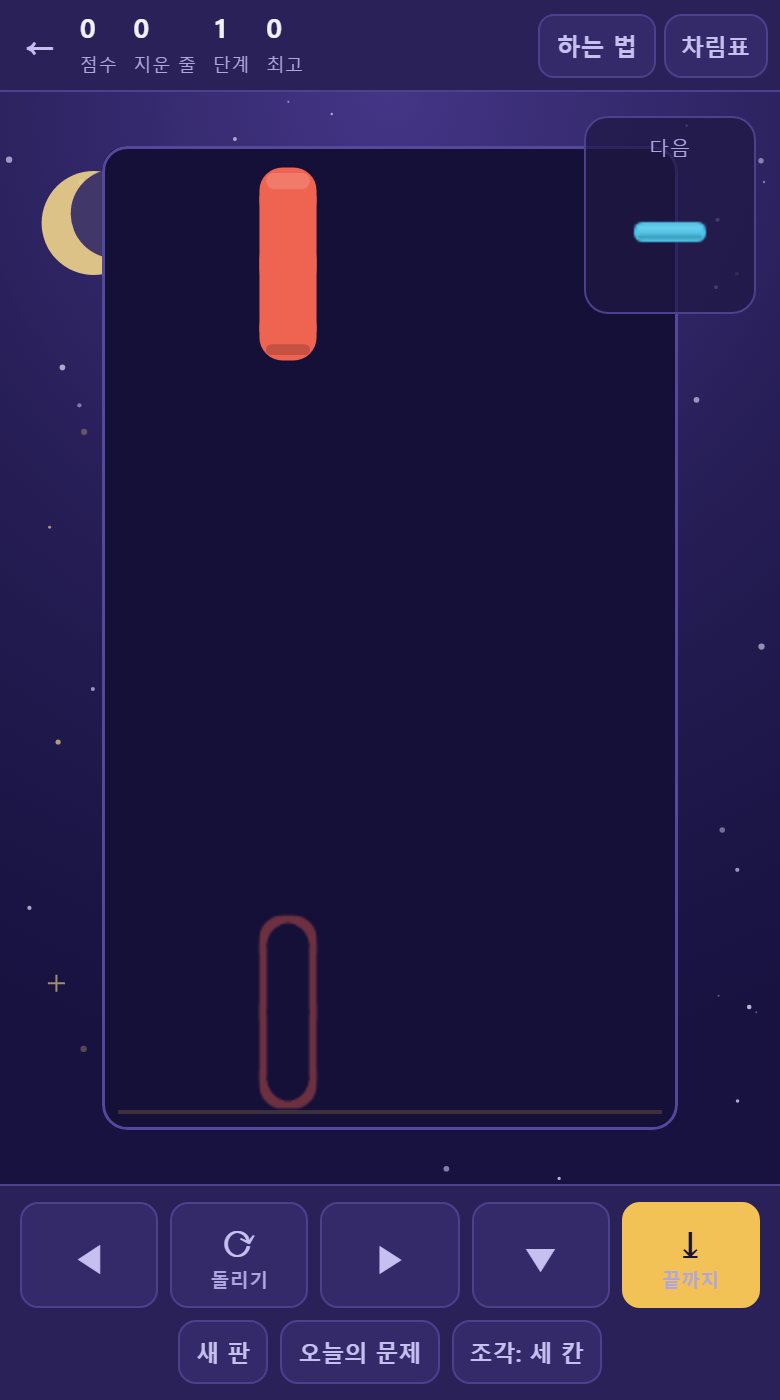
It turns even flat against a wall — if there's no room it nudges itself a square or two to fit. If it still won't turn, there really is no room.
The ring below is where it lands
A ring in the same colour floats where the piece would land if you dropped it now. Get in the habit of checking the ring before you drop — it cuts mistakes right down.
- The ring moves with the piece as you slide and spin.
- When the ring sits where you want it, press ⤓.
- The ring is outline-only, so it never gets mistaken for a settled piece.
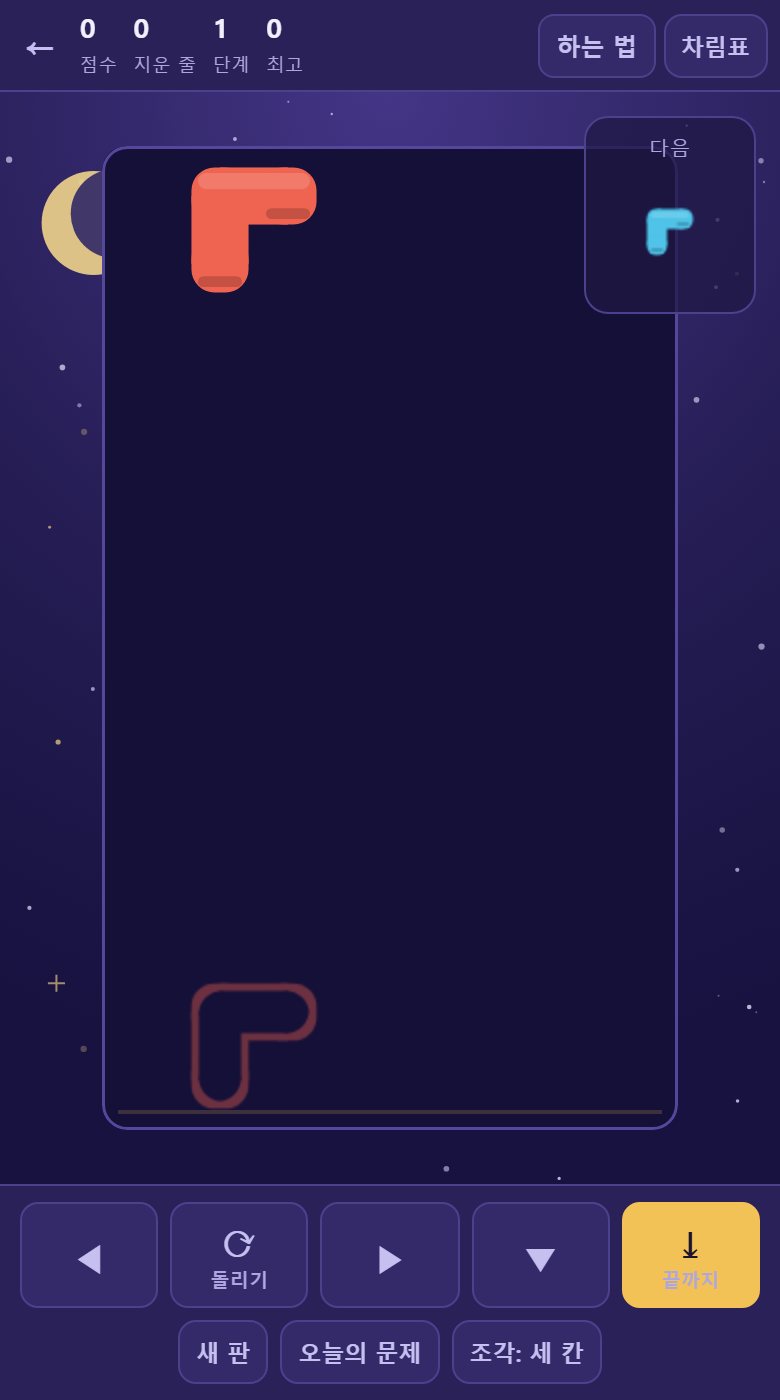
The ring habit pays off even more in the five-square game — the bigger the piece, the easier it is to misjudge by eye. Build the habit on three squares first.
A full line clears
When a line fills with no gaps, it flashes gold, clears, and everything above settles down.
- Stars burst out when it clears — that means you're doing well.
- You score for every line, and the lines number at the top goes up.
- A line with even one gap left will not clear.
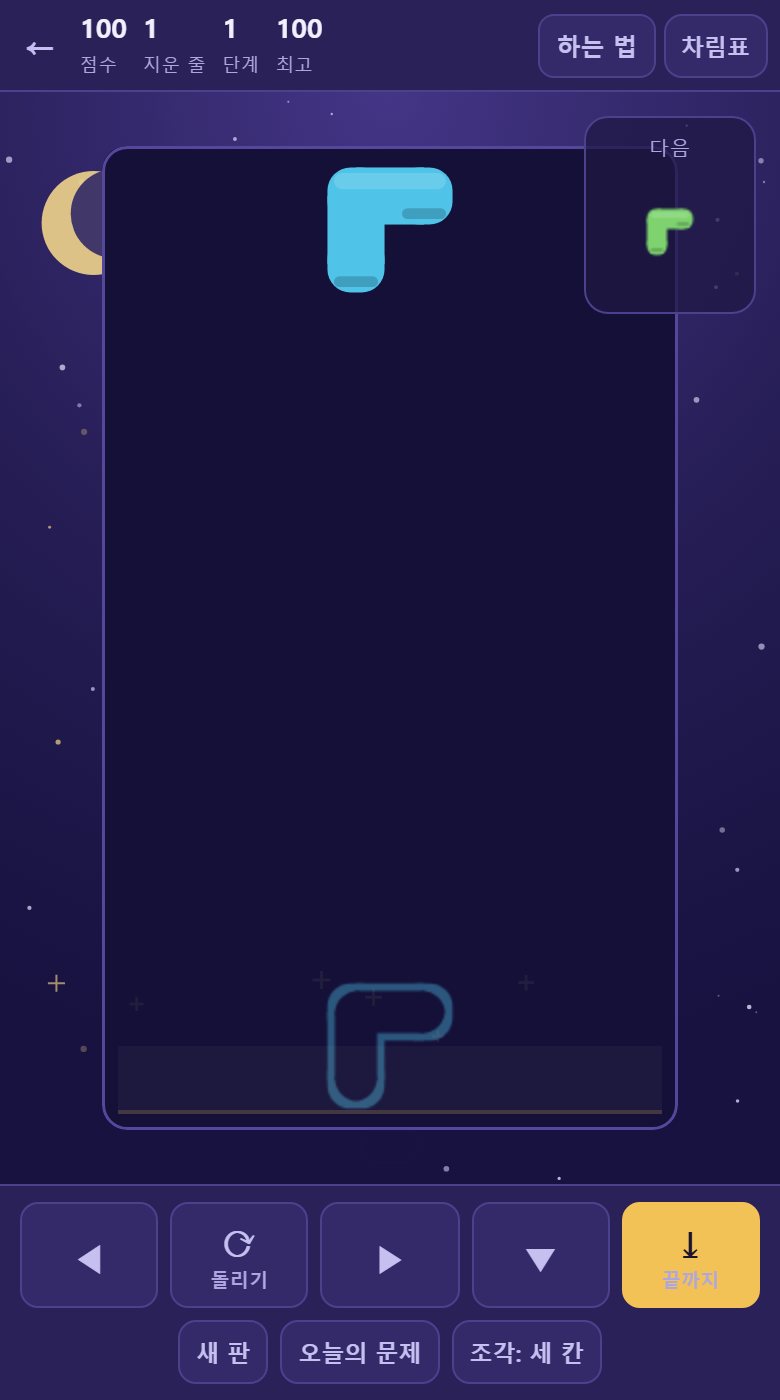
That is the whole point of the game — clear lines to buy yourself room. Stack without clearing and you'll hit the ceiling fast.
Several lines at once is worth more
Clearing two or three lines at once scores much more. One line is 100 points, but two are 300 and three are 600. In the five-square game a five-line clear is worth 1,500.
- Save a standing bar for a deep well and several lines go out together.
- From three lines up, the board gives a little celebration shake.
- At higher levels the same clears score even more.
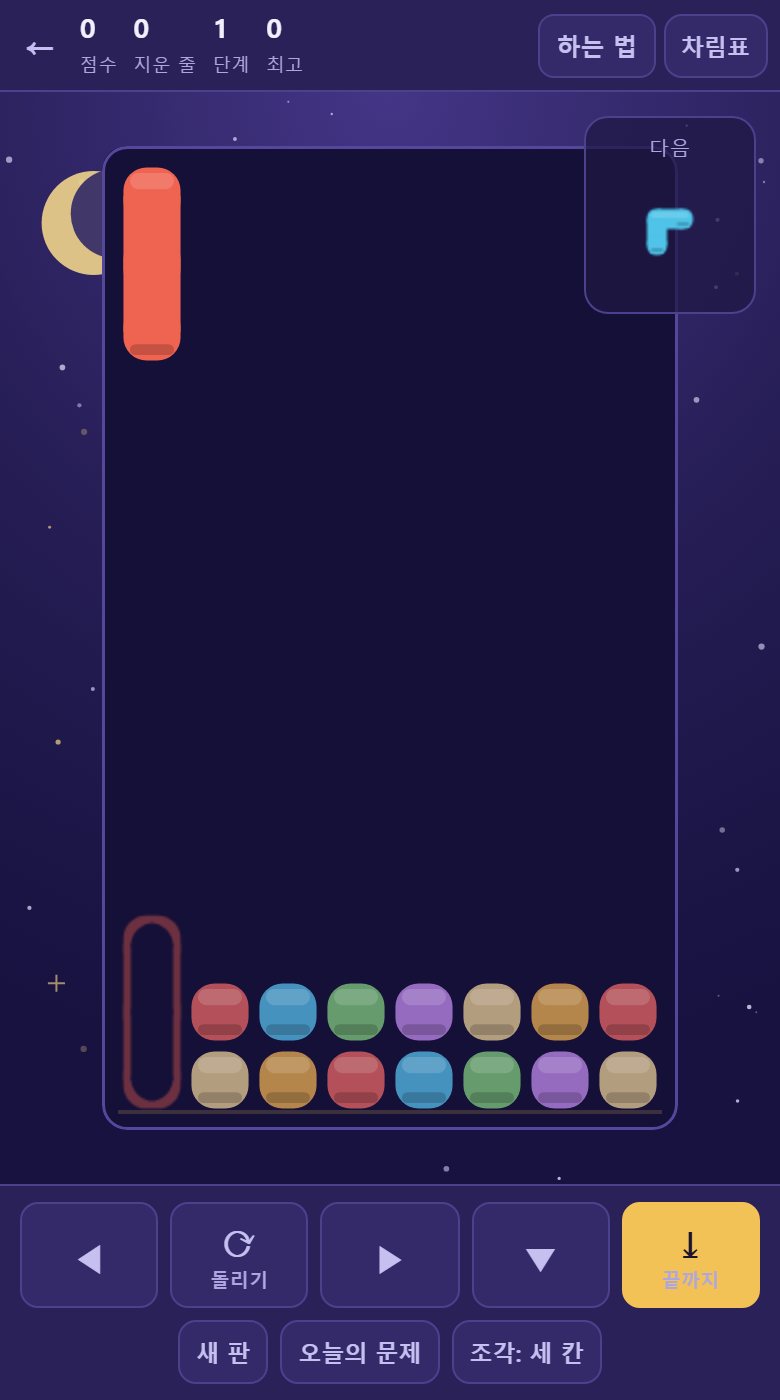
Get greedy and hit the ceiling and you lose it all. Once the board is more than half full, forget the big clears and grind lines out one at a time.
Plan with the next piece
The next window at the top right shows the piece after this one. Thinking one piece ahead when you choose a spot puts you a move in front.
- Next is a bar? You can afford to leave one deep well.
- Next is an L? Leave a corner open and it will fit exactly.
- Not sure? Just keep the stack flat. A flat stack has room for anything.
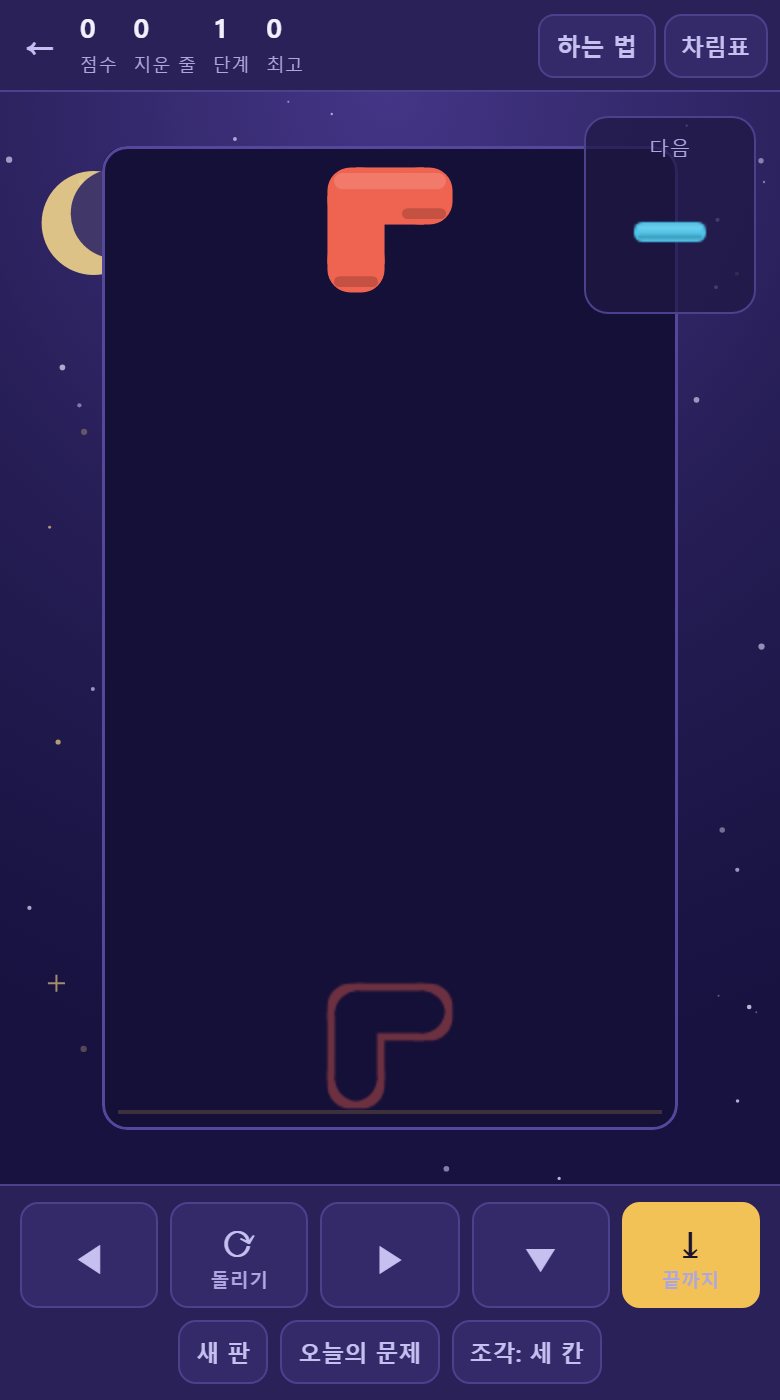
Watching the next window roughly doubles your scores. Even one piece of foresight visibly cuts down on holes.
Flat stacking is half the game
A good player's board is always level. A bumpy board leaves nowhere to fit pieces, and sooner or later you're forced to make a hole.
- A low, even floor beats one tall tower.
- Fill steadily from the left and the board levels itself.
- If one side gets tall, fill the low side first.
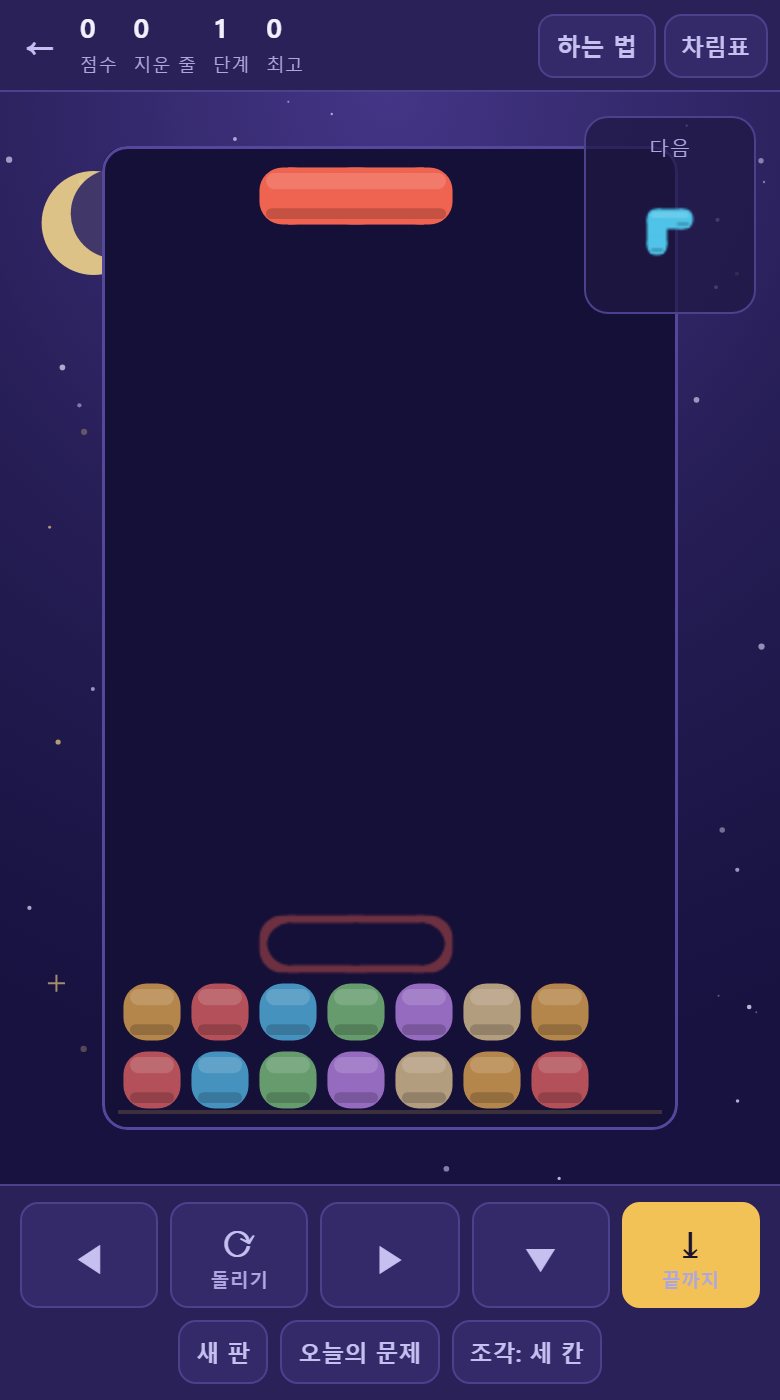
Just stacking flat almost never loses. If you remember one tip, make it this one.
When you get a hole
An empty square trapped under a piece is a hole. A row with a hole will not clear no matter how much you pile on top.
- Keep stacking over a hole and all those rows are stuck together.
- It's better to dig it out early, while the cover above is still thin.
- One hole doesn't end the game. Stay calm and clear from the top down.
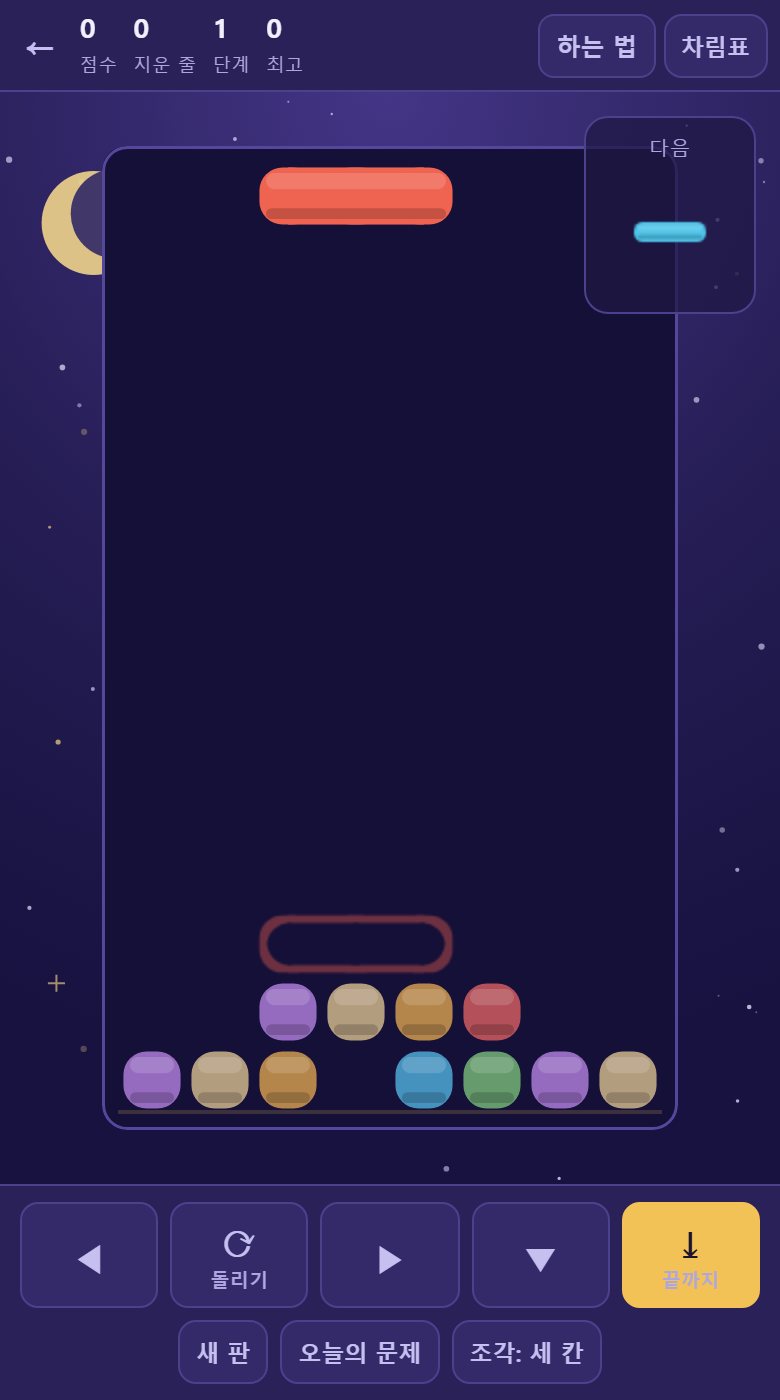
Two or three holes and the board collapses fast. One hole is a mistake; three is a habit — and the fix is the habit of checking the ring before you drop.
Every piece has its own colour
Pieces cycle through six candy colours. Settled pieces fade to calmer shades, so the falling piece always stands out.
- Colour belongs to each individual piece — even in the stack you can see where one piece ends.
- That's also why they're drawn as single jelly blobs.
- Colour has nothing to do with the rules — nothing to memorise.
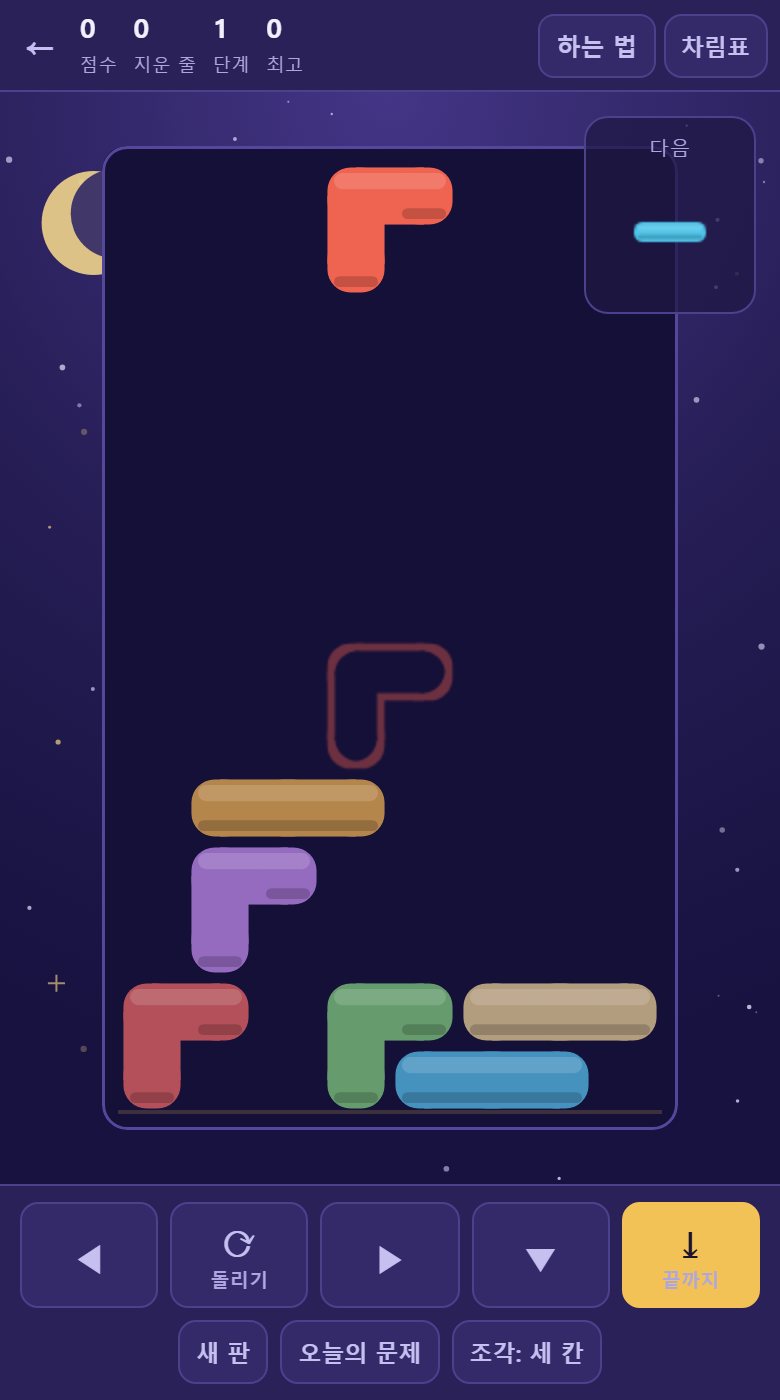
Per-piece colours are handy when playing alongside a child too — you can say "shall we tuck the green one into the left corner?" and point with words.
It speeds up as you clear
Every eight lines the level rises and pieces fall a little faster. Scores also multiply with the level, so later lines are worth more.
- Level 1 is very gentle. No rush at all.
- It never speeds up forever — it stops at a pace a person can play.
- Feeling rushed? Drop early with ⤓ and buy yourself thinking time.
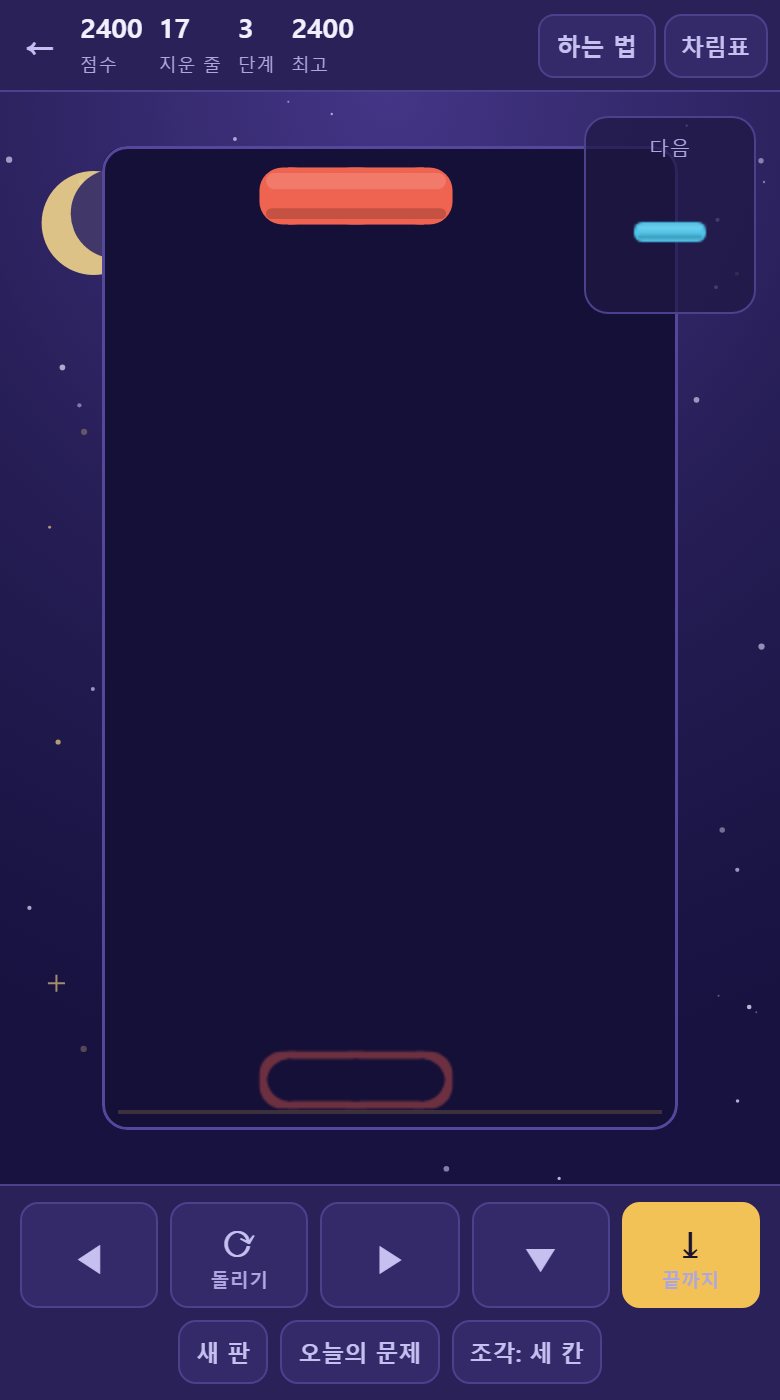
Switch to five squares for a challenge
Press the Pieces: three button below to switch to the five-square game. The board widens to 12 columns and the pieces grow.
- Five-square pieces are pentominoes — a puzzle more than a century old.
- There are twelve shapes, which makes it much harder.
- You can switch back any time with the same button. It starts a fresh board.
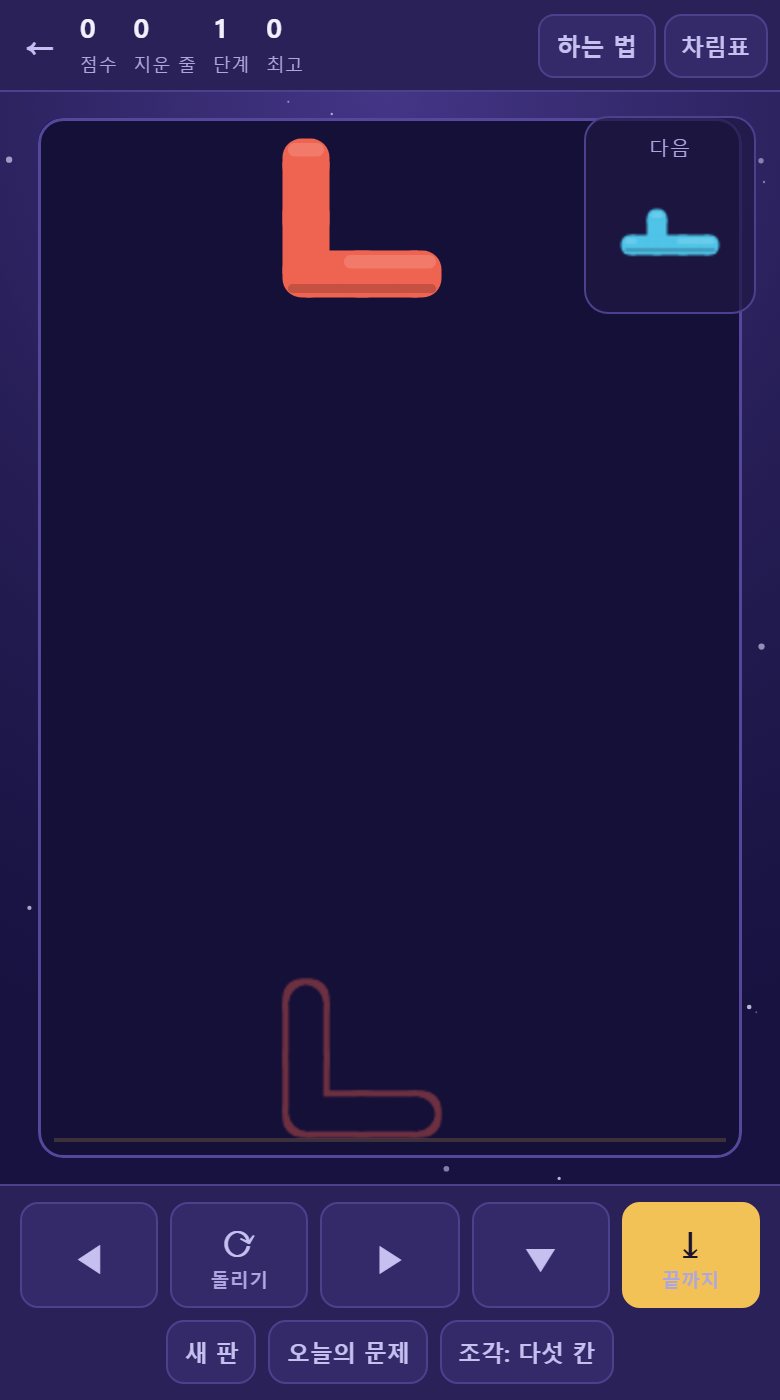
A good time to move up: when you can clear twenty lines without a hole on three squares. Until then, three is simply more fun.
The twelve pentominoes
Five-square pieces come as crosses, steps, U-shapes, canes… all sorts. No shape repeats until all twelve have appeared.
- The cross (X) looks the same however you spin it — the trickiest one to place.
- The long bar (I) is the only piece that can clear five lines at once.
- Cover the notch a U leaves early — its perfect partner won't come soon.
The daily board
Press Daily board below and the date becomes the board number. On the same day, everyone gets the pieces in the same order.
- Great for a family score battle on the same board.
- Tomorrow brings a new one.
- Same board number, same order of pieces — it comes down to skill, not luck.
When you compete on the daily board, match piece sizes too — three squares and five are different games, so scores don't compare.
Stack to the ceiling and it's over
When a new piece has no room to enter, the game ends and your score comes up. Beat your best and New best! ⭐ celebrates with you.
- New game starts you over right away.
- Scores stay on this device only. Nothing is sent anywhere.
- Nothing is lost when it ends — falling-block games always end eventually.

Take a moment to scan the finished board — spot where the holes crept in, and your next game improves by exactly that much.
Fingers or keyboard
On a phone, use the big buttons below; on a computer, the keyboard. You can also touch the board itself.
- Drag sideways on the board and the piece follows.
- Tap the board and the piece spins.
- Swipe down and it drops to the bottom.
- Hold a button and it keeps moving.
The keyboard is fastest once it's in your fingers — arrows to place, X to spin, space to drop. Three beats is all it takes.
Winning habits and common mistakes
Just five habits and your scores jump. Lost games, meanwhile, almost always trace back to one of the mistakes below.
- Stack flat — if you keep one habit, keep this. A level board has room for anything.
- Check the ring before you drop — hitting drop in a hurry is the most common mistake. Press it after the ring settles where you want.
- Think one piece ahead — place for this piece only and the next one ends up homeless.
- Don't build over holes — covering a hole locks all those rows. Dig it out while the cover is thin.
- Save your bars — only a bar fills a deep well. Lay it flat on open ground and the well stays forever.
If it's all a blur, remember one thing — low and flat. And avoid one thing — never cover a hole. Those two alone cut your losses in half.
Great to play with kids
The three-square game was built for first-time kids. Just two chunky shapes, so even young eyes can see exactly where they go.
- No time pressure — level 1 is very gentle, with plenty of time to think.
- Mistakes cost nothing. Make a hole and you just clear it out from the top.
- Sitting alongside and asking "where's the ring?" is all the teaching it takes.
- Flat stacking feels like tidying up — kids are proud of it all by themselves.
It's fun for a grown-up to take the daily board on five squares while the child takes it on three — different games, so there's no comparing, only showing off.
Why are there no four-square pieces?
That famous game with seven four-square pieces is someone else's expression. The combination of those shapes, colours, and board is protected, so we built ours differently from the start. Three squares are easier, and five-square pentominoes have belonged to everyone for over a century. Each has its own flavour — three squares play fast and light, five make you think about holes.
Common questions
There's no room to turn. Next to a wall it will nudge itself over, but if it still won't turn there's truly nowhere to fit. Go down a square and try again.
It's where the piece will land if you drop it now. When the ring sits where you want, press the drop button.
There's a hidden gap. A hole buried under pieces can be invisible from above — clear the rows over it and you'll see it.
It speeds up one level every eight lines. Start a new game and it slows down again. Three-square pieces are easier to handle than five.
Press the Pieces: five button below to go back to three. Build the flat-stacking habit on three squares first, then come back.
A board whose number is today's date. Everyone gets the same order of pieces on the same day — perfect for family score battles.
Only in this device's browser. Nothing is ever sent to a server.
The pieces are different — here it's three and five squares, and the seven four-square pieces are someone else's expression, so we don't use them at all. The board size, colours, and name are ours too.
- Keeping the stack flat is half the game. Dig a deep pit and the right piece never comes.
- Corner pieces go in corners first. Save long bars for filling wells.
- Clearing several lines at once scores far more. A one-square well is worth digging.
- Stuck? Look at the ring below — that's where the piece will land.