 MindHub
How to play Old Maid
One card in the deck has no partner — that is the odd card. You draw from the other hand one card at a time, discarding pairs as they form, and whoever is not left holding the odd card wins.
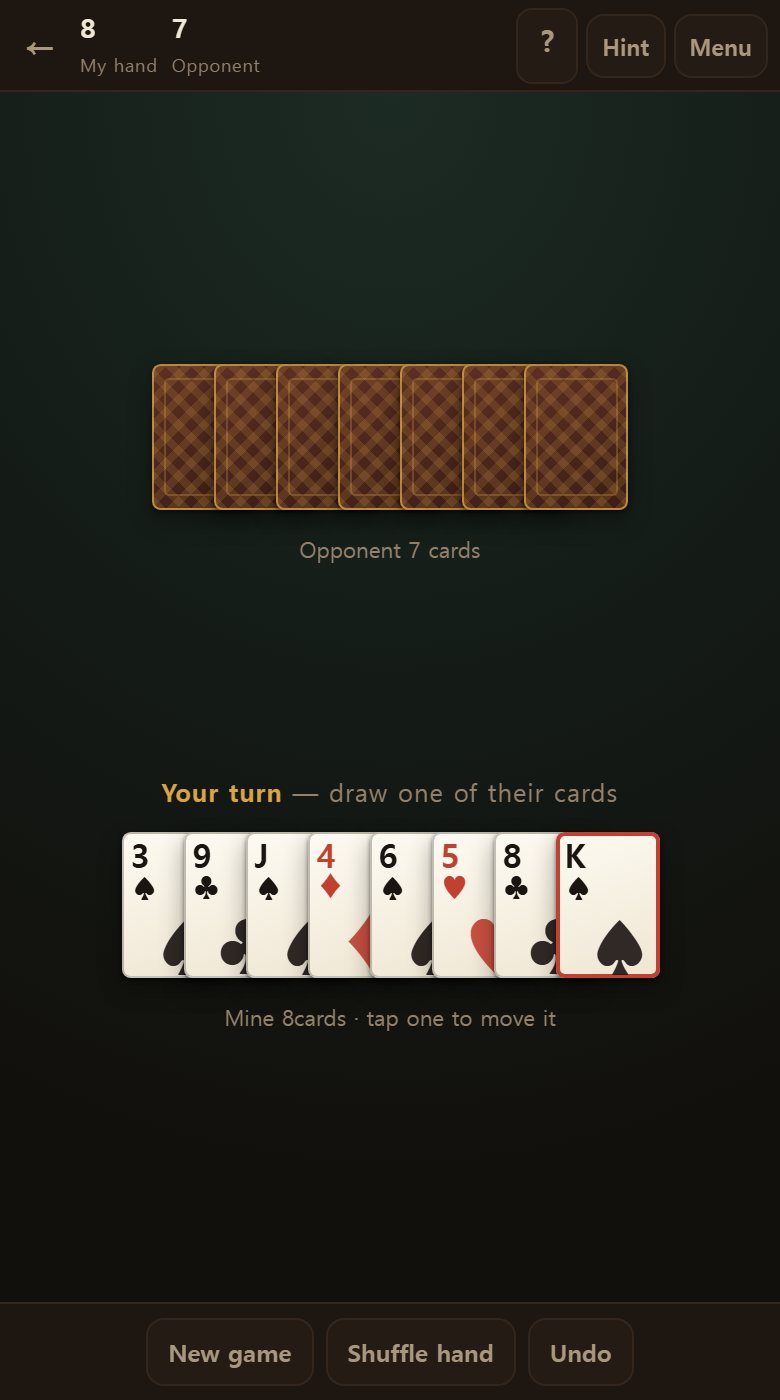
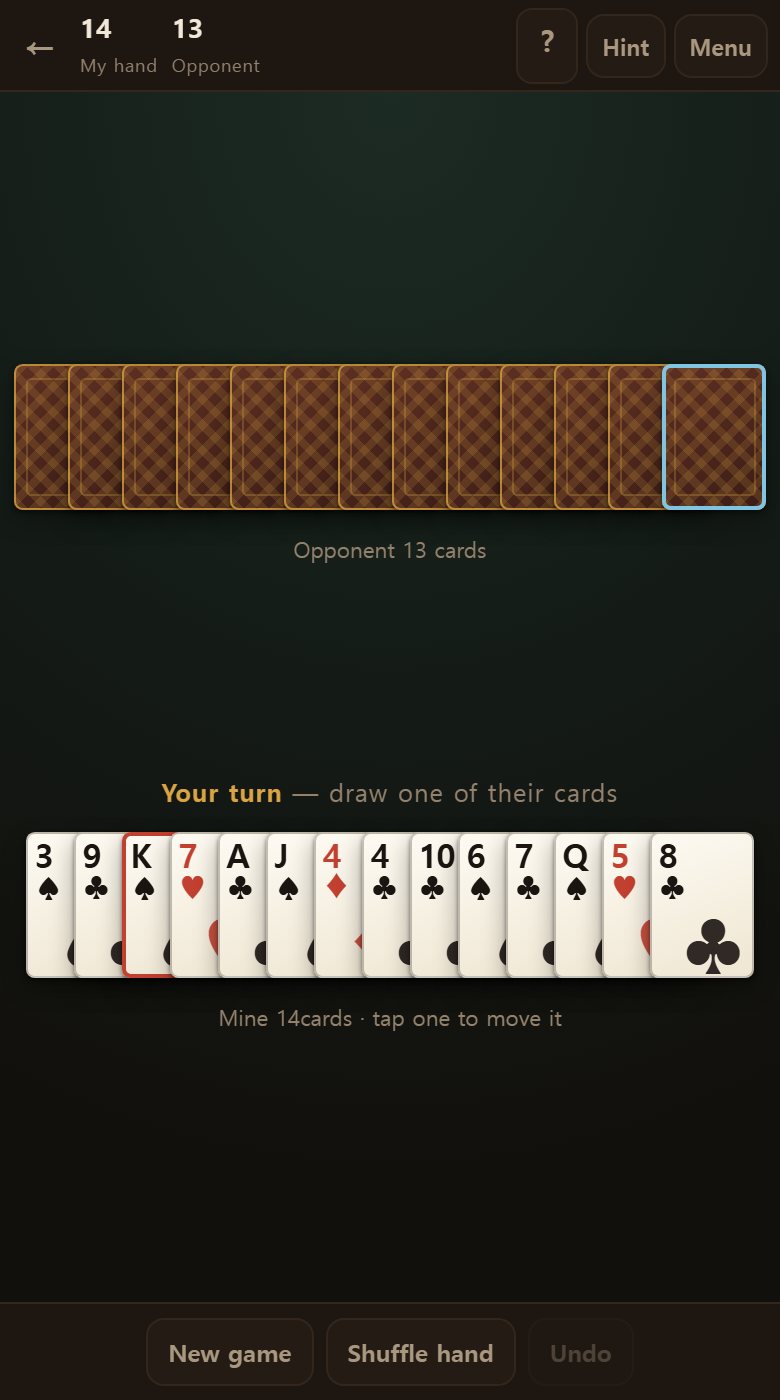
First, a look at the screen
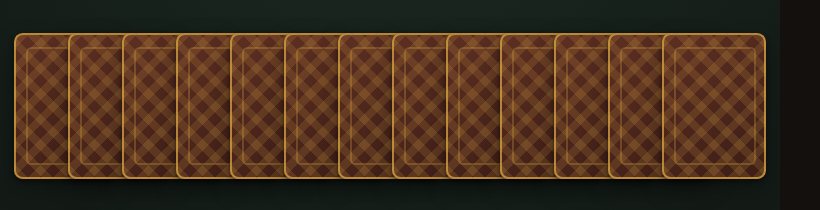
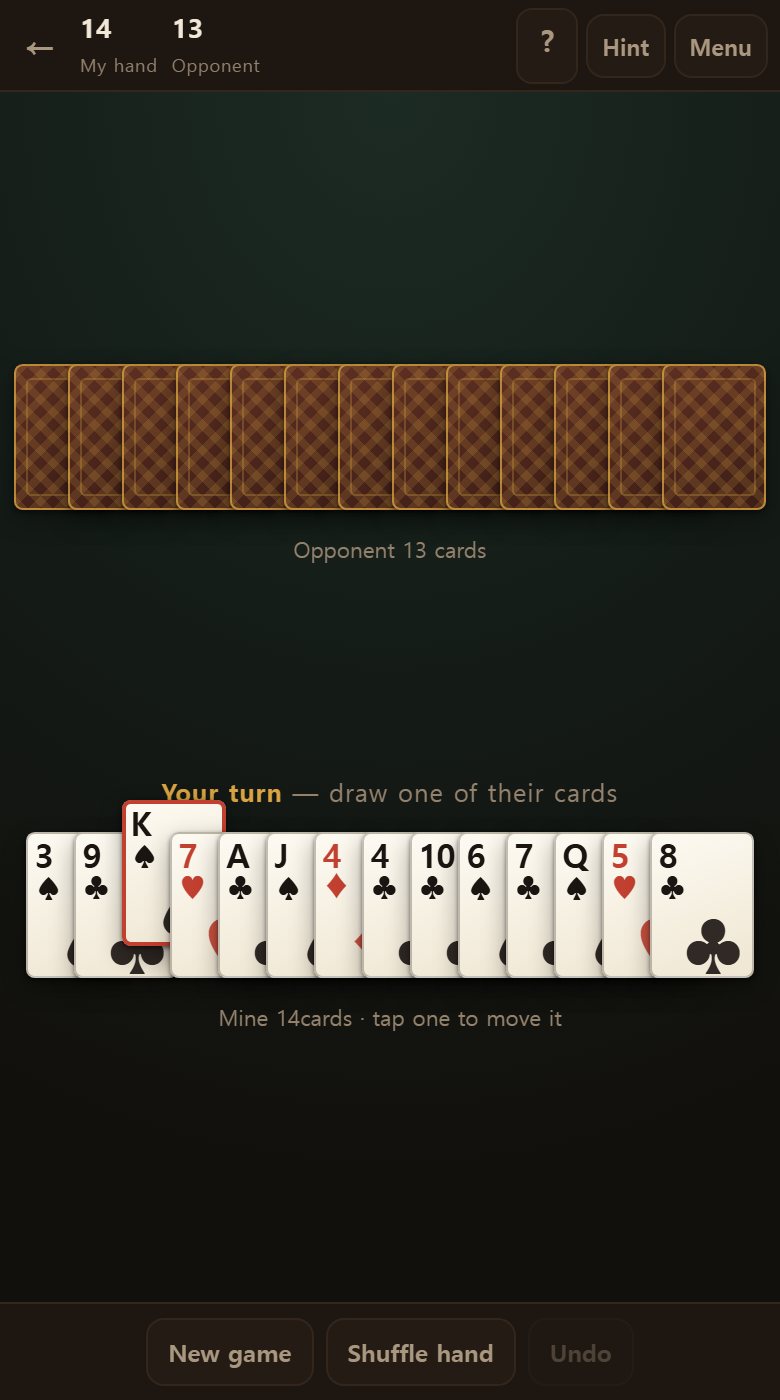
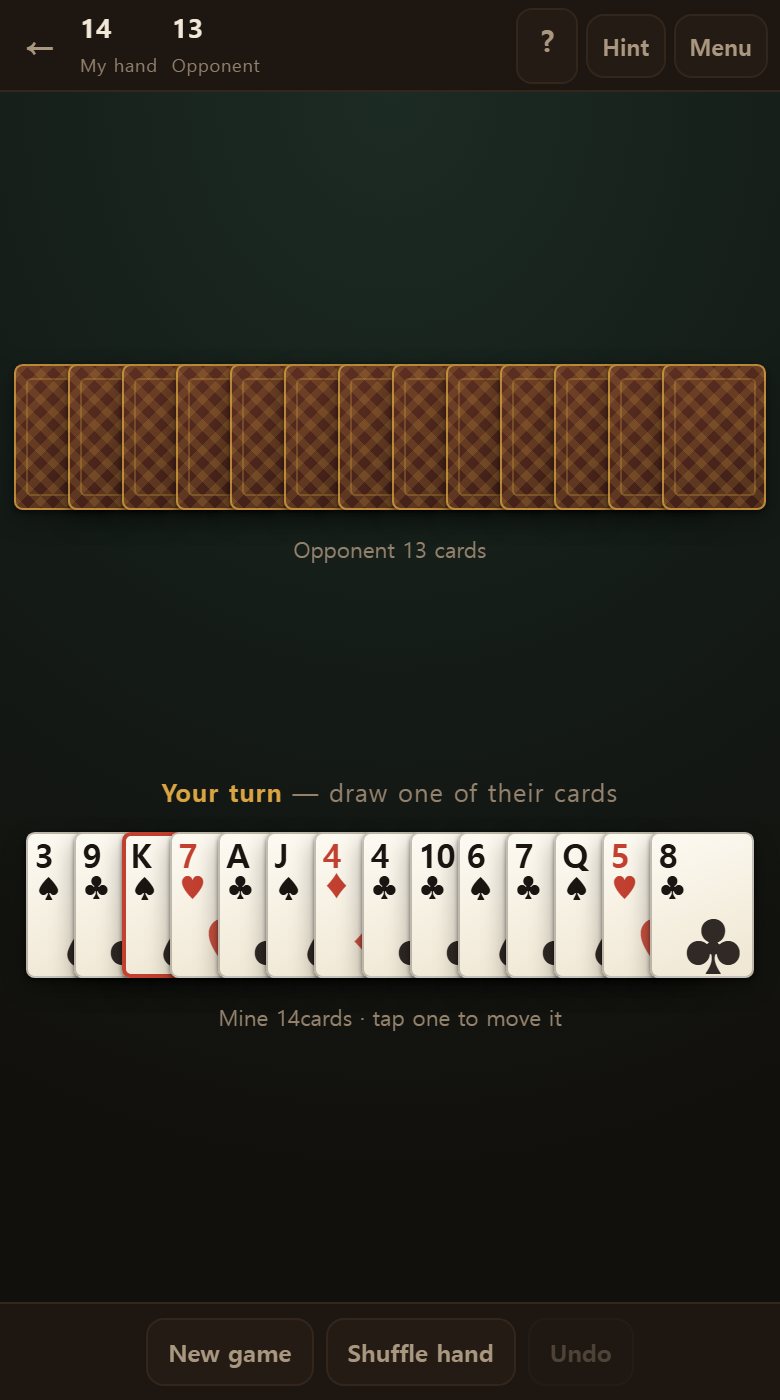
Their cards lie face down above; yours are spread face up below.
- The face-down cards at the top — their hand. This is what you draw from.
- The middle — shows what the card you just drew turned out to be.
- The bottom — your hand. The red ring marks the odd card, K♠.
- The figures at the top — how many cards each side holds, and how many pairs you have discarded.
The red ring is drawn for your eyes only. The computer cannot see your cards. You can turn it off in the menu.
The odd card is the K♠
Old Maid usually uses a joker. Here the K♠ takes that role instead.
The K♠'s partner, the K♣, is removed from the fifty-two before dealing. That leaves the K♠ as the only card without a match.
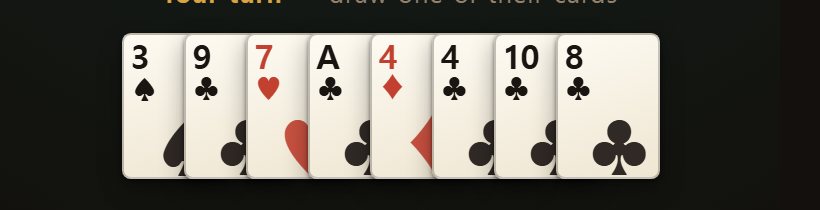
So fifty-one cards are in play — twenty-six to one side and twenty-five to the other.
A pair is the same rank and the same colour
7♠ and 7♣ make a pair; 7♥ and 7♦ make a pair. Matching ranks in different colours do not.
The moment the cards are dealt, every pair in hand is discarded. That is why hands shrink sharply at the start.

Discarding is automatic — there is nothing to tap or choose. The screen tells you how many pairs went.
Drawing a card from their hand
On your turn, tap one of their cards above.
They are face down. You only learn what it is once you have drawn it. All you can choose is the position.
- If the card you draw pairs with one in your hand, both are discarded at once.
- If it pairs with nothing, it simply joins your hand.
- After your draw it is their turn, and they take a card from you.
- You choose only how many along from the end. Nobody knows what is there.
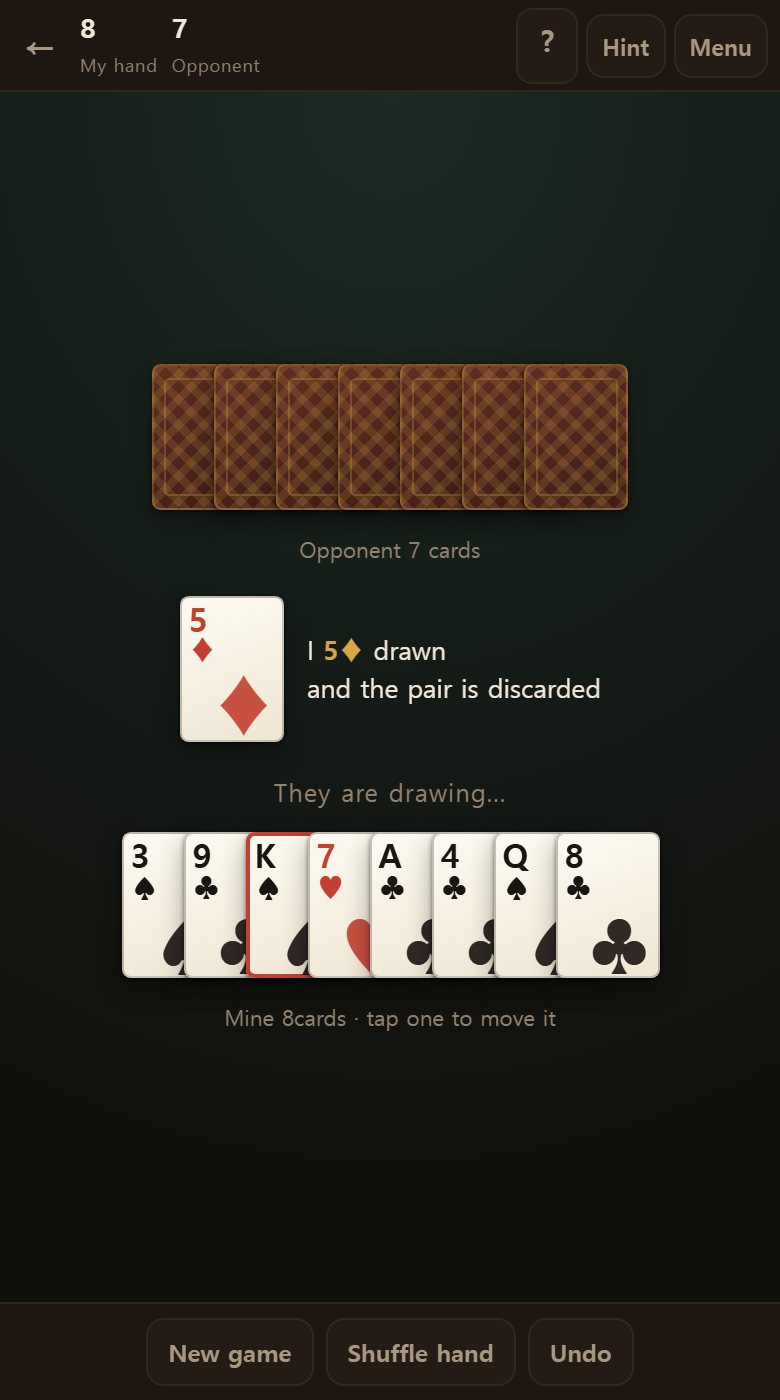
So this is not a game of card skill but of reading positions. Where would they have put the odd card? Where will they reach? That is the whole of it.
The odd card is to be passed on, not hidden
This is the most important thing in the game.
While you hold the odd card, you are only saved if they draw it from you. Hide it too well, nobody takes it, and the game ends with it in your hand.
- Holding it? Put it where it is likely to be drawn.
- People reach for the two ends, which makes the ends good places to pass from.
- When you do not hold it, think about where they would have put theirs, and avoid that.
- They are thinking the same thing — a card at the end may be offered on purpose.
- So when you are not holding it, drawing from the middle is slightly better.
While building this, the computer was set to hide the odd card in the middle. Over 400 games it lost 244 to 184. Hiding loses.
You can rearrange your hand
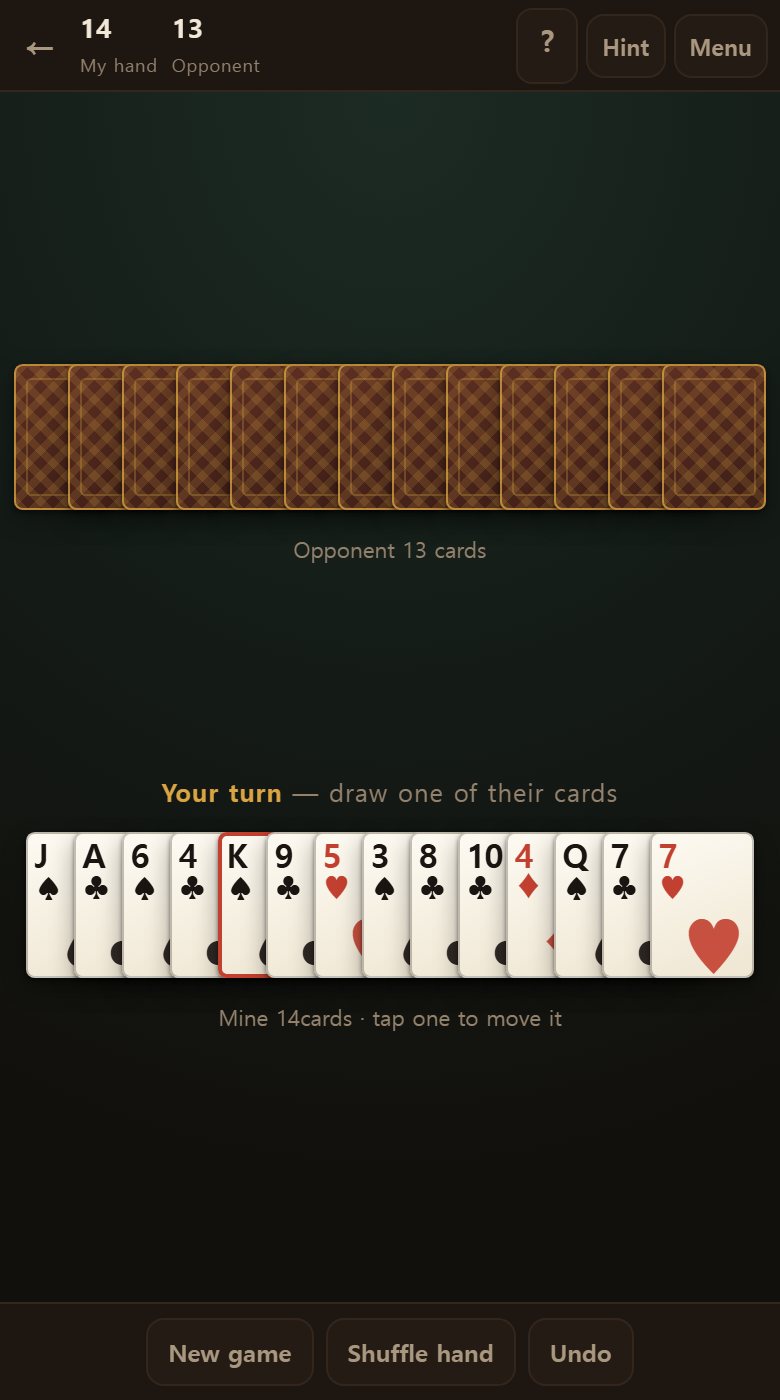
Tap one of your cards and it lifts. Tap the card at the place you want it and it moves there.
This has no effect on the rules. What it changes is which position gets drawn.
- Move the odd card to an end and its chances of being taken go up.
- Shuffle hand below mixes the whole lot.
- Tapped the wrong card? Tap it again, or press Esc to drop it.
- Moving one card and shuffling the lot serve different ends — move when you want the odd card somewhere particular, shuffle when you want to erase the trail.
They do the same. After being drawn from, they rearrange their hand — which is why “it was over there a moment ago” rarely works.
The card they just gave you is not the odd one
There is one clue you can use.
If they have just drawn a card from you, that card came out of your hand. If you were not holding the odd card, it is not the odd card.
And if it is sitting unmatched in their hand, that position is safe.
- If you were not holding the odd card, the one they took is certainly not it.
- If that card met its partner in their hand and was discarded, the clue is gone.
- But while it is still there, that one position is safe for nothing.
But if they rearrange, the position changes. So the clue is good for one draw only. Do not save it — use it at once.
Watch the hands shrink
As the game runs on, hands get smaller — and so do the places to draw from.
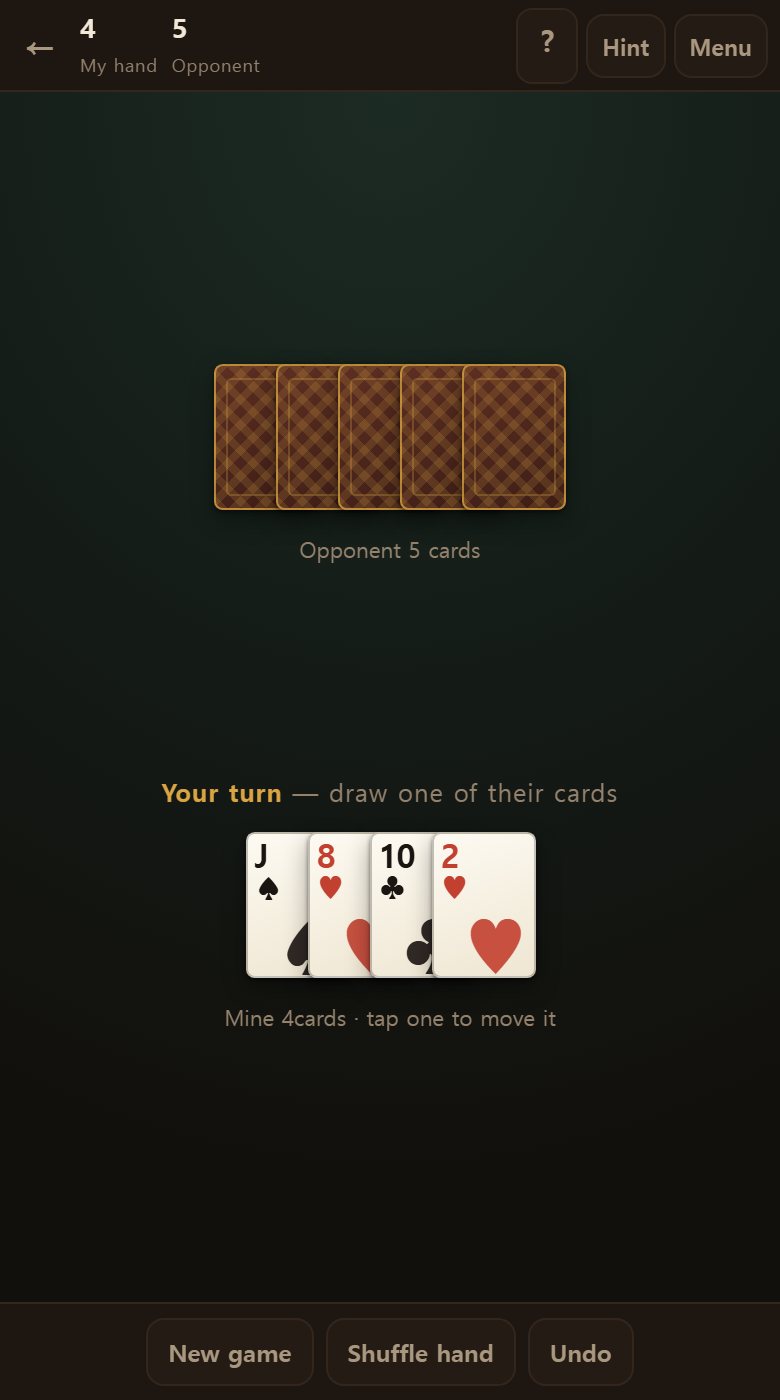
- If they are down to one card and you hold the odd card, you have all but lost.
- Conversely, if you are down to one and it is not the odd card, you win.
- The fewer cards they hold, the more a draw becomes a gamble. Pass the odd card on before then.
- If they hold two and one is the odd card, your chance of drawing it is one in two.
- So it pays to finish before their hand gets small.
The ideal is passing the odd card when you hold two and they hold many. Once it goes, you win on the next turn.
The computer cannot see your cards
It knows only how many cards you hold, not what they are.
With one exception: it knows where the card you just took from it went. That position is unlikely to be the odd card, so it avoids it.
- All it knows is your card count and where the card it just gave you ended up.
- Rearrange or shuffle and even that one piece of knowledge blurs.
- Which makes shuffling the only concealment this game offers.
So when it seems to dodge the odd card, that is reasoning, not peeking. A test keeps that boundary honest.
Undo and hint
Drew badly? Press Undo below. Their draw comes back too, returning it to your turn.
If you cannot decide, press Hint. It picks a position using the same reasoning the computer uses.
- If a position is known to be safe, the hint points there.
- With nothing known, it simply picks one — the odds are the same everywhere.
- On a keyboard, undo is Ctrl+Z and hint is H.
But Old Maid carries a great deal of luck. Follow the hint and you can still draw the odd card. That is not the hint being wrong — it is the game being what it is.
How it ends
It ends the moment one hand is empty.
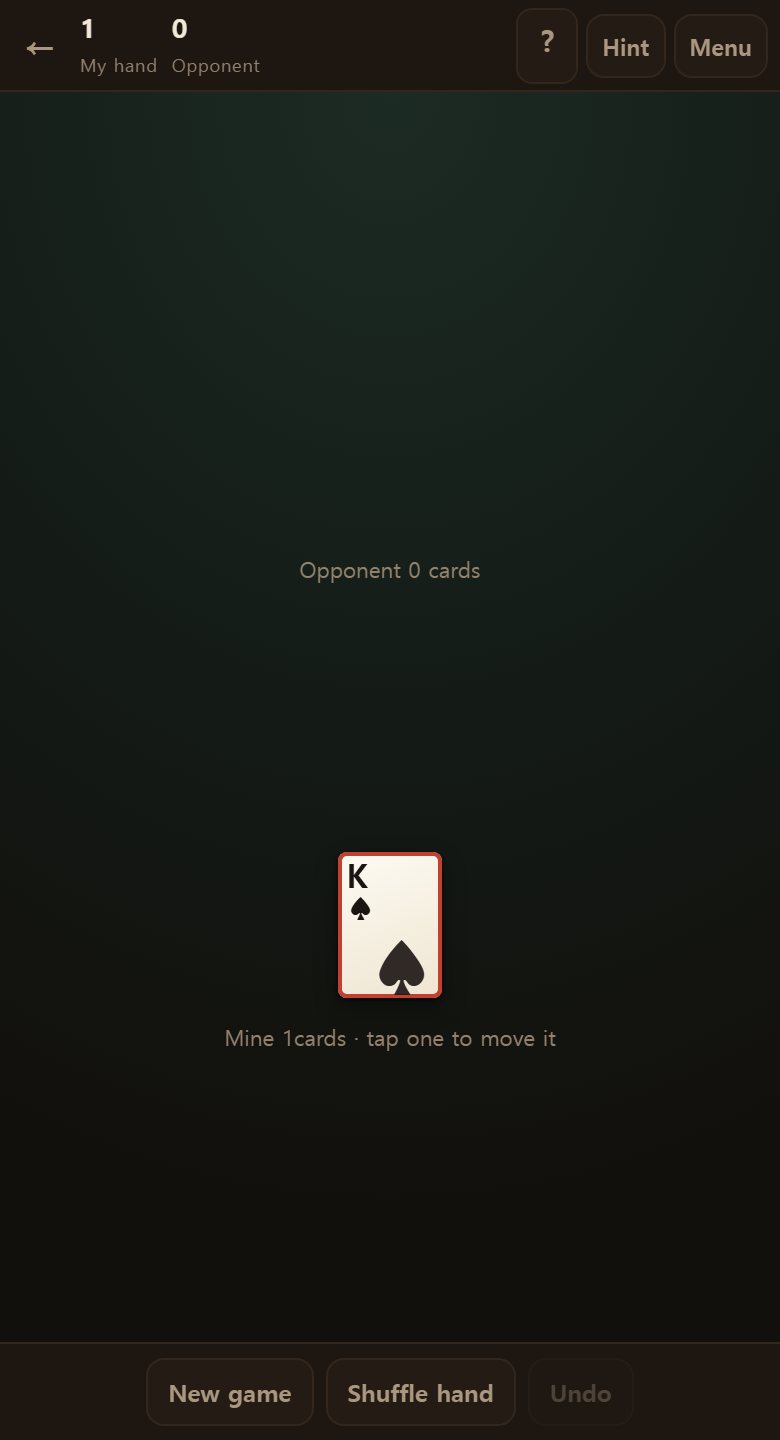
Whoever emptied their hand wins. The single card left is always the odd card — having no partner, it can never be discarded.
- Fifty-one cards are twenty-five pairs plus the odd card, so one card always remains.
- Which means this game can never be drawn. Somebody ends up holding it.
- Down to two cards with the odd one among them, you have to pass it to win.
- To play again, press New game below. The cards are dealt afresh.
Undo
Press Undo at the top and your last draw never happened. Your draw and theirs come back together. On a keyboard it is Ctrl+Z.
- A pair discarded on that draw returns to hand as well.
- You can undo as far back as the start.
- Undo and draw elsewhere and you can find out which position held the odd card.
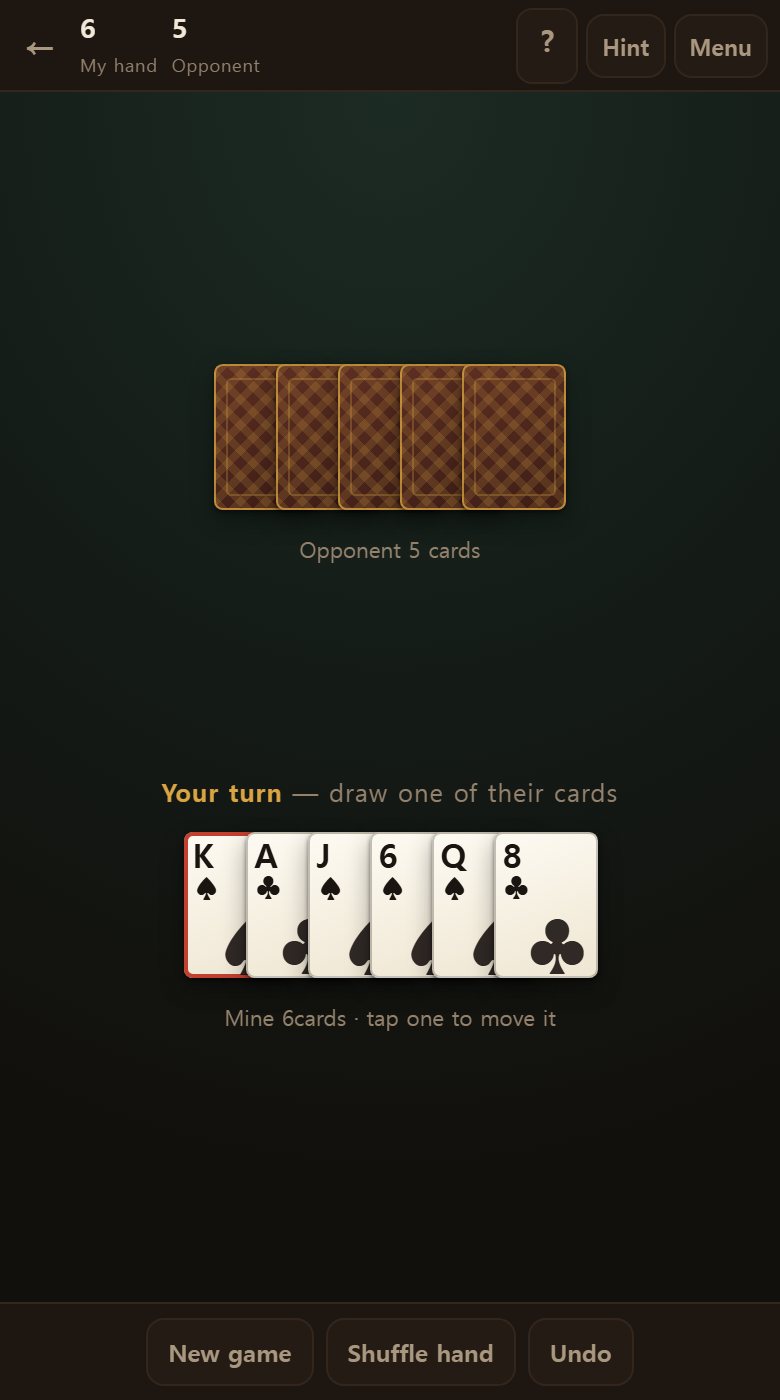
But Old Maid is half luck. Undo and draw again and it may go well or it may not. That too is the game.
How to win
Half is luck; the other half you earn with these five.
- Holding the odd card, put it where it will be drawn. The two ends are such places.
- Not holding it, avoid the position they are offering. The ends are dangerous.
- Shuffle your hand often. They cannot follow where you just tucked something.
- The crisis comes when they hold one or two cards. Pass the odd card before then.
- The card they just took from you is not the odd card. That position is safe.
All five are really one: the odd card has to leave your hand. This is a game of passing it on, not of hiding it.
Common mistakes
Games are lost, more often than not, in one of these four ways.
- Hiding the odd card in the middle — the commonest of all. If nobody takes it, the game ends with it in your hand. Measured while building this, hiding lost clearly more often.
- Not shuffling — leave your hand as it was after being drawn from and they remember exactly where.
- Passing up a safe position — the card they just took from you is not the odd card. Leaving it and drawing elsewhere is a waste.
- Not counting — without watching how many cards they hold, the critical moment goes by unnoticed.
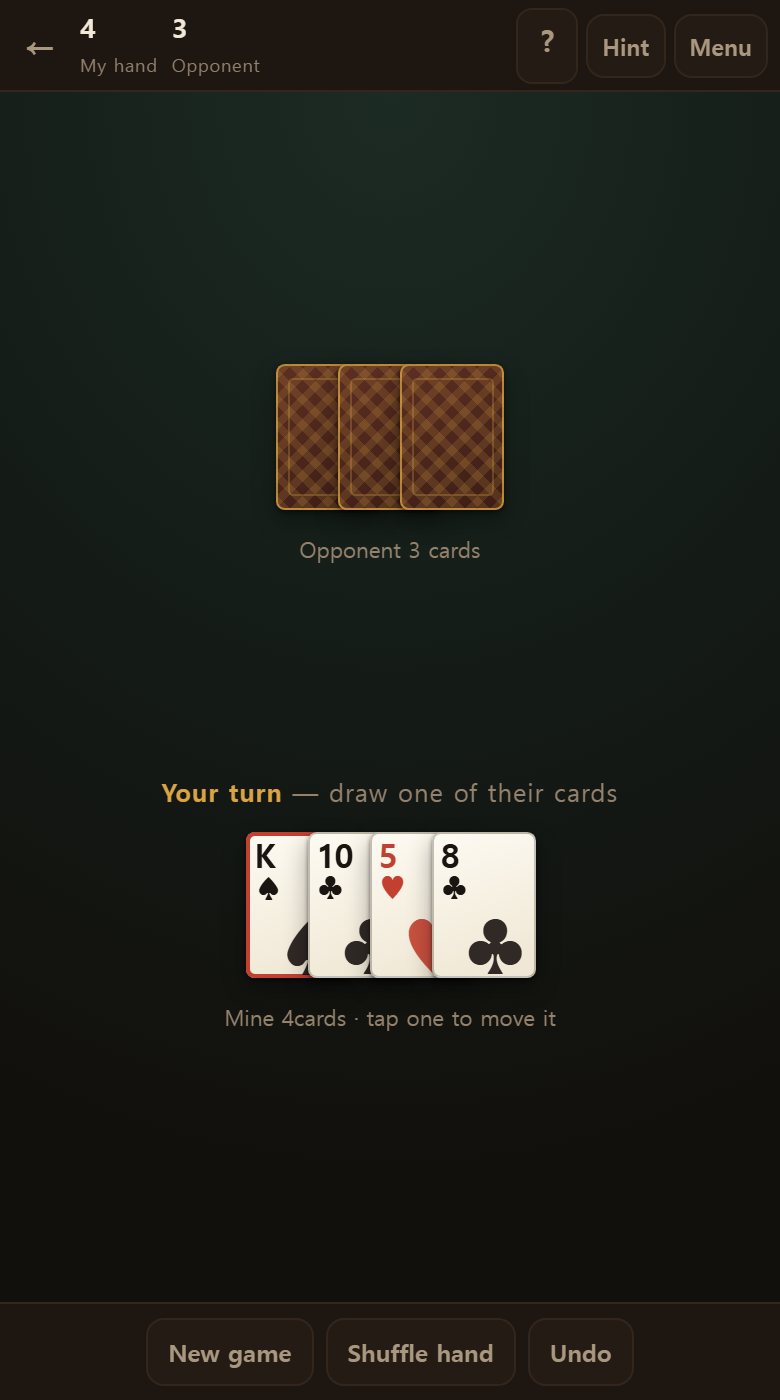
All four come from trying only to hide it. In this game the odd card is not to be hidden but passed on.
How pairs come off
Two cards of the same rank and colour in your hand are discarded by themselves, on the spot. There is nothing to tap.
- So 7♠ and 7♣ pair, both being black.
- 7♠ and 7♥ do not, the colours differing.
- So each rank gives two pairs — one black, one red.
- Except the K♠, which has none, because its partner the K♣ is removed before the deal.
So pairs already in hand at the deal go the instant play begins. That is why hands shrink so sharply as a game opens.
Reading the card counts
All you can see in this game is how many cards. But that alone tells you a surprising amount.
- Draw a card and if your hand did not shrink, it matched nothing — and they can see that.
- If your hand dropped by two, you made a pair and discarded it.
- So they may not know what you drew, but they do know whether it matched.
- You can read their count the same way.
- The figures at the top do the counting for you.

There is one thing more. The odd card has no partner, so whoever holds it always holds an odd number — and both sides can count that. But hands also hold cards whose partners have not turned up yet, so parity alone does not settle it. Treat it as a clue for estimating, not proof.
Common questions
There isn't one. The K♣ is removed instead, which leaves the K♠ without a partner.
It happens by itself. When a drawn card completes a pair, both leave at once.
The colour has to match too. The 7♠ pairs with the 7♣, and the 7♥ with the 7♦.
Somewhere they are likely to draw from. Hide it and you end up holding it.
Not at all. It affects no rule — only which position gets drawn.
It only knows where the card it just gave you went — and that position is not the odd card.
Luck plays a large part. But where you put the odd card shifts the odds appreciably — putting it at an end wins about sixty more games in four hundred than putting it anywhere.
- The card just taken from you is still in their hand. That position is not the odd card.
- The odd card is to be passed on, not hidden. If nobody draws it, you end up holding it.