 MindHub
How to play Minesweeper
Mines are hidden in the squares. Read the numbers, work out where the mines are, and open every square that has no mine.
First, look at the screen
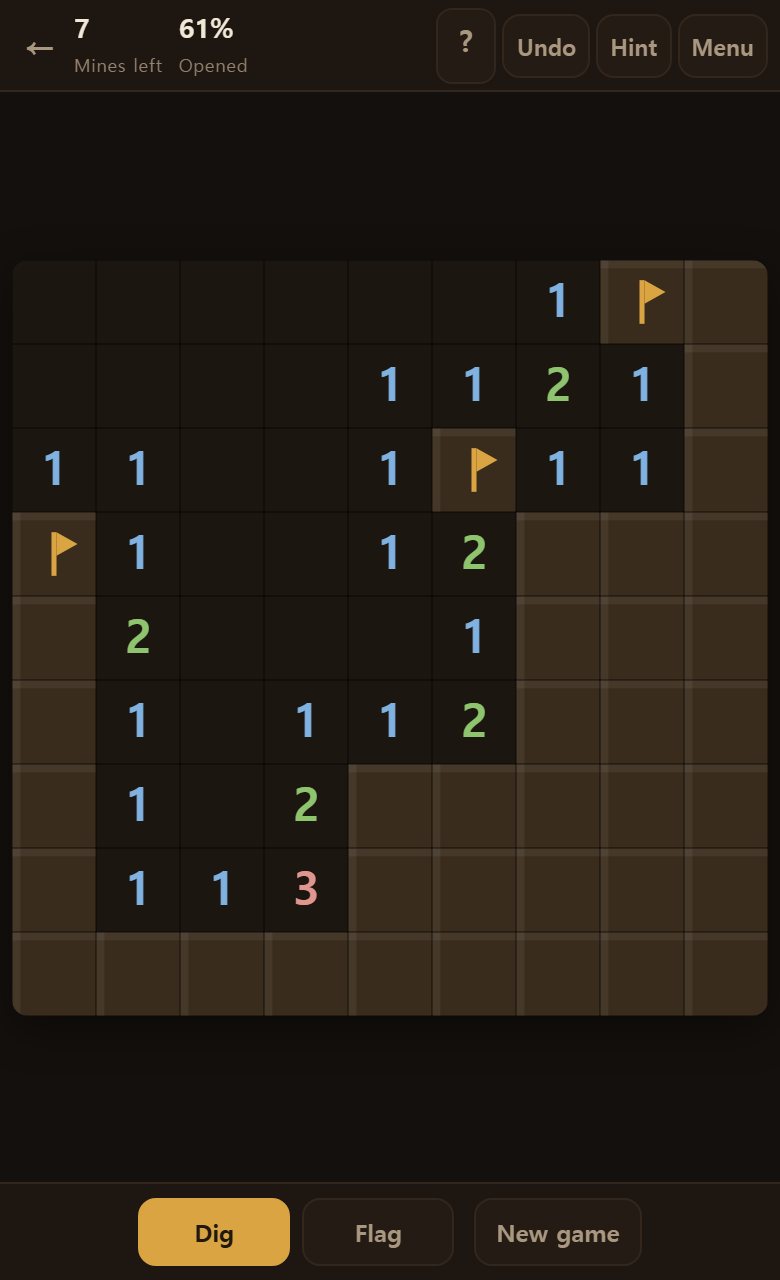
There are lots of square cells. Unopened ones are dark, opened ones are light.
- A number in a light square — how many mines sit in the eight squares touching it.
- A light square with no number — there is not a single mine around it.
- A flag — your own mark saying “a mine is here.”
- The numbers up top — how many mines are still unfound, and how much you have opened.
- The buttons below — switch between digging and flagging, and start a new board.
Each number has its own colour. 1 is blue, 2 is green, 3 is red, and so on. It is there so the numbers register at a glance.
At the start you can see nothing
Open a new board and every square is dark. There is no clue yet.
So for the first square, just tap anywhere. The square you tap first never holds a mine. The board is built that way from the start.
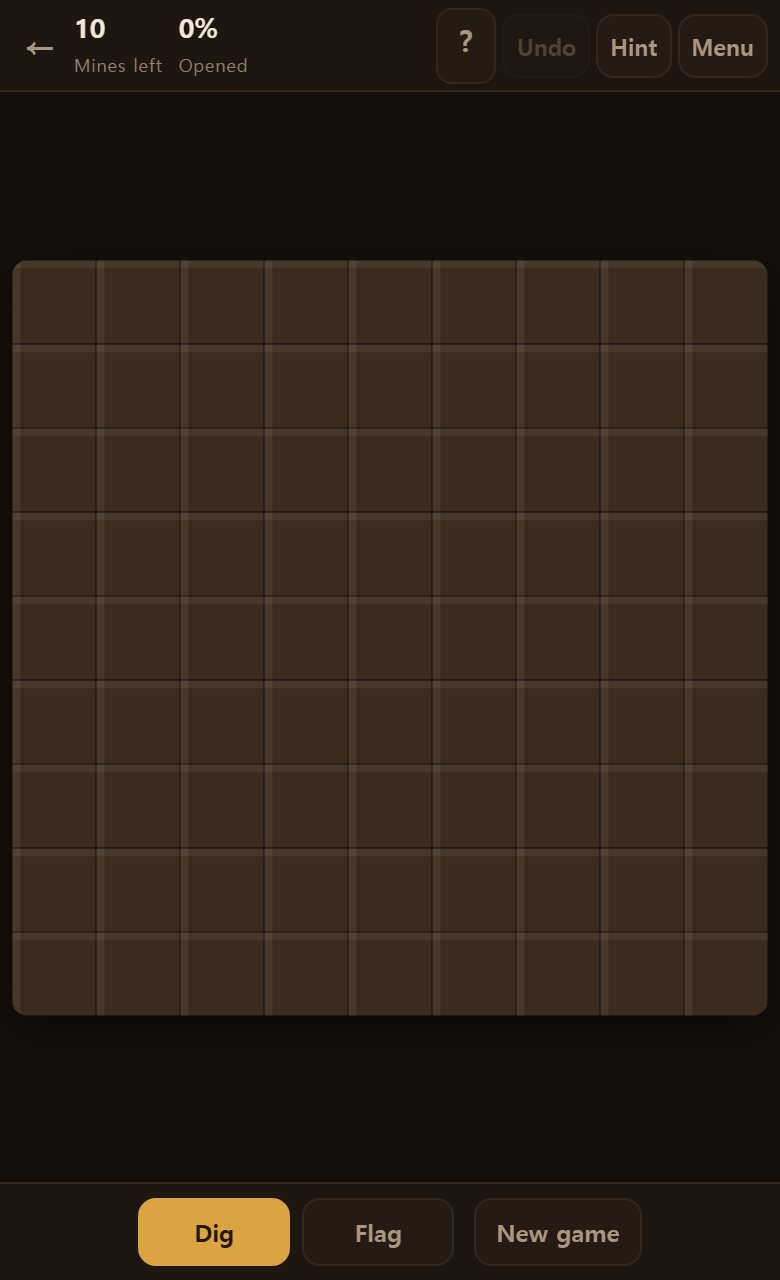
Tap somewhere near the middle and a wide area opens, giving you plenty of clues. Tap a corner and only a little opens.
Reading the numbers is the whole game
A 1 means “exactly one mine sits among the eight squares around me.” A 3 means three.
Those eight squares are up, down, left, right, and the four diagonals. A square on the edge has only five neighbours, and a corner square has just three.
- If a corner shows 1 and exactly one unopened square touches it, that square is a mine. No doubt about it.
- If a 1 already has one flag beside it, every other square touching it is completely safe.
- If a 2 has exactly two unopened squares beside it, both of them are mines.
- Once you have planted as many flags as the number says, every remaining square touching it is safe.
- There are only two rules — if the count of remaining squares equals the number, they are all mines; if the count of flags equals the number, everything else is safe.
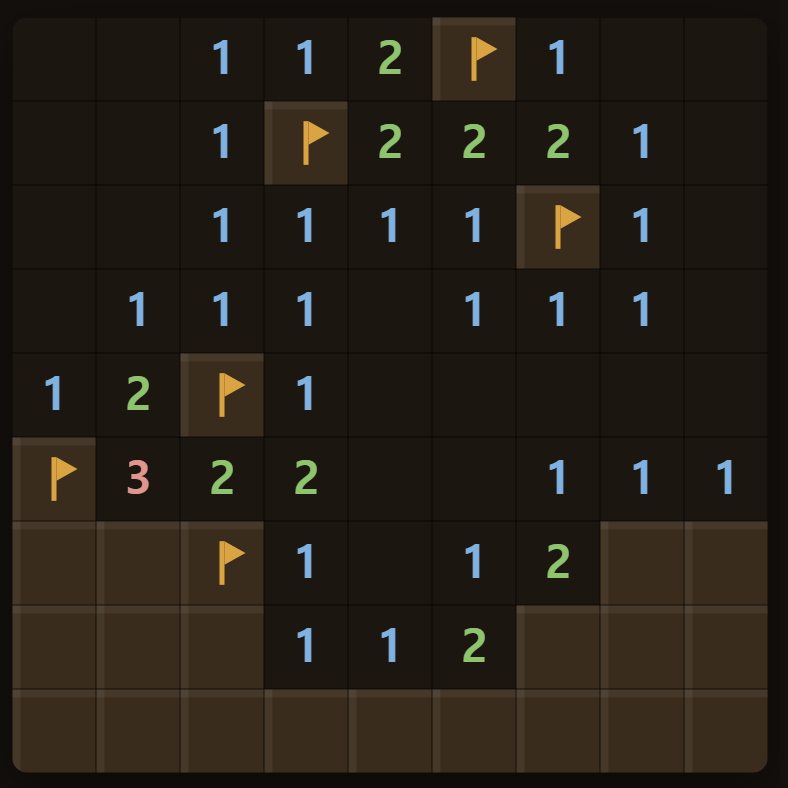
This is not a guessing game. Read the numbers properly and a certain square keeps turning up.
Opening squares and planting flags
A square you believe is safe: just tap it. A square you believe is a mine: press and hold and a flag goes in.
- You can also use the button below to switch between Dig and Flag. If pressing and holding is awkward, this way is easier.
- Planted a flag in the wrong place? Press again to take it out.
- Open a square with no number and the area around it opens up by itself. It keeps spreading as far as the empty squares run.
- Plant a flag and the mines left count at the top drops by one.
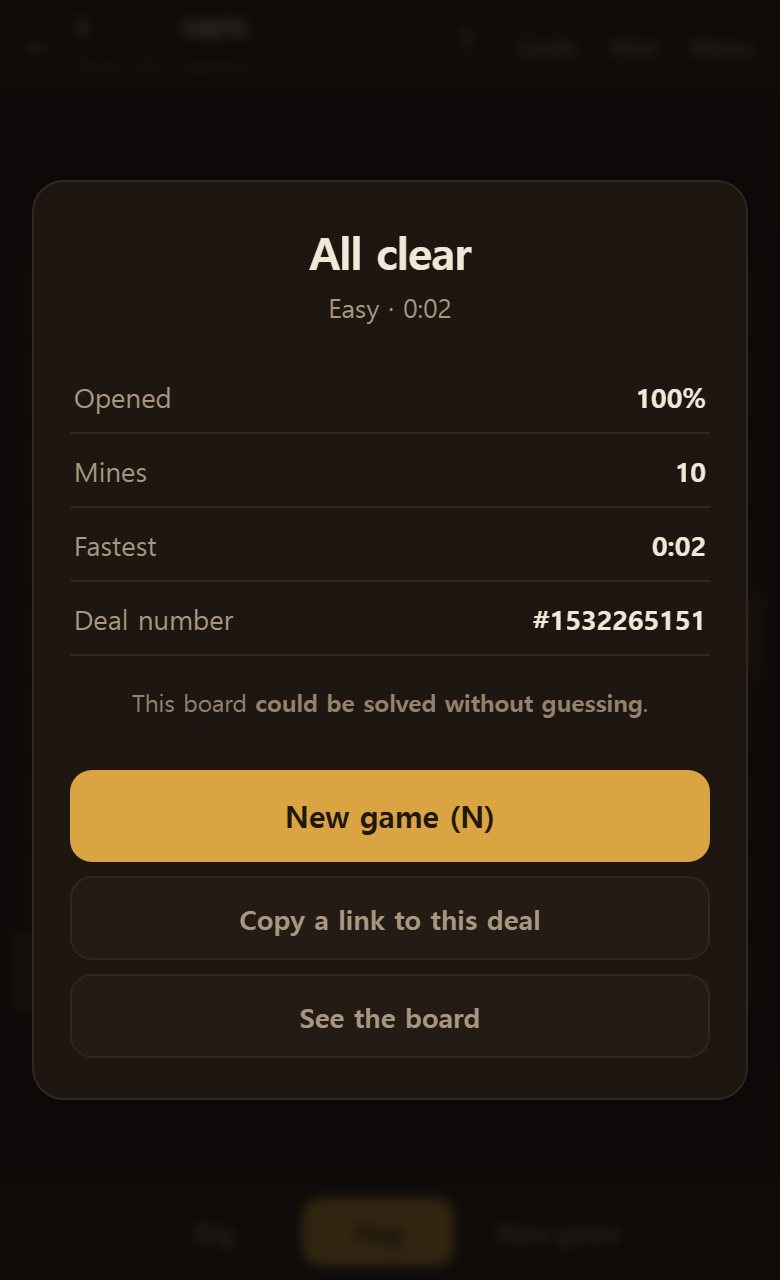
A flag is only your own mark. You can win without planting any. But flags keep you from getting confused, and they let you use “open all at once” below.
Switching between Dig and Flag
The button below switches between Dig and Flag. Whichever is on shows in gold.
In Dig, tapping a square opens it. In Flag, tapping plants a flag.
- Playing with your finger, Flag mode is easier. Press-and-hold does not always register.
- With a mouse you can simply right-click to plant a flag.
- When planting several flags in a row, switching the mode first is far quicker.

You never have to touch the button. Press and hold plants a flag at any time. Use whichever suits you.
Opening several at once
Once you have planted as many flags as the number says, tap the number and every remaining neighbour opens at once. No need to tap them one by one.
For example, if a 2 has two flags beside it, tap that 2 to open the rest in one go. Use this well and you move much faster.
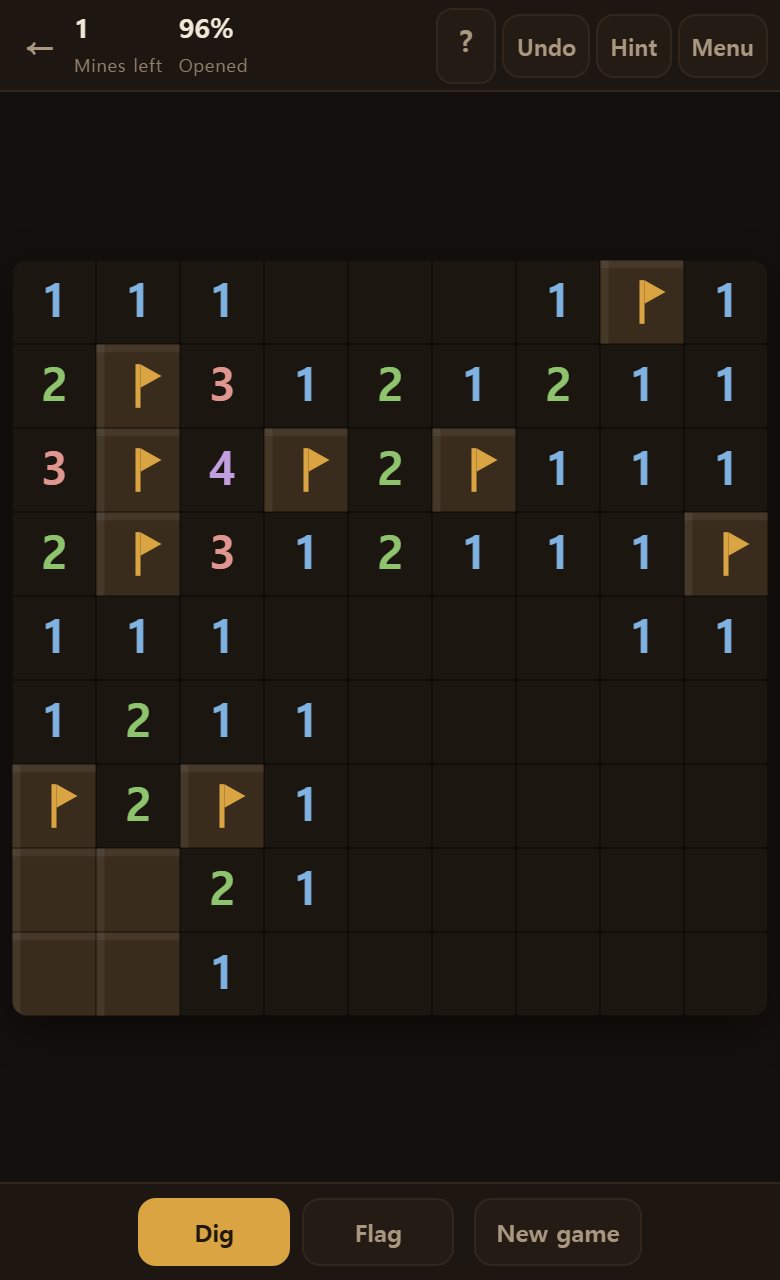
If a flag is in the wrong place and you use this, you step on a mine. Only use it when you are sure.
When you are stuck — the 1-2-1
Sometimes no single number gives you an answer. Then look at two numbers together.
Along an edge you often see 1 2 1 in a row. Here the squares below both 1s are mines, and the square below the middle 2 is safe.
When 1 1 sit side by side, the square they both watch is safe and the one on the outside is a mine.
- 1-2-1 — mines below both 1s, safe below the middle 2.
- 1-2-2-1 — mines below the two middle 2s, safe below both 1s.
- 1-1 against a wall — the square they both watch is safe, the outer one is a mine.
- These shapes turn up most often at walls and corners. Look there first.
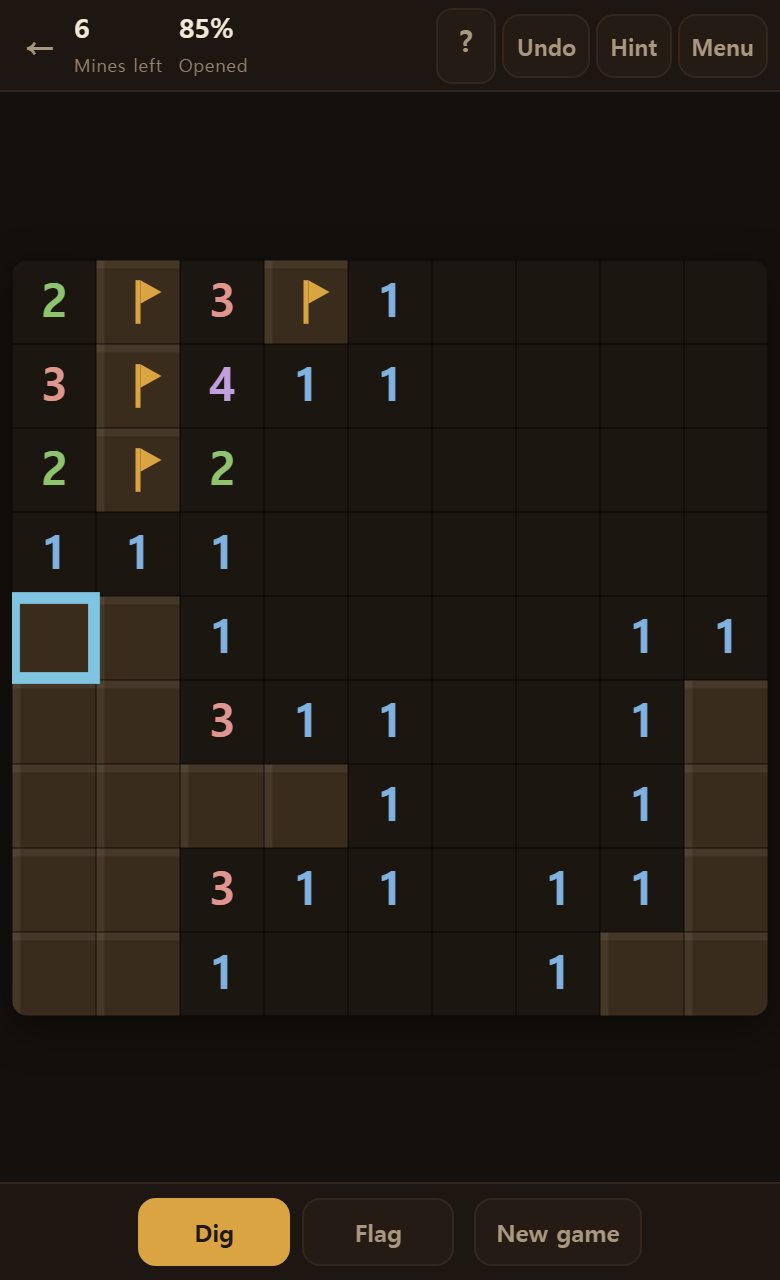
There are only a handful of these shapes. Play a few boards and they start jumping out at you. You do not need to memorise them. Just notice that two numbers are watching the same square, and the answer appears on the spot.
Every board here can be solved without guessing
In minesweeper you sometimes reach a point where there is no way to tell which side it is on, so you have to guess. Dying that way feels unfair.
Here those boards are never dealt at all. When a board is built, we first check whether the numbers alone carry you to the end. A board that does not solve is thrown away and built again.
So if you are stuck, it is not a place to guess — there is a clue you have not spotted yet.
- When a board is built we first check that it solves to the end using only the methods a person uses.
- A board that does not solve is thrown away and built again — as many times as it takes.
- So every board you get here can be solved to the end without guessing.
- When you finish, the screen tells you so once again.
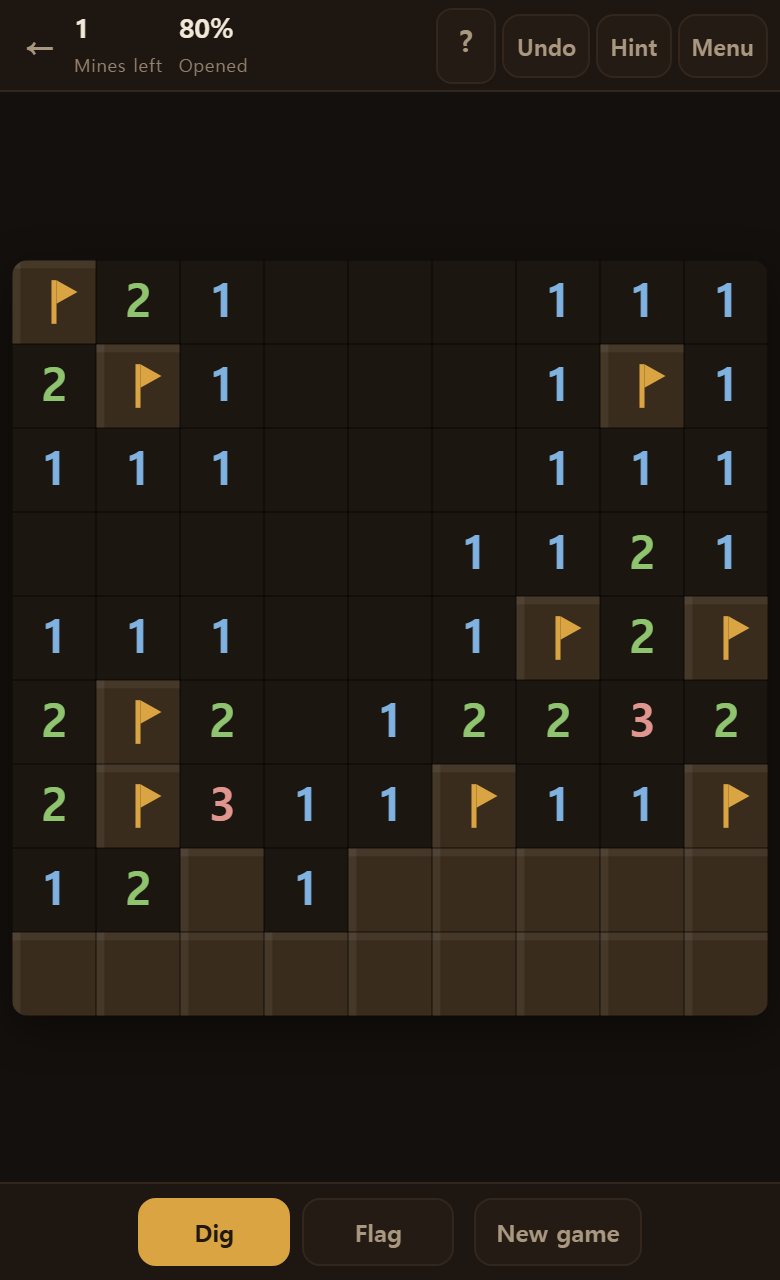
When you are stuck, sweep back over the numbers you have already opened. A newly opened number often unlocks an old one. So in this game you never lose to bad luck. If you stepped on a mine, you misread something somewhere.
You can carry on after dying
Stepping on a mine is not the end. Press Undo and you go back to just before it.
Since the board never needs a guess anyway, look again and the answer is there. You can take back as many moves as you like, so play without worrying.
Once you get the hang of it
Try changing the board size. A bigger board takes longer, but it also gives more clues.
- Walls and corners are the easiest place to start. Fewer squares touch them, so there are fewer possibilities.
- The moment you plant a flag, look again at the numbers next to it. The flag you just planted often unlocks another number.
- Leave the big numbers (4, 5) for later. Small numbers solve far more readily.
- If you are stuck, press Hint. It points out one square that is certain from what you already know.
- The clock is running, but there is no need to rush. One badly dug square costs far more than any time hurrying saves.

The mines left figure at the top is simply the total number of mines minus the flags you planted. It does not check whether the flags are right. A wrong flag still lowers it, so reaching 0 does not mean you have found them all.
Tap a number to open at once
When a numbered square has as many flags around it as the number says, tap the number to open every remaining neighbour at once. No need to tap them one by one.
- If there are too few flags, nothing happens at all. So a stray tap is harmless.
- If a flag is wrong, that is when you step on a mine. Only use this when you are sure.
- Use this well and a board solves several times faster.
- If nothing around it is still unopened, tapping does nothing.
This is the real reason to plant flags. They are not just marks — they are the key to opening several at once.
Hint
Press Hint at the top and it points out one square that can be worked out from what you already know. It also tells you whether that square is safe or a mine.
- If there is a wrongly planted flag, it tells you about that first.
- If a safe square exists, it points and says this one is safe.
- If a square is certainly a mine, it points and says this one is a mine.
- If it says there is nothing to point at, either you have solved it or something is wrong somewhere.
When the hint points at a square, work out for yourself which number gave it away. Doing that once is what makes you see it unaided next time.
Undo — carry on even after dying
Press Undo at the top and your last move never happened. Digs and flags alike step back one at a time. On a keyboard it is Ctrl+Z.
- Step on a mine and one undo takes you back to just before it. That is not the end.
- A wide opening from tapping a blank square also steps back as a single move.
- You can undo all the way back to the start, as many times as you like. The count is not tracked.
Since only guess-free boards are dealt, stepping on a mine means you misread something. Undo, look at that spot again, and it usually shows itself.
How to win
Just five habits will make you much faster.
- Solve edges and corners first. Fewer squares touch them, so there are fewer possibilities.
- Look at small numbers first. 1s and 2s solve far more readily.
- After planting a flag, look again at the numbers beside it right away. What you just planted often unlocks another number.
- When the flags match the number, tap that number and open the rest at once.
- If nothing solves, look at two numbers together. Shapes like 1-2-1 come up often.
All five are really one — only tap what is certain. These boards never need a guess, so the urge to guess means there is a number you have not looked at.
Common mistakes
Boards that end badly nearly always come down to one of these four.
- Guessing — the most common. These boards never need a guess, so the urge to guess is a sign to look somewhere else.
- Opening at once over a wrong flag — tap the number without realising the flag is wrong and you step straight on a mine.
- Ignoring newly opened numbers — opening a square changes what the old numbers mean. Watch only the new ones and you miss a square that is already solved.
- Trusting the mines-left figure — it does not check whether your flags are right. Even at 0 something may be wrong.
All four come from treating something uncertain as if it were certain.
When the board is done
Open every square that is not a mine and you win. You do not have to plant all the flags.
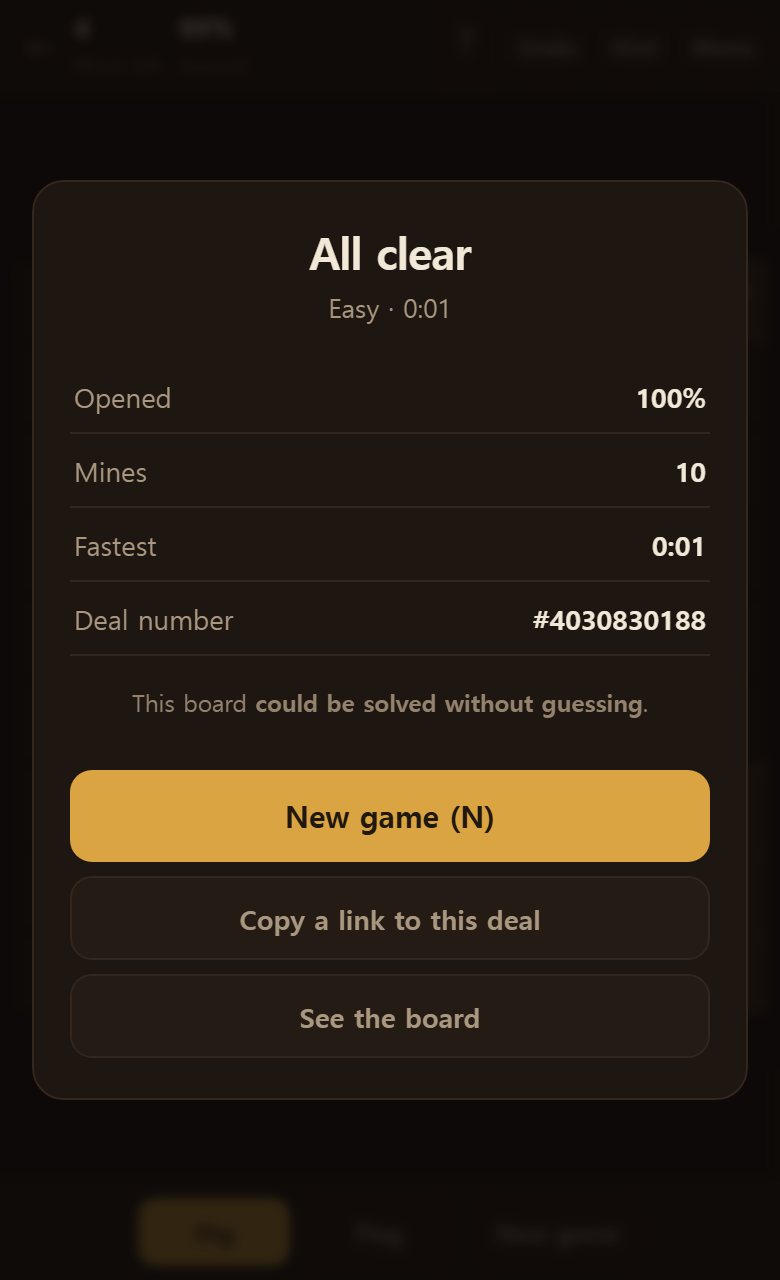
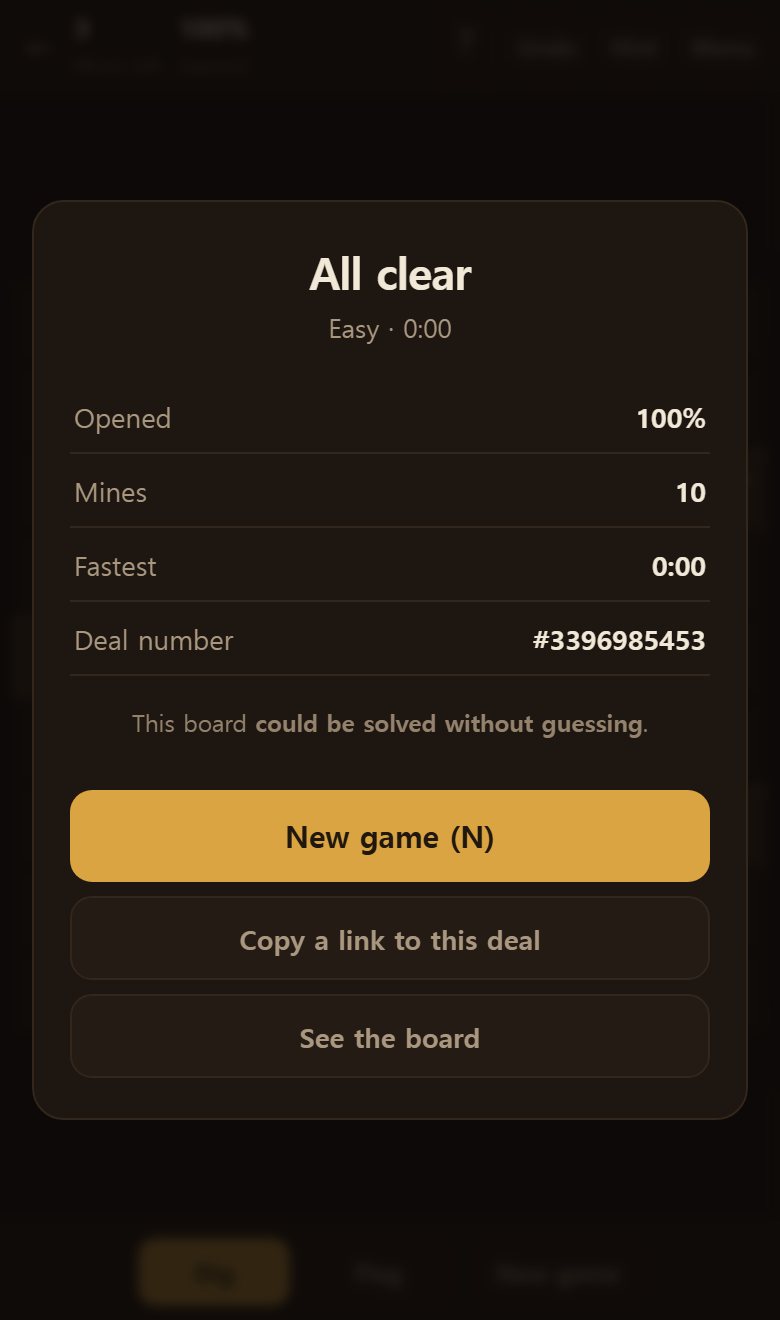
The board number and your time are kept, and it tells you that this board was solvable without guessing.
- Note the board number down and you can open the same board again any time.
- Copy this board’s link and you can send the very same board to someone else.
- Your best time is kept separately for each difficulty. It stays on this device only.
Common questions
Try holding a little longer. Or use the button below to switch to Flag mode and simply tap.
Press Undo and you go back to just before it. Carry on from there.
The flags must match the number before it opens at once. With too few flags, nothing happens.
No. You can win without any. But they keep you from getting confused and let you open several at once, which is handy.
Never. Every board dealt is checked to solve to the end using only the methods a person uses. Boards that do not solve are thrown away and built again.
You win when every square without a mine is open. You do not have to plant all the flags.
That figure is only the total number of mines minus the flags you planted. It does not check whether they are right. Either a flag is in the wrong place, or a safe square is still unopened. Try pressing Hint.
It is the shape where 1 2 1 sit in a row along an edge. The squares below both 1s are mines and the square below the middle 2 is safe. No single number tells you that, but taken together the three leave only one answer.
Start at the edges and corners. Fewer squares touch them, so there are fewer possibilities and a certain square turns up sooner. The middle has eight neighbours, so it settles late.
- Two 1s side by side tell you about the outside, not the squares between them.
- Stuck? Go back over what you have already opened — a new number often unlocks an old one.