 MindHub
How to play Futoshiki
Fill a square grid with numbers. It is much like sudoku, except that greater-than and less-than signs sit between the squares. On a 5 × 5 grid you use 1 to 5. No number may appear twice in a row or a column, and the signs between squares must be obeyed as well. It is far smaller than sudoku with its nine numbers, so you learn it in moments. Yet the signs give you more to reason about, not less.
First, look at the screen
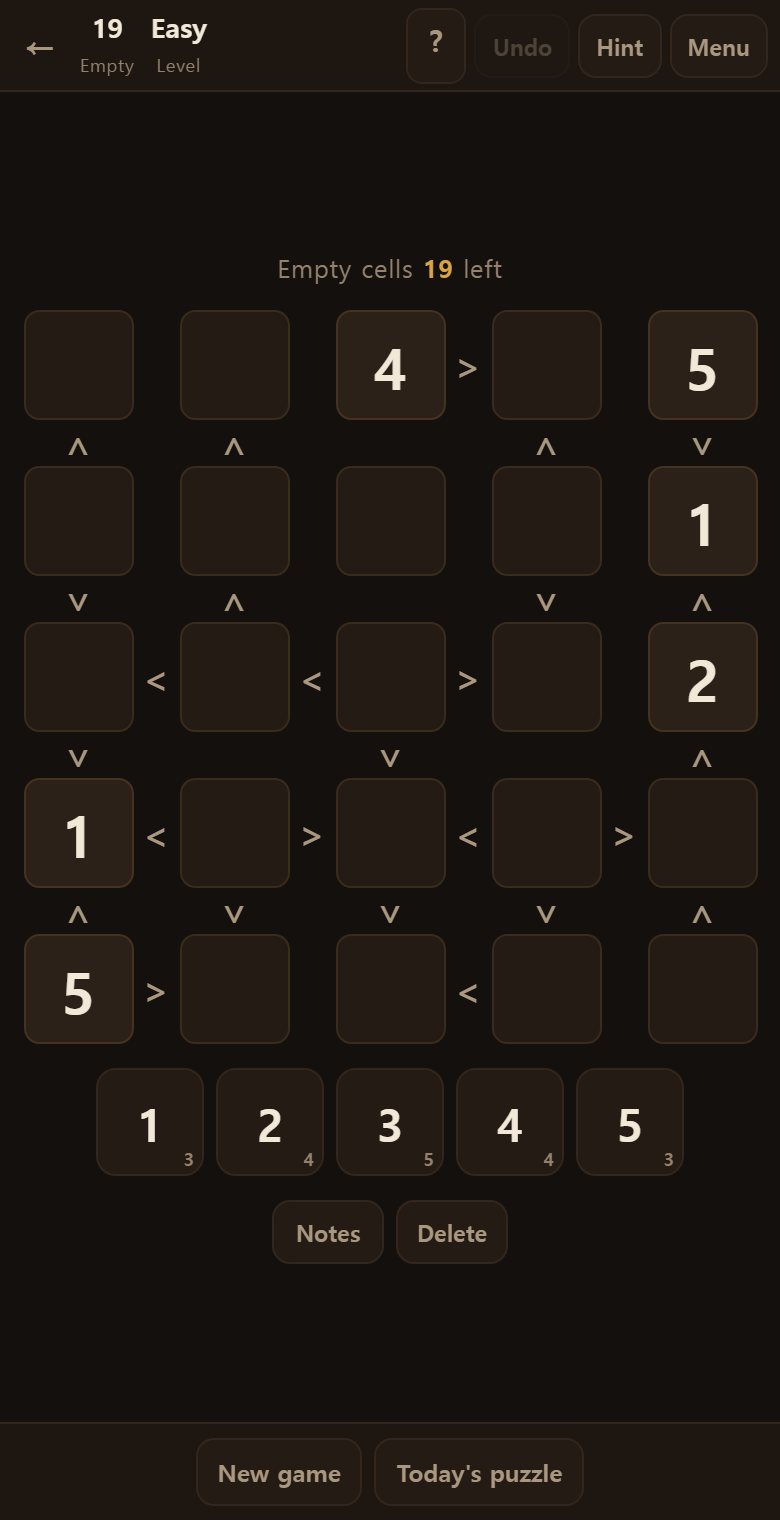
The square grid is in the middle, with the number pad and tools below it.
- The grid — the squares you fill. Bright numbers were there from the start.
- The marks between squares — the inequality signs. Four appear: > < ∨ ∧.
- The number pad — pick a square, then press a number here.
- Notes and Erase — write down candidates, or clear a square.
- The top bar — squares left, time, and difficulty.
When squares left reaches 0 with nothing in conflict, it ends there.
The rules are two lines
First — no number may appear twice in a row or a column. On a 5 × 5 grid each line holds 1, 2, 3, 4 and 5 once each.
Second — where a sign sits between two squares, it must be obeyed too.
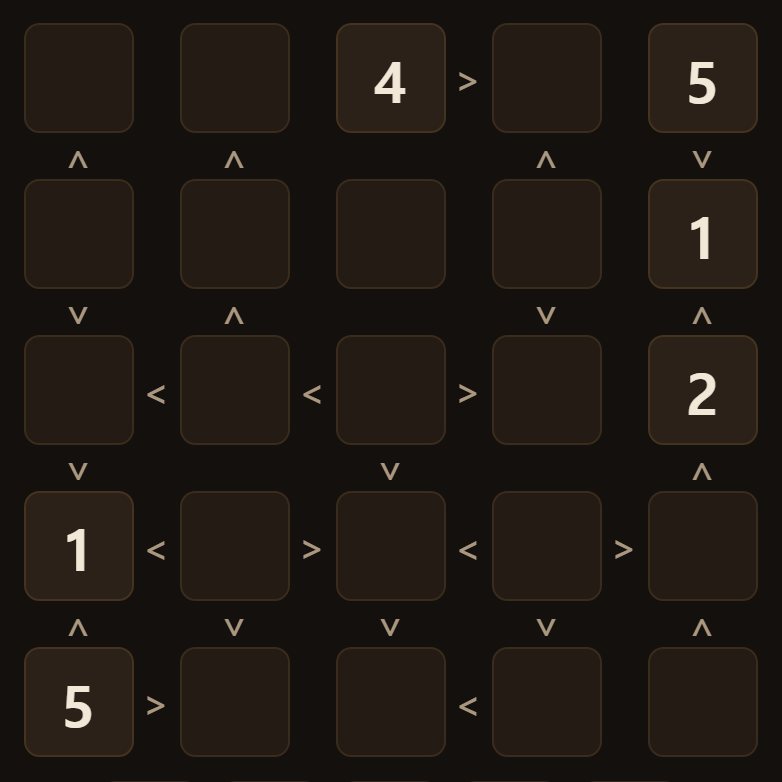
Unlike sudoku there are no 3 × 3 boxes. Only rows and columns. That much simpler.
The open side is the bigger one
There is only one thing to remember about the signs: the open side takes the bigger number.
- > — open on the left, so the left is bigger.
- < — open on the right, so the right is bigger.
- ∨ — open at the top, so the upper square is bigger.
- ∧ — open at the bottom, so the lower square is bigger.
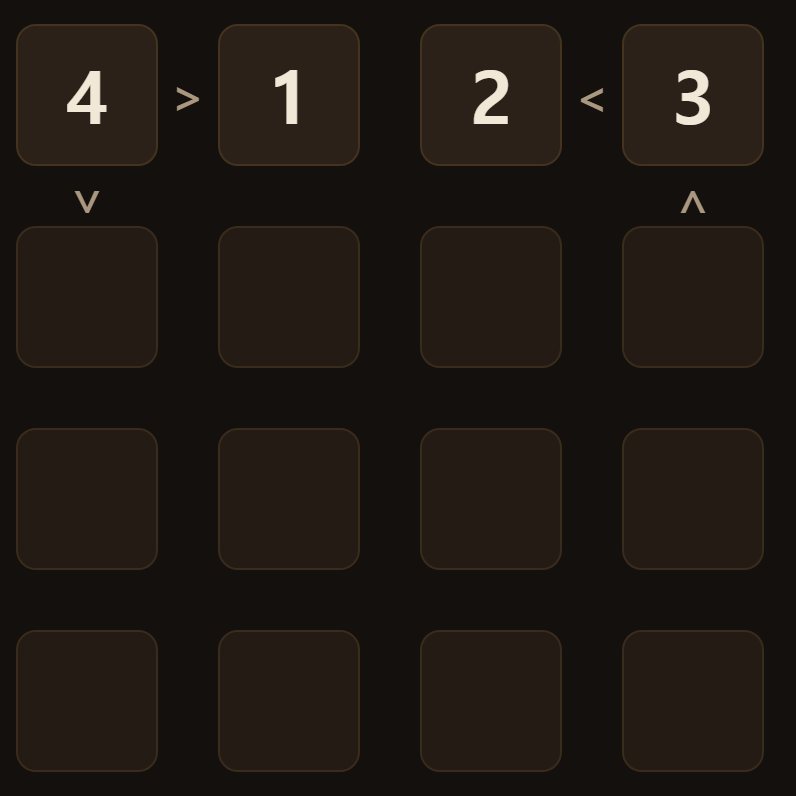
You can equally think of the point as aiming at the smaller side. Some people remember it as a mouth opening wide to eat the bigger number.
Pick a square and its signs light up
Tap an empty square and it takes a gold rim. Every sign touching it turns gold too.
What you must compare it against is visible at a glance, so you never hunt around for the signs.
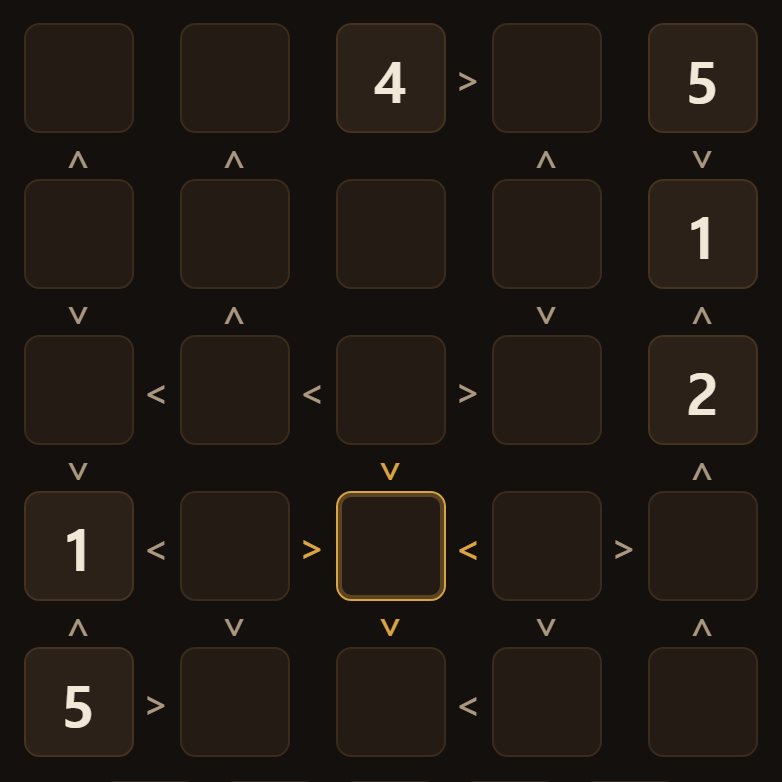
Tap a square holding a number and every matching number on the grid tints faintly, showing you where they all are at once.
How to enter a number
Pick a square, then press a number on the pad below. Pressing the same number again clears it.
Each key carries a small figure at its lower right showing how many are left. On a 5 × 5 grid each number is used five times, so it counts down from 5 to 0.
- With a keyboard, simply typing 1–9 is quicker.
- Arrow keys move the selected square.
- Backspace clears a square.
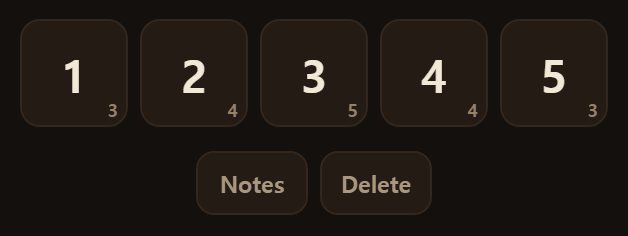
Numbers that were there from the start cannot be changed. Pressing does nothing.
Start with a chain of signs
The first place to look is where the signs run in a chain.
On a 5 × 5 grid, a line with all five squares chained like 1<2<3<4<5 is settled in one go — no other order is possible.
- Even a chain of three is powerful. The leftmost narrows to 1, 2 or 3.
- The longer the chain, the harder it narrows things.
- Do not read only across — look for chains running down as well.
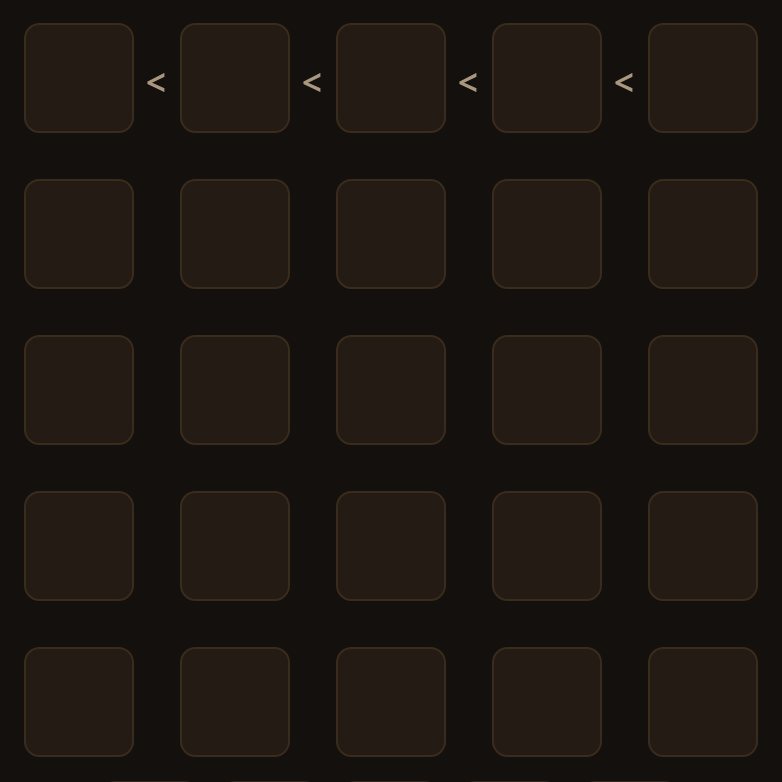
Such a place is the way in to the puzzle. Settle a few squares there and the rest follow in a chain.
Look for squares crowded with signs
When a square has several signs on it all pointing the same way, that square holds either a very large number or a very small one.
- Bigger than all four neighbours and it can only be the largest number.
- Bigger than three neighbours means at least 4 (on a 5 × 5 grid).
- Smaller than all its neighbours and it is 1, or thereabouts.
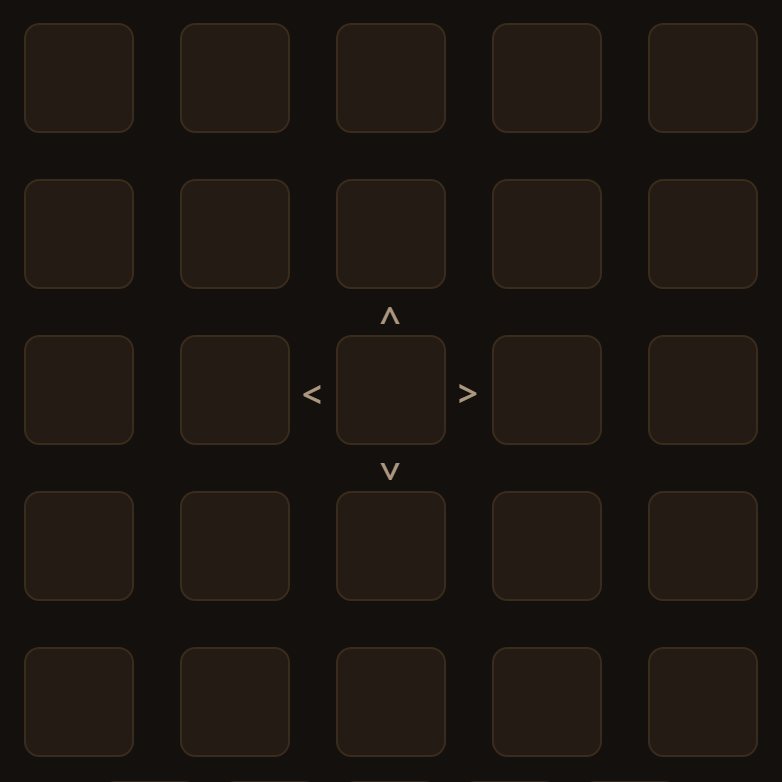
Leave squares with no signs at all for later. They must be reasoned from rows and columns alone, so their clues arrive late.
Even two empty squares narrow each other
A sign works even when both squares are empty. Given A > B, you know this much without knowing what B holds.
- A cannot be 1, since nothing is smaller than 1.
- B cannot be the largest number, since nothing is bigger.
- Pass this back and forth a few times and even empty squares narrow their candidates.
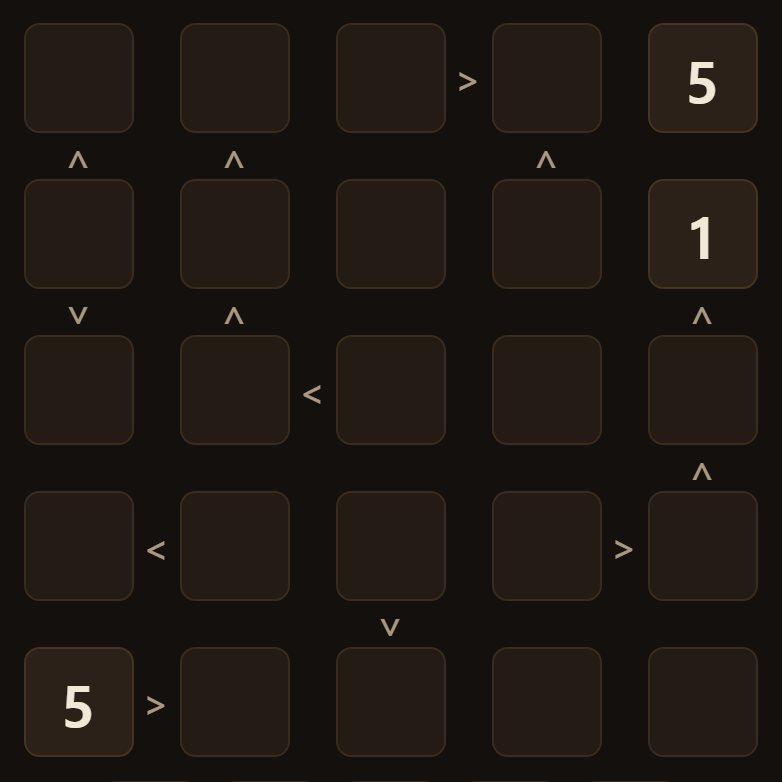
This is exactly the reasoning the Hint does, which is why it says “the signs settle it.”
Writing candidates as notes
Turn on Notes and pressing a number writes it small inside the square — for putting down “2 or 4 here.”
In your head you forget it in moments. Written down, you can go and look elsewhere and pick up your thinking when you come back.
- With Notes on, pressing a number toggles it on and off.
- Enter a real number in that square and the notes clear themselves.
- On a keyboard, M turns Notes on and off.
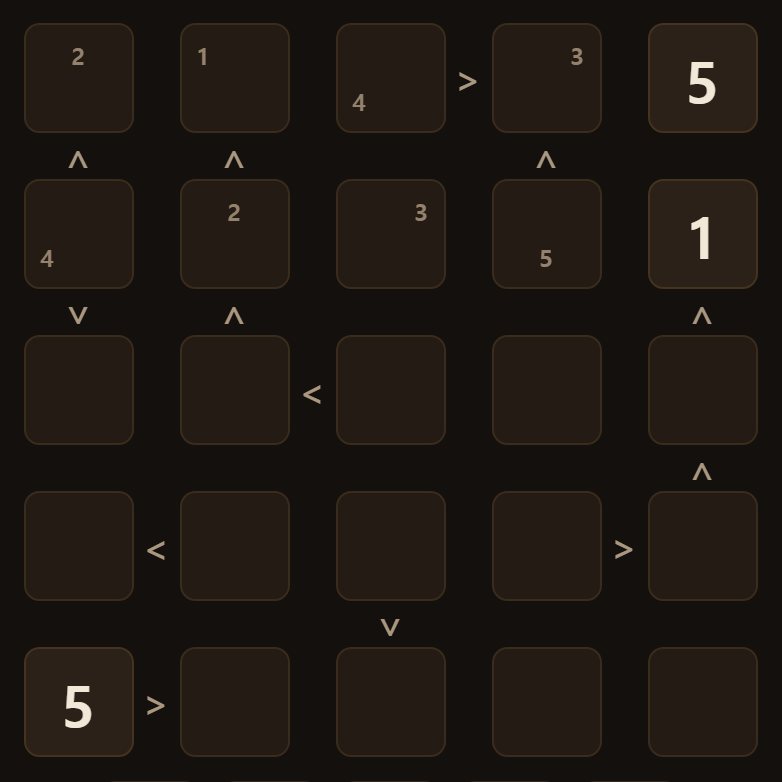
A square narrowed to two candidates is very useful too. If a line holds two such squares with the same pair, you can cross that pair off every other square in the line.
You are told at once if it is wrong
Enter a number that breaks a rule and both squares involved turn red. The top of the grid also says something is in conflict.
You learn it the moment you enter it, not after filling everything in, so nothing collapses far down the line.
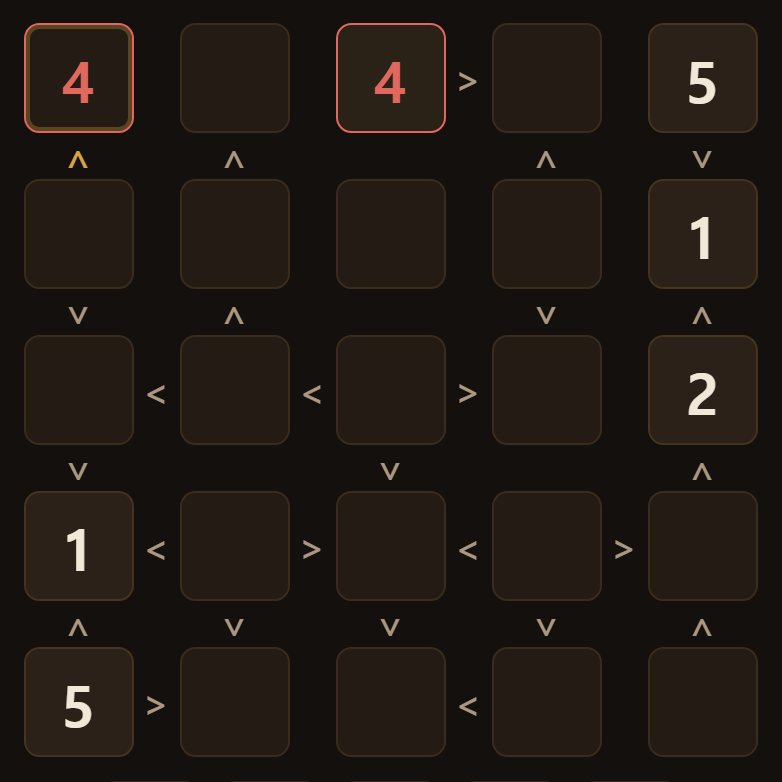
But it only reads what is on the grid now. With many squares still empty, a number can break no rule yet still lead nowhere later.
The hint gives you its reason
Press Hint at the top and it points out one square to fill, and tells you why that number.
- The signs settle it — decided by size relative to a neighbour.
- Every other number is blocked — sweep the row and column and only one is left.
- If something is in conflict, it tells you about that first.
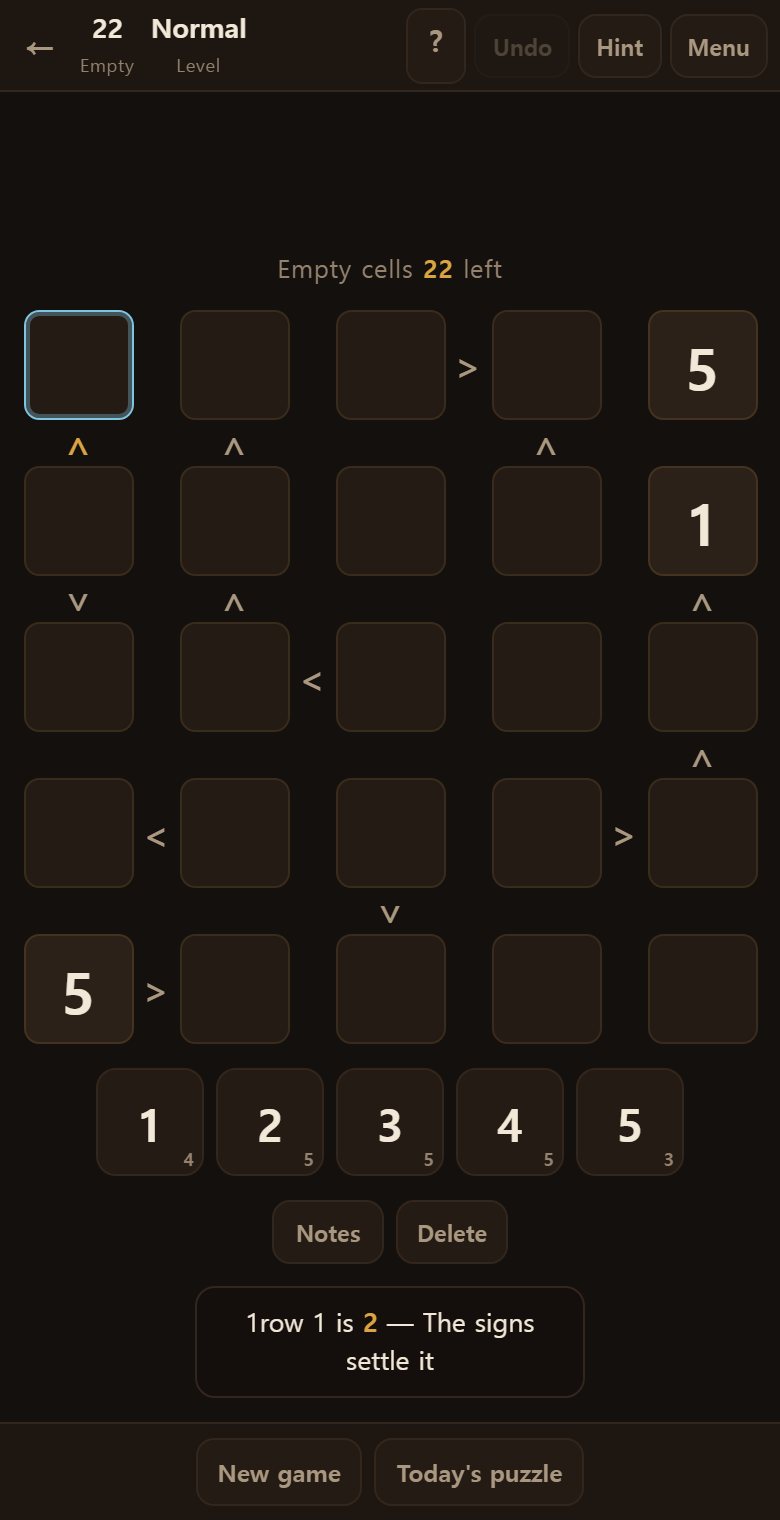
There is no penalty however often you press it. Read the reasons and before long you see them yourself.
Only puzzles with a single answer
Scatter signs and numbers carelessly and you get a puzzle with several answers — where filling it in correctly still gets you told you are wrong.
Here, every puzzle is built and then the answers are counted. If there is more than one, another sign is kept or another number revealed.
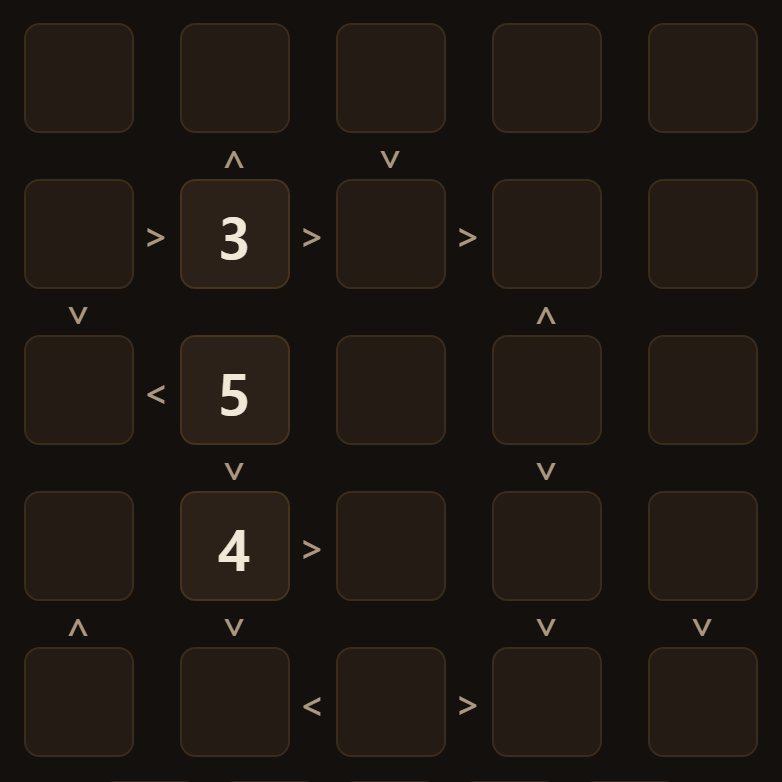
A puzzle someone sends you is counted again at your end. Hand-edit the link to send a broken puzzle and it will not open.
You never have to guess
There is no need to solve by “let me try a 3 here and undo if it fails.”
Every puzzle dealt here can be carried to the end by reasoning alone. When one is built, we check it solves by the methods a person uses, and if not, one more clue is given.
- A square with one candidate left — that is the answer.
- A number with only one place to go in a line — that is its square.
- Those two alone carry you to the end.
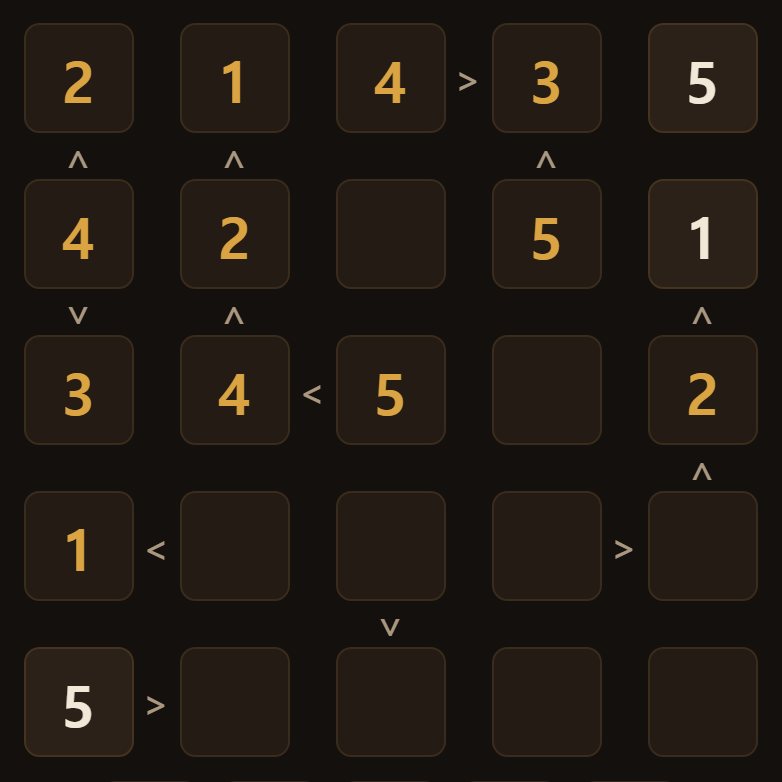
So being stuck means there is a clue you have not seen. Do not guess. Sweep the grid again and it is there.
Line a whole row up at once
Instead of taking the signs one at a time, you can order a whole line at once. Once you are used to it, this is far quicker.
Say a row of a 5 × 5 grid reads:
A > B C < D E
A is bigger than B, and C is smaller than D. There is no sign between E and anything else.
- Since A > B, A is not 1 and B is not 5.
- Since C < D, C is not 5 and D is not 1.
- So 1 can only go in B, C or E.
- And 5 can only go in A, D or E.
- Bring the vertical signs in as well and those three narrow to one.
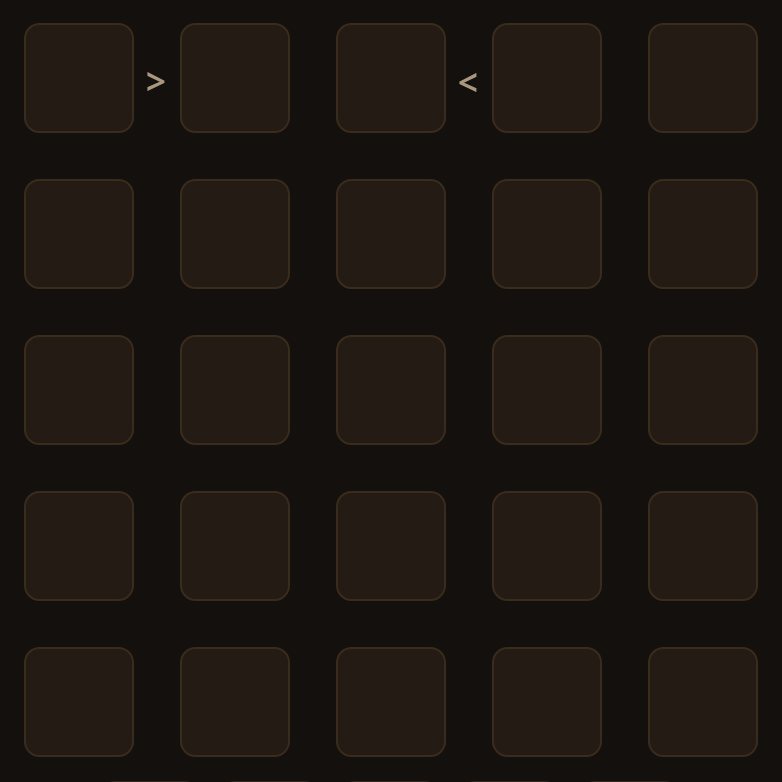
The knack is to place 1 and 5 first. The largest and smallest numbers have the fewest places they can go.
Grid size and difficulty
Choose the grid size and difficulty from the menu.
- 4 × 4 — 1 to 4. Good for learning the rules.
- 5 × 5 — 1 to 5. The size that suits it best.
- 6 × 6 — 1 to 6. Far more to reason about.
- Easy — plenty of signs and plenty of numbers.
- Normal — about half the signs are removed.
- Hard — signs are stripped as far as they can be, and hardly any numbers are given.
On Hard you often get a puzzle with no starting numbers at all. Twenty-five squares, filled from the signs alone.
Sharing a puzzle, and today’s puzzle
When you finish, press Copy this puzzle’s link to send it to someone. Opening that link gives them exactly the same puzzle.
Today’s puzzle, below, is one set puzzle per day. Everyone who opens it gets the same one, so you can race each other.
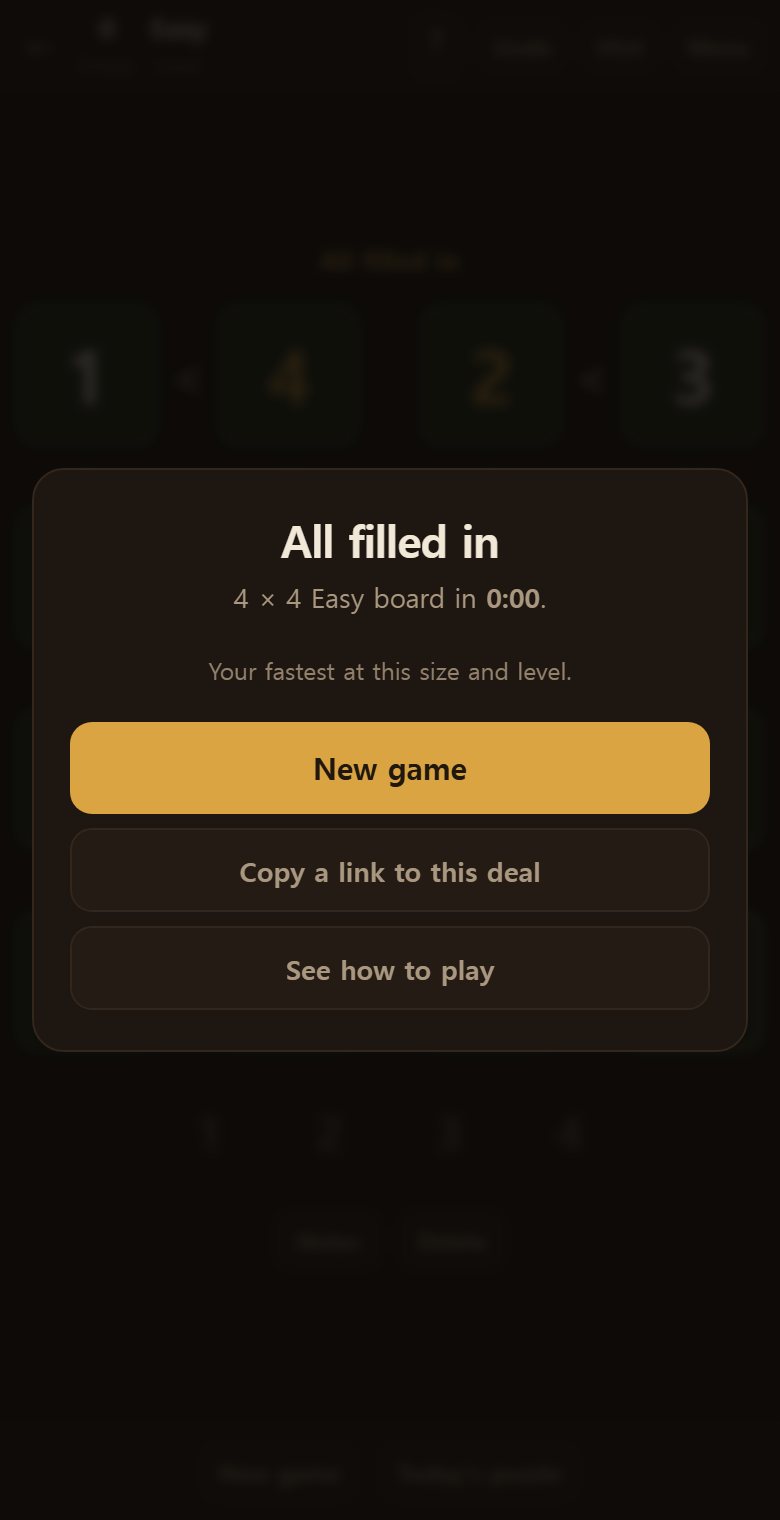
The receiving end counts the answers again too.
How to solve well
Work in this order and it usually falls.
- Find the chains of signs first. That is your way in.
- Look at squares crowded with signs. They are very large or very small.
- Watch the counts on the number pad. Sweeping the grid for the numbers with fewest left is quicker.
- Write notes diligently. Even a square narrowed to two is powerful.
- Tap a square to light its signs. What to compare against shows immediately.
- Do not guess. These puzzles are built to solve by reasoning alone.
- Stuck? Hint. It gives the reason too, so next time you see it yourself.
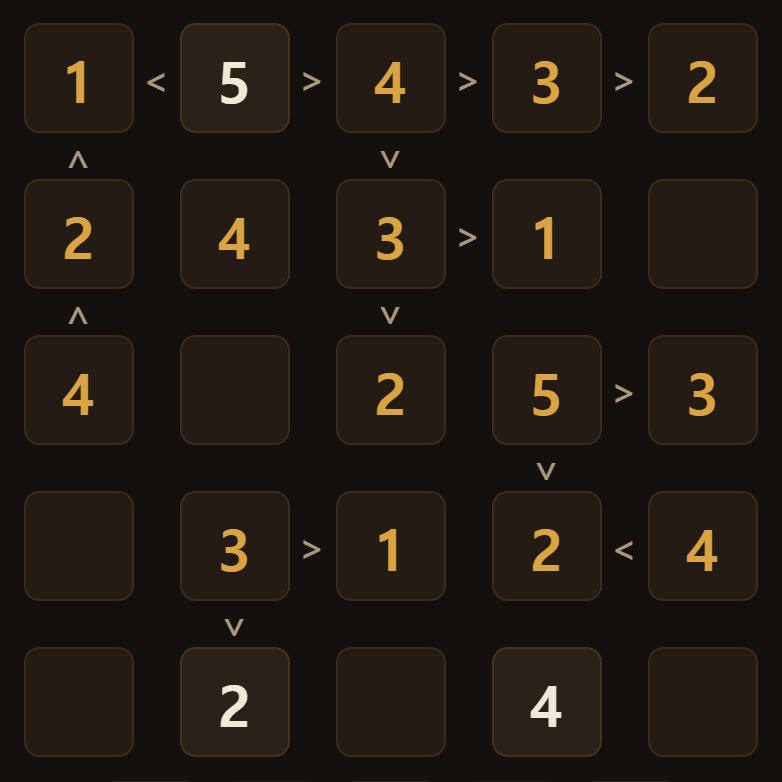
Common mistakes
Puzzles that stall here nearly always come down to one of these four.
- Reading a sign backwards — the most common. Remember one thing: the open side is bigger.
- Missing the vertical signs — reading across only, you overlook them. Tap a square and its signs turn gold; use that.
- Working without notes — you forget the candidates and re-reason the same square over and over.
- Guess and undo — no puzzle here needs it, and it takes longer besides.
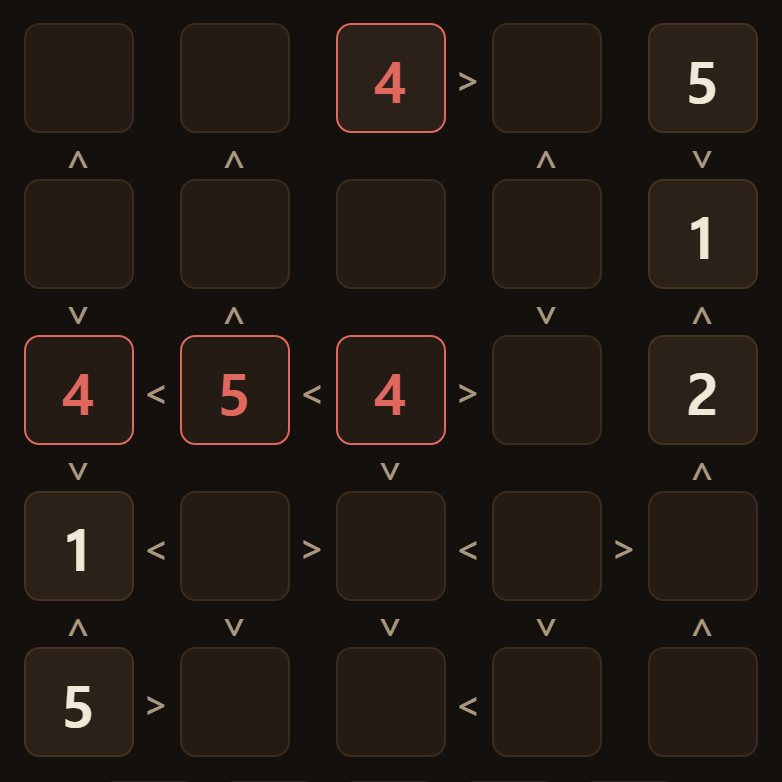
A wrong number turns its square red. Erase it as soon as it does — reason from it and everything else goes wrong.
When you fill it in
When squares left reaches 0 with nothing in conflict, it ends there. The grid turns green and your time appears.
A best time is kept separately for each grid size and difficulty.
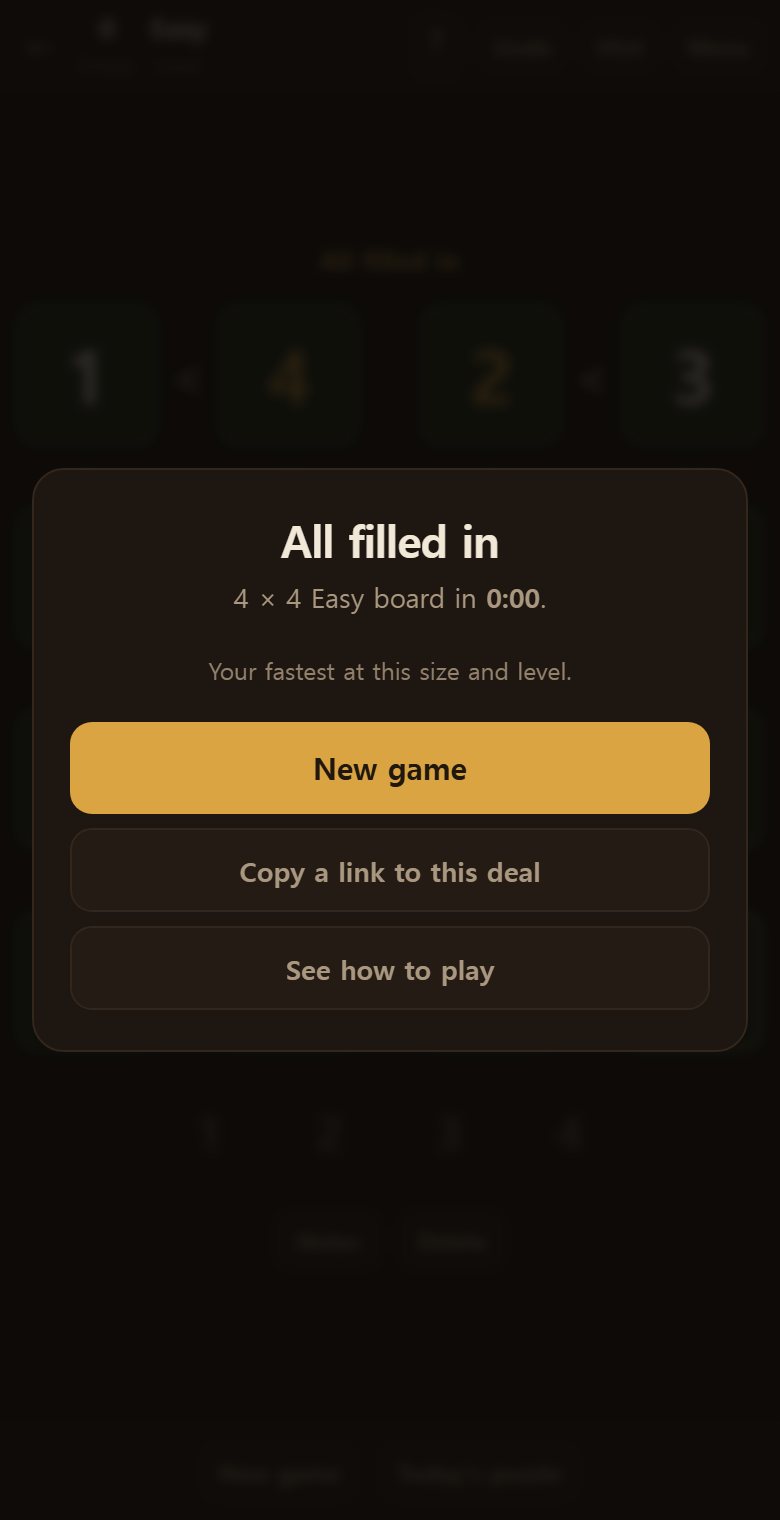
Press New puzzle for a different one. Every puzzle is checked, before it is dealt, for a single answer and for solving without guesswork.
Common questions
The open side is bigger. With > the left is bigger, with < the right, with ∨ the upper square, with ∧ the lower. Equally, the point aims at the smaller side.
No. There are no boxes here. Only rows and columns.
Look first for a chain of signs. On a 5 × 5 grid, five squares chained in a row settle that line in one go.
Something breaks a rule — either the same number twice in a line, or a sign disobeyed. Erase it and look again.
No. Every puzzle has its answers counted before it is dealt. If there is more than one, another clue is given or the puzzle is rebuilt.
Never. Each puzzle is checked to solve by reasoning alone. If you are stuck, there is a clue you have not seen.
Press Notes below, then a number, and it is written small in the square. Entering a real number clears them. On a keyboard it is M.
You often get a puzzle with no starting numbers whatsoever — to be filled from the signs alone. Even so, you never have to guess.
Yes. When you finish, press Copy this puzzle’s link. The receiving end counts the answers again before opening it.
- Start where the signs run in a chain. A run like 1<2<3<4 settles everything at once.
- The cell with the most signs on it is usually the largest or the smallest.
- Pencil the candidates into empty cells as notes. Sooner or later one of them narrows to a single number.
- Press Hint when you are stuck. It tells you the reason too, so next time you will see it yourself.