 MindHub
How to play Traffic Jam
The car park is full, and your car is stuck in the middle of it. Cars move only forwards and backwards — the ones lying across go left and right, the upright ones go up and down. They cannot be turned, and they cannot pass through one another. Clear the cars in your way, one after another, and get your car out through the exit on the right. How few moves it takes is your score.
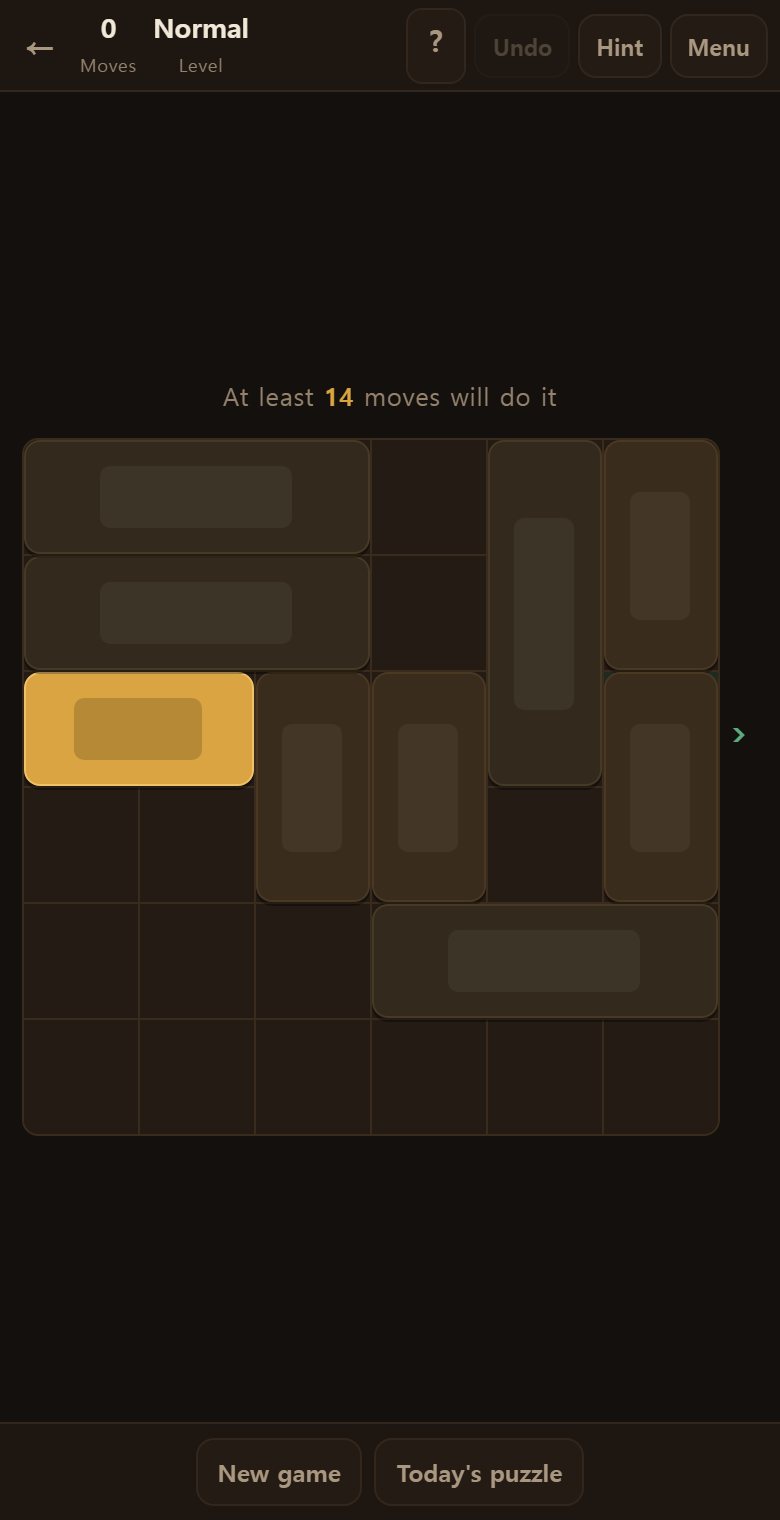
First, a look at the screen
Cars stand in a 6x6 car park.
- The gold car — yours. It always lies across, always in the middle row.
- The brown cars — what stands in your way, two and three squares long.
- The green arrow on the right — the exit. Get out there and it ends.
- The top — moves made, time and difficulty.
The line below the board says the fewest moves in which it can be done.
Your car and the exit
The gold car is yours. It always lies across, always in the row with the exit — the third from the top.
When its right end reaches the right edge of the board, it ends there.
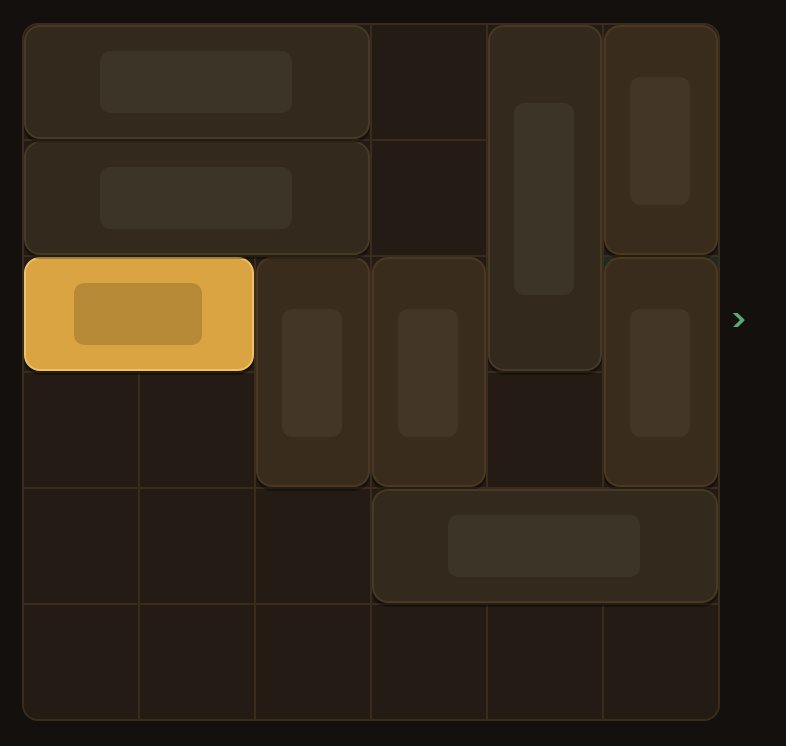
There is no board where your car stands upright or sits in another row. Hand-editing a link to make one will not open.
A car moves only along its own line
This is the first rule of the game.
- Cars lying across — left and right only.
- Upright cars — up and down only.
- They cannot be turned. A car lying across never becomes an upright one.
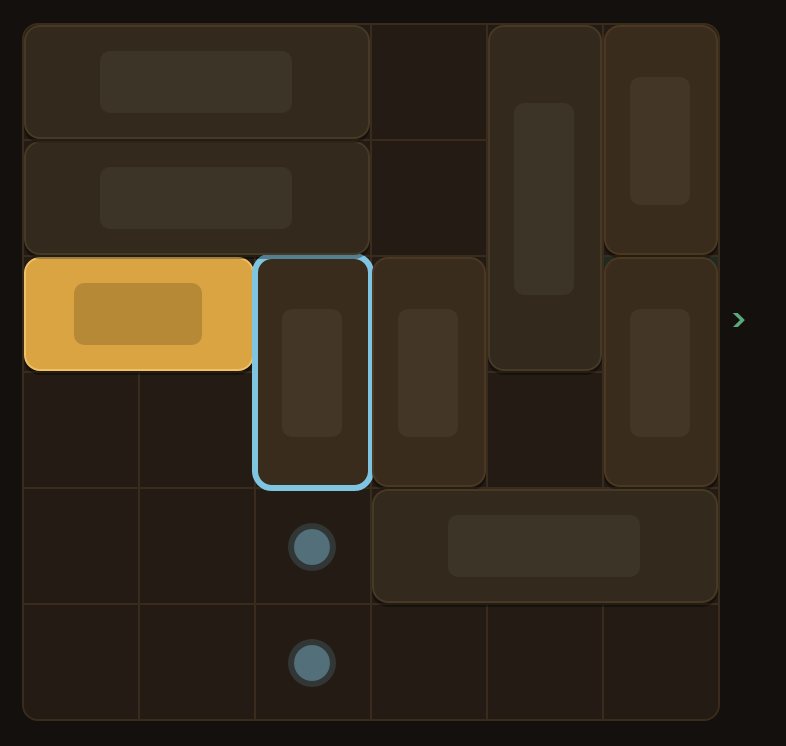
So wherever a car can go lies within its own row or column.
Cars cannot pass through one another
With another car ahead, you stop there. Nothing jumps over anything.
Which makes this a game of getting out of the way. You do not push the car you want to move; you first clear whatever stands in front of it.
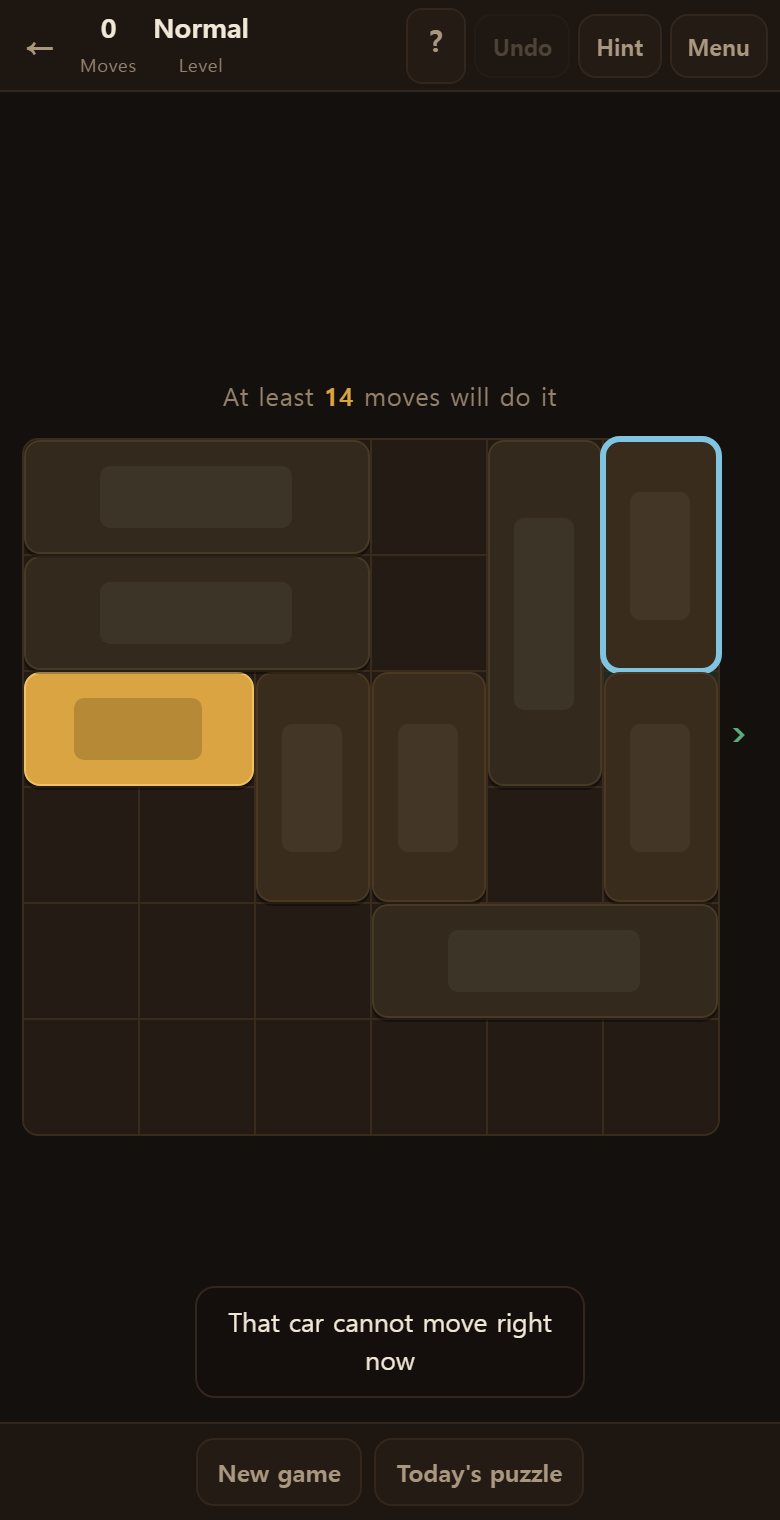
Nor can a car leave the board. Only yours goes out, through the exit on the right.
Tap a car to pick it
Tap the car you want to move and its outline turns blue.
A blue circle then marks every empty square it can reach.
- Tapping the same car again unpicks it.
- Tapping a different car moves the selection to it.
- Tap a car that cannot move at all and it says so.
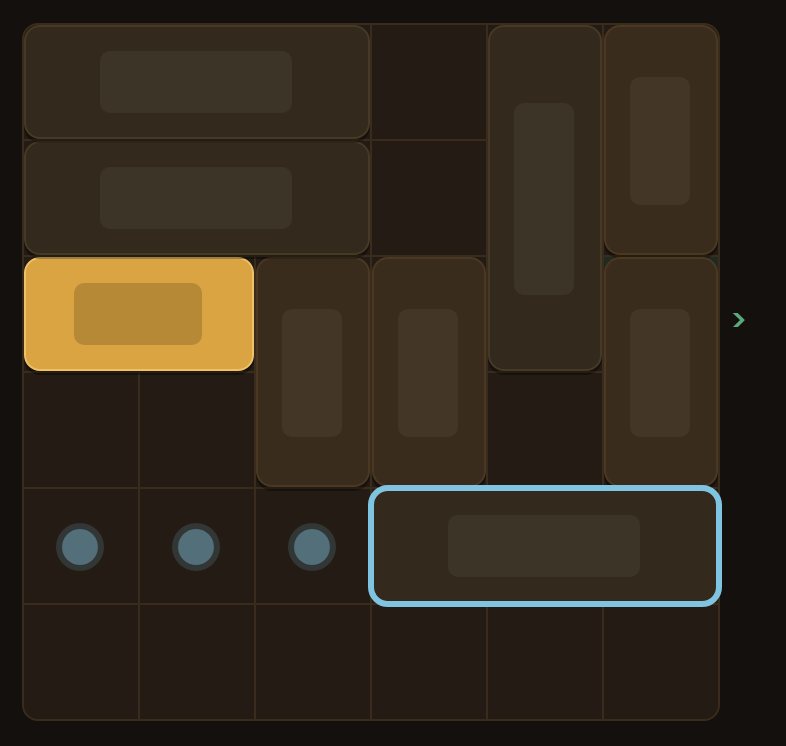
No circles at all means the car is wedged in. Look at what is blocking it.
Tap a circle to move
Tap one of the circles and the car goes all the way there in one move.
For one square, tap the nearest circle; for three, tap the one three away.
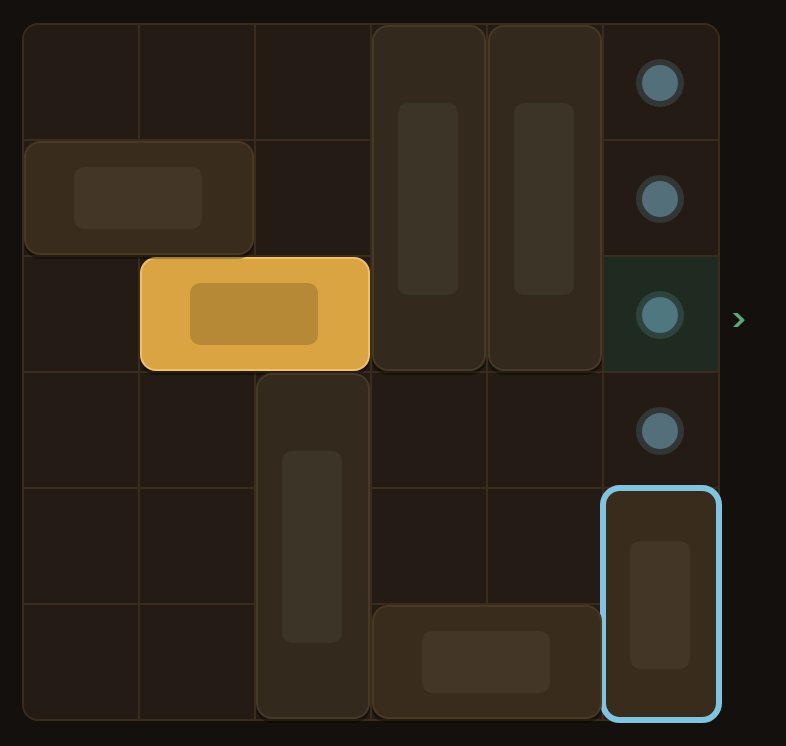
With a car picked, the arrow keys move it a square at a time — ← → for cars lying across, ↑ ↓ for upright ones.
One push is one move
This is easy to get wrong.
One square or three, moving one car is one move — that is how people count it.
So push a car as far as it will go in one go. Pushing a square at a time only runs up the count.
- Pushing a car and pulling it straight back costs two moves and gains nothing.
- Moving another car and then coming back to the first counts as a separate move again.
- A move taken back with undo comes off the count — it resumes from where you undid to.
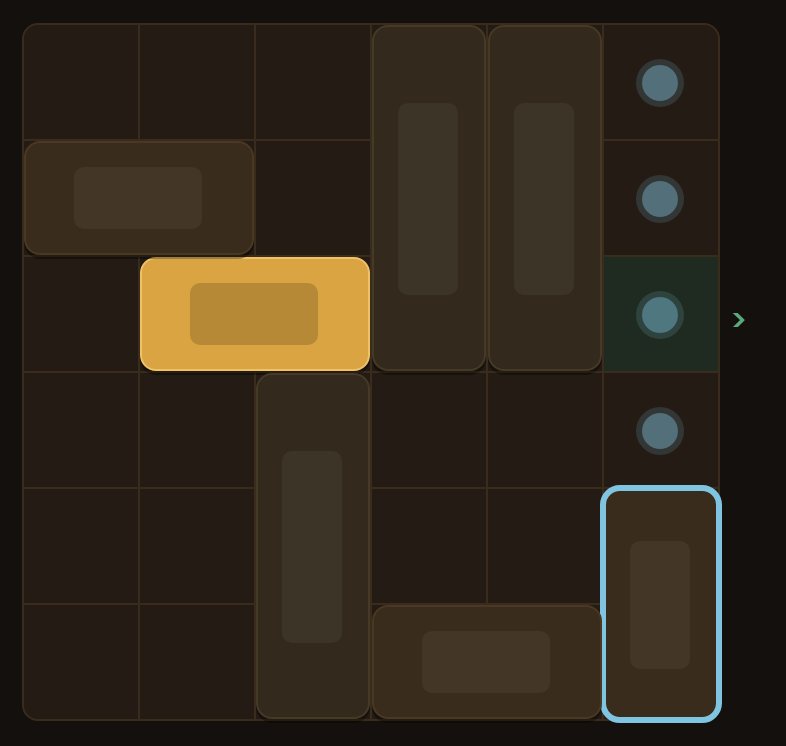
The moves figure at the top counts this way. So deciding how far to go before you push pays off. Let the hand move first and you will touch the same car two or three times.
Three-square cars rarely move
Three-square cars are a slightly different colour. They take up so much room that space to move them rarely appears.
So the trick is to decide where they should sit early. Once one settles, it tends to stay.
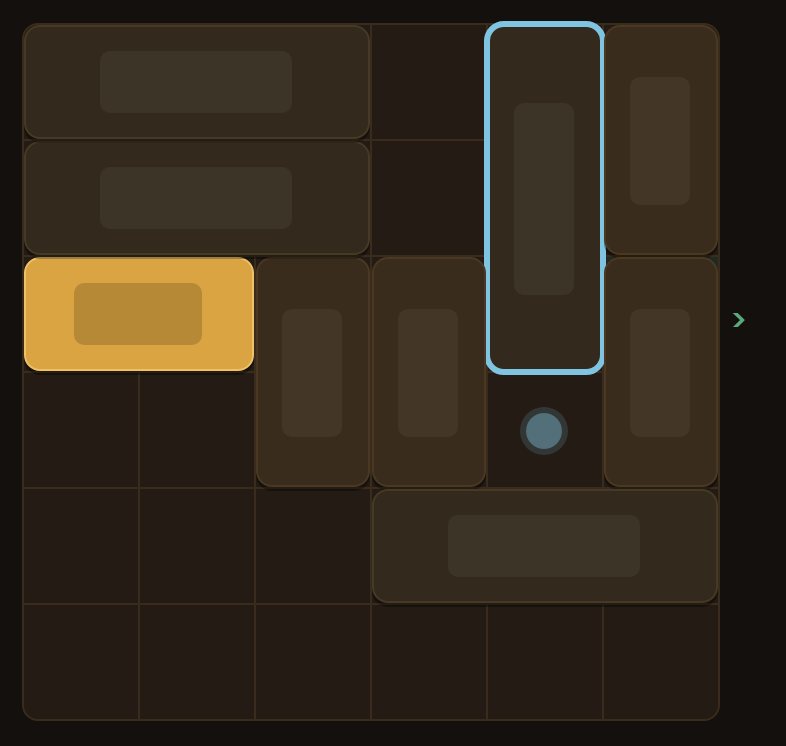
Two three-square cars in a six-square line means that line is effectively full.
Start from what blocks you
A fresh board is bewildering. Always begin in the same place.
See which cars stand between yours and the exit. Until those are cleared, you are not going anywhere.
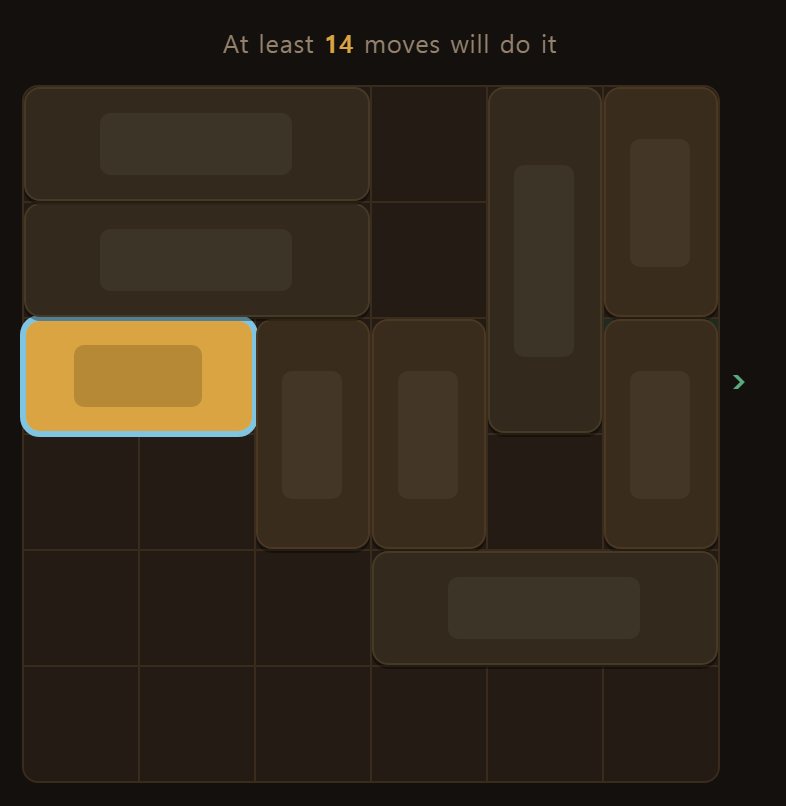
There are usually one to three of them, and they are the problem this board sets. Counting from the exit inwards keeps the order straight. Clear a far one while a near one stands and you have gained nothing.
What blocks the blocker
Having found the blocker, ask why it cannot get out of the way.
If an upright car cannot go up, something is above it. So look at that car instead. Working backwards like this brings you to the car to move first.
- What blocks your car → what blocks that → what blocks that …
- The car with nothing behind it is your first move.
- Move it and the next comes free, and so on down the chain.
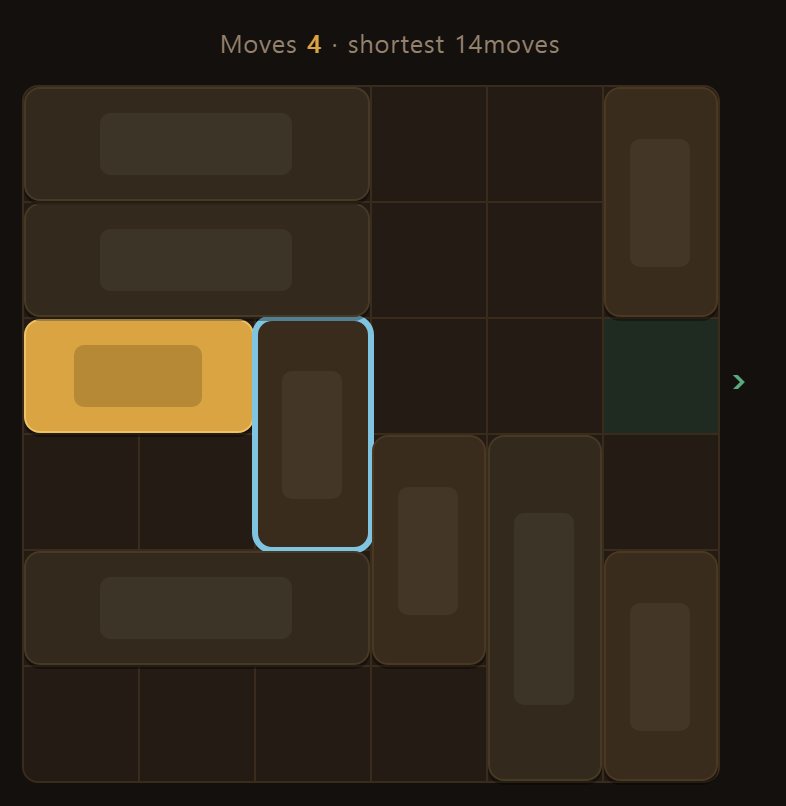
It is hardly an exaggeration to say this working-backwards is the whole game.
The empty squares are the key
A car needs an empty square to move into, and there are only a few on the board.
So turn the question round: not where to move a car, but where to move the empty space.
- Push a car one square right and the empty space moves one square left.
- The car's length makes no difference. Two squares or three, the space appears on the far side by however much you pushed.
- A car in a line with no empty square cannot move at all. There is nothing to read in that line just now.
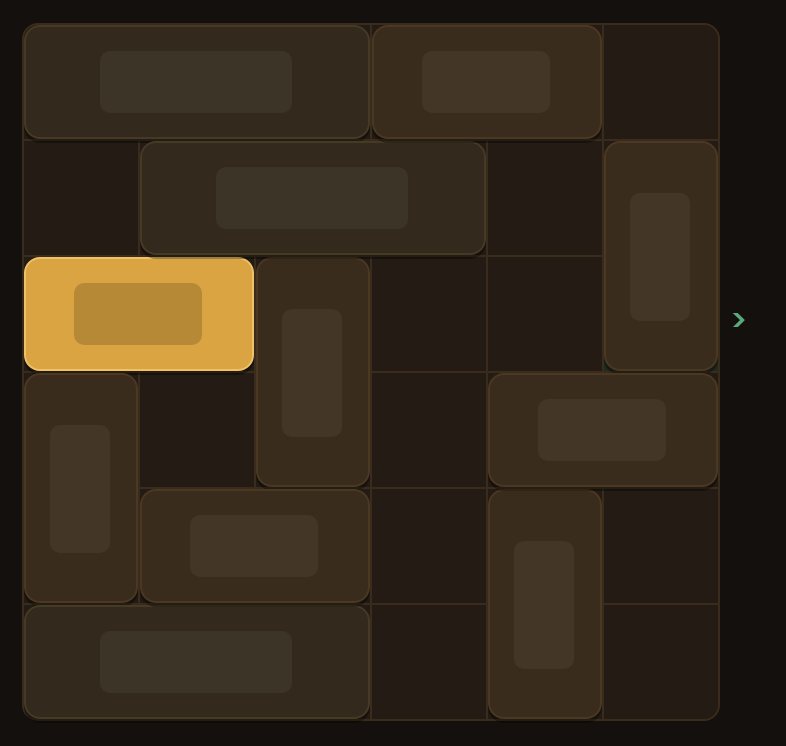
Pushing a car one square sends the empty space the other way. Walking that space to where you need it is what solving this puzzle actually is. When your hand stalls on a jammed board, start by counting where the empty squares are now. The path comes into view from there.
The fewest moves
Below the board it says the fewest moves in which the car can be freed.
That is not an estimate. Every board is actually solved through as it is built, and the shortest solution counted.
- You can never do it in fewer. So if it will not come out, you have taken a wrong road.
- Matching it exactly is as well as it can be done. There is no better.
- Taking more is not a loss. Getting out at all wins the board.
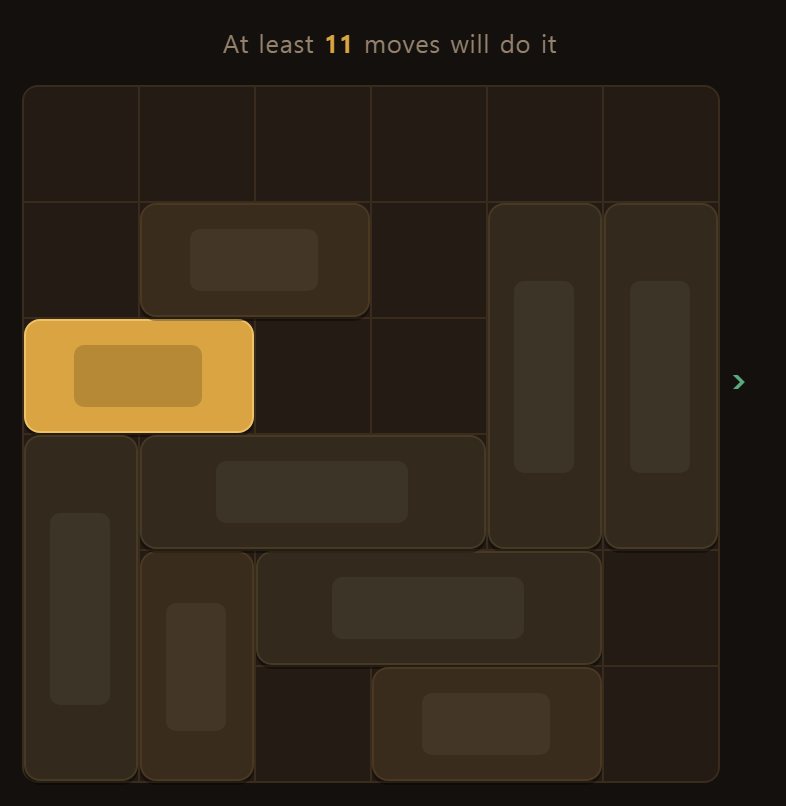
At first, twenty moves over is quite usual. Solve the same board again after undoing back and the count drops markedly — that is when the wasted moves become visible.
Undo
Press Undo at the top and your last push never happened. There is no limit — right back to the start. On a keyboard it is Ctrl+Z.
Do not be sparing with it here. When you jam, undoing to the fork and taking another way is the quicker route.
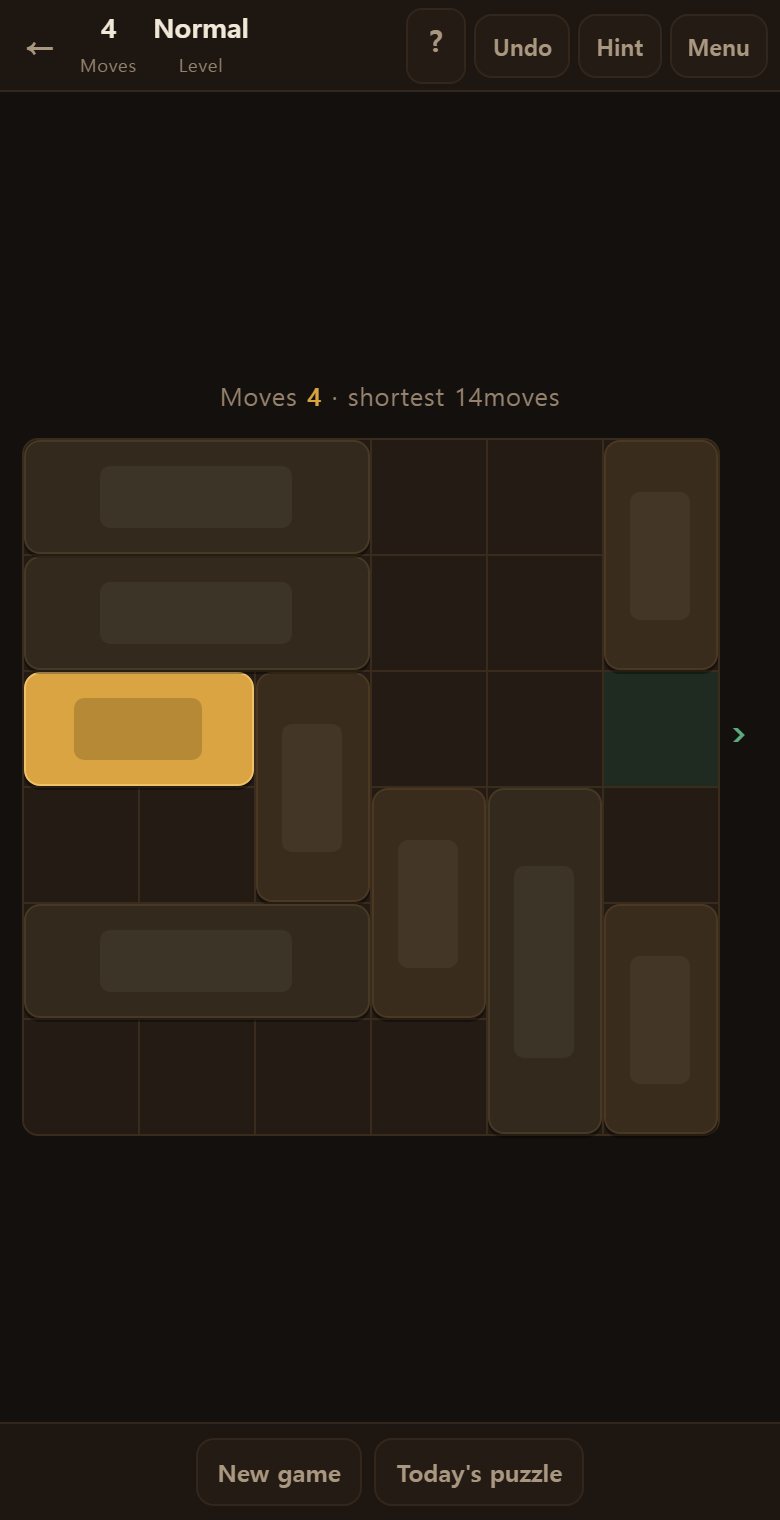
Start over in the menu returns the whole board to its opening position.
Hint
Press Hint at the top and it finds the shortest route from where you are and gives you its first move.
- The car to move is picked out in blue.
- A large circle marks where it should go.
- It also tells you how many moves remain from here.
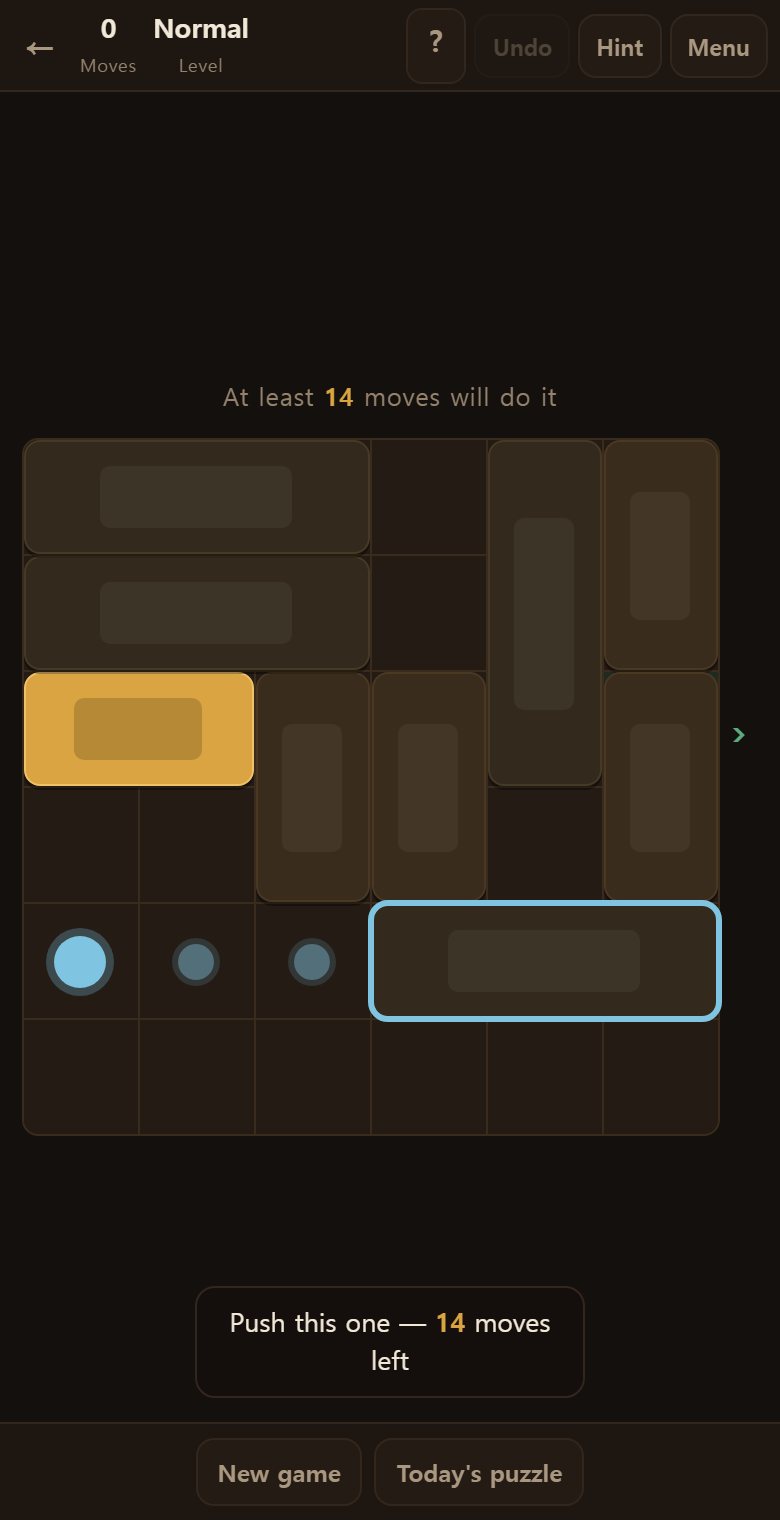
If that figure holds still or rises, your last push was a detour. It makes a very good gauge.
You can simply follow the hint
Push where the hint points, every time, and you take the shortest route without fail.
If the trick has not settled into your hands yet, follow it through one whole board. Which car goes first, and why, becomes visible.
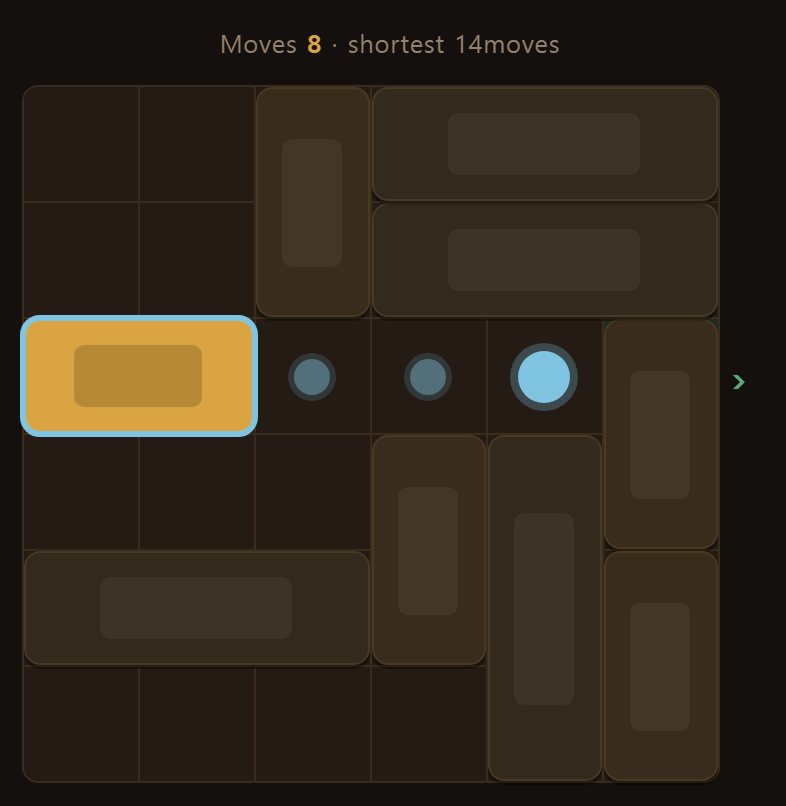
The hint re-solves the whole board before answering, so wherever you are — even well off course — it always points along a correct route.
Difficulty
Set in the menu. Difficulty is measured not by the number of cars but by the length of the shortest solution.
- Easy — six or seven moves. Good for learning the rules.
- Normal — eleven to seventeen. You will work backwards two or three times.
- Hard — over eighteen. The empty space has to be walked a long way.
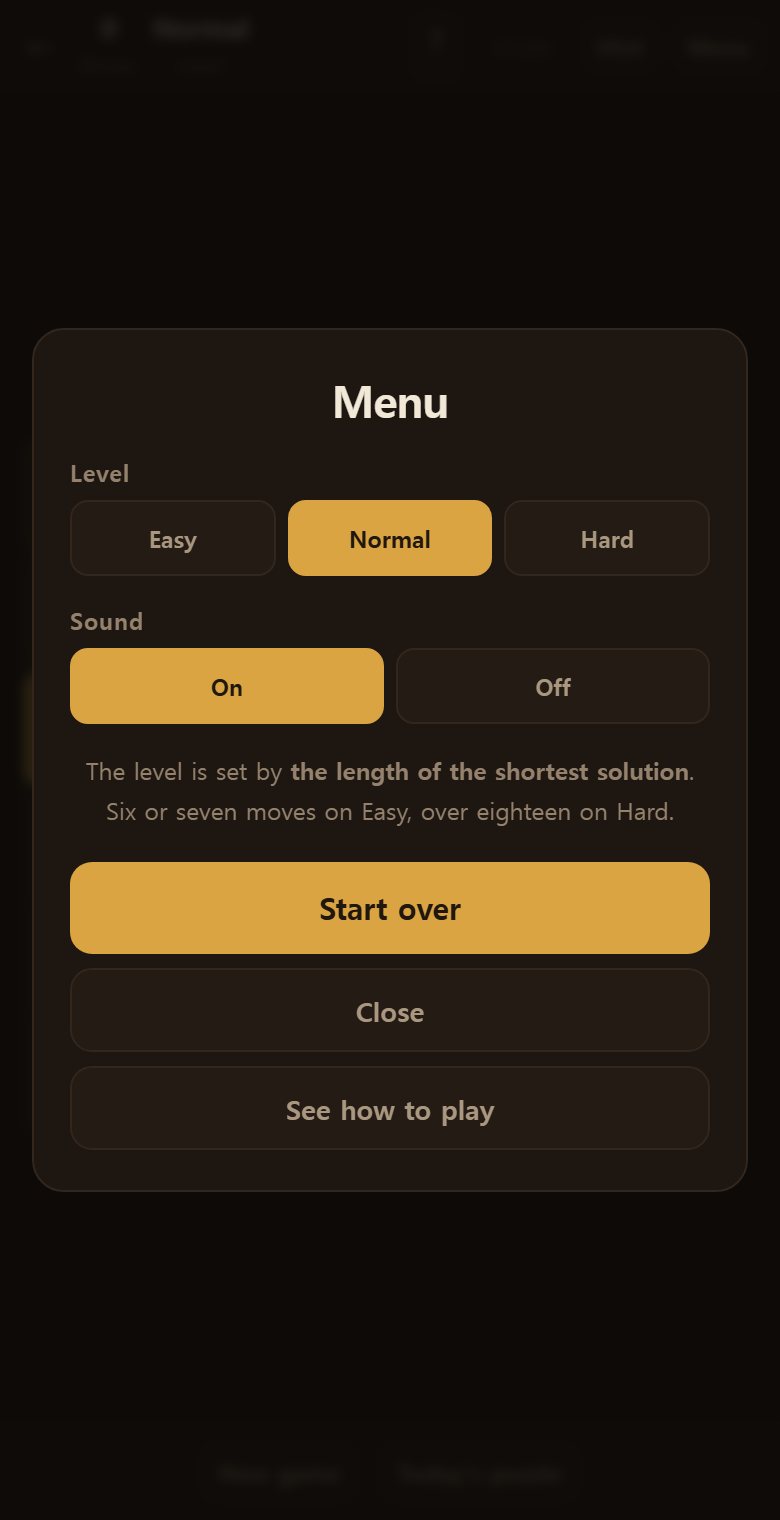
A fewest moves record is kept for each difficulty.
Only solvable boards are handed out
Park cars at random and you get boards that cannot be solved and boards that solve in two moves. Neither makes a game.
So it is done backwards. The cars are placed, every position they can reach is explored, and then distances are measured backwards from the solved position to pick out one needing exactly as many moves as wanted.
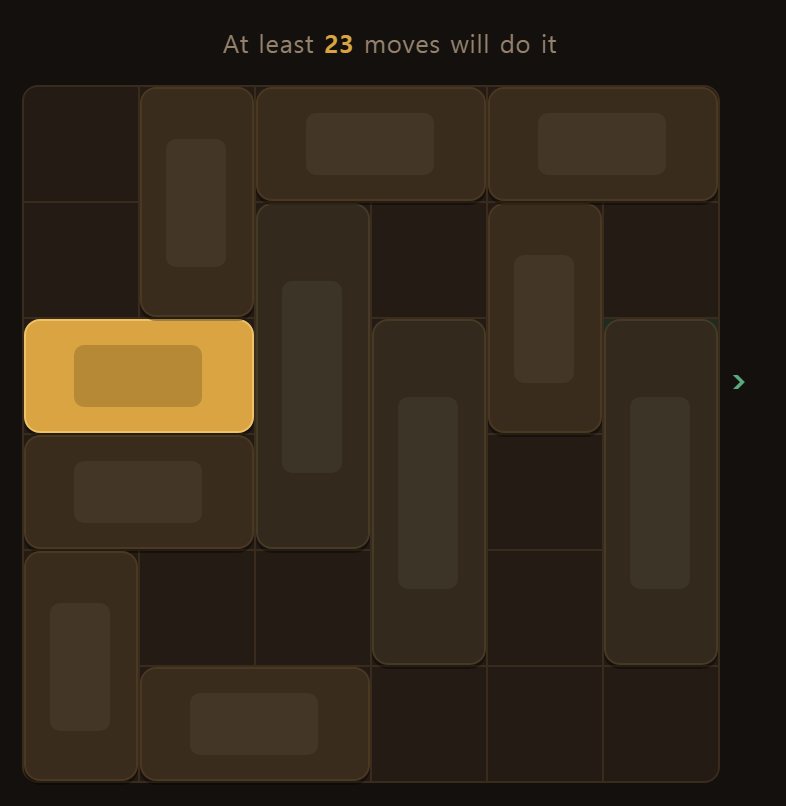
So every board here can be solved, and the figure written under it is true. A link you are sent is solved again on opening.
Sharing, and today's puzzle
Once you are out, Copy link sends this board to someone else. Opening it gives them the same board in its opening position.
Today's puzzle below is set for the day. Everyone gets the same board, so move counts can be compared.
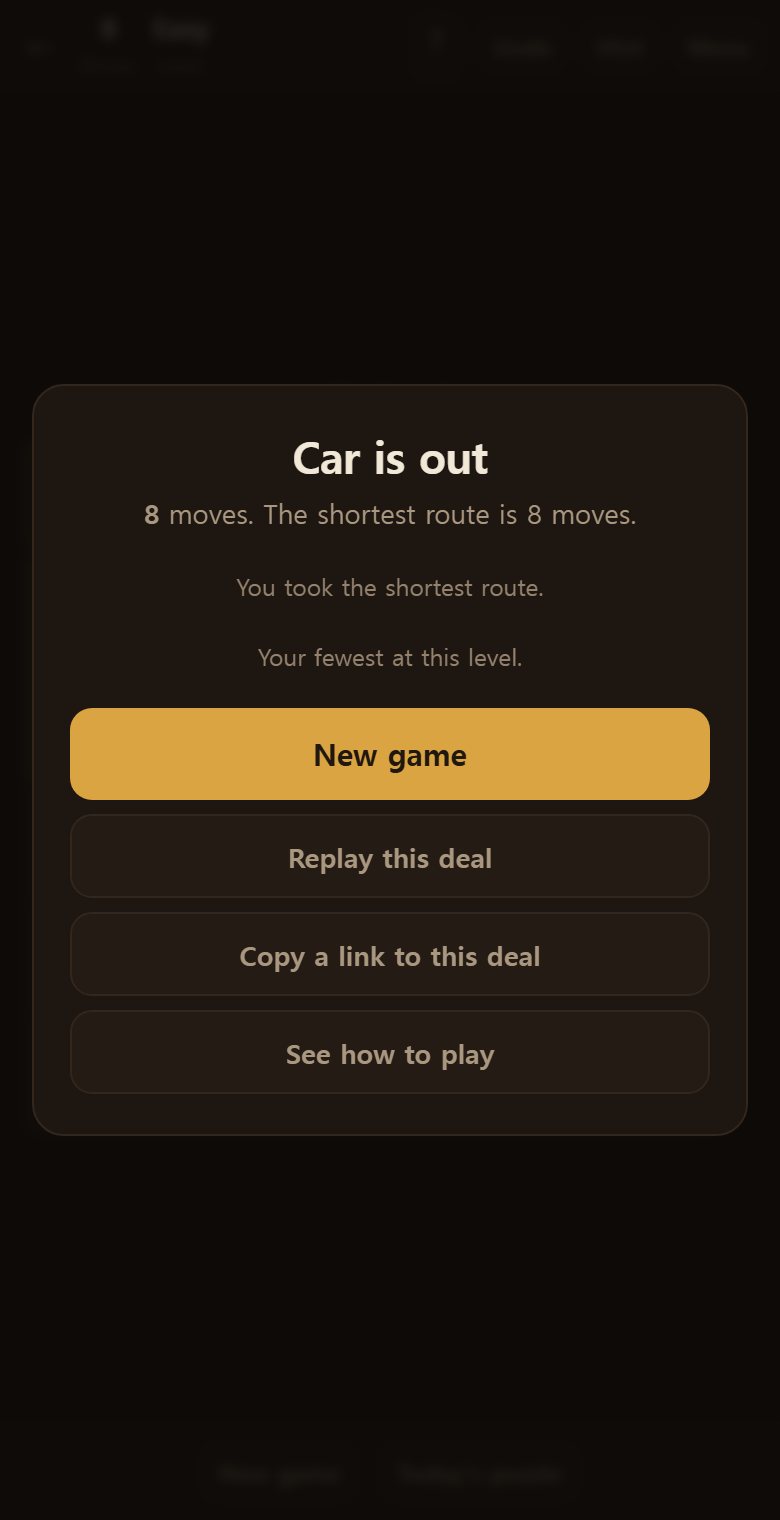
The link carries the opening position. How far you had pushed does not travel with it.
How to solve it
In this order, it usually comes out.
- Find what blocks your car first. That is the problem the board sets.
- Work backwards through why it cannot move. Your first move is at the end of that chain.
- Turn the question into where to move the empty space. There are only a few.
- Settle where the three-square cars belong early. Moving them later is very hard.
- Push as far as it will go, in one move. Splitting it only runs up the count.
- When jammed, undo. The hint's moves remaining tells you whether you are on track.
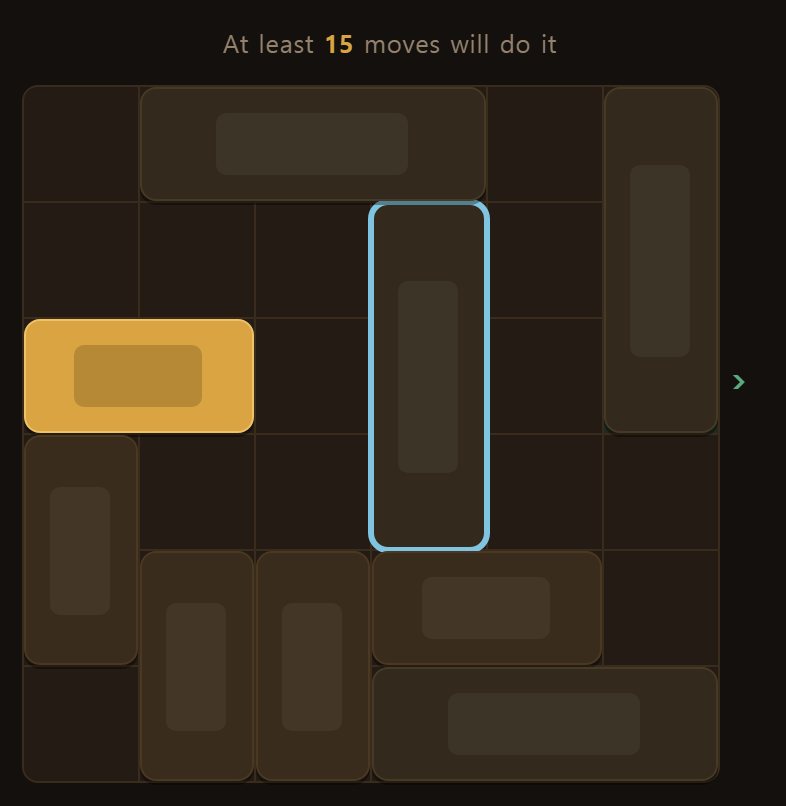
Common mistakes
Move counts run up here in one of four ways.
- Pushing your own car first — with something ahead of it, pushing achieves nothing. Clear the blocker.
- Pushing a square at a time — three squares in one go is one move; split, it is three.
- Pushing whatever will move — being able to move is no reason to. Look only at the cars in the blocking chain.
- Pushing a three-square car anywhere convenient — later that car is what blocks the way.
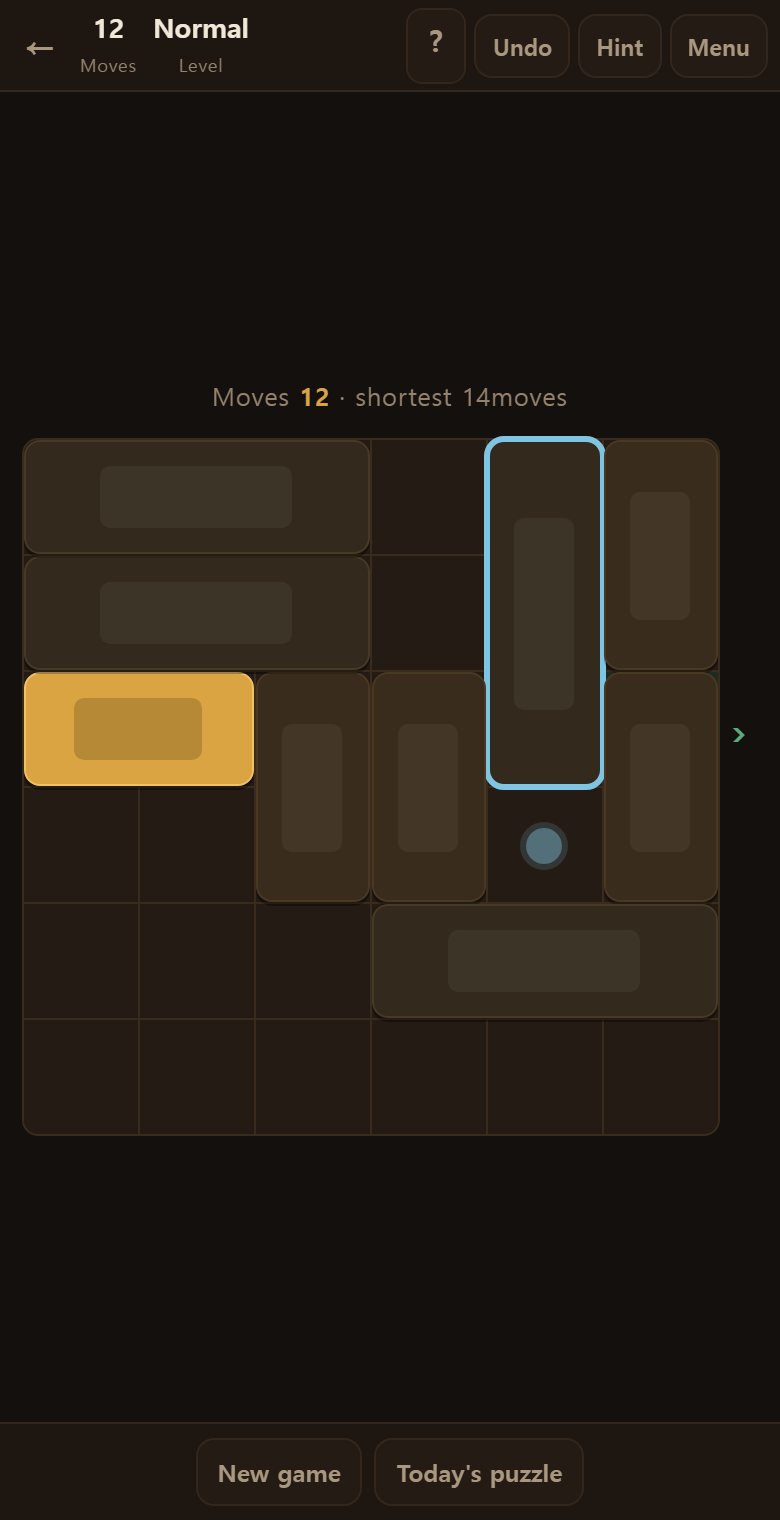
When the count keeps climbing, Start over is quicker. The board is unchanged; only the positions reset.
When the car is out
When your car reaches the right edge it ends there. The car turns green and your move count is shown.
If it matches the shortest solution, it says so.
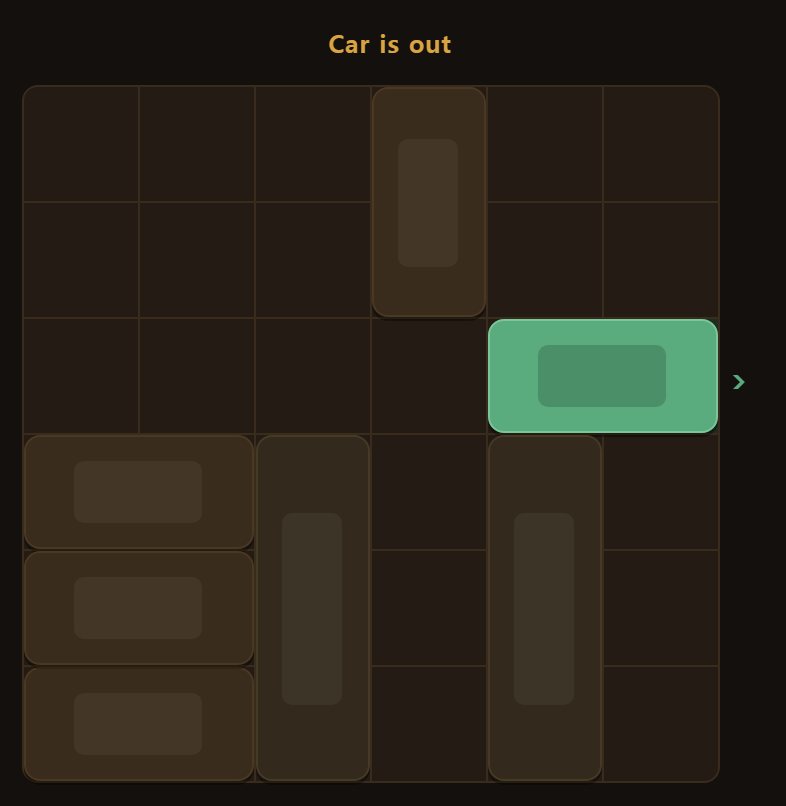
Replay gives you the same board from the start. Try it in fewer.
Common questions
No. Cars lying across go left and right only, upright ones up and down only. Turning does not exist in this game.
The gold one. It always lies across, always in the middle row with the exit.
No — one move. Moving one car is one move, so pushing as far as it will go in one go pays.
Look first at the cars between yours and the exit. Then work backwards through why they cannot move, and the first move appears.
Yes. Every board is solved through as it is built and the shortest route counted. It cannot be done in fewer.
No. Every board is solved before it is handed out, and a link you are sent is solved again on opening.
Press Start over in the menu. The board stays the same; only the positions reset.
It gives one move. It also tells you how many remain, which makes it useful as a gauge of whether you are on track.
Pick a car, then use the arrow keys to move it a square at a time. H is hint, Ctrl+Z undo, and N a new board.
- First see which car is blocking yours. That is the one to clear.
- To clear that one, look at what is blocking it. Work backwards.
- There are usually only a few empty squares. Think about where you want to move the space.
- Three-square cars barely move. Decide where they are going to sit before anything else.
- Undo when you are stuck. Doing it in few moves is the whole point.